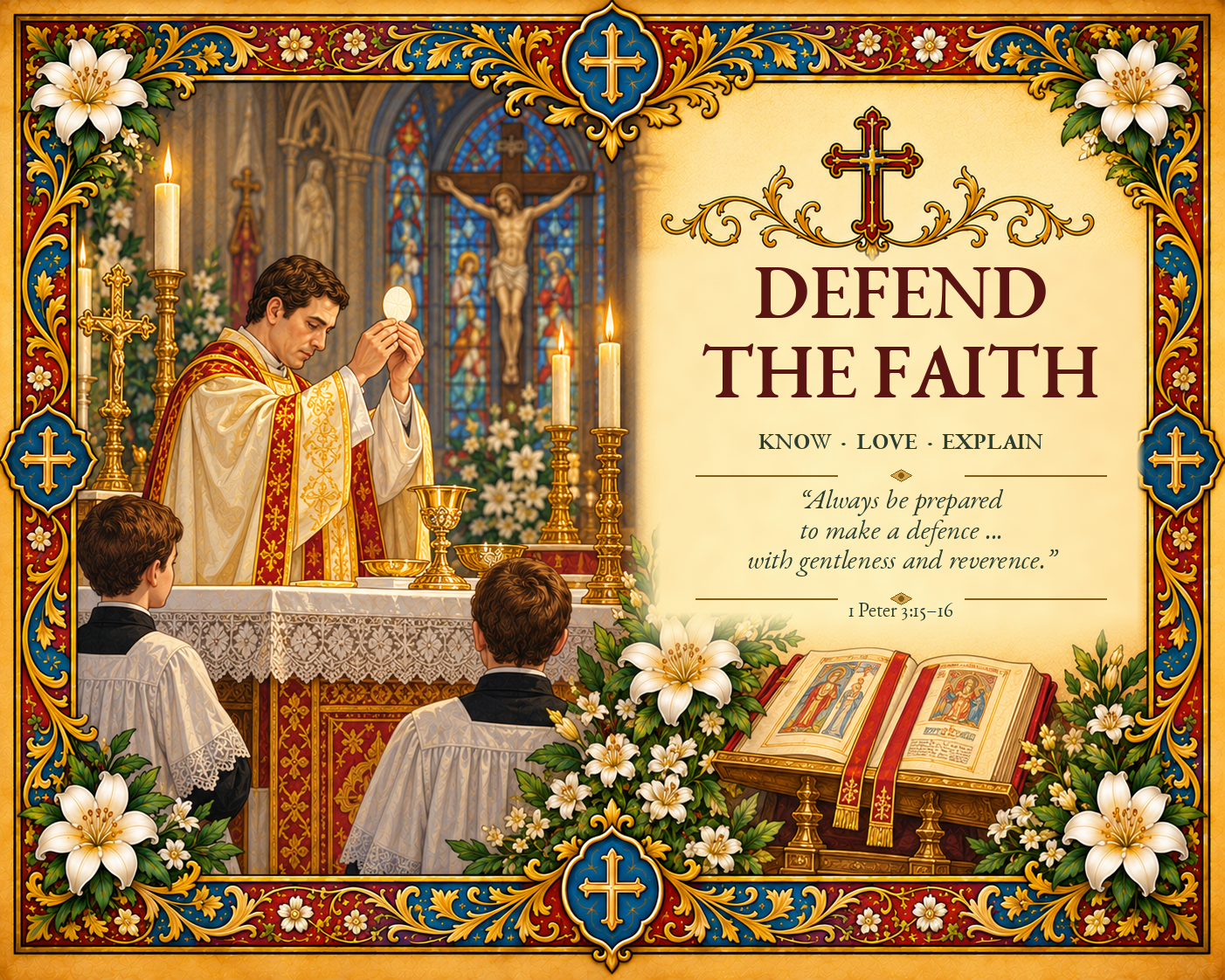
Defend the Faith — Session 16
Christ’s saving work, visible signs, invisible grace, and the life of the Church
Opening Prayer
In the name of the Father, and of the Son, and of the Holy Spirit.
Amen.
Lord Jesus Christ,
You came into the world to save us.
You took our human nature,
died for our sins,
and rose again to give us life.
You continue to act in Your Church
through the power of the Holy Spirit.
Open our hearts to the gifts You have given us.
Strengthen our faith in the sacraments.
Teach us to receive them with reverence,
to cooperate with the grace they give,
and to live as Your faithful disciples.
Amen.
Introduction
Throughout this series, we have been asking what Catholics believe, why we believe it, and how we can explain our faith to others.
We began with Jesus Christ.
We considered the Church He founded, the authority He entrusted to the Apostles, the Scriptures, the Eucharist, Confession, Baptism, and the moral life.
We have also considered suffering, death, prayer, providence, and the way God continues to act in the world.
Most recently, we asked what grace is and why we need it.
We saw that grace is God’s free gift, by which He forgives our sins, shares His life with us, heals our wounded nature, and makes us holy.
That brings us to another question.
What is a sacrament, and why do we need sacraments?
This is one of the most important questions in Catholic Christianity.
Because many people misunderstand the sacraments.
Some think they are simply religious ceremonies.
Others see them as important traditions.
Some think Baptism is merely a celebration of a child’s birth.
Others think First Holy Communion is a milestone to complete.
Confirmation can be mistaken for a graduation from religious education.
Marriage can become primarily a beautiful wedding.
Confession can be regarded as an unnecessary conversation with a priest.
And the Anointing of the Sick is sometimes treated as something to avoid until death is moments away.
But that is not how the Church understands the sacraments.
Others ask more directly:
“Why do Catholics need rituals?”
“Can’t I just pray to God?”
“If Jesus saves us, why do we need sacraments?”
“Didn’t the Church invent them?”
“Surely faith is what matters, not ceremonies?”
These are fair questions.
And the Catholic answer is deeper than many people realise.
The sacraments are not simply things we do for God.
They are actions of Jesus Christ, through which He gives us the grace of His saving work.
A sacrament is not merely a reminder of something holy.
It is a real encounter with Christ.
The same Jesus who forgave sinners, healed the sick, blessed children, and gave Himself to His disciples continues to act in His Church.
He has not left us only memories.
He has given us sacraments.
1. Christianity is not merely a set of ideas
We must begin with something fundamental.
Christianity is not simply a collection of beliefs.
It certainly includes beliefs.
We must believe what Christ has revealed.
Truth matters.
Doctrine matters.
The Creed matters.
But Christianity is not only about knowing things.
It is about being brought into communion with God.
Jesus did not come merely to give religious lectures.
He came to save us.
He came to reconcile us to the Father.
He came to forgive sin.
He came to conquer death.
He came to give us the Holy Spirit.
He came to make us children of God.
And He came to establish a Church through which His saving work would continue.
This is why the Church is more than a group of people who happen to agree about Jesus.
The Church is His Body.
Christ is the Head.
We are the members.
And the life of Christ flows through His Body.
This is the foundation of the sacraments.
Jesus does not merely tell us about forgiveness.
He gives forgiveness.
He does not merely speak about new life.
He gives new life.
He does not merely teach us about spiritual nourishment.
He gives Himself as our food.
He does not merely tell us that God cares for the sick.
He comes to strengthen them.
Christianity is not simply God’s advice for better living.
It is God’s saving action.
And the sacraments are part of that saving action.
2. Why does God use physical things?
One of the great objections to the sacraments is this:
“If God is spiritual, why does He use water, oil, bread, wine, words, and gestures?”
The answer begins with creation.
God made the material world.
And He made it good.
The body is good.
Water is good.
Food is good.
Human touch is good.
The created world is not something God despises.
And then something extraordinary happened.
The Son of God became man.
Jesus Christ is not God pretending to be human.
He is truly God and truly man.
He has a real human body.
He was born.
He ate.
He drank.
He slept.
He grew tired.
He wept.
He suffered.
He died.
And He rose bodily from the dead.
The Incarnation changes how we understand everything.
God chose to reach us through a real human life.
Jesus healed people by touching them.
He placed His hands upon the sick.
He used mud to heal the blind man.
He spoke words of forgiveness.
He took bread and wine at the Last Supper.
He allowed His side to be pierced, from which blood and water flowed.
God did not consider physical things beneath Him.
He used them.
So why should we be surprised that Christ continues to use physical signs to give spiritual grace?
In Baptism, He uses water.
In Confirmation, the anointing with chrism and the laying on of hands belong to the sacramental celebration.
In the Eucharist, He uses bread and wine.
In Confession, we hear the words of absolution.
In the Anointing of the Sick, oil is placed upon the sick person.
In Holy Orders, the bishop lays hands upon the one being ordained.
In Marriage, husband and wife give themselves to one another through their consent.
God reaches human beings as human beings.
We are not angels.
We have bodies.
We see, hear, touch, taste, and speak.
And because God made us this way, He gives us visible signs of His invisible grace.
The sacraments show that God does not save us by ignoring our humanity. He saves us as whole human persons.
Body and soul.
3. What exactly is a sacrament?
The Catechism of the Catholic Church gives a clear definition.
A sacrament is an effective sign of grace, instituted by Christ and entrusted to the Church.
Those words matter.
Let us take them carefully.
First, a sacrament is a sign.
It uses something visible to signify something invisible.
Water signifies cleansing and new life.
Oil signifies strengthening, healing, and consecration.
Bread and wine are used in the Eucharist, where Christ gives His Body and Blood.
Words and gestures communicate what is taking place.
But a sacrament is not only a sign.
It is an effective sign.
That means it actually brings about the grace it signifies.
This is the difference between a sacrament and an ordinary symbol.
A wedding photograph reminds us of a marriage.
But the photograph does not create the marriage.
A certificate records a Baptism.
But the certificate does not give new life in Christ.
The sacrament itself is different.
In Baptism, the person really is cleansed of sin and born again.
In Confession, sins really are forgiven.
In the Eucharist, Christ really gives Himself under the appearances of bread and wine.
Something happens.
God acts.
Secondly, the sacraments were instituted by Christ.
They are not ceremonies the Church invented simply because they seemed helpful.
They come from the saving work of Jesus.
Thirdly, they have been entrusted to the Church.
The Church does not own the sacraments as though she could redesign them according to preference.
She receives them.
She safeguards them.
She celebrates them.
She hands them on.
They belong to Christ.
That is why the Church takes their celebration so seriously.
The sacraments are holy because Christ acts through them.
4. Why are there seven sacraments?
The Church recognises seven sacraments instituted by Christ.
They are not seven unrelated ceremonies.
They form a unity.
They accompany the Christian life from its beginning, through its growth, healing, and service.
The Church groups them into three families.
The sacraments of Christian initiation
Baptism, Confirmation, and the Eucharist.
Baptism gives new birth.
We are freed from sin, become children of God, and are incorporated into Christ and His Church.
Confirmation strengthens and seals us with the gift of the Holy Spirit for Christian witness.
The Eucharist nourishes us with Christ Himself and brings Christian initiation to its fullness.
Notice the movement.
We are born into Christ.
We are strengthened in Christ.
We are nourished by Christ.
The Eucharist holds a unique place because the other sacraments are ordered towards communion with Christ, who gives Himself to us.
The sacraments of healing
Penance, or Confession, and the Anointing of the Sick.
Baptism gives new life, but Christians can still sin.
When we fall into serious sin, Christ does not abandon us.
He gives the sacrament of Penance.
Through the ministry of the priest, Christ forgives and reconciles us.
And when sickness or the weakness of old age threatens us seriously, Christ comes through the Anointing of the Sick.
He strengthens the soul, gives peace and courage, forgives sins under the proper conditions, and may also grant bodily healing if it is conducive to salvation.
Christ knows our weakness.
So He gives us sacraments of mercy.
The sacraments at the service of communion and mission
Holy Orders and Matrimony.
In Holy Orders, a man receives a sacred ministry through which Christ continues to shepherd, teach, sanctify, and serve His Church.
In Matrimony, a baptised man and woman enter a lifelong covenant, and Christ gives sacramental grace to strengthen their faithful, fruitful love.
These sacraments serve not merely the individuals receiving them, but the life and mission of the Church.
Not every Catholic receives every sacrament.
Not everyone marries.
Not everyone is ordained.
Not everyone needs the Anointing of the Sick at the same time.
But together, the seven sacraments show how completely Christ cares for His people.
He gives birth.
He strengthens.
He feeds.
He forgives.
He heals.
He consecrates.
He sustains.
The seven sacraments are not seven separate religious achievements.
They are seven ways in which the one saving work of Christ reaches His Church.
5. Are the sacraments really biblical?
Some Christians object that the Catholic Church added sacraments which Jesus never taught.
But when we read the New Testament carefully, we find that sacramental life is present from the beginning.
Jesus commands His Apostles to baptise in the name of the Father, and of the Son, and of the Holy Spirit.
He speaks of being born of water and the Spirit.
At the Last Supper, He gives His Body and Blood and commands the Apostles to do this in remembrance of Him.
After the Resurrection, He breathes the Holy Spirit upon the Apostles and gives them authority concerning the forgiveness of sins.
In the Acts of the Apostles, we see the laying on of hands associated with the reception of the Holy Spirit.
Saint James tells the sick to call for the priests of the Church, who are to pray over them and anoint them with oil.
Saint Paul speaks about the gift received through the laying on of hands.
Jesus teaches the permanence and sacredness of marriage, and Saint Paul speaks of the union of husband and wife in relation to Christ and His Church.
The precise forms of sacramental celebrations developed in the Church’s life.
But development is not invention.
The Church did not simply wake up centuries later and decide to create seven religious activities.
She gradually recognised, clarified, and faithfully handed on the sacramental gifts entrusted to her by Christ.
This is important.
Not every sacrament is described in the New Testament with a complete modern ritual.
But its foundation belongs to Christ and the apostolic Church.
Catholics do not believe that everything essential to Christianity must appear in Scripture as a fully written ceremony.
We have already seen that Scripture belongs within the living apostolic Tradition of the Church.
The sacraments belong to that same apostolic faith.
They are not additions to Jesus.
They are gifts from Jesus.
6. Why not just pray directly to God?
This is perhaps the most common objection.
“Why do I need a sacrament? Can’t I just speak to God?”
Of course you can speak directly to God.
You should.
Prayer is essential.
We have already considered why prayer matters.
God hears His children.
We can ask for mercy, help, healing, strength, and guidance.
But prayer and the sacraments are not rivals.
The question is not whether God can hear us outside a sacrament.
He can.
The question is whether we should accept the means of grace Christ Himself has given us.
Think about Confession.
Of course we should tell God we are sorry.
But Christ also gave the Church a sacrament in which forgiveness is spoken personally and authoritatively.
Think about the Eucharist.
Of course we can pray to Jesus at home.
But prayer at home does not become Holy Communion.
In the Eucharist, Christ gives us His Body and Blood.
Think about Baptism.
Parents can pray for their child.
But their prayers do not make Baptism unnecessary.
Christ gave Baptism as the ordinary means of new birth into His life.
The sacraments do not prevent us from approaching Jesus.
They are ways Jesus has chosen to approach us.
That is why asking, “Why can’t I just pray?” can miss the point.
Christ has given us more than the permission to pray.
He has given us sacred encounters in which He acts.
Why would we refuse them?
7. Does God only give grace through the sacraments?
We must answer carefully.
No.
God is not imprisoned within the sacraments.
He is sovereign.
He can act beyond the visible means He has established.
The Church teaches, for example, about Baptism of desire and Baptism of blood.
God’s mercy is not limited by our knowledge or circumstances.
He can reach those who, through no fault of their own, have not received the sacraments.
But we must not misuse that truth.
The fact that God can act outside the sacraments does not mean the sacraments are unnecessary.
Christ gave them for our salvation.
We do not reject what He has given because we imagine another way might be possible.
God can nourish a person in extraordinary circumstances.
That does not make ordinary food unnecessary.
God can heal without medicine.
That does not mean we should reject medical care.
Likewise, God can give grace outside the sacraments.
But that does not make the sacraments optional extras for those who know Christ has given them.
We should never use God’s extraordinary mercy as an excuse for neglecting His ordinary gifts.
The Catholic attitude is simple.
Trust God’s mercy for those whose circumstances we do not know.
And faithfully receive the sacraments Christ has entrusted to His Church.
8. Who is really acting in the sacraments?
This is one of the most comforting teachings of the Church.
Christ Himself acts in the sacraments.
The priest is a minister.
The bishop is a minister.
The deacon has his proper sacramental ministry.
In Marriage, the spouses themselves confer the sacrament upon one another according to the Latin Church’s understanding.
But ultimately, the saving power belongs to Christ.
This means the sacraments do not depend on the personal holiness of the priest.
A priest should certainly be holy.
He should pray.
He should live faithfully.
He should celebrate with reverence.
He should give good example.
And when priests sin or betray their responsibilities, the Church must take that seriously.
But the sacraments are not made effective by the priest’s personal goodness.
Imagine if they were.
How could anyone ever have certainty?
How would we know whether our Baptism was real?
How would we know whether our sins had been forgiven?
How would we know whether the Eucharist was truly Christ?
We would have to investigate the private holiness of the minister.
That would be impossible.
The Church teaches instead that when a sacrament is validly celebrated, with the necessary matter, form, intention, and minister where required, Christ acts through it.
Theologians call this ex opere operato.
That simply means the sacraments act by the saving work of Christ, not by the personal holiness of the minister.
This does not make priests unimportant.
It makes Christ central.
The sacrament is not the priest’s achievement.
It is Christ’s gift.
When a priest absolves, Christ forgives.
When the Eucharist is consecrated, Christ becomes truly present.
When a child is baptised, Christ gives new life.
We can trust the sacraments because we can trust Christ.
9. Do the sacraments work automatically?
Here we need another distinction.
The sacraments are not magic.
A sacrament is not simply a ceremony that produces spiritual benefits regardless of everything else.
Christ truly acts through valid sacraments.
But the grace received must also be welcomed and lived.
The Church teaches that the fruits of the sacraments depend upon the disposition of the person receiving them.
This is especially important for adults and for those who have reached the use of reason.
Think about Holy Communion.
The Eucharist is truly Christ.
That truth does not change according to the feelings of the person receiving.
But someone who knowingly receives Holy Communion in a state of mortal sin does not receive its grace fruitfully.
Saint Paul himself warns against receiving the Lord’s Body and Blood unworthily.
That is why Confession matters.
Think about Marriage.
A couple can make their vows, but they must also live those vows.
The sacrament gives grace for faithful love.
It does not remove the need for patience, sacrifice, fidelity, forgiveness, and prayer.
Think about Confirmation.
Confirmation truly gives its sacramental grace and the special strengthening of the Holy Spirit.
But the confirmed person must cooperate with that grace.
Confirmation does not make holiness automatic.
This is the difference between the grace Christ gives and the way we respond.
God gives freely.
But He does not abolish human freedom.
He does not force us to become holy against our will.
We can cooperate with grace.
We can neglect grace.
We can resist grace.
And through mortal sin, we can lose sanctifying grace.
The sacraments are powerful precisely because Christ acts in them.
But their purpose is to bring us into a living relationship with Him.
They are not substitutes for that relationship.
They are gifts that establish, restore, strengthen, and nourish it.
10. Why does preparation matter?
This brings us to something very practical.
If the sacraments are gifts of grace, why does the Church prepare people to receive them?
Why not simply arrange a date?
Why spend time teaching?
Why encourage Mass, prayer, repentance, and Christian living?
Why ask whether someone is ready?
The answer is not that people must earn a sacrament.
That would misunderstand grace.
Sacraments are not rewards for people who are already holy. They are gifts through which Christ makes us holy.
But the gifts of Christ should not be treated casually.
The Church prepares people because faith matters.
Understanding matters.
Intention matters.
Conversion matters.
The way we receive sacred gifts matters.
Preparation helps us recognise whom we are meeting.
It helps us understand what we are asking for.
It helps us remove obstacles to grace.
And it helps us begin living the new life Christ gives.
This is why the Church teaches that the sacraments presuppose faith, while also nourishing, strengthening, and expressing it.
That does not mean every candidate must have the same level of understanding.
An infant cannot profess faith personally.
In infant Baptism, the faith of the Church is expressed by the parents and godparents, who undertake to help the child grow in the faith received.
A young child preparing for First Holy Communion needs understanding appropriate to the child’s age and development.
An adult preparing for Baptism or reception into the Church needs a more developed personal response of faith and conversion.
A sick person may be unable to speak or participate fully, yet still receive the Church’s sacramental care.
The Church is not asking everyone to pass the same examination.
She is asking us to receive Christ truthfully, according to our circumstances.
That is why preparation should be personal.
Not simply enrolling names.
Not simply distributing worksheets.
Not simply completing a set number of sessions.
Not simply counting down to a ceremony.
A sacramental pathway is meant to accompany someone towards Christ.
Teaching has its place.
Learning prayers has its place.
Understanding the rite has its place.
But all these things serve a deeper purpose.
The person is preparing to encounter the living Lord.
A family may need help to begin attending Sunday Mass.
A parent may need encouragement to pray with a child.
A teenager may need time to understand what Confirmation asks of them.
An adult may need to rediscover the faith after many years away.
A couple may need to understand the sacred promises of Marriage.
A person returning to Confession may need patient reassurance.
Preparation makes room for these real human journeys.
It is not intended to create obstacles for their own sake.
Nor should readiness become a demand for perfection.
The Church is a place where sinners receive grace.
We must never forget that.
But neither should we pretend that preparation and disposition are unimportant.
There is a difference between a person who is struggling sincerely to follow Christ and a person who has no intention of receiving or living what the sacrament means.
Good pastoral care recognises that difference.
Sometimes the right response is to arrange the sacrament.
Sometimes it is to give further teaching.
Sometimes it is to encourage a return to Sunday Mass.
Sometimes it is to spend more time in conversation and prayer.
Sometimes the celebration may need to wait while faith and intention are clarified.
But such discernment must always serve the person’s good.
It must never become a punishment.
And it must never treat grace as something earned by passing a course.
The purpose is simple:
To help people receive Christ’s gifts well and begin living the life those gifts establish.
11. The sacraments are not graduation ceremonies
This is another misunderstanding worth correcting.
Sometimes people think of sacraments as stages to complete.
Baptism is done.
First Holy Communion is done.
Confirmation is done.
Marriage is done.
The certificate is collected.
The photographs are taken.
And life continues much as before.
But that reverses the meaning of the sacraments.
Baptism is not the end of anything.
It is the beginning of Christian life.
First Holy Communion is not the completion of a childhood religious course.
It is the beginning of a new depth of Eucharistic life.
Confirmation is not leaving religious education behind.
It is a strengthening for Christian discipleship and witness.
Marriage is not completed when the wedding ends.
The sacramental covenant is lived day after day.
Holy Orders is not simply an honour received.
It is a life of sacred service.
The Anointing of the Sick is not merely the announcement that someone is dying.
It is Christ coming to strengthen someone in serious illness.
And Confession is not a humiliating interruption to Catholic life.
It is one of Christ’s great gifts for our continuing conversion.
The sacraments are meant to shape a whole life.
A child who has received Holy Communion needs to keep coming to Mass.
A confirmed young person needs to keep praying, receiving the sacraments, and following Christ.
A married couple needs to keep living the promises made.
A baptised person needs to grow into the grace received.
The sacrament is not a conclusion.
It is a gift intended to bear fruit.
This is why accompaniment after a sacrament matters too.
The Church should not disappear from someone’s life once the celebration has taken place.
She should continue to pray, encourage, teach, welcome, and accompany.
The goal is not simply that people receive sacraments.
The goal is that people live sacramentally, in communion with Christ and His Church.
12. The sacraments belong to the Church
There is another important point.
Sacraments are personal, but they are not merely private.
They belong to the Church.
Even when a sacrament is celebrated quietly, it is an action of Christ and His Church.
A Baptism brings someone into the Body of Christ.
The Eucharist builds up the communion of the Church.
Confession reconciles a sinner with God and with the Church.
Confirmation strengthens a member of the Church for witness.
Marriage gives a Christian family a particular place in the life and mission of the Church.
Holy Orders establishes men in sacred ministry for the service of God’s people.
Anointing joins the suffering person more deeply to Christ and His Church.
This matters because Christianity is not individualism.
Jesus did not establish a collection of isolated believers.
He founded a Church.
And the sacraments both express and build up that Church.
So a Catholic does not say:
“My Baptism is only about me.”
Or:
“My Communion is only about my private feelings.”
Or:
“My Confirmation has nothing to do with the parish.”
The sacraments make us members of one Body.
They draw us into the worship, faith, charity, and mission of the Church.
This is also why sacramental preparation cannot be separated from ordinary Catholic life.
Sunday Mass matters.
Prayer matters.
Belonging matters.
Christian charity matters.
Living the commandments matters.
The sacraments are not detached ceremonies existing alongside parish life.
They are at the very heart of it.
13. What is the difference between sacraments and sacramentals?
Catholics also have many other holy signs and practices.
Holy water.
Blessings.
Rosaries.
Medals.
Scapulars.
Relics.
The Sign of the Cross.
Blessed candles.
These are valuable, but they are not all sacraments.
The Church calls many such things sacramentals.
Sacramentals are sacred signs instituted by the Church which prepare us to receive grace and help sanctify the circumstances of life.
They dispose us to receive the grace of the sacraments and encourage prayer and devotion.
They are not the same as the seven sacraments instituted by Christ.
This distinction matters because Catholic practice can sometimes become confused.
A medal is not a magical charm.
Holy water is not a substitute for Baptism or Confession.
A blessing is not a replacement for conversion.
A Rosary is not a substitute for Sunday Mass.
These devotions and signs are good when properly understood.
They help us remember God.
They encourage prayer.
They express faith.
But they must always lead us towards Christ and the sacramental life of His Church.
A Catholic should love holy things without becoming superstitious.
The sacraments are Christ’s particular gifts of grace.
Sacramentals help prepare us to receive and live that grace.
14. How to answer this simply
So if someone asks:
“What is a sacrament?”
You can say:
“A sacrament is an effective sign of grace instituted by Christ and entrusted to the Church. Through the sacraments, Jesus really acts and gives us His grace.”
If someone asks:
“Why do Catholics need sacraments?”
You can say:
“Because Jesus gave them to us. They are not merely human ceremonies. They are the ordinary means through which Christ gives us new life, forgiveness, nourishment, healing, and strength.”
If someone says:
“Can’t I just pray to God?”
You can say:
“Of course you can, and you should. But prayer does not replace the sacraments Christ instituted. Jesus gave us both.”
If someone says:
“Aren’t sacraments just symbols?”
You can say:
“They are signs, but not empty signs. They actually give the grace they signify because Christ Himself acts through them.”
If someone asks:
“Did the Church invent the seven sacraments?”
You can say:
“No. The Church recognises seven sacraments instituted by Christ and handed on in the apostolic faith. Their rites developed, but their foundation is in Christ.”
If someone says:
“What if the priest is a sinner?”
You can say:
“Priests are sinners who need grace too. But a valid sacrament does not depend upon the priest’s personal holiness. Christ is the one who acts.”
If someone asks:
“Why must people prepare?”
You can say:
“Not because they have to earn grace, but because the sacraments are sacred gifts. Preparation helps people understand, welcome, and live the grace Christ gives.”
And if someone asks:
“Does receiving a sacrament make someone holy automatically?”
You can say:
“The sacraments truly give grace, but we must cooperate with that grace. Their purpose is not to complete a ceremony, but to help us live in Christ.”
These answers are simple.
But they contain the heart of Catholic sacramental theology.
15. What this asks of us
If the sacraments are encounters with Christ, then we should approach them differently.
We should not treat them casually.
We should not receive them simply because everyone else does.
We should not see them merely as family occasions.
We should not make the date more important than the grace.
We should not mistake preparation for a bureaucratic process.
We should not think that receiving the sacrament means Christian formation is finished.
Instead, we should ask:
What is Christ giving me?
What is He asking of me?
How can I receive His grace more fruitfully?
How should my life change?
Do I approach Confession with genuine repentance?
Do I receive Holy Communion with faith and reverence?
Do I remember the promises of my Baptism?
Do I cooperate with the gift of the Holy Spirit received in Confirmation?
Do I support families who are trying to live their sacramental promises?
Do I help those who are preparing, especially those returning to the faith?
Do I understand that the sacraments are gifts of Christ, not achievements of my own?
These questions matter.
Because a sacrament is never meant to be an isolated moment.
It is a meeting with Christ whose grace is meant to shape our lives.
Our parish life should reflect that truth.
People should be welcomed.
The faith should be explained.
Those who are ready should be helped to receive the sacraments well.
Those who need more time should be accompanied patiently.
And after the celebration, the Church should continue to support them.
Not because we want to make the sacraments difficult.
But because we believe they are real.
The more seriously we believe in grace, the more lovingly we should help people receive it.
Conclusion
So what is a sacrament, and why do we need sacraments?
A sacrament is not simply a religious ceremony.
It is not merely a sign of belonging.
It is not a reward for being good.
It is not a graduation from a course.
It is not a magical act.
It is an effective sign of grace, instituted by Jesus Christ and entrusted to His Church.
Through the sacraments, Christ continues His saving work among us.
He gives new life.
He strengthens faith.
He nourishes us with His Body and Blood.
He forgives sins.
He heals and consoles.
He consecrates people for service.
He strengthens Christian marriage.
And through these sacred gifts, He draws His people more deeply into communion with Himself.
The sacraments matter because grace matters.
Grace matters because salvation matters.
And salvation matters because we were made for eternal life with God.
So we do not say:
“The sacraments are just ceremonies.”
We say:
“Christ is acting through His Church.”
We do not say:
“I have completed my sacrament, so I am finished.”
We say:
“Christ has given me grace, and I must now live that grace.”
We do not say:
“I must become perfect before Christ will give me anything.”
We say:
“Christ gives me grace so that I can become holy.”
And we do not say:
“Faith and sacraments are two different things.”
We say:
“The sacraments express, nourish, and strengthen the faith by which we belong to Christ.”
To summarise, remember these three simple answers.
What is a sacrament?
A sacrament is an effective sign of grace instituted by Christ.
Why do we need the sacraments?
Because Christ has given them as ordinary means of sharing His saving life with us.
What must we do with the grace we receive?
Welcome it, cooperate with it, and live it.
If you remember nothing else, remember this:
The sacraments are not simply things we do for God. They are sacred actions in which Jesus Christ acts for us, giving the grace that makes us His disciples and draws us towards eternal life.
And perhaps each of us should ask one final question:
When I come to the sacraments, am I simply attending a ceremony, or am I coming to meet Christ?
Because the sacraments are not only about what happens in church on a particular day.
They are about what Christ is doing in us.
And what He intends to do with the whole of our lives.
Amen.
Q&A after Session 16
- What makes a sacrament different from an ordinary religious ceremony?
- Why does God use physical signs to give spiritual grace?
- Where do the seven sacraments come from?
- Why can’t Catholics simply pray instead of receiving the sacraments?
- Does God give grace outside the sacraments?
- Do sacraments still work if the priest is sinful?
- Can someone receive a sacrament without benefiting spiritually from it?
- Why does the Church require sacramental preparation?
- Why are infant Baptism and adult sacramental preparation different?
- What is the difference between a sacrament and a sacramental?
- Why is Sunday Mass so important to the sacramental life?
- How do we continue living the grace received after the ceremony?
Closing Prayer
Lord Jesus Christ,
You have not left Your Church without Your presence.
You continue to give us life,
to forgive our sins,
to strengthen our weakness,
and to nourish us with Your grace.
Renew our faith in the sacraments.
Help us never to treat Your gifts casually.
Give courage to those preparing to receive them,
mercy to those returning after many years,
wisdom to those who accompany others,
and perseverance to all who have received Your grace.
May the Holy Spirit bring to fulfilment
the work You have begun in us,
until we come at last to the joy of eternal life.
Amen.
In the name of the Father, and of the Son, and of the Holy Spirit.
Amen.


