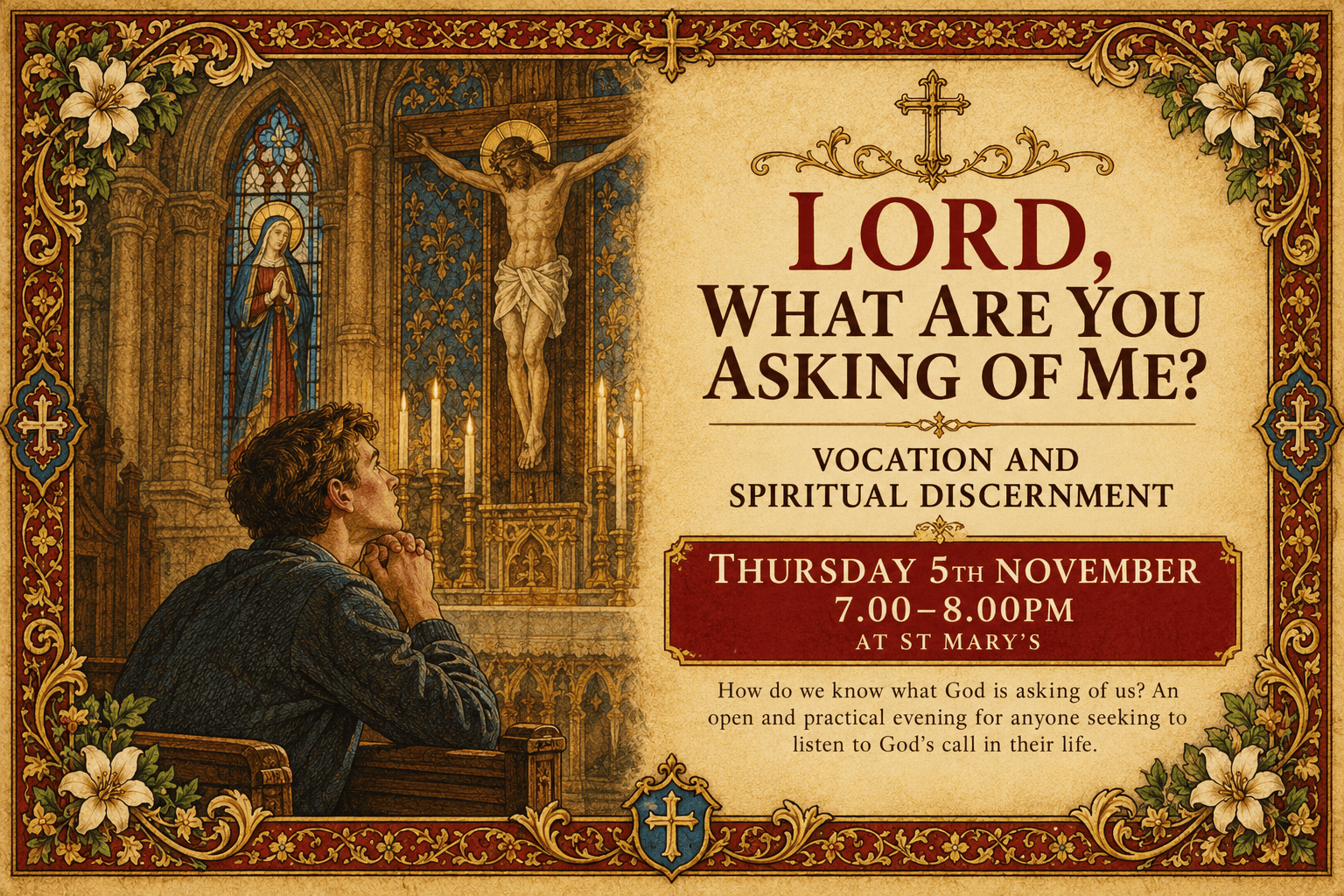
Vocation and Spiritual Discernment
How do we know what God is asking of us?
How can we distinguish a genuine calling from our own wishes, fears or imagination?
Do we need a dramatic sign?
What if the way ahead is not clear?
Catholic discernment is not about trying to solve a secret puzzle which God has deliberately made difficult. It is about learning to listen, becoming free enough to respond, and taking the next faithful step.
The word vocation means a calling.
We often hear the word and immediately think of priests or religious sisters. Those are certainly vocations, but vocation is much larger than that.
Every Christian has a vocation from God.
We are called first to holiness: to know God, love him, belong to him and allow his grace to shape our lives.
Within that universal call, God may lead us towards a particular state of life such as marriage, priesthood or consecrated life. Some people will live a faithful unmarried life of service.
And throughout every life there are countless smaller discernments:
Should I take this job?
Should I begin this relationship?
Should I leave something which is leading me away from God?
Should I serve in this particular way?
Should I speak?
Should I wait?
Should I act?
The question beneath them all is:
Lord, what are you asking of me?
Our First Vocation: Holiness
Before asking whether we should marry, enter religious life or become a priest, there is a more basic question:
Am I willing to belong to Jesus Christ?
Our deepest vocation is the same.
We are all called to holiness.
Holiness does not mean becoming strange, remote or unusually pious. It means belonging increasingly to God and allowing his grace to transform the whole of our life.
No state of life automatically makes a person holy.
A priest can fail to become holy.
A married person can fail to become holy.
A religious can fail to become holy.
Someone whose life has not unfolded as expected can become profoundly holy.
The state of life is the road.
Christ is the destination.
Vocation Is Not the Same as a Career
A career asks:
What work am I suited to?
A vocation asks:
How is God asking me to give my life?
Sometimes career and vocation overlap.
A person may feel strongly drawn towards teaching, medicine, care, public service or another profession. Such work may become an important part of living a Christian vocation.
But marriage, priesthood and consecrated life concern the gift of the whole person in a more fundamental way.
The central question is not simply:
What will make me happiest?
Christian discernment asks:
Where am I being called to love faithfully?
Vocation always involves self-gift.
The Christian life is not primarily about constructing the most comfortable possible life for ourselves.
It is about learning to give ourselves in love.
How Does God Call?
Some people imagine that if God wants something from us, he will make it absolutely unmistakable.
Perhaps there will be a voice from heaven, a miraculous sign, a dream or a sudden certainty.
God can certainly act extraordinarily.
But ordinarily, he guides us through much more familiar means.
Scripture and the Teaching of the Church
God never contradicts himself.
If we believe God is calling us towards something which contradicts Scripture, Catholic faith or Christian morality, we have misunderstood.
We do not need to discern whether adultery is acceptable, whether theft is right, whether Sunday worship matters or whether we may deliberately do evil to achieve a good result.
Some things have already been revealed.
Discernment takes place within truth, not outside it.
Prayer
We learn to recognise God by spending time with him.
If we pray only when a major decision appears, discernment becomes much more difficult.
Regular prayer gradually changes our desires.
At first we may pray:
Lord, tell me what I should do.
But deeper prayer gradually becomes:
Lord, make me willing to do what you ask.
That is a much more important prayer.
Discernment is not simply about receiving information from God.
It is about becoming free enough to respond to him.
The Sacraments
A person seriously seeking God’s will should remain close to Mass and Confession.
Discernment is not merely psychological analysis.
We need grace.
Sin can distort judgement.
Pride, lust, resentment, greed, vanity and fear can persuade us that something is God’s will simply because we strongly desire it.
Confession helps restore freedom.
The Eucharist keeps our discernment centred upon Christ rather than upon ourselves.
Wise Counsel
God frequently guides us through other people.
A priest, spiritual director, parent, spouse, trusted Catholic friend or another wise person may notice something which we cannot easily see ourselves.
This does not mean giving somebody else control of our life.
A priest should not tell someone:
“God has told me that you must become a priest.”
Nor should another person decide whom somebody ought to marry.
Good spiritual counsel helps us see more clearly.
It helps us become freer to make a responsible response to God ourselves.
Circumstances and Providence
God calls real people in real circumstances.
Discernment should therefore remain connected to reality.
We should ask:
- What gifts has God actually given me?
- What responsibilities do I already have?
- What possibilities genuinely exist?
- What do people who know me well recognise in me?
- Are doors opening or remaining firmly closed?
Not every obstacle means that God is saying no.
The saints often persevered through enormous difficulties.
But circumstances still matter.
Discernment must not become fantasy.
Peace Does Not Always Mean Ease
People sometimes say:
“I knew it was God’s will because I felt peaceful.”
Peace can be important.
But peace does not necessarily mean emotional comfort.
Doing the right thing can be frightening.
Our Lord in Gethsemane did not experience emotional ease.
The saints often followed God through difficulty, uncertainty and sacrifice.
Likewise, something wrong may initially feel extremely pleasant.
We cannot therefore say:
“I feel good about this, therefore God must want it.”
Christian peace is deeper than comfort.
It is the growing ability to say:
This may cost me something, but I believe I am honestly trying to follow Christ.
Desire Matters
We should not simply distrust all our desires.
God created us.
Grace ordinarily heals and perfects our nature rather than destroying it.
A genuine and persistent desire may therefore be important.
A man repeatedly drawn towards priesthood should not immediately dismiss the thought.
Someone strongly desiring marriage and family life should take that desire seriously.
A person repeatedly drawn towards contemplative prayer, poverty, community and complete consecration to Christ should investigate religious life rather than merely wondering about it indefinitely.
But desires need to be purified.
We can ask:
Why do I want this?
Do I want priesthood because I love Christ and his people, or because I want status?
Do I want marriage because I am ready to give myself faithfully, or because I am frightened of being alone?
Do I want religious life because Christ is drawing me, or because I simply want to escape ordinary responsibilities?
Mixed motives are normal.
Discernment helps purify them.
Fear Is a Poor Director
Fear sometimes disguises itself as prudence.
We may say:
“I am simply being sensible.”
when what we really mean is:
“I am afraid to trust God.”
But the opposite error also exists.
Impulsiveness can disguise itself as faith.
We may say:
“I am trusting God.”
when in reality we are refusing to think responsibly.
Catholic discernment avoids both extremes.
Faith and reason belong together.
Consolation and Desolation
A useful traditional distinction is between spiritual consolation and spiritual desolation.
Consolation does not simply mean feeling cheerful.
It is a movement which draws us towards God: towards greater faith, hope, charity, repentance, generosity and desire for prayer.
Desolation draws us towards discouragement, isolation, self-absorption, loss of faith or abandonment of what we already know to be good.
This does not mean that every difficult feeling is spiritually bad.
Grief can coexist with deep faith.
Neither does every pleasant feeling come from God.
The important question is:
Where is this leading me?
Towards greater faithfulness?
Or away from Christ?
Do Not Make Major Decisions in Panic
When we are exhausted, angry, frightened or spiritually unsettled, it is usually wise not to make an immediate irreversible decision unless circumstances require it.
Return first to what you already know.
Pray.
Go to Mass.
Keep your duties.
Go to Confession if necessary.
Speak to someone wise.
Allow the situation to settle.
God is not generally trying to trap us into making a decision before we can possibly recognise what is happening.
Discerning Marriage
Christian marriage is much more than finding somebody who makes us feel complete.
Marriage is a covenant in which a man and woman give themselves faithfully and permanently to one another, open to the gift of life.
Someone discerning marriage should ask:
- Can I make a lifelong promise?
- Am I capable of fidelity?
- Am I willing to sacrifice for another person?
- Do I accept the Church’s understanding of marriage?
- Am I willing to welcome children if God gives them?
- Does this relationship help both of us towards holiness?
The question is not merely:
Do I love this person?
It is also:
Can we help one another reach heaven?
Discerning Priesthood
A priest is ordained to serve Christ and his Church through preaching, the Sacraments and pastoral care.
A man discerning priesthood should look for:
- love for Christ;
- love for the Mass and the Holy Eucharist;
- a desire to serve people;
- willingness to preach and teach the Catholic faith;
- a capacity for prayer;
- willingness to embrace celibacy;
- emotional and human maturity;
- obedience to the Church;
- a persistent attraction which deserves testing.
A man does not simply decide for himself that he has a vocation to priesthood.
He presents himself to the Church.
The Church also discerns.
A priestly vocation is both personal and ecclesial.
Discerning Consecrated Life
Religious and consecrated life gives particular witness to the kingdom of God.
Men and women consecrate themselves to Christ through the evangelical counsels of poverty, chastity and obedience, according to a particular form of life.
Some communities are active.
Some are contemplative.
Some teach, care for the sick, serve the poor or evangelise.
Others give themselves particularly to prayer.
Someone who is repeatedly drawn towards giving everything directly to Christ should not dismiss that attraction simply because such a life seems unusual in the modern world.
The sensible response is:
Go and see.
Visit.
Pray.
Meet the community.
Learn what the life actually involves.
Discernment requires reality, not imagination.
The Unmarried Life
Not everybody will marry, become a priest or enter consecrated life.
Some people live an unmarried life because of circumstances.
Others may discern a stable life of service without entering a formal consecrated state.
Such a life is not necessarily a failure or an incomplete human existence.
Every baptised Christian can live a fruitful life in Christ.
The essential question remains:
How can I love God and my neighbour faithfully in the life actually entrusted to me?
What If I Have Already Made My Major Life Choice?
Discernment is not only for young people deciding what to do with their lives.
A married person still asks:
How is God calling me to love my spouse and family today?
A priest still asks:
What does faithful priesthood require of me now?
A retired person still has a vocation.
A widowed person still has a vocation.
Someone facing illness still has a vocation.
Someone whose plans have collapsed still has a vocation.
We never graduate from listening to God.
“Speak, Lord, for Your Servant Is Listening”
One of the great biblical stories of vocation is found in 1 Samuel 3:1–10.
Samuel hears a voice but does not immediately recognise that God is calling him.
That itself is encouraging.
Sometimes God’s call is already present before we understand it.
Samuel eventually learns to say:
“Speak, Lord, for your servant is listening.”
Notice the order.
He does not begin:
“Lord, here is my plan. Please approve it.”
He listens.
That remains one of the most important dispositions in Christian discernment.
A Simple Way to Pray When Discerning
Become quiet.
Place yourself consciously in God’s presence.
You do not have to create his presence.
He is already with you.
Begin by saying:
Speak, Lord, your servant is listening.
Then bring before God the reality of your life as it actually is:
your relationships;
your responsibilities;
your hopes;
your uncertainties;
your unfinished decisions.
Ask:
Lord, what have you already made clear?
Perhaps there is already something you know you should do:
a prayer you have neglected;
someone you need to forgive;
a duty you are avoiding;
a Confession you need to make;
a conversation you need to have;
a possibility you need to investigate.
Do not search immediately for something dramatic.
Then ask:
Lord, where are you asking me to become more generous?
If you are discerning a particular decision, place it before Christ:
Jesus, if this is good, lead me towards it.
If it is not, close the way.
Give me freedom to want what you want.
Finally ask:
What is the next faithful step?
Not the entire plan.
Just the next step.
It may be:
to pray;
to seek advice;
to investigate a vocation;
to speak to somebody;
to wait;
to make a decision which is already sufficiently clear;
or simply to fulfil today’s duty properly.
What If I Make the Wrong Decision?
God is not waiting to destroy our lives because we make an honest mistake.
Important decisions should be made responsibly.
But Providence is larger than our mistakes.
If we remain close to God, repent when we sin and continue responding to grace, God can work through circumstances which we would never have chosen for ourselves.
Discernment is serious.
It does not need to become fearful.
Should I Ask God for a Sign?
We may certainly ask God for help and clarity.
But repeatedly demanding extraordinary signs can become a way of avoiding responsible discernment.
Ordinarily, use the means God has already given:
prayer, Scripture, the teaching of the Church, the Sacraments, reason, circumstances and wise counsel.
God is perfectly capable of making extraordinary things happen.
We should not demand that he does so before we obey him.
Do I Need to Feel Completely Certain?
Not always.
Some decisions become morally and reasonably clear without producing complete emotional certainty.
Faith sometimes means acting prayerfully and responsibly while accepting that we cannot know the future.
Waiting for absolute certainty can itself become a way of never acting.
A genuine vocation should be tested over time.
A passing enthusiasm is not necessarily a vocation.
But neither should a persistent attraction be postponed forever because somebody is waiting for a certainty which may never arrive.
At some point, discernment requires a concrete step.
Take One Faithful Step
Discernment becomes clearer when we act faithfully.
Choose one thing.
Not five.
One.
Perhaps:
- give ten minutes each day to prayer;
- make a good Confession;
- speak to a priest;
- contact the diocesan vocations director;
- visit a religious community;
- have an honest conversation about marriage;
- ask a trusted Catholic for advice;
- stop pursuing something you already know is wrong;
- investigate a possibility rather than merely thinking about it;
- fulfil one neglected responsibility faithfully.
God often gives us enough light for the next step rather than the whole road.
That is enough.
A Prayer for Vocation and Discernment
Father in heaven,
you created each of us in love
and called us by name.
Through Baptism
you made us your sons and daughters
and members of the Body of Christ.
Give us ears to hear your call.
Give courage to those discerning marriage.
Strengthen husbands and wives
in fidelity and generous love.
Call men generously to the priesthood
and give them courage to respond.
Call women and men
to consecrated life
and strengthen those who have already given themselves to you.
Guide young people
who are wondering what their lives are for.
Console those whose vocation has taken a path
they did not expect.
Help each of us to recognise
the duties and opportunities you place before us today.
Save us from fear, selfishness and indecision.
Give us the freedom to say with Samuel:
Speak, Lord, for your servant is listening.
And with Our Lady:
Let it be done to me according to your word.
Through Christ our Lord. Amen.
Our Lady, Mother of the Church, pray for us.
St Joseph, pray for us.
St John Bosco, pray for us.


