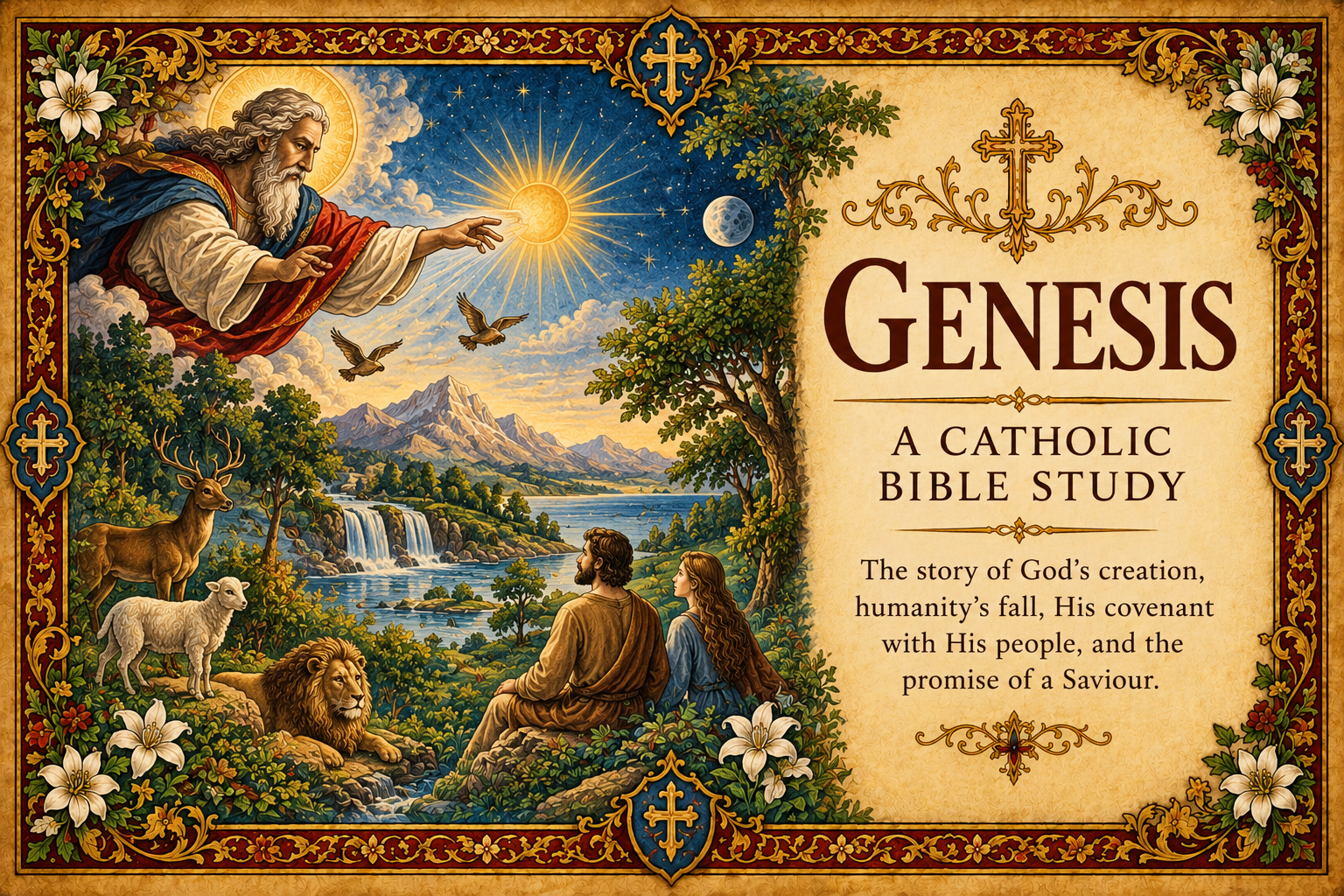
Abraham, Isaac, Jacob and Joseph — The Promises of God and the Beginnings of Israel
Part Two of the History of Salvation
Principal Scripture: Genesis 12–50
“And in thee shall all the kindreds of the earth be blessed.” (Genesis 12:3, Douay-Rheims)
Introduction: From the Fall of Man to the Calling of Abraham
The first eleven chapters of Genesis describe the beginnings of the world and of human history. God creates all things in goodness, makes man in His own image and likeness, and places our first parents in a state of original holiness. Through the disobedience of Adam and Eve, sin and death enter human history. The consequences of the Fall become increasingly evident in the murder of Abel, the wickedness preceding the Flood, and the pride of mankind at Babel.
Yet God never abandons His creation.
Even after the Fall, He promises that the offspring of the woman will overcome the serpent (Genesis 3:15). This first promise of redemption, traditionally called the Protoevangelium, or First Gospel, reveals that God intends to rescue mankind from the power of sin and death.
Genesis 12 marks a decisive new stage in this plan.
Until now, the biblical account has concerned the human race as a whole. From this point onwards, Sacred Scripture concentrates upon one man, his descendants and the people who will arise from them.
That man is Abraham.
God chooses Abraham not because the rest of mankind has ceased to matter, but because He intends to bring salvation to all nations through Abraham’s descendants.
The history of Abraham, Isaac, Jacob and Joseph is therefore much more than a collection of family stories. It is the beginning of the history of Israel, the people from whom the Messiah will come.
The promises made to Abraham will ultimately find their fulfilment in Jesus Christ, the Son of Abraham and Son of David (Matthew 1:1).
1. The Calling of Abraham: Faith and Obedience
Read Genesis 12:1–9
Abram, whose name God will later change to Abraham, lives in a world where the worship of false gods is widespread. Joshua 24:2 recalls that his ancestors had served other gods.
Into this situation God intervenes.
He commands Abram to leave his country, his kindred and his father’s house, and to journey to a land that He will show him.
God makes three great promises:
- Abraham will become the father of a great nation.
- God will give his descendants a land of their own.
- Through Abraham, all the families of the earth will be blessed.
These promises establish the foundation of the history of Israel.
Abraham must respond through faith.
He does not yet possess the promised land. He has no child through whom the promised nation can arise. He cannot see how God’s promises will be fulfilled.
Nevertheless, he obeys.
This is the essential character of biblical faith: trusting God because He is truthful and faithful, even when we cannot understand how His purposes will be accomplished.
Abraham as the Father of Faith
The New Testament repeatedly presents Abraham as an example of faith.
St Paul teaches that Abraham believed God and that his faith was reckoned to him unto justice (Romans 4:3).
The Epistle to the Hebrews likewise praises Abraham because he obeyed God’s call and departed without knowing where he was going (Hebrews 11:8).
Catholic teaching does not regard Abraham’s faith as merely an intellectual acceptance that God exists.
His faith involves trust, obedience and the willingness to order his life according to God’s will.
This is important when considering the relationship between faith and works.
Abraham’s obedience does not earn God’s original invitation. God takes the initiative through grace. But Abraham responds to that grace through a living and obedient faith.
St James uses Abraham to show that genuine faith is active and fruitful:
“Seest thou, that faith did co-operate with his works; and by works faith was made perfect?” (James 2:22)
There is no contradiction between St Paul and St James.
St Paul teaches that salvation begins with God’s grace and cannot be earned by merely human effort. St James teaches that authentic faith cannot remain barren or separated from obedience.
The Catholic Church holds both truths together.
What Abraham Teaches Us
God does not always reveal His entire plan at once.
Abraham receives a promise and must begin the journey before seeing its fulfilment.
The same is true in Christian life.
A person discerning a vocation, returning to the sacraments, beginning conversion or struggling to obey God’s commandments may not know what the future holds.
Faith means following God faithfully with the light He has already given.
2. God’s Covenant with Abraham
Read Genesis 15 and 17
God’s promises to Abraham are not simply encouraging words. They become the foundation of a covenant.
A covenant is a sacred bond establishing a relationship of fidelity and obligation.
Throughout the Old Testament, God enters into covenants with His people, gradually preparing them for the new and everlasting covenant established through the Blood of Jesus Christ.
In Genesis 15, God promises Abraham descendants as numerous as the stars.
Abraham is advanced in years, and Sarah has not borne him a child. Humanly speaking, the promise appears impossible.
Yet Abraham believes.
God then confirms His promise through a solemn covenant ceremony involving divided animals.
The symbolism reflects the seriousness of covenant obligations. But the remarkable feature is that God Himself takes the initiative and solemnly guarantees His promise.
The fulfilment depends ultimately upon divine faithfulness.
The Change of Name
In Genesis 17, God changes Abram’s name to Abraham.
The new name expresses his vocation as the father of a multitude of nations.
Sarai likewise receives the name Sarah.
In Sacred Scripture, a change of name frequently indicates a new mission given by God.
We see something similar when Christ gives Simon the name Peter, signifying his special role in the foundation and governance of the Church (Matthew 16:18).
The connection does not mean that Abraham and Peter have identical missions. Rather, both changes of name express divine authority and a vocation within God’s saving plan.
Circumcision and the Covenant
God establishes circumcision as the sign of His covenant with Abraham and his male descendants.
Circumcision marks belonging to the covenant people.
It is an outward sign of a sacred relationship, but the Old Testament also insists that God’s people must possess an inward disposition of faithfulness.
Deuteronomy speaks of the need for circumcision of the heart (Deuteronomy 10:16; 30:6).
In the New Testament, St Paul explains that Christians enter the new covenant through Christ.
Baptism, not circumcision, is the sacrament of incorporation into Christ and His Church.
St Paul connects Christian Baptism with the spiritual reality foreshadowed by circumcision in Colossians 2:11–12.
The Covenant Fulfilled in Christ
The promise that all nations will be blessed through Abraham reaches its fulfilment in Jesus Christ.
St Paul teaches:
“And to thy seed, which is Christ.” (Galatians 3:16)
Christ is the promised descendant through whom God’s blessing reaches the nations.
Those who belong to Christ become heirs of the promise made to Abraham (Galatians 3:29).
The Church is therefore not an unrelated institution appearing suddenly in the New Testament.
She belongs to the fulfilment of the divine plan already unfolding in Genesis.
As the Catechism of the Catholic Church explains, God’s calling of Abraham is an important stage in gathering divided humanity into unity (CCC 59–61).
3. Abraham’s Trials and God’s Faithfulness
Read Genesis 12:10–20; 16; 20
Although Abraham is the great father of faith, Sacred Scripture does not conceal his weaknesses.
When famine drives him into Egypt, Abraham fears that the Egyptians may kill him because Sarah is his wife.
He therefore asks Sarah to say that she is his sister.
A similar incident occurs later in Genesis 20.
These accounts show that Abraham’s faith is genuine but still undergoing purification.
He trusts God, yet sometimes acts through fear and imperfect judgement.
The Bible does not present its principal figures as morally flawless heroes.
Instead, it reveals God’s grace working through weak and imperfect human beings.
Hagar and Ishmael
Abraham and Sarah also struggle with the apparent delay in God’s promise of a son.
Sarah gives her servant Hagar to Abraham, hoping to obtain a child through her.
Ishmael is born, but God makes clear that His covenant promise will continue through the son whom Sarah herself will bear.
That son will be Isaac.
The episode illustrates the danger of attempting to fulfil God’s promises through merely human schemes rather than patiently trusting His providence.
Yet God does not abandon Hagar or Ishmael.
He hears Hagar’s distress and promises a future for her son.
The account reveals both God’s particular covenant purpose and His care for those outside the chosen line.
A Lesson in Conversion
Abraham’s greatness does not consist in never having failed.
It consists in his willingness to continue responding to God.
Holiness involves growth, repentance, trust and perseverance.
This should encourage Catholics who recognise their own weaknesses.
God calls us to genuine holiness, not to despair when we discover how far we still have to go.
4. The Three Visitors and the Promise of Isaac
Read Genesis 18:1–15
One of the most mysterious and beautiful episodes in Abraham’s life occurs at the oak of Mamre.
Three visitors appear to Abraham.
He welcomes them with extraordinary hospitality, offering water, rest and food.
During their visit, the promise of a son is renewed.
Sarah, hearing that she will bear a child despite her advanced age, laughs.
The Lord asks:
“Is there any thing hard to God?” (Genesis 18:14)
The question reaches beyond Sarah’s circumstances.
It expresses a fundamental truth of divine omnipotence.
God is not limited by the apparent impossibility of human situations.
A Traditional Christian Interpretation
Christian tradition has frequently contemplated the three visitors as a mysterious foreshadowing of the Most Holy Trinity.
The famous icon of the Trinity associated with St Andrei Rublev depicts this encounter.
Some Fathers of the Church also interpreted the passage as a manifestation of the divine Word accompanied by angels.
It is important to distinguish these traditional interpretations from a claim that Abraham received the full New Testament revelation of the Trinity.
The mystery of the Trinity is fully revealed through Jesus Christ.
Nevertheless, Christians may legitimately contemplate this Old Testament episode in the light of that revelation.
Hospitality and Charity
Abraham’s welcome also teaches the importance of hospitality.
The Epistle to the Hebrews recalls that some have entertained angels without knowing it (Hebrews 13:2).
Christian charity requires us to recognise the dignity of those who come into our lives.
The stranger, the poor and the vulnerable must never be regarded merely as inconveniences.
5. Sodom and Gomorrah: Sin, Judgement and Mercy
Read Genesis 18:16–33 and 19
The destruction of Sodom and Gomorrah is among the most solemn accounts in Genesis.
It reveals the seriousness of grave sin and the reality of divine judgement.
The wickedness of these cities has become so great that God announces judgement upon them.
Abraham responds by interceding for the inhabitants.
He asks whether God will destroy the righteous together with the wicked.
In a remarkable dialogue, Abraham pleads for mercy, gradually asking whether the city might be spared for the sake of a smaller number of righteous people.
This passage reveals Abraham as an intercessor.
It also teaches that divine justice is never arbitrary.
God knows the innocent and the guilty, and His judgement is perfectly just.
The Sin of Sodom
The attempted sexual violence against Lot’s visitors is a grave part of the account.
Other passages of Scripture also condemn Sodom for pride, injustice, neglect of the poor and wider moral corruption (Ezechiel 16:49–50).
Catholic tradition has additionally understood the account within the biblical condemnation of certain gravely disordered sexual acts.
These aspects should not be set against one another. The Scriptural picture is one of profound moral corruption involving violence, injustice and serious offences against God’s law.
The Church teaches that all persons possess inherent dignity and must be treated with respect and charity. The condemnation of sinful actions never permits cruelty or contempt towards persons.
Lot’s Wife
Lot and his family are instructed to flee.
His wife looks back and becomes a pillar of salt.
Our Lord later warns:
“Remember Lot’s wife.” (Luke 17:32)
The traditional spiritual lesson concerns the danger of attachment to a sinful way of life.
Conversion requires more than outward departure from sin.
The heart must also turn towards God.
Judgement and Mercy
The destruction of Sodom reminds us that divine mercy does not abolish divine justice.
God is infinitely merciful, but He does not declare evil to be good.
The Christian response is repentance, trust and conversion.
The same God who judges sin offers forgiveness to those who turn towards Him.
6. The Birth of Isaac: The Child of Promise
Read Genesis 21:1–21
At last, Sarah gives birth to Isaac.
His birth fulfils the promise that had appeared impossible.
Isaac is not simply the result of ordinary human expectation. His birth occurs through God’s faithful intervention in circumstances that seemed beyond hope.
The name Isaac is associated with laughter, recalling Sarah’s earlier reaction to the promise.
The laughter of doubt becomes the joy of fulfilment.
Isaac and the Promise of Salvation
Isaac occupies a central place in salvation history because the covenant line continues through him.
God’s promises to Abraham will pass through Isaac and then Jacob.
The New Testament sees significance in the distinction between the child of promise and the child born through ordinary human arrangements.
St Paul uses Isaac’s birth to illustrate the primacy of God’s promise and grace (Galatians 4:21–31).
The allegory must be understood carefully. It is a theological argument about covenant and freedom in Christ, not a justification for contempt towards the Jewish people.
God remains faithful to His promises, and the Church recognises the enduring significance of Israel in salvation history (Romans 11; CCC 839).
7. The Sacrifice of Isaac: A Figure of Calvary
Read Genesis 22:1–19
This is one of the most important passages in the whole Old Testament.
God tests Abraham by commanding him to offer Isaac, the son through whom the covenant promise is to continue.
The command is astonishing.
Isaac is the beloved son, born through God’s promise, and the apparent future of Abraham’s descendants.
Yet Abraham obeys.
He takes Isaac to the land of Moriah.
Isaac carries the wood for the sacrifice, while Abraham carries the fire and the knife.
As they journey, Isaac asks where the victim for the sacrifice is to be found.
Abraham replies that God will provide.
At the decisive moment, the angel of the Lord prevents Abraham from harming Isaac.
A ram is provided and offered instead.
God does not permit Isaac to be sacrificed.
The event reveals Abraham’s obedience and God’s rejection of the actual killing of the child.
Isaac as a Figure of Christ
Catholic tradition recognises a profound typological connection between Isaac and Jesus Christ.
| Isaac | Jesus Christ |
|---|---|
| The beloved son of Abraham | The beloved Son of the Father |
| Carries the wood for the sacrifice | Carries the Cross |
| Submits to his father’s will | Freely obeys the Father’s saving will |
| Is spared from death | Freely undergoes death for our salvation |
| A ram is offered in his place | Christ is Himself the true sacrificial Lamb |
The parallels are striking, but there is also an essential difference.
Isaac is spared.
Christ is not spared the Passion, because He freely offers Himself for the salvation of the world.
St Paul draws upon the language of the beloved son when he writes that God did not spare His own Son but delivered Him up for us all (Romans 8:32).
The Teaching of the Fathers
Origen, in his homilies on Genesis, develops the connection between Isaac carrying the wood and Christ carrying His Cross.
The Fathers saw in this episode not merely a test of Abraham’s faith, but a providential preparation for understanding the sacrifice of Calvary.
The Catechism of the Catholic Church also identifies Isaac’s sacrifice as a figure of the sacrifice of Christ (CCC 2572).
Why Would God Test Abraham?
God does not test Abraham because He lacks knowledge of Abraham’s heart.
The trial manifests and perfects Abraham’s faith.
Abraham learns to entrust even the most precious gift of his life to God.
This does not mean that Christians should imitate the outward action of attempting to sacrifice a child. The event belongs to a unique moment of divine revelation, and God explicitly prevents the killing.
The lasting lesson is total trust in God’s goodness and obedience to His true commands.
Living the Lesson
Many people are willing to trust God until obedience requires a painful sacrifice.
Abraham teaches that nothing should be placed above God.
Family, possessions, security and personal plans are good gifts, but they must never become idols.
True faith trusts the Giver more than the gifts.
Abraham Purchases a Burial Place — Faith in God’s Promise (Genesis 23)
When Sarah died, Abraham purchased the cave of Machpelah, near Hebron, as a burial place for her. This may seem a small event, but it has great significance. God had promised Abraham and his descendants the land of Chanaan, yet Abraham had spent much of his life living there as a stranger. By purchasing the burial place, he acquired a permanent possession in the land God had promised him. Sarah was buried there, and Abraham himself would later be laid to rest in the same place. The Church Fathers recognised the importance of Abraham’s unwavering trust in God’s promises, even when their complete fulfilment remained in the future. The burial place reminds us that faith does not depend upon seeing every promise fulfilled during our earthly lives. Abraham trusted that God would accomplish what He had promised. For Christians, this also points towards our hope of the resurrection of the body. Death is not the end of God’s promises. Through Jesus Christ, who died and rose again, we look forward to eternal life and the final resurrection. Like Abraham, we are called to live by faith, trusting that God will fulfil His promises even beyond our earthly lifetime.
8. Isaac, Rebekah and the Continuation of the Promise
Read Genesis 24–26
Following Sarah’s death, Abraham arranges for a wife to be found for Isaac.
Abraham’s servant travels to find a suitable bride from among Abraham’s relatives.
Through prayer and providential circumstances, Rebekah is chosen.
The account emphasises the importance of seeking God’s guidance in the decisions that shape family life.
Isaac and Rebekah marry, and the covenant promise continues.
Marriage and God’s Plan
Marriage is not presented merely as a private arrangement between individuals.
Within the history of salvation, the family becomes an important means through which God’s promises are transmitted from one generation to another.
Christian marriage is raised by Christ to the dignity of a sacrament between the baptised.
The marriage of Isaac and Rebekah is not itself the sacrament of Matrimony as instituted in the New Covenant, but it belongs to the long biblical preparation for the Christian understanding of marriage.
The family is called to be a place where faith is received, practised and handed on.
Isaac’s Place in Salvation History
Isaac receives a renewal of God’s promises.
The Lord assures him that the covenant made with Abraham remains in force.
This is significant because God’s plan does not depend upon one generation alone.
His faithfulness continues even when human circumstances change.
9. Jacob and Esau: The Mystery of God’s Election
Read Genesis 25:19–34 and 27
Isaac and Rebekah have twin sons, Esau and Jacob.
Esau is the elder, but Jacob eventually receives the birthright and the paternal blessing.
The account is morally complicated.
Esau treats his birthright lightly, exchanging it for food.
Later, Jacob deceives his father Isaac in order to obtain the blessing intended for Esau.
Scripture does not require us to approve Jacob’s deception.
God’s providence can accomplish His purposes despite human sin, but this does not make sinful actions good.
God’s Choice and Human Freedom
The selection of Jacob illustrates that God’s saving plan begins with divine initiative.
St Paul discusses Jacob and Esau in Romans 9 when explaining God’s freedom in His election and the unfolding of salvation history.
Catholic teaching holds together divine grace and genuine human freedom.
God’s grace comes first. No one can earn the initial gift of salvation.
Nevertheless, human beings are called to respond freely to grace.
We must not conclude that God arbitrarily creates certain people for damnation. The Church explicitly rejects predestination to evil (CCC 1037).
The Danger of Treating Holy Things Lightly
Esau’s willingness to exchange his birthright for immediate satisfaction provides a warning.
People can sacrifice lasting spiritual goods for temporary pleasures.
A Catholic may neglect Sunday Mass, abandon prayer, refuse repentance or disregard the sacraments because something immediately attractive seems more important.
The lesson is simple: never exchange an eternal good for a passing satisfaction.
10. Jacob’s Ladder: Heaven and Earth United
Read Genesis 28:10–22
As Jacob journeys away from home, he stops for the night and sleeps with a stone beneath his head.
In a dream, he sees a ladder reaching from earth to heaven, with angels ascending and descending.
The Lord renews the covenant promises made to Abraham and Isaac.
Jacob awakens and recognises that the place is holy.
He names it Bethel, meaning the House of God.
Christ the True Meeting of Heaven and Earth
Our Lord alludes to this vision in John 1:51, speaking of the angels ascending and descending upon the Son of Man.
Christian tradition sees Jacob’s ladder as a figure of Christ.
Through the Incarnation, the eternal Son of God unites divine and human nature in His one divine Person.
He is the one Mediator between God and men (1 Timothy 2:5).
Through Him, mankind receives access to the Father.
The ladder is therefore a beautiful image of the reconciliation of heaven and earth accomplished by Christ.
The Church and the Sacraments
The Church is the Body of Christ and the instrument through which He continues to communicate His grace.
In the sacraments, Christ acts through visible signs to give divine life.
The connection with Jacob’s ladder is spiritual and typological, rather than a claim that the passage directly describes the seven sacraments.
Nevertheless, the central truth is the same: God does not leave mankind separated from Himself.
He provides the way by which we may come to Him.
11. Jacob’s Family and the Twelve Tribes of Israel
Read Genesis 29–35
Jacob’s life continues through many difficulties.
He works for Laban, marries Leah and Rachel, and becomes the father of a large family.
The account contains jealousy, rivalry, deception and suffering.
Once again, Sacred Scripture does not disguise the imperfections of those through whom God’s plan unfolds.
Jacob’s twelve sons become the ancestors of the twelve tribes of Israel.
These tribes will form the covenant people who eventually emerge from Egypt under Moses.
Why Twelve Tribes Matter
The number twelve becomes significant throughout salvation history.
Israel is constituted through twelve tribes.
When Christ establishes the apostolic foundation of His Church, He chooses twelve Apostles.
This is not accidental.
The twelve Apostles signify the restoration and fulfilment of God’s people in the New Covenant.
Our Lord promises the Apostles a special role in relation to the twelve tribes of Israel (Matthew 19:28).
The heavenly Jerusalem is likewise described with twelve gates and twelve foundations associated with the tribes of Israel and the Apostles of the Lamb (Apocalypse 21:12–14).
The Church is thus revealed as the people of God gathered through Christ from Israel and the nations.
Jacob Becomes Israel
In Genesis 32, Jacob wrestles through the night with a mysterious figure.
He receives the name Israel.
The name is associated with striving with God.
The episode has been interpreted spiritually as an image of perseverance in prayer and the struggle of faith.
Jacob emerges wounded but blessed.
His experience reminds us that an encounter with God can transform a person profoundly.
The spiritual life is not always comfortable.
Prayer may involve struggle, patience, repentance and surrender.
Yet those who persevere in faith discover God’s blessing.
12. Joseph and His Brothers: Providence in Human Suffering
Read Genesis 37–50
The final major section of Genesis concerns Joseph, one of Jacob’s sons.
Joseph is particularly loved by his father.
His brothers become jealous, especially after Joseph receives dreams suggesting that he will one day hold authority over them.
Their jealousy grows into hatred.
They eventually sell him into slavery, and Joseph is taken to Egypt.
The brothers deceive Jacob into believing that Joseph has died.
Joseph’s story reveals the destructive power of envy, but also the remarkable providence of God.
Joseph in Egypt
Joseph serves in the household of Potiphar.
When Potiphar’s wife attempts to seduce him, Joseph refuses to sin against God.
He is falsely accused and imprisoned.
His fidelity does not immediately bring worldly success.
Instead, doing what is right leads to suffering.
This is an important lesson for Christians.
Obedience to God’s commandments does not guarantee an easy life.
Sometimes fidelity brings misunderstanding, rejection or loss.
Yet God remains present.
Joseph’s Rise to Power
Through God’s gift, Joseph is able to interpret dreams.
He eventually interprets Pharaoh’s dreams, foretelling seven years of abundance followed by seven years of famine.
Pharaoh appoints Joseph to a position of great authority.
Joseph wisely prepares Egypt for the coming famine.
When famine spreads, his brothers travel to Egypt seeking food.
They do not recognise Joseph.
Joseph eventually reveals his identity, and the family is reconciled.
God’s Providence
Joseph expresses one of the most important teachings in the whole of Genesis:
“You thought evil against me: but God turned it into good.” (Genesis 50:20)
Joseph’s brothers genuinely committed evil.
Their actions were not made good simply because God later brought blessings from them.
Rather, God in His providence was able to draw good from the evil they freely committed.
This is a fundamental Catholic teaching.
God never becomes the author of sin.
Nevertheless, His wisdom and power are so great that He can bring good even from human wickedness.
The supreme example is the Passion of Christ.
The betrayal, condemnation and Crucifixion of Our Lord involved grave human sins.
Yet through these very events, freely permitted within God’s saving plan, Christ accomplished the redemption of the world.
The Catechism of the Catholic Church explains this mystery of divine providence in CCC 311–314.
13. Joseph as a Figure of Jesus Christ
The Fathers of the Church frequently recognised Joseph as a figure of Christ.
His life contains numerous parallels with the life and saving work of Our Lord.
| Joseph | Jesus Christ |
|---|---|
| Beloved son of Jacob | Beloved Son of the Father |
| Hated by his brothers | Rejected by many of His own people |
| Sold for silver | Betrayed by Judas for silver |
| Suffers despite his innocence | Suffers though entirely without sin |
| Is humbled before being exalted | Is obedient unto death and exalted in glory |
| Becomes a source of food during famine | Gives Himself as the Bread of Life |
| Forgives his brothers | Offers forgiveness to sinners |
| Preserves his family from death | Saves mankind from sin and eternal death |
These connections are examples of biblical typology.
They do not mean that every detail of Joseph’s life directly predicts an event in Christ’s life.
Rather, God has ordered salvation history so that earlier persons and events prepare us to recognise the fuller reality revealed in His Son.
Joseph and Forgiveness
One of Joseph’s greatest qualities is his willingness to forgive.
He has suffered profoundly because of his brothers.
He possesses the power to punish them.
Yet he chooses reconciliation.
This anticipates the mercy of Christ, who prays for those responsible for His Crucifixion.
Forgiveness does not require pretending that evil never occurred.
Joseph recognises the wrongdoing of his brothers.
Nevertheless, he refuses to let hatred determine the future.
For Catholics, forgiveness is essential to the Christian life.
Our Lord teaches that we must forgive others if we wish to receive forgiveness ourselves (Matthew 6:14–15).
This does not mean that justice, appropriate boundaries or protection from further harm are unnecessary.
It means renouncing hatred and vengeance, and seeking the good in accordance with truth and charity.
14. Israel Goes Down into Egypt
Read Genesis 46–50
When Joseph reveals himself to his brothers, he invites Jacob and the whole family to settle in Egypt.
Jacob journeys there with his household.
The family is preserved from famine.
At first, Egypt becomes a place of refuge.
But the situation will eventually change.
A later Pharaoh will arise who does not know Joseph, and the descendants of Israel will be reduced to slavery.
Thus the conclusion of Genesis prepares directly for the Book of Exodus.
Jacob’s Blessings
Before his death, Jacob blesses his sons.
Genesis 49 contains an especially important prophecy concerning Judah.
The royal authority associated with Judah will eventually find its fulfilment in the Davidic kingship and, ultimately, in Jesus Christ.
Our Lord belongs to the tribe of Judah.
The Book of the Apocalypse calls Him the Lion of the tribe of Judah (Apocalypse 5:5).
The promises made to Abraham are therefore moving steadily towards their fulfilment.
Joseph’s Final Act of Faith
Before his death, Joseph expresses confidence that God will one day bring the Israelites out of Egypt.
He asks that his bones be carried with them when they depart.
The Epistle to the Hebrews praises this as an act of faith (Hebrews 11:22).
Joseph dies in Egypt, but his hope rests upon God’s promise.
The final words of Genesis leave the reader awaiting the next great act of divine deliverance.
15. The Great Catholic Themes of Genesis 12–50
Having followed the history of Abraham, Isaac, Jacob and Joseph, we can now draw together the principal doctrines and spiritual lessons.
A. Salvation Begins with God’s Grace
Abraham does not discover God through his own greatness.
God calls him.
The covenant begins with divine initiative.
Likewise, our salvation begins with grace.
No human being can earn the first gift of justification by natural efforts alone.
God calls us, enlightens us and gives us the grace to respond.
Faith itself is a gift, but it calls for our free cooperation.
B. God Is Faithful to His Promises
Throughout Genesis 12–50, the fulfilment of God’s promises often appears impossible.
Sarah is barren.
Isaac faces death.
Jacob must flee.
Joseph is sold into slavery.
Yet God’s purpose continues.
This does not mean that every difficulty will end as we would wish.
It means that God’s ultimate saving purpose cannot fail.
C. Faith Requires Obedience
Abraham’s faith is demonstrated through his actions.
He leaves his homeland.
He accepts God’s covenant.
He trusts God concerning Isaac.
Catholic faith is never intended to remain a merely private opinion.
It must shape our choices, conduct, worship and relationships.
As St James teaches, faith without works is dead (James 2:26).
D. God Works Through Imperfect People
Abraham, Isaac, Jacob and Joseph’s brothers are not presented as flawless.
They struggle with fear, jealousy, deception and sin.
Yet God continues to act.
This should never be used to excuse wrongdoing.
Rather, it demonstrates that human weakness cannot defeat divine providence.
God calls sinners to repentance and holiness.
E. The Family Has a Place in God’s Plan
The promises are handed down through generations.
The family becomes a place where faith, responsibility and divine blessing are transmitted.
This anticipates the importance of Christian family life.
Parents have the first responsibility for the religious education of their children.
The parish assists them, but does not replace their vocation.
F. The Old Testament Prepares for Christ
Abraham’s promised descendant, Isaac’s sacrifice, Jacob’s ladder, the twelve tribes and Joseph’s suffering all prepare us to understand the New Testament.
The Old Testament is not a discarded religious history.
It is the inspired preparation for the coming of Christ.
As St Augustine famously expressed it, the New Testament is hidden in the Old, and the Old is made manifest in the New (cf. Questions on the Heptateuch, 2.73).
G. God’s Plan Is Universal
Although God chooses Abraham and his descendants, His ultimate purpose concerns all nations.
The covenant with Abraham is ordered towards the blessing of the entire human race.
In Christ, the promise reaches its fulfilment.
The Church is sent to proclaim the Gospel to every nation.
16. Questions and Difficulties
Why did God choose Abraham rather than someone else?
God’s election is a free act of divine wisdom.
Abraham is not chosen because other human beings have no value.
He is chosen for a mission that will ultimately benefit the whole world.
The particular election of Israel serves God’s universal plan of salvation.
Did Abraham earn salvation through his works?
No.
Abraham’s relationship with God begins through divine grace.
His faith and obedience are responses to God’s initiative.
Catholic teaching rejects the idea that salvation can be earned independently of grace, while also rejecting the idea that saving faith can remain separated from love and obedience.
Why did God command Abraham to sacrifice Isaac?
The event is a unique divine test of Abraham’s faith.
God prevents Isaac’s death and provides a substitute.
The episode also foreshadows the sacrifice of Christ.
It must never be used to justify violence against children or the belief that God ordinarily commands people to commit acts contrary to His moral law.
Why does Scripture include polygamy, deception and family conflict?
Sacred Scripture records many actions without approving them.
The patriarchal narratives describe people living within particular historical circumstances.
God’s revelation unfolds gradually, and His providence operates even amid human weakness.
Christ later recalls God’s original design for marriage as the union of one man and one woman (Matthew 19:4–6).
Does God’s choice of Jacob mean human freedom is meaningless?
No.
God’s election and human freedom are not contradictory.
Catholic doctrine teaches that grace precedes and enables our response, while human beings remain genuinely responsible for their choices.
God predestines no one to evil.
Why did God allow Joseph to suffer?
God permitted Joseph’s suffering but did not approve the sins committed against him.
Through His providence, God brought about the preservation of many lives.
This anticipates the supreme mystery of the Cross, where God brings the greatest good from the gravest human evil.
Are the patriarchs simply symbolic characters?
The Catholic Church receives Genesis as inspired Scripture and recognises that it communicates real truths concerning God’s saving action in history.
The Church’s interpretation takes account of literary forms and the intention of the sacred authors.
The patriarchal narratives are presented as the history of God’s covenant dealings with the ancestors of Israel. Their theological meaning should not be reduced to merely invented moral tales.
At the same time, not every narrative detail requires interpretation according to the conventions of modern historical writing.
Faithful Catholic interpretation respects both the historical character of revelation and the literary form of the inspired text.
17. What Genesis 12–50 Teaches Us About Catholic Life
The patriarchs lived many centuries before Christ, yet their experiences speak directly to Christians today.
Trust God when the future is uncertain. Abraham obeyed without knowing the entire journey.
Be patient with God’s providence. Sarah and Abraham waited many years for the promised son.
Never place created things above God. Abraham’s trial concerning Isaac teaches the priority of obedience to the Lord.
Take spiritual responsibilities seriously. Esau’s birthright reminds us not to exchange lasting spiritual goods for temporary satisfaction.
Persevere in prayer. Jacob’s struggle recalls the need to remain faithful even when prayer is difficult.
Remain faithful in temptation. Joseph refused grave sin even when obedience brought suffering.
Do not surrender to resentment. Joseph forgave those who had wronged him.
Remember that God can bring good from evil. His providence remains active even when human actions appear to frustrate His purposes.
These lessons find their fullest expression in the life and teaching of Jesus Christ.
The patriarchs point towards Him.
He is the true fulfilment of the promises, the perfectly obedient Son, the innocent Sufferer, the source of divine blessing and the Saviour of the world.
18. Questions for Reflection
1. What does Abraham’s willingness to leave his homeland teach me about trusting God?
2. Are there areas of my life where I know God’s will but hesitate to obey?
3. Do I sometimes treat the sacraments or my spiritual responsibilities as lightly as Esau treated his birthright?
4. How does the sacrifice of Isaac help me understand the Father’s gift of His Son?
5. What can I learn from Jacob’s perseverance in prayer?
6. Have I ever experienced God bringing some good from a painful or difficult situation?
7. Is there someone towards whom I need to begin practising forgiveness?
8. How can I help pass on the Catholic faith within my family or parish?
9. Do I recognise the unity between the Old and New Testaments?
10. How does knowing that Christ fulfils the promises made to Abraham strengthen my faith?
Conclusion: God’s Promise Continues
Genesis began with the creation of the world.
It revealed the goodness of God’s work, the tragedy of the Fall and the first promise of redemption.
In chapters 12–50, that promise begins to take a more definite shape.
God calls Abraham, establishes His covenant, preserves the line of Isaac and Jacob, and forms the family from which the people of Israel will arise.
Through Joseph, that family is brought into Egypt, where the next great stage of salvation history will unfold.
The story has not yet reached its fulfilment.
The descendants of Abraham will experience slavery, deliverance, covenant, kingship, exile and restoration.
The prophets will announce the coming of the Messiah.
And in the fullness of time, Jesus Christ will be born of the Virgin Mary.
He is the promised descendant of Abraham, the true Son of God, the fulfilment of the covenant and the Saviour of all nations.
The history of the patriarchs therefore belongs to our own history as Christians.
Through Baptism, we belong to Christ.
And because we belong to Christ, we are heirs of the promise made to Abraham.
“And if you be Christ’s, then are you the seed of Abraham, heirs according to the promise.” (Galatians 3:29)
A Prayer
Almighty and eternal God,
You called Abraham to leave his homeland and follow You in faith. You remained faithful to Your promises through Isaac, Jacob and Joseph, preparing the way for the coming of Your Son.
Increase our faith, strengthen our obedience and teach us to trust Your providence in every circumstance of life.
Help us to recognise Your saving plan throughout Sacred Scripture, to remain faithful to the covenant established through the Precious Blood of Christ, and to live as true children of Your Church.
Through the intercession of the Blessed Virgin Mary, Mother of our Saviour, lead us ever closer to Your Son, who lives and reigns with You in the unity of the Holy Spirit, God, for ever and ever.
Amen.

