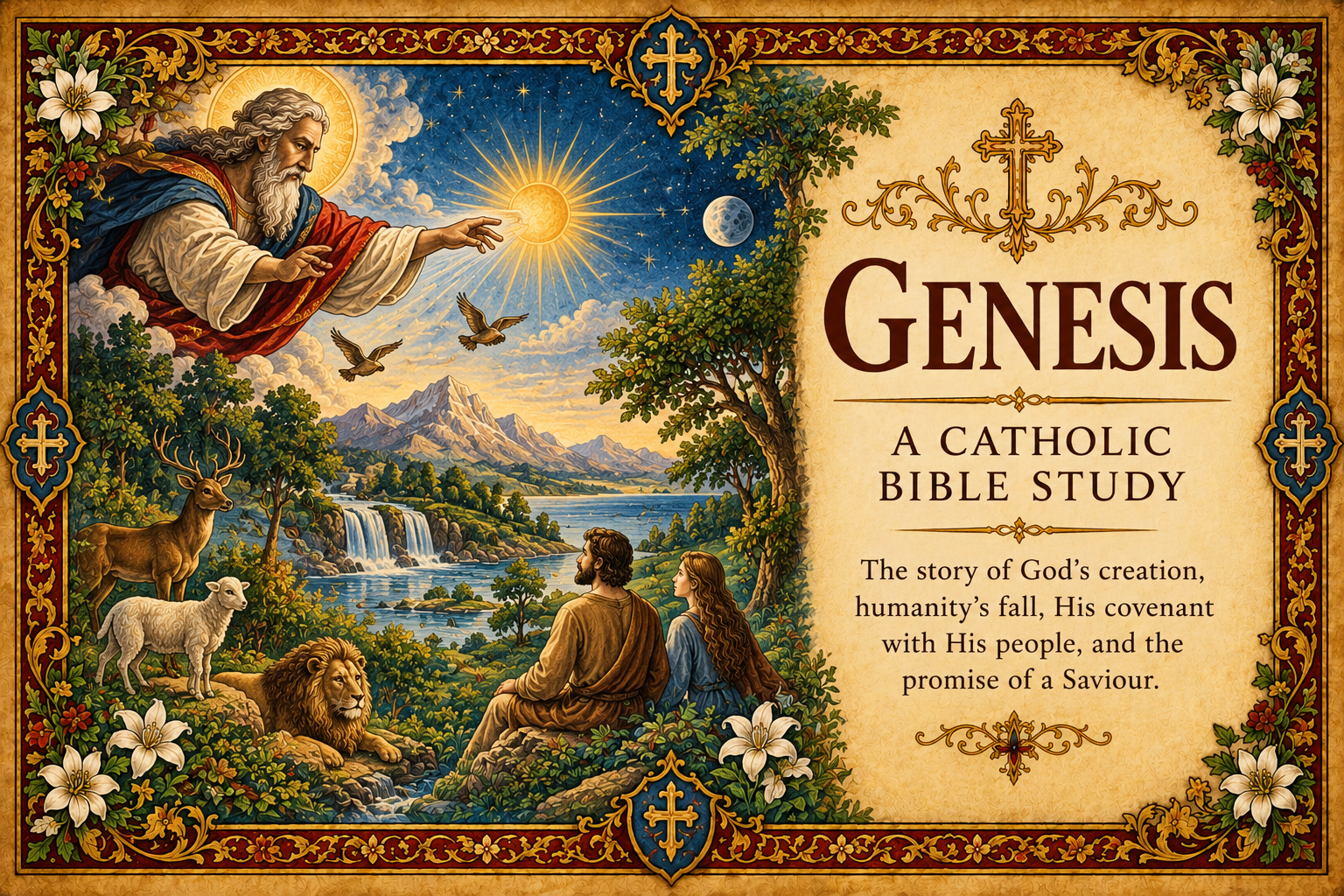
A Catholic Bible Study — Understanding God’s Creation and What It Means for Our Lives
Introduction: Why Genesis Matters
The Bible begins with some of the most important words ever written:
“In the beginning God created heaven, and earth.”
Genesis 1:1, Douay-Rheims
These words tell us something wonderful.
We are not here by accident. The world did not create itself. Everything that exists owes its existence to God.
Genesis is the first book of the Bible. Its name means beginning or origin. It teaches us about the beginning of the world, the creation of humanity, our relationship with God and, in the chapters that follow, how sin entered human history.
But Genesis is not simply about events long ago.
It helps us answer questions that every person eventually asks:
Where did everything come from?
Why am I here?
Does my life have a purpose?
Why is the world good, yet filled with suffering?
What does God expect of me?
How does creation lead us to Jesus Christ?
The Catholic Church teaches that Genesis is truly the inspired Word of God. Its message is not merely an ancient human opinion about the world. Through the sacred author, God Himself teaches us the truths He wishes us to know for our salvation.
We must therefore approach Genesis with faith, reverence and a willingness to learn.
We must also read it as the Church reads it: respecting what the sacred author intended to affirm, recognising its different ways of expressing truth, and understanding it in the light of Jesus Christ.
The purpose of this study is simple: to understand what God teaches us through Genesis Chapter 1 and to discover how that teaching should shape our lives.
1. Everything Begins with God
“In the beginning God created heaven, and earth.”
Genesis 1:1
The Bible does not begin by trying to prove that God exists.
It begins by declaring that He is the Creator.
Before there were stars, planets, oceans, mountains or human beings, God already existed.
He did not come from anywhere. Nobody made Him. He has no beginning and will have no end.
God is eternal.
Everything else depends upon Him for its existence.
This is the first great truth of the Bible.
God is the Creator. We are His creatures.
That distinction matters enormously.
The world is not God. Nature is not God. Human beings are not God.
We may admire creation, study it and enjoy its beauty, but we must worship its Creator.
What the Church Fathers Teach
Saint Basil the Great, in his Hexaemeron, begins his explanation of creation by drawing attention to the greatness of the opening words of Genesis.
Moses, writing under the inspiration of the Holy Spirit, begins by proclaiming God’s creative action.
He does not begin with speculation about competing gods or the supposed eternity of matter.
He proclaims the one true God, from whom everything comes.
What This Means for Us
If God created us, our lives have a purpose.
We do not belong entirely to ourselves.
Our abilities, our possessions, our opportunities and even the time we have been given are gifts from God.
This should change the way we live.
Instead of asking only, “What do I want from life?” we should also ask:
“Lord, what did You create me for?”
The answer is found in the Church’s traditional teaching: we were created to know God, love Him, serve Him in this world and be happy with Him forever in Heaven.
That is the purpose of every human life.
2. God Created Everything Out of Nothing
The Church teaches that God created the world ex nihilo.
This Latin expression means out of nothing.
When a carpenter makes a table, he needs wood.
When an artist paints a picture, she needs paint and canvas.
When a builder constructs a house, he needs bricks and other materials.
Human beings make things from materials that already exist.
God is different.
He did not need anything already existing in order to create the universe.
He brought everything into existence by His own power.
As Scripture teaches:
“For he spoke and they were made: he commanded and they were created.”
Psalm 32(33):9
What the Church Fathers Teach
Saint Theophilus of Antioch, writing in the second century, explained that human craftsmen require materials, whereas God brings into existence whatever He wills.
This is an important distinction between the Creator and His creatures.
God’s power is unlimited.
Nothing outside Him restricts His ability to create.
What About the Six Days?
Genesis describes God’s work of creation in six days.
Catholics must believe that God truly created all things, that creation depends entirely upon Him, and that the account of creation teaches divine truth.
The Church does not require every Catholic to believe that the six days were necessarily six periods of twenty-four hours.
Some Fathers, including Saint Basil and Saint Ephrem, interpreted the days in a more straightforward chronological manner.
Saint Augustine explored the possibility that God created all things together and that the six days express the order of creation in a way suited to human understanding.
The Church allows legitimate discussion about the manner and duration of creation, provided the truths revealed by God are preserved.
God certainly possesses the power to create in six ordinary days, instantaneously, or through an ordered process according to His wisdom.
We should not make one disputed interpretation of the days a test of Catholic faith.
The essential truth is that God created everything freely, wisely and without depending upon anything outside Himself.
What This Means for Us
Sometimes we think our problems are too great for God.
We worry about our families, our health, our future or our sins.
Genesis reminds us who God is.
The One who brought the universe into existence is not powerless before our difficulties.
This does not mean He will always remove our problems in the way we expect.
It means that we can trust His wisdom, power and love.
Practical lesson: When facing something difficult, begin with prayer rather than despair. Remember that nothing is impossible for God.
3. “Let There Be Light” — The Father, Son and Holy Spirit
“And God said: Be light made. And light was made.”
Genesis 1:3
God creates by His word.
He speaks, and creation obeys.
This is important because the New Testament reveals something wonderful about God’s Word.
Saint John begins his Gospel:
“In the beginning was the Word, and the Word was with God, and the Word was God.”
John 1:1
He continues:
“All things were made by him.”
John 1:3
Who is this eternal Word?
Jesus Christ, the Son of God.
Saint John later tells us:
“And the Word was made flesh, and dwelt among us.”
John 1:14
The Child born at Bethlehem is the eternal Son through whom all things were created.
Genesis also tells us that the Spirit of God moved over the waters.
In the light of the New Testament, the Church recognises the work of the Holy Trinity in creation.
The Father creates through His eternal Son in the Holy Spirit.
There are not three creators.
There is one God in three divine Persons: Father, Son and Holy Spirit.
What the Church Fathers Teach
Saint Ambrose, in his teaching on the six days of creation, draws attention to the divine Word through whom God creates.
The Fathers understood that the Old Testament prepares us for the fuller revelation of the Trinity in the New Testament.
We should remember that Genesis does not yet explain the doctrine of the Trinity as clearly as the New Testament does. Rather, Christians read Genesis in the light of the revelation completed in Jesus Christ.
What This Means for Us
Every time we make the Sign of the Cross, we profess faith in the same Trinity through whom we were created and by whom we are saved.
We say:
In the name of the Father, and of the Son, and of the Holy Spirit. Amen.
This should never become an empty habit.
The Sign of the Cross reminds us who God is and to whom we belong.
Practical lesson: Make the Sign of the Cross reverently each morning, thanking the Father for creating you, the Son for redeeming you and the Holy Spirit for sanctifying you.
4. The Six Days — God Creates with Wisdom and Order
Genesis describes God’s work in an orderly sequence.
The account presents the creation of light, the heavens, the seas, the dry land, vegetation, the heavenly lights, living creatures and finally humanity.
There is a beautiful order to the whole account.
God does not act foolishly or without purpose.
Everything is brought into existence according to His wisdom.
The repeated words:
“And God saw that it was good.”
remind us that creation comes from the goodness of God.
Understanding the Six Days
The Church encourages us to take Scripture seriously, but taking Scripture seriously does not mean treating every passage as though it were written in the same literary form.
The Psalms contain poetry.
The Gospels proclaim the historical life, death and Resurrection of Jesus.
The prophets employ images and symbolic actions.
Genesis uses solemn, structured language to teach the truth of creation.
The Catechism explains that Scripture presents creation symbolically as a succession of six days of divine work, followed by the rest of the seventh day (CCC 337).
This does not mean creation is imaginary.
It means that the inspired account teaches real truths through the form of writing God chose to use.
The Church insists that the world is genuinely created by God, that it is ordered and good, and that humanity occupies a special place within it.
What the Church Fathers Teach
Saint Basil strongly defended the reality and goodness of God’s creative work.
Saint Augustine examined how the six days should be understood and warned against careless interpretations that could bring Scripture into unnecessary conflict with sound knowledge.
Both believed firmly that Scripture is God’s Word.
Their different approaches remind us that faithful Catholics can sometimes disagree about how a difficult passage should be interpreted while remaining united in the truths of the faith.
What This Means for Us
God creates with wisdom and order.
Our lives should reflect something of that order.
A Christian life should have room for work, prayer, family, rest and worship.
Many people live in constant confusion because everything competes for their attention.
Genesis invites us to put God first and to order everything else around Him.
Practical lesson: Establish a simple daily pattern: morning prayer, honest work, time for others, an examination of conscience and rest.
5. God Saw That Creation Was Good
“And God saw all the things that he had made, and they were very good.”
Genesis 1:31
These words are among the most important in the chapter.
God created a good world.
The material world is not evil.
Our bodies are not evil.
Food, work, marriage, friendship and the beauty of nature are all part of God’s good creation.
This is why Catholicism does not teach that holiness means despising the world God made.
We must reject sin, but we must not reject creation itself.
Sin has wounded the world, but it has not made creation evil in itself.
What the Church Fathers Teach
Saint Irenaeus defended the goodness of creation against those who claimed that the material world came from an inferior or evil power.
He taught that the one true God created all things and that humanity finds its true life in communion with Him.
His famous teaching is that the glory of God is man fully alive, and man’s life consists in the vision of God.
Why This Is Important for Catholics
The goodness of creation helps us understand the sacraments.
God uses material things to communicate His grace.
Water is used in Baptism.
Oil is used in Confirmation and the Anointing of the Sick.
Bread and wine are consecrated at Mass and become the Body and Blood of Christ.
The Son of God Himself took a real human body.
The Incarnation shows us that matter is not beneath God’s concern.
What This Means for Us
We should be grateful for ordinary things.
A meal shared with family.
A beautiful landscape.
A child’s laughter.
The ability to work.
The kindness of a friend.
These are not replacements for God, but gifts that can lead us towards Him.
Practical lesson: Each evening, thank God for three particular blessings from the day.
Gratitude teaches us to recognise the goodness of our Creator.
6. Creation as a Temple — The World Exists to Glorify God
A temple is a place set apart for the worship of God.
The Fathers and later Christian teachers recognised that the creation account contains themes that resemble the ordering of a sanctuary.
The world is prepared as a place where God’s glory may be revealed.
The heavens declare His greatness.
The earth displays His wisdom.
Living creatures reveal His generosity.
Humanity is given a special responsibility within creation.
We are able to recognise the Creator and consciously offer Him praise.
The Psalms express this beautifully:
“The heavens shew forth the glory of God, and the firmament declareth the work of his hands.”
Psalm 18(19):2
What the Church Fathers Teach
Saint Maximus the Confessor developed a rich understanding of creation as ordered towards communion with God.
Human beings, possessing both body and soul, have a special vocation to bring their lives and the created world into harmony with God’s purposes.
This is a theological way of expressing a simple truth:
Everything we have should ultimately be used for God’s glory.
Creation and the Holy Mass
At Mass we offer bread and wine, fruits of the earth and the work of human hands.
These gifts come from God’s creation.
Through the words of consecration, by the power of Christ and the Holy Spirit, they become the true Body and Blood of Our Lord.
The Mass is not merely a celebration of creation. It is the sacramental making-present of Christ’s one sacrifice upon the Cross.
Yet creation itself is drawn into this mystery, as ordinary gifts are used by Christ to communicate His extraordinary grace.
What This Means for Us
Worship should not be confined to one hour on Sunday.
Our whole life should give glory to God.
A parent caring patiently for a child.
A worker doing an honest day’s work.
A young person studying diligently.
Someone caring for an elderly relative.
All these ordinary actions can become offerings to God when performed in charity and united to Christ.
Practical lesson: Before beginning your work, say: “Lord, I offer You everything I do today.”
7. Man and Woman — Created in God’s Image
“And God created man to his own image: to the image of God he created him: male and female he created them.”
Genesis 1:27
Human beings occupy a unique place in creation.
We are not merely another species of animal.
We possess spiritual, rational souls.
We can know truth, freely choose the good, love others and enter into a personal relationship with God.
This is what it means to be made in God’s image.
It does not mean that God has a human body.
God is spirit.
Rather, we reflect something of His wisdom and love.
What the Church Fathers Teach
Saint Gregory of Nyssa explains that the divine image is especially reflected in humanity’s spiritual capacities, including reason and freedom.
Saint Hilary of Poitiers, reflecting on the words “Let us make man”, understood them in the light of the relationship between the Father and the Son.
The Church sees these words as consistent with the mystery of the Trinity, fully revealed in Christ.
Every Human Life Has Dignity
Because every human being is created in God’s image, every person possesses dignity.
That dignity does not depend upon intelligence, wealth, strength, health, age or usefulness.
An unborn child possesses human dignity.
A person living with a disability possesses human dignity.
Someone who is elderly or seriously ill possesses human dignity.
The poor, the lonely and the forgotten possess human dignity.
Every person matters because every person is created and loved by God.
This is the foundation of the Church’s teaching on the sanctity of human life.
Male and Female
Genesis also teaches that God created humanity male and female.
Both possess equal dignity.
Their differences belong to the goodness of God’s creation.
Marriage, as further revealed in Genesis Chapter 2 and confirmed by Jesus, belongs to God’s plan for humanity.
Man and woman are called to love, mutual self-giving and openness to the gift of life.
What This Means for Us
If every person bears God’s image, we must treat others accordingly.
We cannot claim to love God while deliberately despising our neighbour.
We should examine how we speak about people, especially those with whom we disagree.
Practical lesson: Treat one person with particular patience and kindness today, remembering that he or she is made in God’s image.
8. Dominion and Stewardship — Caring for God’s Creation
“Increase and multiply, and fill the earth, and subdue it.”
Genesis 1:28
God gives humanity authority over the created world.
But authority does not mean unlimited permission to do whatever we please.
We are not the owners of creation in an absolute sense.
God is its Creator and Lord.
We are its stewards.
A steward is someone entrusted with caring for something that belongs to another.
This means we should use creation responsibly.
We may cultivate the land, raise animals, build homes, develop medicine, pursue science and use the earth’s resources for legitimate human needs.
But we should not waste, destroy or exploit creation without good reason.
What the Church Fathers Teach
Saint John Chrysostom, in his homilies on Genesis, emphasised the dignity and responsibility given to humanity through God’s gift of dominion.
Human authority must be exercised under God’s authority.
We should imitate His wisdom and goodness rather than act selfishly.
The Dignity of Work
Work is part of God’s original plan.
It is not simply a punishment for sin.
Although work became burdensome after the Fall, humanity was already called to care for creation.
Honest work therefore possesses dignity.
Whether someone works in a factory, an office, a school, a hospital, a shop or the family home, that work can be a way of serving God.
What This Means for Us
We should avoid wastefulness, respect the natural world, care properly for animals and use our possessions responsibly.
We should also remember that people matter more than profit.
Practical lesson: Carry out your ordinary responsibilities faithfully and without unnecessary complaint. Offer your work to God.
9. The Seventh Day — God Teaches Us to Rest
“And he rested on the seventh day from all his work which he had done.”
Genesis 2:2
The seventh day is described at the beginning of Genesis Chapter 2, but it completes the account of creation.
God rests.
Does this mean He was tired?
Of course not.
God never becomes weary.
His rest signifies the completion and goodness of His work.
The seventh day is blessed and made holy.
This teaches us that life is not meant to consist entirely of work.
We were created for communion with God.
The Sabbath and Sunday
For Israel, the Sabbath was the seventh day, Saturday.
It recalled God’s rest after creation and His deliverance of Israel from Egypt.
Christians celebrate Sunday, the first day of the week, because Jesus rose from the dead on that day.
Sunday is the Lord’s Day.
It celebrates not only the original creation but also the new creation begun through Christ’s Resurrection.
This is why Sunday Mass is central to Catholic life.
We do not attend Mass merely because it is a useful custom.
We gather to worship the living God and to participate in the sacrifice of Christ.
What the Church Fathers Teach
Saint Augustine saw the final rest of creation as a sign of our eternal destiny.
Our hearts were made for God, and they cannot find lasting peace apart from Him.
The rest of the seventh day points towards the everlasting joy of Heaven.
What This Means for Us
Sunday should be different from other days.
It should be centred upon God, worship, family, charity and suitable rest.
We should avoid allowing unnecessary work, shopping, entertainment or other activities to push Sunday Mass aside.
Practical lesson: Prepare for Sunday Mass. Arrive in good time, pray attentively and make room for genuine rest and family life.
10. Jesus Christ — The Beginning of the New Creation
Genesis begins with creation.
The New Testament reveals that everything was created through Jesus Christ and for Him.
Saint Paul writes:
“For in him were all things created in heaven and on earth, visible and invisible.”
Colossians 1:16
Jesus is not simply a religious teacher who appeared long after creation.
He is the eternal Son of God.
He was present with the Father and the Holy Spirit before the world began.
Through Him all things were made.
When humanity fell into sin, God did not abandon His creation.
He sent His Son to redeem it.
This is why the Bible must always be read as one great story.
Genesis tells us about the first creation.
The Gospel tells us about the new creation in Christ.
Christ the True Light
Genesis tells us that God created light.
Jesus declares:
“I am the light of the world.”
John 8:12
The first light overcame physical darkness.
Christ overcomes the darkness of sin and death.
Christ the Perfect Image of God
Human beings were made in God’s image.
But sin wounded our likeness to Him.
Christ, the perfect image of the invisible God, comes to restore us.
Through Baptism and the life of grace, we are called to become more like Him.
Christ and the New Creation
Jesus rose from the dead on the first day of the week.
The Fathers also spoke of Sunday as the eighth day, the beginning of the new creation.
Through His Resurrection, Christ opens the way to eternal life.
The world is not destined simply to disappear into meaninglessness.
God promises new heavens and a new earth.
What This Means for Us
Jesus came not merely to teach us how to behave, but to make us new.
He forgives sins.
He restores our friendship with God.
He gives us grace through the sacraments.
He calls us to holiness.
Practical lesson: Do not be satisfied with simply believing that Jesus exists. Seek to know Him through prayer, the Gospels, Confession and the Holy Eucharist.
11. The Great Catholic Truths of Genesis Chapter 1
Having read the chapter, we can now bring its teaching together.
God Alone Is the Creator
Everything exists because God freely created it.
He alone is eternal and uncreated.
God Created Out of Nothing
He did not require pre-existing materials.
All creation depends upon Him.
Creation Is Good
The world is not evil in itself.
It comes from the goodness and wisdom of God.
Creation Has Order and Purpose
The six-day account teaches us that God creates wisely and that His works are ordered towards His purposes.
Humanity Is Made in God’s Image
Every human person possesses dignity and is called to know and love God.
Man and Woman Are Both Created by God
They possess equal dignity and are called to live according to His wise design.
Humanity Must Care for Creation
We have received responsibility, not unrestricted ownership.
Worship Belongs at the Centre of Life
The seventh day reminds us that we were created not merely to work, but to worship and enjoy communion with God.
Everything Finds Its Fulfilment in Christ
The Son through whom all things were created is the same Son who became man for our salvation.
These are not optional ideas.
They belong to the Catholic understanding of creation.
The Church teaches them because they are revealed by God.
12. Living Genesis Chapter 1 Every Day
It is possible to understand the creation account and still fail to allow it to change our lives.
Sacred Scripture is not given simply to satisfy curiosity.
God speaks so that we may believe, repent and live according to His will.
Genesis Chapter 1 gives us a simple pattern for daily Catholic living.
Begin the day with God. Before reaching for your telephone or beginning your work, thank Him for the gift of another day.
Recognise your dignity. Do not think of yourself as worthless or without purpose. You were created in God’s image and called to eternal life.
Respect the dignity of others. Speak kindly, forgive generously and remember that every person is loved by God.
Work faithfully. Carry out your duties with honesty and care, offering your labour to the Lord.
Be grateful for creation. Enjoy God’s gifts without becoming attached to them more than to God Himself.
Keep Sunday holy. Make Mass the centre of the Lord’s Day and allow time for prayer, charity and rest.
Remember your final purpose. You were not created merely for this world. You were created for eternal communion with God.
None of these actions requires great learning or extraordinary ability.
They are simple ways of living the truth revealed in Genesis.
And they are open to every Catholic.
Questions for Reflection
Take a few moments to consider these questions prayerfully.
Do I truly believe that God created me for a purpose?
Do I thank Him for the gift of life?
Have I allowed work, money or other concerns to become more important than God?
Do I treat other people as those made in God’s image?
Am I using my gifts and abilities responsibly?
Do I make Sunday Mass a genuine priority?
Is there something in my life that needs to be brought back into God’s order?
Am I allowing Jesus Christ to make me a new creation through His grace?
Choose one area in which you can make a practical change this week.
It is better to put one truth of Scripture into practice than merely to admire many truths without acting upon them.
A Simple Prayer with Genesis Chapter 1
Read Genesis 1:1 slowly:
“In the beginning God created heaven, and earth.”
Pause.
Remember that the God who created the universe also created you.
Then pray:
Heavenly Father,
You created heaven and earth by Your wisdom and power.
You created me in Your image and called me to know, love and serve You.
Forgive me for the times I have forgotten You or misused the gifts You have given me.
Teach me to recognise Your goodness in creation, to respect the dignity of every person, and to carry out my daily duties faithfully.
Help me to keep Sunday holy and to make room for prayer in my life.
Above all, draw me closer to Your Son, Jesus Christ, through whom all things were made and through whom all things are redeemed.
May the Holy Spirit guide me in understanding Your Word and putting it into practice.
Through Christ our Lord.
Amen.
Conclusion: Creation Leads Us to Worship
Genesis Chapter 1 is not simply an explanation of how the world began.
It is a revelation of who God is.
He is eternal.
He is almighty.
He is wise.
He is good.
He is the Creator of everything that exists.
And He created humanity for communion with Himself.
This is why the proper response to Genesis is not merely curiosity.
It is gratitude, reverence and worship.
Every sunrise reminds us of His power.
Every human life reminds us of His image.
Every good gift reminds us of His generosity.
Every Sunday reminds us that we were created for something greater than earthly labour.
And every Holy Mass directs us towards Jesus Christ, the eternal Word through whom the world was made and through whom it is redeemed.
The God who said, “Let there be light”, still desires to bring His light into our hearts.
May we receive that light, live according to His Word, and one day enter the eternal rest for which He created us.
“Bless the Lord, all ye works of the Lord: praise and exalt him above all for ever.”
Daniel 3:57

