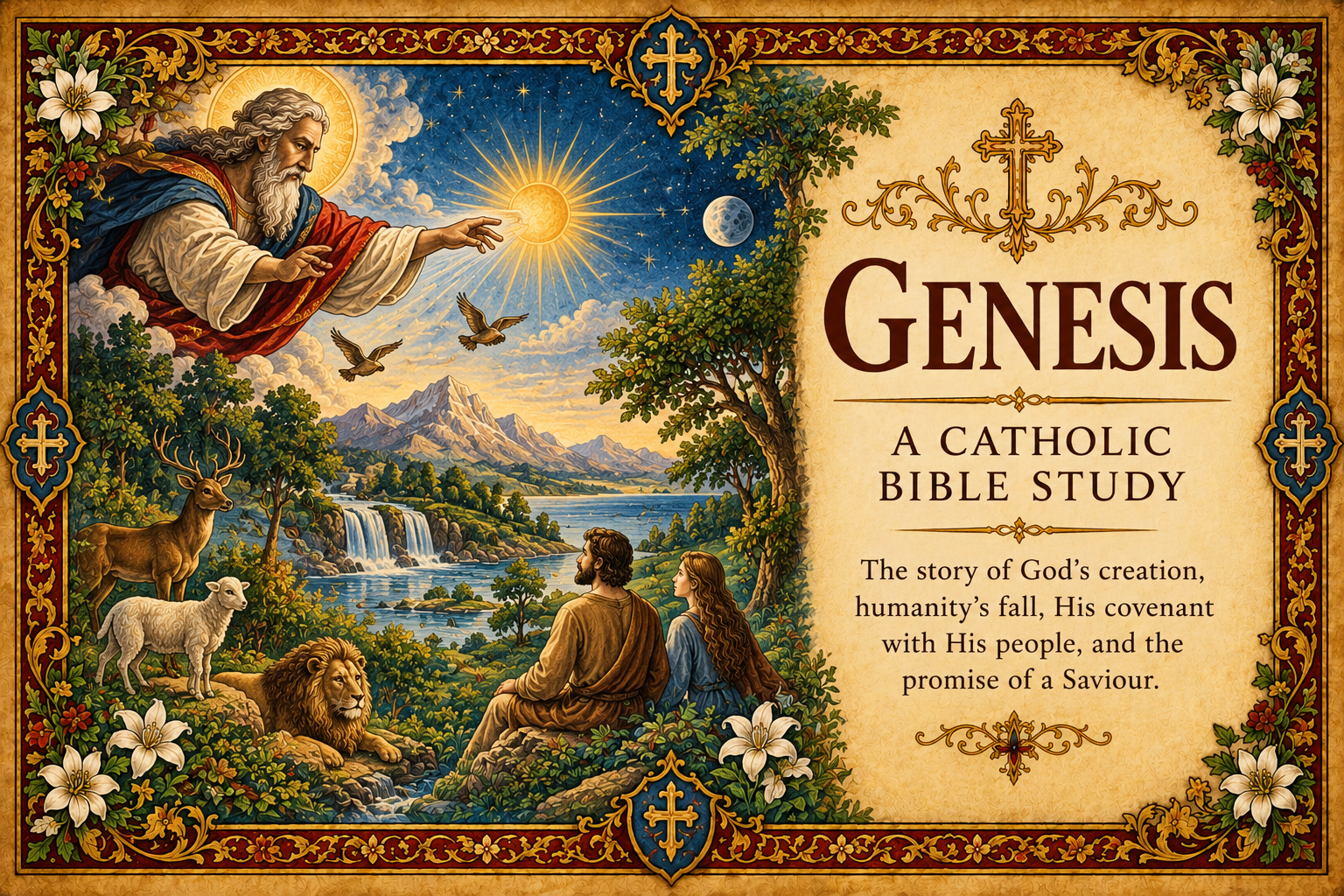
A Catholic Bible Study — The Garden of Eden, the Creation of Man and Woman, Marriage and Our Friendship with God
Introduction: God Created Us for Friendship with Himself
In Genesis Chapter 1, we discovered that God created heaven and earth.
He made the light, the seas, the land, the plants and the living creatures.
Finally, He created humanity in His own image.
Everything God made was good.
Genesis Chapter 2 now invites us to look more closely at the creation of man and woman.
We discover that God did not create human beings simply to exist upon the earth.
He created us to know Him, to love Him and to live in friendship with Him.
This chapter helps us answer some important questions:
- Why did God create human beings?
- What does it mean that man was formed from the dust of the earth?
- Why did God place Adam in the Garden of Eden?
- Why did God give Adam a commandment?
- Why did God create woman?
- What does Genesis teach us about marriage?
- What was life like before sin entered the world?
- How does all of this point towards Jesus Christ?
Genesis Chapter 2 reveals something beautiful about God.
He is not a distant Creator who makes the world and then abandons it.
He is a loving Father who gives life, provides for His creatures and invites humanity into communion with Himself.
The chapter also shows us what God originally intended human life to be: a life of friendship with Him, harmony with others, meaningful work and love without sin.
Although that original harmony would later be wounded by sin, God’s plan would not be defeated.
Through Jesus Christ, He would open the way for humanity to return to Him.
1. From the Creation of the World to the Creation of Man
Genesis Chapter 1 gives us the great picture of creation.
God speaks, and the world comes into existence.
The heavens, the earth and every living creature owe their existence to Him.
Genesis Chapter 2 brings us closer.
Instead of looking at the whole universe, we are invited to consider the special place of humanity within God’s creation.
We hear about the formation of Adam, the Garden of Eden, the first commandment and the creation of Eve.
These two chapters are not simply repeating the same information.
They teach us about creation from different perspectives.
Genesis Chapter 1 reveals the greatness of God’s creative power.
Genesis Chapter 2 reveals His personal care for humanity.
The first chapter teaches that we are made in God’s image.
The second helps us understand what that means for our relationship with Him and with one another.
What the Church Fathers Teach
Saint John Chrysostom, in his homilies on Genesis, draws attention to the way Scripture speaks of God’s care for humanity.
The account does not present human life as something insignificant.
It shows that God provides for man and gives him a particular place and responsibility within creation.
The details are important because they help us understand God’s love.
What This Means for Us
God does not look upon us as an anonymous part of creation.
He knows us personally.
He knows our needs, our difficulties and our weaknesses.
Every human life matters to Him.
Sometimes people think that God is too great to be concerned with their ordinary problems.
Genesis teaches otherwise.
The God who made heaven and earth is the same God who cares for each one of us.
Practical lesson: Speak to God personally in prayer. Do not think that your everyday concerns are too small to bring before Him.
2. The Seventh Day — God Teaches Us to Rest
“And he rested on the seventh day from all his work which he had done.”
Genesis 2:2
The chapter begins by completing the account of creation.
God rests on the seventh day.
Does this mean that God became tired?
No.
God is almighty. He never becomes exhausted or loses His strength.
His rest signifies that His work of creation has reached its completion.
He has made a good and ordered world.
He blesses the seventh day and makes it holy.
This teaches us that life is not meant to consist entirely of activity.
We were created for more than work, possessions and earthly success.
We were created for communion with God.
God Continues to Care for Creation
Although Genesis tells us that God rested, this does not mean He stopped caring for the world.
God continues to sustain everything He has made.
If God did not continually uphold creation, nothing could continue to exist.
Jesus Himself says:
“My Father worketh until now; and I work.”
John 5:17
God is never absent from His creation.
Every moment of our existence depends upon Him.
What the Church Fathers Teach
Saint Augustine understood God’s rest as pointing towards the eternal peace for which humanity was created.
Our final purpose is not endless labour.
It is everlasting happiness with God.
The peace of Heaven is the fulfilment of the rest described in Genesis.
Why Sunday Matters
For the Jewish people, the Sabbath was the seventh day.
For Christians, Sunday is the Lord’s Day because Jesus Christ rose from the dead on the first day of the week.
His Resurrection marks the beginning of the new creation.
This is why Sunday Mass is so important.
We gather not merely to rest from work, but to worship God and receive the grace of Christ.
What This Means for Us
Modern life can become so busy that we leave little time for God.
Work, shopping, entertainment and other commitments can gradually take over.
Genesis reminds us that worship must have a proper place in our lives.
Practical lesson: Make Sunday Mass the centre of your week. Allow time for prayer, family, charity and genuine rest.
3. The Garden of Eden — God Prepares a Home for Humanity
“And the Lord God planted a paradise of pleasure from the beginning: wherein he placed man whom he had formed.”
Genesis 2:8
God places Adam in the Garden of Eden.
The garden is described as a place of beauty and abundance.
There are trees, flowing waters and everything needed for life.
God provides generously for the man He has created.
The Garden of Eden teaches us about humanity’s original friendship with God.
It is a place where man is called to live according to God’s will, receiving His gifts with gratitude.
The Garden as a Sacred Place
Christian writers have often recognised similarities between the Garden of Eden and the later Temple in Jerusalem.
Both are associated with God’s presence.
Both contain imagery of life and holiness.
Both remind us that humanity is called to worship its Creator.
The garden may therefore be understood spiritually as a place of communion between God and man.
This does not mean that Genesis is simply describing a church building.
Rather, the garden helps us understand something that will become clearer throughout the Bible:
God desires to dwell with His people.
The Tree of Life
Genesis tells us that the tree of life stood in the garden.
This tree becomes important later in the story.
After humanity’s fall, access to the tree of life is lost.
Yet the image appears again in the final book of the Bible.
In Revelation, the tree of life is associated with the heavenly Jerusalem and the gift of eternal life.
Christian tradition also recognises a connection between the tree of life and the Cross.
Through the Cross, Jesus Christ opens the way to eternal life.
Where humanity lost life through disobedience, Christ restores the hope of life through His obedience.
What the Church Fathers Teach
Saint Ephrem the Syrian reflected deeply on Paradise as a place of holiness and divine generosity.
Saint Irenaeus also explained how Christ’s obedience restores what humanity lost through sin.
These spiritual connections help us see that Genesis belongs to the one great story of salvation.
What This Means for Us
God created humanity for friendship with Himself.
Sin damages that friendship, but through Christ we can be reconciled with God.
We should never become so attached to the gifts of this world that we forget the One who gives them.
Practical lesson: Thank God for the blessings you enjoy, but remember that your greatest blessing is the opportunity to know and love Him.
4. The Formation of Man — Dust and the Breath of Life
“And the Lord God formed man of the slime of the earth: and breathed into his face the breath of life, and man became a living soul.”
Genesis 2:7
This is one of the most beautiful passages in Genesis.
God forms man from the earth and gives him life.
The language is very personal.
It presents God as a craftsman carefully forming something precious.
But we should not imagine that God has a physical body or that He needed human hands to create Adam.
Scripture uses language we can understand to reveal God’s creative action and His special care for humanity.
What Does the Dust Mean?
The dust reminds us that we are creatures.
Our bodies belong to the material world.
We are not gods.
We are dependent upon our Creator.
The Church reminds us of this truth on Ash Wednesday when we receive ashes as a sign of our mortality and our need for repentance.
We should never become proud or imagine that we can live without God.
What Does the Breath of Life Mean?
The breath of life teaches us that our existence comes from God.
Human beings are not merely collections of material parts.
We are a unity of body and spiritual soul.
The Church teaches that each human spiritual soul is created immediately by God.
Our souls enable us to know truth, to love freely and to enter into communion with Him.
The breath in Genesis should not be confused with saying that human beings possess a piece of God’s divine substance, or that the breath is simply identical with the Holy Spirit.
Rather, the passage reveals that our life is God’s gift and that humanity has a unique spiritual dignity.
What the Church Fathers Teach
Saint Gregory the Great frequently reminded Christians of both the humility and the dignity of the human condition.
We come from the earth and must not become proud.
Yet we are created and loved by God and must never lose hope.
These two truths belong together.
We are humble creatures.
But we are precious in God’s sight.
What This Means for Us
Our bodies deserve respect because they belong to the persons God created.
Our souls deserve care because we were made for eternal life.
We therefore need to care for both our physical and spiritual well-being.
Food, rest and health matter.
But so do prayer, the sacraments, repentance and the life of grace.
Practical lesson: Remember that you are both body and soul. Care for your health, but never neglect the needs of your soul.
5. Adam in the Garden — Work and Worship
“And the Lord God took man, and put him into the paradise of pleasure, to dress it, and to keep it.”
Genesis 2:15
God gives Adam a responsibility.
He is placed in the garden to cultivate it and care for it.
This is important because it happens before sin enters the world.
Work was therefore part of God’s original plan for humanity.
Work itself is not a punishment.
It is a good thing.
The difficulties, exhaustion and frustrations associated with work become more prominent after the Fall, but meaningful activity already belongs to human life.
Why God Gives Us Work
God created human beings with abilities, intelligence and freedom.
He invites us to use these gifts responsibly.
We can cultivate the earth, build homes, care for families, make useful things, help others and contribute to society.
Honest work allows us to serve God and our neighbour.
The person who cares for a child, prepares a meal, repairs a building, teaches a lesson or tends a garden can glorify God through that work.
Work and Worship Belong Together
Christian tradition has recognised a spiritual meaning in Adam’s responsibility to cultivate and guard the garden.
The words describing his task have connections with language later used for sacred service.
This has encouraged Christian writers to see Adam as having a vocation not only to care for creation but also to direct it towards the praise of God.
Saint Maximus the Confessor reflected on humanity’s calling to bring the material and spiritual dimensions of creation into harmony under God.
The important lesson is simple.
Our daily work should not be separated from our faith.
We can offer our labour to God.
What This Means for Us
Some people imagine that holiness belongs only to priests, religious or those who spend many hours in prayer.
But every Christian is called to holiness.
Ordinary work can be part of that calling.
What matters is that we carry out our responsibilities with love, honesty and faithfulness.
Practical lesson: Before beginning your work, pray: “Lord, I offer You my work today. Help me to do it well and for Your glory.”
6. The First Commandment — Freedom and Obedience
“Of every tree of paradise thou shalt eat: But of the tree of knowledge of good and evil, thou shalt not eat.”
Genesis 2:16–17
God gives Adam great freedom.
He may enjoy the many gifts of the garden.
But there is one commandment he must obey.
He must not eat from the tree of the knowledge of good and evil.
Why does God give this command?
Because human freedom is meant to be exercised in friendship with God.
God does not create Adam as a machine.
He gives him the ability to choose.
And with freedom comes responsibility.
Why Does Obedience Matter?
We sometimes think freedom means being able to do absolutely anything we want.
But that is not true freedom.
A person enslaved to anger, addiction, pride or selfishness is not truly free simply because he follows every desire.
True freedom means being able to choose what is good.
God’s commandments help us live according to the purpose for which we were created.
He does not command us out of cruelty.
His commandments are given for our good.
The Tree of the Knowledge of Good and Evil
The tree teaches that human beings must recognise God’s authority.
Adam and Eve are not free to decide independently of God what is ultimately good and evil.
They must trust His wisdom.
The problem is not that knowledge itself is evil.
The problem will be the temptation to reject God’s authority and claim the right to determine good and evil for themselves.
We will see the consequences in Genesis Chapter 3.
What the Church Fathers Teach
Saint Irenaeus connected humanity’s growth towards perfection with free obedience to God.
Love cannot be reduced to outward behaviour.
It involves the free response of the person to the Creator.
Obedience is therefore not simply about following instructions.
It is about trusting the God who loves us.
What This Means for Us
Every Christian faces choices.
Will I tell the truth when lying would be easier?
Will I forgive when I would rather remain angry?
Will I follow the teaching of Christ even when it is unpopular?
Will I keep God’s commandments when doing so requires sacrifice?
These decisions reveal whether we truly trust Him.
Practical lesson: When a commandment of God feels difficult, ask for the grace to understand that His will is always directed towards your true good.
7. “It Is Not Good for Man to Be Alone”
“And the Lord God said: It is not good for man to be alone: let us make him a help like unto himself.”
Genesis 2:18
Throughout Genesis Chapter 1, God repeatedly declares that His creation is good.
Now, for the first time, something is described as not good.
It is not good for man to be alone.
Why?
Because human beings were created for relationships.
We are not intended to live entirely for ourselves.
We need love, friendship, community and communion.
Adam’s Solitude
Genesis describes the living creatures being brought before Adam.
He gives them names.
But none is a companion corresponding to him.
This teaches us that human beings are different from the animals.
Animals are part of God’s good creation and deserve proper care.
But another human person shares our nature and dignity in a unique way.
Adam needs a companion who can share human life with him.
What Saint John Paul II Teaches
Saint John Paul II reflected on this passage in his teachings on the human person and the body.
He explained that Adam’s original solitude reveals humanity’s special place within creation.
Man is capable of knowing himself, recognising God and entering into personal relationships.
His solitude prepares us to understand the gift of another human person.
We Were Created for Communion
God Himself is an eternal communion of Father, Son and Holy Spirit.
Human relationships can reflect something of divine love.
We are called to love others, to give ourselves generously and to avoid living selfishly.
This does not mean that everyone must marry.
The Church honours both marriage and consecrated celibacy.
Those who remain unmarried can live fruitful lives of love, friendship and service.
The deeper truth is that no human being is created for selfish isolation.
What This Means for Us
Modern life can leave people feeling lonely even when they are surrounded by others.
Genesis reminds us that relationships matter.
Family life matters.
Friendship matters.
Parish community matters.
Care for those who are lonely matters.
Practical lesson: Make time for someone who may be isolated or forgotten. A visit, a telephone call or a simple act of kindness can be a real expression of Christian love.
8. The Creation of Woman — Bone of My Bones
Genesis tells us that God causes a deep sleep to fall upon Adam.
Then God forms woman from his side.
When Adam sees her, he declares:
“This now is bone of my bones, and flesh of my flesh.”
Genesis 2:23
Adam recognises someone who shares his own human nature.
She is not simply another creature.
She is a person like himself.
She possesses the same human dignity.
Why Is Woman Formed from Adam’s Side?
The Church Fathers recognised a beautiful spiritual meaning in this passage.
Woman is not presented as an inferior creature.
She shares the same humanity.
The image of her being formed from Adam’s side expresses closeness, unity and companionship.
The man and the woman are called to live together in mutual love.
Neither is merely an object for the other’s use.
Both are created in the image of God.
Both are called to holiness.
Both possess the same fundamental human dignity.
What the Church Fathers Teach
Saint John Chrysostom emphasised the close relationship between Adam and Eve and the special dignity of the woman God created as Adam’s companion.
Christian tradition has often reflected on the symbolism of the woman’s creation from Adam’s side.
This imagery helps us understand the unity and shared vocation of man and woman.
The Gift of Another Person
Adam’s response is one of recognition and joy.
He discovers someone with whom he can share his life.
This is a reminder that love begins by recognising the dignity and goodness of another person.
True love does not seek simply to possess or control.
It seeks the good of the beloved.
What This Means for Us
We should never treat another human being merely as someone who exists to satisfy our needs.
Marriage, friendship and family relationships require respect, patience and generosity.
We must learn to see others as persons to be loved rather than objects to be used.
Practical lesson: Examine how you treat those closest to you. Do they experience your love through patience, respect and self-giving?
9. Marriage — God’s Plan from the Beginning
“Wherefore a man shall leave father and mother, and shall cleave to his wife: and they shall be two in one flesh.”
Genesis 2:24
These words reveal the foundation of marriage.
Marriage is not merely a human invention or a social arrangement.
It belongs to God’s plan for man and woman.
From the beginning, God wills that man and woman should be united in a faithful and lasting communion of life and love.
The Meaning of Marriage
Marriage involves more than affection.
It is a lifelong covenant.
Husband and wife are called to give themselves to one another faithfully and generously.
Their union is ordered towards their mutual good and the generation and upbringing of children.
The expression “one flesh” reveals the deep unity God intends between husband and wife.
Marriage joins their lives together in a unique way.
Jesus Confirms God’s Plan
When Jesus is questioned about marriage and divorce, He directs people back to Genesis.
He says:
“What therefore God hath joined together, let no man put asunder.”
Matthew 19:6
Jesus teaches that marriage is intended to be a permanent union.
He calls husbands and wives to a love that is faithful even when difficulties arise.
Marriage as a Sacrament
Marriage existed from the beginning as part of God’s good creation.
But Christ raises marriage between baptised persons to the dignity of a sacrament.
This is an important distinction.
Marriage was established in the order of creation.
In the New Covenant, Christian marriage becomes a sacramental sign of Christ’s love for His Church.
Saint Paul writes about the union of husband and wife and then explains:
“This is a great sacrament; but I speak in Christ and in the church.”
Ephesians 5:32
A Christian husband is called to love his wife with the self-sacrificing love of Christ.
A Christian wife is called to share in that same mutual self-giving and fidelity.
Both are called to help one another become holy.
What Saint John Paul II Teaches
Saint John Paul II reflected extensively on the meaning of the human body, marriage and self-giving love.
He taught that man and woman discover their dignity not through selfishness but through sincere self-giving.
Marriage is one of the great ways this love is lived.
What This Means for Us
Marriage needs prayer, forgiveness, sacrifice and grace.
It is not sustained by feelings alone.
Those preparing for marriage should take seriously the promises they intend to make.
Those already married should remember that their vocation is a path to holiness.
The wider parish community should support marriages and families through prayer, encouragement and practical kindness.
Practical lesson: Pray for married couples, especially those facing difficulties. If you are married, consider one practical way to show your spouse greater love and appreciation.
10. “They Were Naked and Were Not Ashamed” — Original Innocence
“And they were both naked: to wit, Adam and his wife: and were not ashamed.”
Genesis 2:25
Genesis Chapter 2 ends with these words.
They describe the original innocence of Adam and Eve.
Before sin entered human history, their relationship with God and with one another was marked by harmony.
They did not experience the disorder that sin would later introduce.
They could see one another without selfishness or shame.
Their bodies were good.
Their love was rightly ordered.
Their friendship with God was unbroken.
What Is Original Holiness?
The Church teaches that our first parents were created in a state of original holiness and justice.
They lived in friendship with God.
They possessed a special harmony within themselves and with one another.
Their relationship with creation was also rightly ordered.
This original state was a gift of God’s grace.
It was not something they had earned.
Why Were They Not Ashamed?
Shame entered the story after the Fall.
Before sin, Adam and Eve did not look upon each other with lust or selfish desire.
They recognised the goodness and dignity of the person.
Their nakedness therefore expressed their original innocence.
This does not mean that modesty is unnecessary today.
After the Fall, human desires are wounded by sin, and modesty helps protect personal dignity and the goodness of human love.
What the Church Fathers Teach
Saint John Chrysostom and other Fathers reflected on the innocence of Adam and Eve before sin.
In Syriac Christian tradition, writers such as Saint Ephrem used the image of humanity being clothed in glory.
This expresses the beauty of humanity’s original friendship with God.
Such imagery is a spiritual reflection on the passage rather than a claim that Genesis explicitly describes literal garments of light.
What This Means for Us
We live in a world where the human body is often treated as an object.
People are judged by their appearance.
Human sexuality can be separated from love and responsibility.
Others may be used for selfish pleasure.
Genesis reminds us that the body is good and that human dignity must always be respected.
Christian purity is not hatred of the body.
It is learning to love according to God’s plan.
Practical lesson: Guard the dignity of others in your thoughts, words and actions. Ask God for a pure heart that recognises every person as someone to be loved and respected.
11. The Great Catholic Truths of Genesis Chapter 2
Having studied the chapter, we can now bring its teaching together.
God Created Humanity with Love
The creation of Adam reveals God’s personal care for the human person.
Human Beings Are Body and Soul
Our bodies are part of God’s good creation, and our spiritual souls give us a unique dignity.
As the Catechism teaches:
“The human body shares in the dignity of ‘the image of God’: it is a human body precisely because it is animated by a spiritual soul.”
Catechism of the Catholic Church, 364
We Were Created for Friendship with God
The Garden of Eden reveals the original harmony God intended between humanity and Himself.
Work Is Part of God’s Plan
Adam was given responsibility in the garden before the Fall.
Honest work can be a way of serving God.
Freedom Must Be Guided by Truth
God’s commandment teaches us that true freedom does not mean independence from our Creator.
It means freely choosing what is good.
Human Beings Are Made for Love and Communion
Adam’s solitude reveals the importance of personal relationships.
We were not created for selfish isolation.
Man and Woman Possess Equal Human Dignity
Both are created in God’s image.
Their relationship is meant to express mutual love, respect and self-giving.
Marriage Belongs to God’s Plan
Marriage is a faithful and lasting union of man and woman, raised by Christ to the dignity of a sacrament between the baptised.
Humanity Was Originally Created in Holiness
Adam and Eve lived in friendship with God before sin wounded human nature.
Jesus Christ Restores What Sin Has Damaged
Through His death and Resurrection, Christ opens the way to reconciliation with God and eternal life.
These truths help us understand both who we are and how God calls us to live.
12. Christ the New Adam and Mary the New Eve
The story of Genesis does not end in the Garden of Eden.
Everything that happens in the opening chapters of Scripture prepares us to understand the saving work of Jesus Christ.
The Church Fathers recognised that Adam and Eve point forward to Christ and Our Lady.
Jesus Christ, the New Adam
Saint Paul teaches that Jesus is the new Adam.
The first Adam disobeyed God.
Christ obeyed His Father perfectly.
Through Adam’s disobedience, sin entered human history.
Through Christ’s obedience, salvation is offered to humanity.
Saint Paul teaches:
“For as by the disobedience of one man, many were made sinners: so also by the obedience of one, many shall be made just.”
Romans 5:19
Jesus does not simply repair a small part of the damage caused by sin.
He opens the way to a new life of grace.
Through Baptism, we are united with His death and Resurrection.
Through the sacraments, He continues to strengthen and sanctify us.
Through His grace, we are called to become new creations.
The Side of Adam and the Side of Christ
Genesis tells us that Eve was formed from Adam’s side while he slept.
The Fathers recognised a connection with Christ upon the Cross.
When Jesus died, His side was pierced, and blood and water flowed out.
The Church sees in this event a sign of the sacraments, especially Baptism and the Eucharist.
Christian tradition therefore draws a beautiful comparison:
From the side of Adam came Eve.
From the pierced side of Christ comes the Church, His Bride.
Saint Augustine reflected upon this connection in his teaching on the Gospel of Saint John.
This is one of the many ways the Old Testament prepares us to understand the New Testament.
Mary, the New Eve
The Church also recognises Our Lady as the new Eve.
Eve listened to the serpent and disobeyed God.
Mary listened to the angel Gabriel and freely accepted God’s will.
At the Annunciation she said:
“Behold the handmaid of the Lord; be it done to me according to thy word.”
Luke 1:38
Through Mary’s obedience, the Son of God entered the world as man.
Saint Irenaeus spoke of Mary’s obedience as answering Eve’s disobedience.
This does not mean Mary saves us independently of Jesus.
Christ alone is the Saviour.
Mary’s unique role is always dependent upon His grace and saving work.
Through her faithful cooperation with God, she becomes the Mother of the Redeemer and, in the order of grace, our spiritual Mother.
From Eden to Heaven
The Garden of Eden was a place of friendship with God.
Sin brought about the loss of that original harmony.
But God’s plan did not end in failure.
Christ came to reconcile humanity with the Father.
Through Him, we are called to eternal life.
The Bible begins with humanity placed in a garden.
It ends with the heavenly Jerusalem, where God dwells with His people forever.
The story of creation finds its fulfilment in the story of salvation.
What This Means for Us
We cannot restore ourselves to friendship with God by our own strength.
We need Jesus Christ.
Through Baptism, we receive new life.
Through Confession, we receive forgiveness when we fall into sin.
Through the Holy Eucharist, Christ nourishes us with His own Body and Blood.
Through prayer and obedience, we grow in holiness.
And in Our Lady we have a beautiful example of trusting God’s will.
Practical lesson: Ask Jesus to renew your life through His grace. Ask Our Lady to help you respond to God with the same faith and obedience she showed at the Annunciation.
Living Genesis Chapter 2 Every Day
Genesis Chapter 2 is not simply an account of life in the Garden of Eden.
It teaches us how God wants us to live today.
Its lessons are practical and apply to every Christian.
Remember that your life comes from God. Begin each day with gratitude. You are not an accident. You were created and loved by Him.
Care for your body and soul. Make time for physical rest, but also for prayer, the sacraments and spiritual growth.
Carry out your daily work faithfully. Whether your responsibilities are at home, in employment, at school or within the parish, offer them to God.
Trust God’s commandments. His laws are not obstacles to happiness. They guide us towards the good for which we were created.
Make time for other people. Do not allow busyness or selfishness to prevent you from caring for family, friends, neighbours and those who are lonely.
Respect the dignity of every person. Never treat another human being merely as an object for your own benefit.
Support marriage and family life. Pray for husbands and wives, parents and children, and those whose family relationships are experiencing difficulties.
Seek purity of heart. Ask God to help you love others sincerely, without selfishness or dishonesty.
Remain close to Jesus Christ. Only through His saving grace can we overcome sin and grow in the holiness for which we were created.
These actions may seem ordinary.
But holiness is often found in ordinary faithfulness.
Every day gives us opportunities to live according to God’s original plan.
Questions for Reflection
Take some time to consider these questions prayerfully.
- Do I remember that my life is a gift from God?
- Am I caring for both my body and my spiritual life?
- Do I offer my daily work and responsibilities to God?
- Is there a commandment of God that I find difficult to accept or obey?
- Do I trust God’s wisdom more than my own desires?
- Am I making enough time for family, friendship and parish life?
- Do I treat other people with the dignity and respect they deserve?
- How can I better support marriage and family life?
- Are there attitudes or habits in my life that are preventing me from loving others properly?
- Am I allowing Jesus Christ to renew me through His grace?
Choose one area in which you can make a practical change this week.
Remember that spiritual growth usually takes place through small acts of faithfulness repeated over time.
A Simple Prayer with Genesis Chapter 2
Read Genesis 2:7 slowly:
“And the Lord God formed man of the slime of the earth: and breathed into his face the breath of life, and man became a living soul.”
Pause for a moment.
Remember that your life comes from God.
He created you in love and calls you to eternal friendship with Himself.
Then pray:
Heavenly Father,
You created me in Your image and gave me the gift of life.
You formed humanity with love and called us to live in friendship with You.
Forgive me for the times I have forgotten Your goodness or chosen my own will instead of Yours.
Teach me to use my freedom wisely and to follow Your commandments with trust.
Help me to carry out my daily responsibilities faithfully and to offer my work for Your glory.
Give me a generous heart, so that I may love others with patience, kindness and respect.
Bless all married couples and families, and strengthen those who are experiencing difficulties.
Through Your Son, Jesus Christ, restore in me the holiness that sin has wounded.
May the Blessed Virgin Mary, the new Eve, teach me to listen to Your Word and respond with faith.
Guide me by the Holy Spirit until I enter the eternal joy of Your Kingdom.
Through Christ our Lord.
Amen.
Conclusion: Created for Love, Called to Holiness
Genesis Chapter 2 reveals the beauty of God’s original plan for humanity.
God created man and woman in His image.
He gave them life.
He placed them in a good world.
He entrusted them with responsibility.
He gave them freedom.
He created them for love and communion.
Above all, He called them to live in friendship with Himself.
This is the dignity of the human person.
We are not merely creatures who happen to exist upon the earth.
We are created by God, loved by Him and called to share in His eternal life.
Yet Genesis also prepares us for the tragedy of sin.
The freedom God gives humanity can be misused.
The harmony of Eden can be wounded.
Friendship with God can be lost through disobedience.
That is what we will discover in Genesis Chapter 3.
But even before we reach the story of the Fall, we should remember that sin will never have the final word.
Jesus Christ, the new Adam, has come to restore humanity to the Father.
Through His Cross and Resurrection, He opens the way to eternal life.
Our Lady, the new Eve, shows us the beauty of responding to God with humble obedience.
And the Church continues to offer us the saving grace of Christ through the sacraments.
The lesson of Genesis Chapter 2 is therefore both simple and profound:
We were created by God, for God, and our hearts will never find lasting peace apart from Him.
May we live each day remembering the dignity of our creation, the goodness of God’s commandments and the eternal happiness for which He made us.
“For thou hast created all things; and for thy will they were, and have been created.”
Apocalypse (Revelation) 4:11

