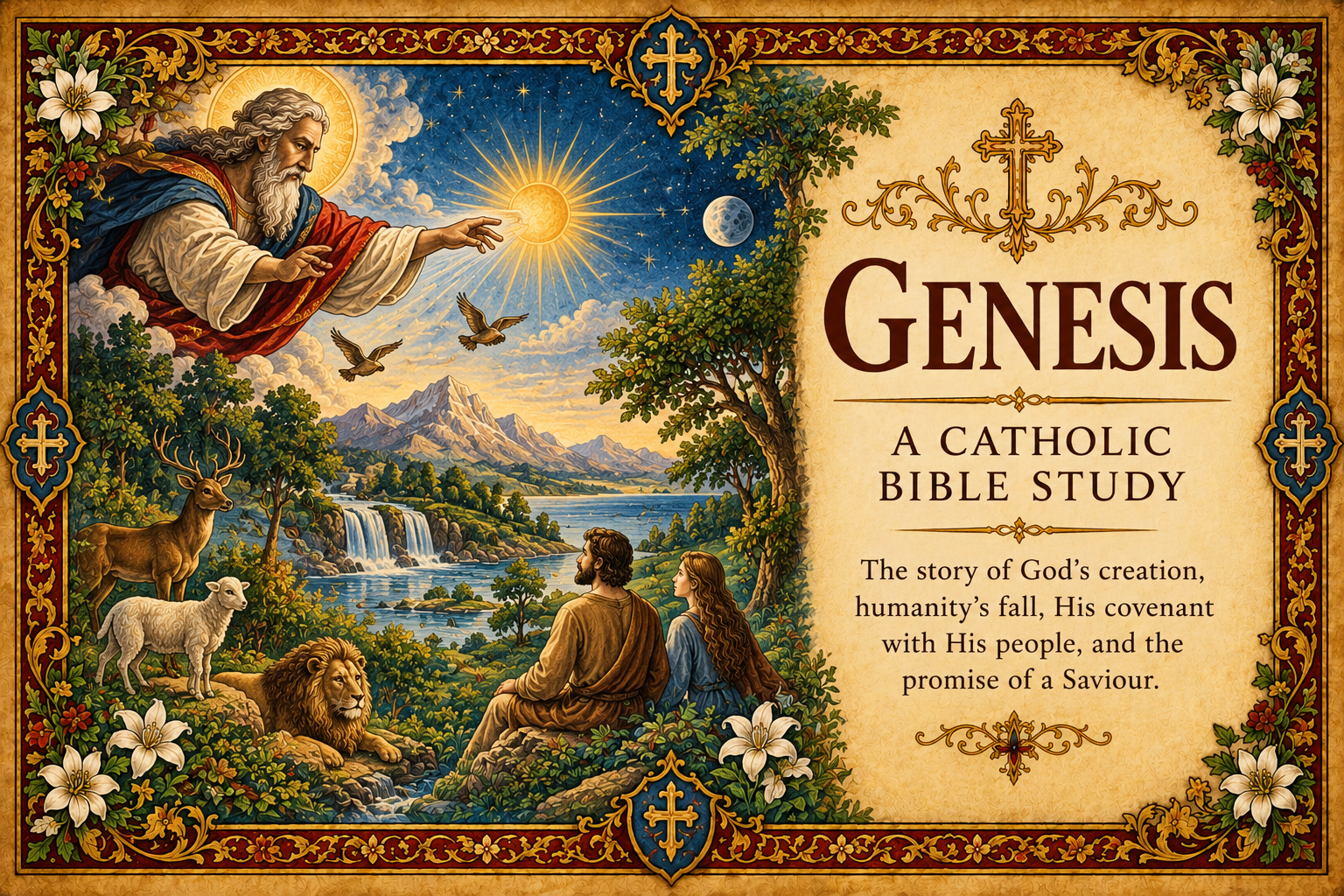
A Catholic Bible Study — Understanding Human Life, Death, God’s Faithfulness, Enoch, Noah and the Promise of Eternal Life
Introduction: Why Does the Bible Give Us So Many Names?
In Genesis Chapter 1, we discovered that God created heaven and earth and that everything He made was good.
In Genesis Chapter 2, we saw that God created man and woman for friendship with Himself.
In Genesis Chapter 3, we learned how Adam and Eve disobeyed God and lost the original holiness in which they had been created.
In Genesis Chapter 4, we saw how sin began to spread through the human family.
Cain became jealous of Abel and eventually murdered him.
Yet even after these terrible events, God did not abandon humanity.
Adam and Eve had another son, Seth, and people continued to call upon the name of the Lord.
Now we come to Genesis Chapter 5.
At first, this chapter may seem less interesting than those which came before it.
It contains a long list of names.
We are told that one man lived for many years, had children and eventually died.
Then the same pattern is repeated with another generation.
For many readers, this is the sort of chapter they are tempted to skip.
But Sacred Scripture contains nothing without purpose.
God has inspired this chapter for our instruction.
And when we read it carefully, we discover some very important truths.
This chapter teaches us about the passing of human life, the consequences of original sin, the faithfulness of God and the hope of eternal life.
It also introduces two important figures: Enoch, who walked with God, and Noah, through whom God would preserve the human family.
Genesis Chapter 5 helps us answer several questions:
Why does the Bible record so many generations?
What does it mean that Adam’s descendants were born in his likeness?
Why do the early patriarchs live for so many years?
Why does the chapter repeatedly say, “And he died”?
Who was Enoch, and why did God take him?
What can we learn from Methuselah’s extraordinary lifespan?
Why was Noah’s birth so important?
How does this genealogy point towards Jesus Christ?
What does the chapter teach us about preparing for death and eternal life?
These questions concern every one of us.
For Genesis Chapter 5 reminds us of something we often prefer not to think about.
Our earthly lives will not last forever.
But it also reminds us that God created us for something greater than death.
The chapter is therefore not simply a record of people who lived and died. It is part of the story of God’s promise to bring humanity to eternal life.
1. The Generations of Adam — God’s Plan Continues
“This is the book of the generation of Adam.”
Genesis 5:1
Genesis Chapter 5 begins by recording the descendants of Adam.
This is what the Bible calls a genealogy.
A genealogy is a record of family relationships and successive generations.
It tells us who came before whom and how different people belong to the same family history.
Today, many people enjoy discovering their family trees.
They search old records to learn about their grandparents, great-grandparents and earlier ancestors.
The Bible also contains family histories.
But biblical genealogies often do more than preserve names.
They help us understand how God’s plan unfolds through successive generations.
Why Does Genesis Record These Names?
God created Adam and Eve for friendship with Himself.
Their disobedience brought sin and death into human history.
Cain’s murder of Abel showed how deeply sin could damage the human family.
Yet God’s plan did not end.
Human life continued.
Children were born.
Families developed.
And the promise of salvation remained.
Genesis Chapter 5 follows the line of Adam through Seth towards Noah.
It shows that God’s purposes continue even when human beings have been unfaithful.
God Remembers His People
We sometimes think that important history consists only of great battles, powerful kings and famous events.
But Scripture often tells the story of ordinary generations.
Parents have children.
Children grow up.
Families continue.
People work, pray, suffer and die.
Through these ordinary lives, the history of salvation unfolds.
God’s plan does not depend only upon extraordinary events.
He also works through the passing of everyday human life.
What the Church Fathers Teach
Saint Augustine reflected upon the genealogies of Genesis in The City of God.
He understood them as part of the unfolding history of humanity and God’s saving purposes.
The generations recorded in Scripture remind us that God continues to work through human history despite the consequences of sin.
They also prepare us for the coming of Jesus Christ.
The names are therefore not unimportant details.
They belong to the history through which God’s promises are gradually fulfilled.
What This Means for Us
We sometimes underestimate the importance of ordinary faithfulness.
A parent teaching a child to pray.
A grandparent passing on the faith.
A family attending Sunday Mass.
A parishioner quietly helping someone in need.
These may appear to be small things.
But they contribute to the continuing life of the Church.
We do not have to be famous or powerful to have a place in God’s plan.
Practical lesson: Think about the people who helped pass the Catholic faith on to you. Thank God for them, and consider how you can help another person come closer to Him.
2. Created in God’s Image — Born into a Fallen World
“And Adam lived a hundred and thirty years, and begot a son to his own image and likeness, and called his name Seth.”
Genesis 5:3
This verse contains an important detail.
In Genesis Chapter 1, God created humanity in His own image.
Now Genesis tells us that Adam has a son in his own image and likeness.
Why does Scripture draw attention to this?
Because Adam is now living after the Fall.
He has lost the original holiness in which God created him.
His descendants are born into the same wounded human condition.
Do We Still Bear God’s Image?
Yes.
The Fall did not destroy the image of God in humanity.
Every human person still possesses dignity.
We are still capable of knowing truth, choosing the good and loving God.
We still possess spiritual souls.
We are still created for eternal life.
But our nature has been wounded by sin.
We are no longer born possessing the original holiness and justice given to our first parents.
This is part of what the Church means by original sin.
Understanding Original Sin
Original sin is not a personal act committed by a newborn child.
A baby has not personally chosen to disobey God.
Rather, original sin is the fallen condition into which human beings are born.
We inherit a human nature deprived of original holiness and justice.
Our minds and wills are weakened.
We experience disordered desires.
We are subject to suffering and death.
Yet our nature remains fundamentally good because it comes from God.
The Catechism explains this in paragraphs 404–405.
What the Church Fathers Teach
Saint Irenaeus emphasised that Christ restores humanity.
The Son of God became man not merely to forgive particular actions but to renew human life through His saving grace.
Saint Augustine also taught that humanity inherits a fallen condition and needs the grace of Christ.
This is why the Church has always regarded Baptism as so important.
Baptism Gives Us New Life
Through Baptism, original sin is removed.
We receive sanctifying grace.
We become adopted children of God and members of the Church.
But we must still struggle against temptation.
Baptism does not remove every weakness of our fallen nature.
The Christian life therefore involves continued conversion and cooperation with God’s grace.
What This Means for Us
We should remember both our dignity and our weakness.
We are made in God’s image.
But we are not spiritually self-sufficient.
We need Him.
We need His forgiveness.
We need the sacraments.
We need His grace throughout our lives.
Practical lesson: Thank God for your Baptism. If you have children or grandchildren, help them understand the importance of belonging to Christ and living according to the grace of Baptism.
3. “And He Died” — The Reality of Human Mortality
“And all the time that Adam lived came to nine hundred and thirty years, and he died.”
Genesis 5:5
As we read through Genesis Chapter 5, we notice a repeated expression.
A man lives.
He has children.
He lives for many more years.
And then Scripture tells us:
“And he died.”
The words appear again and again.
They remind us of the consequence of the Fall.
In Genesis Chapter 3, God warned Adam that disobedience would bring death.
Now, as the generations pass, death becomes a repeated feature of human history.
Why Does the Bible Repeat These Words?
The repetition is important.
It shows that even those who live for many years eventually die.
Their lives may be long.
They may have many descendants.
They may achieve important things.
But their earthly lives come to an end.
No amount of earthly success can remove the reality of death.
Why Did People Live So Long?
Genesis records extraordinary lifespans for the early generations of humanity.
Adam lived 930 years.
Seth lived 912 years.
Methuselah lived 969 years.
These ages may seem remarkable to us, but they are recorded in Sacred Scripture and deserve to be treated with reverence.
Many traditional Christian commentators understood these as the actual lifespans of the early patriarchs.
There is no difficulty in believing that God, who created human life, could have permitted the first generations to live for many centuries.
God is almighty.
He is the Creator of life and the Lord of time.
Nothing is impossible for Him.
We should therefore never reject the traditional understanding merely because the ages recorded in Genesis are far greater than those we ordinarily encounter today.
The Church has not defined precisely how every number in these ancient genealogies must be understood, and faithful Catholics may discuss their interpretation.
Nevertheless, the traditional understanding of the long lives of the patriarchs is worthy of respect.
It reminds us that human life is entirely in God’s hands.
He determines the limits of our earthly existence according to His wisdom.
However long the patriarchs lived, the repeated message of the chapter remains important.
Again and again Scripture tells us:
“And he died.”
Through the Fall, humanity became subject to death.
But God did not abandon His people.
He continued to preserve the human family and prepare the way for the coming of the Redeemer.
What the Church Fathers Teach
Saint Augustine considered the extraordinary ages recorded in Genesis while reflecting on the history of the human race.
In The City of God, he defended the credibility of the ancient generations recorded in Scripture.
The Fathers approached these accounts with reverence because they recognised them as part of God’s inspired Word.
Their reflections remind us that the lives of the early patriarchs belong to the unfolding history of salvation.
Why Do We Die?
The Church teaches that death entered human history through sin.
Saint Paul writes:
“Wherefore as by one man sin entered into this world, and by sin death.”
Romans 5:12
Human beings were created for life with God.
Death was not part of the original harmony of humanity with its Creator.
Through the Fall, human beings became subject to death.
Yet the Christian understanding of death does not end there.
Jesus Christ has conquered death through His Resurrection.
What This Means for Us
We live in a society that often tries to avoid thinking about death.
We become occupied with work, money, possessions and entertainment.
But Genesis reminds us that earthly life is temporary.
This should not make us gloomy.
It should help us live wisely.
We should use the time God gives us well.
We should forgive rather than hold grudges.
We should pray rather than continually postpone our spiritual lives.
We should seek reconciliation with God while we have the opportunity.
Practical lesson: Remember that your time is a gift. Do not put off the important things of faith, charity, forgiveness and repentance.
4. Every Name Matters — God’s Plan Is Personal
Genesis Chapter 5 contains many names.
Adam.
Seth.
Enos.
Cainan.
Malaleel.
Jared.
Henoch.
Mathusala.
Lamech.
Noe.
Some of these names may be unfamiliar.
We may struggle even to pronounce them.
Yet they have been preserved in Sacred Scripture.
Why?
Because salvation history concerns human lives, families and generations.
God Does Not Forget His Creatures
To us, these people may seem distant.
They lived in a world very different from our own.
We know little about their daily lives.
We do not know most of their thoughts or experiences.
Yet each name belongs to the history recorded in God’s Word.
This reminds us that human lives matter.
God is not interested only in nations and great events.
He knows individual persons.
The Genealogy of Jesus Christ
The importance of these generations becomes clearer when we read the New Testament.
Saint Luke traces the ancestry of Jesus Christ backwards through many generations, eventually reaching Adam.
At the end of the genealogy, he refers to:
“Adam, who was of God.”
Luke 3:38
This connection is important.
Jesus Christ truly entered human history.
He was born of the Blessed Virgin Mary.
He belonged to the human family.
He came to save the descendants of Adam.
Genesis Chapter 5 therefore belongs to the long history that prepares us for the Incarnation.
What the Church Fathers Teach
Saint Augustine understood the generations of Genesis as helping to reveal the continuity of God’s plan.
The story moves through the centuries towards the salvation accomplished in Christ.
The genealogies teach us that God works through the passing of generations.
They also remind us that salvation history is not simply a collection of disconnected events.
From the beginning, God is directing history towards the fulfilment of His promises.
What This Means for Us
Every human life has dignity.
This includes people whom the world considers unimportant.
The elderly.
The sick.
Those with disabilities.
The poor.
Those who live quietly and receive little recognition.
Their lives matter to God.
We should never judge a person’s worth by wealth, influence or worldly success.
Practical lesson: Remember someone who may feel forgotten. A visit, telephone call, prayer or act of kindness can remind them that their life matters.
5. The Meaning of the Names — Lessons from the Generations
In Sacred Scripture, names frequently have important meanings.
The Church Fathers often reflected upon these meanings, recognising that even the genealogies can help us understand God’s saving plan.
Some names have clear meanings, while the precise origins of others are less certain.
Traditional Christian commentators have sometimes recognised a spiritual pattern in the names recorded in Genesis Chapter 5, seeing them as reminders of humanity’s fall, the need for holiness and the hope of redemption.
Such reflections can be valuable when read in harmony with the rest of Sacred Scripture and the teaching of the Church.
They remind us that even passages containing long lists of names can lead us towards Jesus Christ.
Adam — Humanity
The name Adam is connected with the Hebrew word for man or humanity and with the language of the ground from which man was formed.
This reminds us of our common human origin.
We belong to one human family.
We are all created by God.
Seth — Appointed or Granted
Seth’s name is connected with Eve’s recognition that God had given her another son after Abel’s death.
His birth represents renewed hope after tragedy.
God’s plan continues despite human sin.
Enos — Man or Mortal Humanity
The name Enos is associated with humanity and human frailty.
It reminds us that our lives are dependent upon God.
However strong or successful we become, we remain creatures who need their Creator.
Cainan
The ancient name Cainan has been interpreted in different ways.
Some traditional explanations associate it with possession or acquisition.
Such reflections can remind us that human beings often become attached to earthly things.
Yet possessions cannot give us lasting happiness.
Only God can satisfy the deepest desires of the human heart.
Malaleel — Praise of God
This name is commonly connected with the praise of God.
It reminds us that humanity’s proper response to the Creator is worship and thanksgiving.
We were not created simply to pursue earthly success.
We were created to glorify God.
Jared — Descent
The name Jared is often associated with descent.
Christian commentators have sometimes reflected upon this as a reminder of humanity’s fallen condition and the need for divine help.
Such spiritual reflections invite us to consider how deeply we depend upon God’s mercy.
Henoch — Dedicated
The name Henoch, often written Enoch in modern English Bibles, is associated with dedication.
His life becomes especially important because Scripture tells us that he walked with God.
His name and example remind us of the importance of consecrating our lives to the Lord.
Mathusala — Methuselah
The meaning of Methuselah’s name has received various traditional explanations.
One familiar interpretation connects his name with death and something that follows it.
Some Christian commentators have associated this with the coming of the Flood.
This is an interesting traditional reflection, particularly because the chronology of the Hebrew text places Methuselah’s death in the year of the Flood.
Although the precise meaning of the name is not certain, these reflections direct our attention towards the approaching judgement and the patience of God.
Lamech
The meaning of Lamech’s name is less clear.
The important point in Genesis is the hope expressed when his son Noah is born.
Lamech looks forward to relief from the burdens of life after the Fall.
Noe — Rest or Comfort
Noe, usually called Noah in modern English, is connected in Genesis with the hope of relief and comfort.
His birth points towards the next stage of the story.
Through Noah, God will preserve the human family during the Flood.
What the Church Fathers Teach
The Fathers frequently sought spiritual lessons in the names and genealogies of Scripture.
They understood that the inspired Word of God could teach through historical events, family relationships, names and symbols.
These reflections should be received with reverence.
They do not replace the ordinary meaning of Scripture, but can help us appreciate the richness of God’s Word.
The chief purpose of the genealogy remains clear.
Through these generations, the history of humanity continues towards the coming of the Redeemer.
What This Means for Us
Every generation has its own responsibilities.
Some people are remembered because of their achievements.
Others because of their faith.
Others because of their failures.
What matters most is not whether our names become famous.
It is whether we live faithfully before God.
Practical lesson: Ask yourself what kind of example you are leaving to those who come after you. Will they remember your faith, kindness and generosity?
6. Enoch — The Man Who Walked with God
“And he walked with God, and was seen no more: because God took him.”
Genesis 5:24
In the middle of the genealogy, something remarkable happens.
The pattern changes.
One generation after another ends with the words:
“And he died.”
But when Scripture comes to Enoch, it says something different.
Enoch walked with God.
And God took him.
This makes Enoch one of the most interesting figures in the chapter.
What Does It Mean to Walk with God?
The expression does not merely mean that Enoch believed God existed.
It suggests a life lived in faithfulness and friendship with Him.
Enoch’s relationship with God shaped the way he lived.
He is remembered not primarily for wealth, power or worldly success.
He is remembered because he walked with God.
This is a beautiful description of holiness.
Holiness Is a Daily Journey
Walking is something we do step by step.
We do not usually reach a destination in one movement.
We travel gradually.
The spiritual life is similar.
We grow in holiness through everyday faithfulness.
Prayer.
Obedience.
Charity.
Repentance.
Patience.
Perseverance.
A person may not perform extraordinary deeds, yet live a deeply holy life by remaining faithful to God.
Why Did God Take Enoch?
Genesis tells us that God took Enoch.
The Letter to the Hebrews explains:
“By faith Henoch was translated, that he should not see death.”
Hebrews 11:5
Scripture therefore presents Enoch as receiving an extraordinary gift from God.
Unlike the other figures in the genealogy, his departure from earthly life is described differently.
The traditional Christian understanding recognises that God preserved Enoch from undergoing death in the ordinary way.
This is a remarkable sign of God’s power.
The same God who created human life is able to preserve it according to His will.
We should not confuse Enoch’s translation with Christ’s Resurrection and Ascension.
Jesus Christ is the risen Lord, the conqueror of death and the source of our resurrection.
Enoch’s extraordinary privilege depends entirely upon God’s power.
What the Church Fathers Teach
Saint Augustine reflected upon Enoch’s mysterious departure in his discussion of the early generations.
Christian tradition has often seen Enoch as a sign that death does not place limits upon God’s power.
His life reminds us that communion with God is greater than earthly success.
It also directs our attention towards the hope of eternal life.
How Can We Walk with God?
Walking with God does not require us to withdraw completely from ordinary responsibilities.
We can walk with Him while caring for a family.
While working.
While studying.
While suffering illness.
While carrying out our daily duties.
The important thing is to remain faithful to Him.
We should pray regularly.
Listen to His Word.
Keep His commandments.
Receive the sacraments.
Seek His forgiveness when we fall.
And practise charity towards others.
What This Means for Us
Enoch shows us what truly matters in life.
Genesis does not tell us about his possessions.
It does not praise his wealth.
It does not describe great political achievements.
It simply tells us that he walked with God.
That is a wonderful summary of a holy life.
Practical lesson: Ask yourself each evening: “Have I walked with God today?” Consider how you have prayed, treated others and responded to His will.
7. Methuselah — Even the Longest Life Comes to an End
“And all the days of Mathusala were nine hundred and sixty-nine years, and he died.”
Genesis 5:27
Methuselah is remembered for his extraordinary lifespan.
According to Genesis, he lived 969 years.
This is the longest lifespan recorded in the Bible.
Yet even his life ends with the same words we have heard throughout the chapter.
“And he died.”
What Does Methuselah Teach Us?
His story reminds us that the length of our earthly life does not change our final destiny.
Whether someone lives for a few years or many decades, earthly life comes to an end.
We do not know how much time God will allow us.
That is why we should use the present well.
Methuselah and the Flood
Methuselah lived during the generations leading towards the great Flood.
According to the chronology of the Hebrew biblical text, his death falls in the same year as the Flood.
This has long attracted the attention of Christian commentators.
Some traditional interpretations have associated Methuselah’s extraordinary lifespan with the patience of God before the coming judgement.
His long life reminds us that the Lord gives humanity time to repent.
God does not delight in the destruction of sinners.
He calls them to turn away from evil and return to Him.
The story of Methuselah therefore prepares us for the events that follow in Genesis.
Human wickedness will increase, and God will bring judgement through the Flood.
Yet even then, His mercy will be revealed through Noah and the ark.
The lesson is clear.
God is patient and merciful, but His patience must never be taken as permission to continue in sin.
What the Church Fathers Teach
Saint Jerome and other Christian writers reflected upon the chronological details of the early genealogies.
The Fathers approached these passages as part of the sacred history recorded in Scripture.
Their reflections invite us to recognise God’s providence even in the passing of generations and the length of human life.
The extraordinary age of Methuselah therefore leads us towards a simple spiritual lesson.
Our lives are in God’s hands.
And the time He gives us should be used wisely.
What This Means for Us
People sometimes assume that they will have plenty of time to change their lives.
They say:
“I will start praying when I am older.”
“I will return to Mass eventually.”
“I will go to Confession another time.”
“I will make peace with that person later.”
But none of us knows how much time remains.
The Church encourages us to prepare for death by living faithfully now.
This is not meant to frighten us.
It is meant to help us live wisely.
Practical lesson: Do not postpone an important act of repentance, reconciliation or charity. If something needs to be put right, begin today.
8. Lamech and Noah — The Promise of Rest
“And he called his name Noe, saying: This same shall comfort us from the works and labours of our hands on the earth, which the Lord hath cursed.”
Genesis 5:29
Towards the end of the chapter, a child is born.
His name is Noah.
His father, Lamech, speaks of the hope that this child will bring relief from the hardship of human labour.
This takes us back to Genesis Chapter 3.
After the Fall, Adam was told that working the ground would involve suffering and difficulty.
Now, generations later, that burden remains.
Human beings continue to experience the consequences of sin.
Yet Lamech speaks with hope.
Why Is Noah Important?
Noah will become one of the great figures of the Old Testament.
In the chapters that follow, humanity’s wickedness will become widespread.
God will bring judgement through the Flood.
But Noah will find favour with Him.
God will instruct him to build an ark.
Through the ark, Noah and his family will be preserved.
After the Flood, God will establish a covenant with Noah.
The story will reveal both the seriousness of sin and God’s faithfulness to His creation.
What Does Noah’s Name Mean?
Genesis connects Noah’s name with the hope of comfort or relief.
The language expresses Lamech’s longing for an end to the burdens of fallen human life.
His words point forward to the special role Noah will play.
Yet Noah himself will not remove sin from the world.
That will require a greater Saviour.
Noah Points Towards Christ
Christian tradition sees Noah as a figure who prepares us to understand Jesus Christ.
Noah is associated with preservation through the waters of the Flood.
Christ brings salvation through His death and Resurrection.
The First Letter of Saint Peter explicitly connects the waters of the Flood with Baptism (1 Peter 3:20–21).
The ark is therefore understood in Christian tradition as a figure of the Church.
Just as Noah and his family were preserved through the Flood, so the Church is the ordinary means through which Christ gathers His people into the life of salvation.
This is a beautiful example of biblical typology.
An event in the Old Testament prepares us to understand something greater in the New Testament.
What the Church Fathers Teach
Saint Ambrose and other Fathers reflected upon Noah and the ark as pointing towards the saving work of Christ.
The story of Noah would become especially important in Christian teaching about Baptism.
God’s saving work in the Old Testament prepares us for the sacraments of the New Covenant.
Christ Gives True Rest
Lamech hopes that Noah will bring relief from difficult labour.
Jesus Christ offers something greater.
He says:
“Come to me, all you that labour, and are burdened, and I will refresh you.”
Matthew 11:28
Christ offers rest for the soul.
He forgives sins.
He reconciles us with the Father.
He strengthens us through His grace.
And He opens the way to eternal rest in Heaven.
What This Means for Us
We all experience burdens.
Work can be difficult.
Family responsibilities can be demanding.
Illness and suffering can leave us exhausted.
We may also carry the spiritual burden of guilt or anxiety.
Jesus invites us to come to Him.
He does not promise a life without difficulties.
But He offers grace, peace and the strength to persevere.
Practical lesson: When you feel overwhelmed, turn towards Christ in prayer. Bring your worries before Him and ask for the strength to carry your responsibilities faithfully.
9. The Great Catholic Truths of Genesis Chapter 5
Having studied the chapter, we can now bring its teaching together.
God Remains Faithful Throughout History
Humanity has fallen into sin, but God’s plan of salvation continues through successive generations.
Every Human Life Has Dignity
The genealogies remind us that human beings are not forgotten or unimportant.
Each person has a place within God’s providence.
We Remain Created in God’s Image
Original sin has wounded human nature, but it has not destroyed our fundamental dignity.
Original Sin Affects the Whole Human Family
We inherit a fallen condition and need the saving grace of Jesus Christ.
Earthly Life Is Temporary
The repeated words “and he died” remind us that every earthly life comes to an end.
The Long Lives of the Patriarchs Reveal God’s Power
Scripture records that the early patriarchs lived for many centuries.
The traditional understanding of these extraordinary lifespans reminds us that human life is entirely dependent upon God, who is Lord of creation and time.
We Must Prepare for Death
The Christian response to death is not despair, but faithful preparation for eternal life.
Holiness Matters More Than Worldly Success
Enoch is remembered because he walked with God.
His life teaches us the importance of daily faithfulness.
God Is More Powerful Than Death
Enoch’s extraordinary departure reminds us that human destiny rests in God’s hands.
God’s Patience Calls Us to Conversion
The passing of generations reminds us that God gives opportunities for repentance.
Noah Prepares Us to Understand Salvation
His story will lead towards the Flood, the ark and God’s covenant.
These events prepare us to understand Baptism and the saving work of Christ.
Jesus Christ Is the Fulfilment of God’s Plan
The history that begins with Adam leads towards the coming of the Saviour.
Eternal Life Is Our True Hope
Christ has conquered death and promises resurrection to those who belong to Him.
These teachings help us understand why Genesis Chapter 5 is far more than a list of ancient names.
It teaches us how to live and how to prepare for eternity.
10. Jesus Christ — The New Adam Who Conquers Death
The genealogy of Genesis Chapter 5 begins with Adam.
The Gospel of Saint Luke traces the ancestry of Jesus Christ back to Adam.
This connection is important.
Jesus did not simply appear in history without any connection to humanity.
He truly became man.
He was born of the Blessed Virgin Mary.
He entered the human family.
He came to save the descendants of Adam.
Adam and Christ
Saint Paul explains:
“And as in Adam all die, so also in Christ all shall be made alive.”
1 Corinthians 15:22
Adam is the first man.
Christ is called the new Adam.
Through Adam’s disobedience, humanity fell into sin.
Through Christ’s obedience, humanity receives the gift of salvation.
Adam’s descendants experience death.
Those who belong to Christ are given the hope of resurrection and eternal life.
Christ Has Conquered Death
The repeated words of Genesis Chapter 5 remind us of the power death holds over fallen humanity.
“And he died.”
Again and again.
Yet in the Gospel, Jesus declares:
“I am the resurrection and the life: he that believeth in me, although he be dead, shall live.”
John 11:25
These words change everything.
Jesus does not simply teach us to accept death.
He conquers it.
Through His own death and Resurrection, He opens the way to eternal life.
The Resurrection of the Body
Catholics believe in the resurrection of the body.
At the end of time, Christ will raise the dead.
Our final hope is not merely that our souls will somehow continue to exist.
God intends the redemption of the whole human person.
Those who die in God’s grace and are purified will enjoy eternal happiness with Him.
At the final resurrection, body and soul will be reunited.
The righteous will share in the glory of Christ’s Resurrection.
This is why we profess in the Creed:
“I look forward to the resurrection of the dead and the life of the world to come.”
Death Is Not the End
Death remains a serious reality.
It separates us from those we love.
It brings sorrow.
It reminds us of our human weakness.
But for the Christian, it is not the final word.
Jesus Christ has risen.
And those who remain faithful to Him are called to share in His victory.
What the Church Fathers Teach
Saint Irenaeus emphasised the saving work of Christ as the new Adam.
Christ restores humanity through His obedience and gives us the hope of eternal life.
Saint Augustine also reflected upon the contrast between the mortality inherited from Adam and the life offered through Christ.
The genealogies of Genesis prepare us to recognise the greatness of what Jesus has accomplished.
What This Means for Us
Our faith should change the way we think about death.
We should pray for those who have died.
We should attend funerals with Christian hope.
We should remember the importance of the Holy Sacrifice of the Mass offered for the faithful departed.
We should also prepare for our own death through repentance, prayer and the sacraments.
Practical lesson: Pray for the souls of the faithful departed, especially members of your family and those who may have nobody to pray for them.
11. Living Genesis Chapter 5 Every Day
Genesis Chapter 5 may appear to be a simple list of generations.
Yet it offers important guidance for our daily lives.
Remember That Your Life Is a Gift
You did not give yourself life.
It comes from God.
Be grateful for the days He has given you.
Respect the Dignity of Every Person
Each human being is created in God’s image.
Do not judge people merely by age, wealth, health, achievements or social position.
Pass On the Faith
The generations of Genesis remind us that faith must be handed on.
Parents and grandparents have a particular responsibility to teach children about God.
Every Catholic can help others grow in faith through prayer, good example and encouragement.
Remember That Life Is Short
Even a long life eventually comes to an end.
Do not waste the years God gives you.
Use them for His glory.
Prepare for Death
Live in friendship with God.
Make regular use of Confession.
Attend Sunday Mass.
Receive the Holy Eucharist worthily.
Do not postpone repentance.
Walk with God Like Enoch
Holiness is not only for extraordinary people.
It is found in daily faithfulness.
Pray.
Obey God’s commandments.
Be patient.
Forgive.
Love others.
Use Your Time Wisely
Do not allow unnecessary distractions to consume your life.
Make time for God, family, charity and the things that truly matter.
Trust God’s Patience
When you become discouraged by your weaknesses, remember that the Lord continues to call you to conversion.
His mercy is greater than your sins.
Bring Your Burdens to Christ
Noah’s name reminds us of the longing for rest.
Christ offers true rest for our souls.
Turn towards Him when life becomes difficult.
Pray for the Dead
Remember those who have gone before us.
Offer prayers and Mass intentions for the faithful departed.
The Church’s charity extends beyond death.
Live with Hope
The Christian life is not a journey towards nothingness.
We are travelling towards eternal life.
Christ has conquered death.
Those who remain in His friendship are called to share in His glory.
Practical lesson: Choose one of these areas in which you can make a genuine change this week. Remember that holiness usually grows through small acts of faithfulness repeated over time.
12. The Continuity of Faith — God Never Forgets His Promise
Genesis Chapter 5 begins with Adam.
It continues through generation after generation.
And it ends by introducing Noah and his sons.
At first glance, it seems to be a simple record of human life.
But it is part of something much greater.
It shows that God’s plan continues.
From Adam to Noah
Adam and Eve sinned.
Cain murdered Abel.
Human wickedness began to spread.
Yet God continued to sustain the human family.
Through Seth’s descendants, the history of salvation moved forward.
Enoch walked with God.
Noah was born.
And God prepared the next stage of His saving plan.
From Noah to Abraham
The chapters that follow will tell us about the Flood and God’s covenant with Noah.
Later, God will call Abraham.
He will promise that through Abraham’s descendants all the nations of the earth will be blessed.
The history of salvation will continue.
From Abraham to Jesus Christ
God’s promises will lead through the history of Israel.
Through Moses.
Through David.
Through the prophets.
And finally to Jesus Christ.
The Son of God will become man.
He will die upon the Cross.
He will rise from the dead.
And He will establish His Church to proclaim the Gospel until the end of time.
Where Do We Fit Into This Story?
We are not simply spectators reading about people who lived long ago.
We belong to the same history of salvation.
We are descendants of Adam according to our common humanity.
Through Baptism, we are called to become children of God in Jesus Christ.
We live in the age of the Church.
We receive the saving grace of Christ through the sacraments.
We hear the same Gospel proclaimed.
And we await the glorious return of the Lord.
Our Own Generations
One day, our own earthly lives will come to an end.
Our names may be remembered for a few generations.
Eventually, most of the details of our lives may be forgotten by the world.
But God does not forget us.
He knows those who belong to Him.
The important question is not whether the world will remember our names.
It is whether we have lived faithfully before God.
What This Means for Us
The story of salvation continues through the Church.
Every generation has a responsibility to receive the faith, live it and pass it on.
This is particularly important for parents, grandparents, godparents and all those involved in the formation of children and young people.
We cannot force faith upon another person.
But we can teach it faithfully, live it sincerely and pray that others will respond to God’s grace.
Practical lesson: Consider what example of Catholic faith you are giving to those around you. Ask God to make your life a witness that helps others come closer to Christ.
Questions for Reflection
Take some time to consider these questions prayerfully.
Do I remember that my life is a gift from God?
Am I grateful for the people who passed the faith on to me?
Do I understand that every person remains created in God’s image, even though human nature is wounded by original sin?
Do I make good use of the time God has given me?
Am I putting off any important act of repentance or reconciliation?
What does it mean for me personally to walk with God as Enoch did?
Is prayer a regular part of my daily life?
Do I allow work, money or other concerns to become more important than God?
Am I helping children, family members or others grow in the Catholic faith?
Do I pray for those who have died?
Do I truly believe that Jesus Christ has conquered death?
Am I preparing for eternal life through prayer, the sacraments and faithful obedience?
When life becomes difficult, do I turn towards Christ for strength and peace?
What practical change can I make this week to become more faithful to God?
Choose one area in which you can make a genuine change.
Remember that the Christian life is not about achieving worldly greatness.
It is about growing in holiness and remaining faithful to the Lord.
A Simple Prayer with Genesis Chapter 5
Read the words of Genesis 5:24 slowly:
“And he walked with God, and was seen no more: because God took him.”
Pause for a moment.
Think about your own journey through life.
God has given you the gift of time.
He has given you opportunities to know Him, love Him and serve Him.
One day, your earthly life will come to an end.
But you were created for eternal life.
Ask God to help you walk faithfully with Him.
Then pray:
Heavenly Father,
You are the Lord of life and the Creator of every generation.
You made us in Your image and called us to friendship with Yourself.
Although sin has wounded our nature and brought death into the world, You have never abandoned Your children.
You preserved Your promise through the generations of Adam.
You called Enoch to walk faithfully with You.
You prepared Noah for the work You had entrusted to him.
Teach me to remember that my life is Your gift.
Help me to use my time wisely and to carry out my daily responsibilities with faith and love.
Give me the grace to walk with You through prayer, obedience and charity.
Forgive me for the times I have wasted Your gifts or turned away from Your commandments.
Strengthen me against temptation and help me to persevere in holiness.
Bless my family and all those who have helped me grow in faith.
May I pass on the truth of Your Gospel through my words and example.
Remember also those who have died.
Grant eternal rest to the faithful departed, and may perpetual light shine upon them.
Through Your Son, Jesus Christ, who conquered death by His Cross and Resurrection, give me the hope of eternal life.
May I remain faithful to You until the end of my earthly journey and one day enter the joy of Your heavenly Kingdom.
Through Christ our Lord.
Amen.
Conclusion: Our Days Are Numbered, but God’s Promise Endures
Genesis Chapter 5 may at first seem to be little more than a list of names and ages.
One generation follows another.
Children are born.
Families grow.
Years pass.
And again and again we hear the words:
“And he died.”
These words remind us of the consequences of the Fall.
Human life is fragile.
Our time upon earth is limited.
No amount of wealth, knowledge or worldly success can prevent death forever.
Yet Genesis Chapter 5 is not simply a chapter about dying.
It is also a chapter about God’s faithfulness.
Despite the sin of Adam and Eve, human life continues.
Despite Cain’s terrible crime, God’s plan is not defeated.
Through Seth, the generations continue.
Through Enoch, we discover the beauty of walking faithfully with God.
Through Noah, we begin to see the next stage of God’s saving plan.
And through all these generations, the promise of a Redeemer moves towards its fulfilment.
That Redeemer is Jesus Christ.
Where Adam brought humanity into a fallen condition marked by death, Christ opens the way to eternal life.
Where the genealogy repeatedly declares, “And he died”, the Gospel proclaims the words of Jesus:
“I am the resurrection and the life.”
John 11:25
This is the hope of every Christian.
We cannot escape the reality of death through our own strength.
But through Jesus Christ, death has been conquered.
He has risen from the dead.
He has opened the way to Heaven.
He has given us His Church and His sacraments to strengthen us on our journey.
And He promises eternal life to those who remain faithful to Him.
Genesis Chapter 5 therefore invites us to consider what really matters.
Not how many years we live.
Not how much money we earn.
Not how successful we become.
Not whether our names are remembered by the world.
But whether we have lived in friendship with God.
Enoch is remembered because he walked with God.
That is the example we should seek to follow.
May we use the time God gives us wisely.
May we remain faithful in prayer, worship and charity.
May we help others come to know Jesus Christ.
And when our earthly lives are complete, may we enter the eternal rest for which God created us.
For our days upon earth are numbered, but God’s promise of eternal life endures forever.
Amen.

