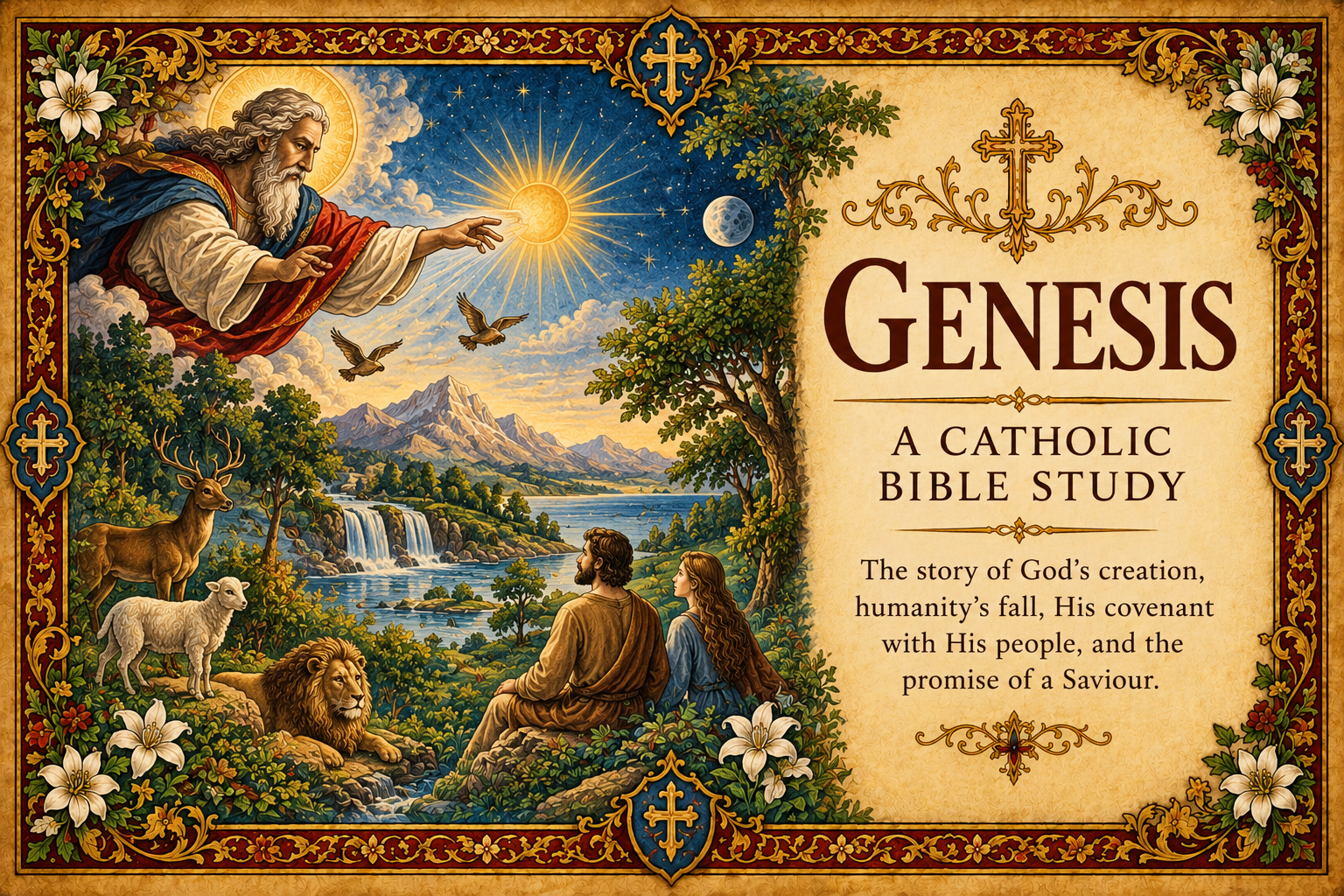
A Catholic Bible Study — Understanding the Wickedness of the World, God’s Judgement and Mercy, Noah’s Faith, the Ark and Salvation Through Jesus Christ
Introduction: When the World Turns Away from God
In Genesis Chapter 1, we discovered that God created heaven and earth and that everything He made was good.
In Genesis Chapter 2, we saw how God created man and woman for friendship with Himself.
In Genesis Chapter 3, we learned how Adam and Eve disobeyed God and lost their original holiness.
In Genesis Chapter 4, we saw the consequences of sin spreading through the human family, as Cain became jealous of Abel and murdered him.
In Genesis Chapter 5, we followed the generations from Adam to Noah.
Again and again, the chapter reminded us of the reality of death.
Yet we also discovered that God’s plan of salvation continued, despite human sin.
Now we come to Genesis Chapter 6.
The situation has become much worse.
Humanity has multiplied upon the earth, but wickedness has also increased.
People have turned away from God.
Violence and corruption have become widespread.
The goodness of creation has been wounded by the wickedness of those whom God created in His own image.
God now announces a great judgement.
He will send the Flood upon the earth.
Yet in the middle of this terrible situation, Scripture tells us something wonderful:
“But Noe found grace before the Lord.”
Genesis 6:8
One man remains faithful when the world around him has turned towards evil.
God chooses Noah and commands him to build an ark.
Through the ark, Noah, his family and representatives of the living creatures will be preserved.
This chapter therefore teaches us two great truths.
God is just, and sin has serious consequences.
But equally:
God is merciful, and He provides a way of salvation.
The story of Noah is not simply an ancient account of a great Flood.
It prepares us to understand Jesus Christ, His Church, the Sacrament of Baptism and the salvation God offers to humanity.
This chapter helps us answer some important questions:
- Why did wickedness become so widespread before the Flood?
- Who were the sons of God and the daughters of men?
- Who were the giants mentioned in Genesis?
- Why does Scripture say that God regretted creating humanity?
- Why did God decide to send the Flood?
- What made Noah different from the people around him?
- Why did God command Noah to build an ark?
- What does the ark teach us about the Catholic Church?
- How does the Flood point towards Baptism?
- What does Noah’s obedience teach us about living faithfully today?
These questions are important because we too live in a world where faith is often neglected and God’s commandments are frequently ignored.
Genesis Chapter 6 reminds us that holiness is possible even when the surrounding world has turned away from God.
And it teaches us that our greatest security is found not in ourselves, but in the saving grace of Jesus Christ.
1. The Spread of Wickedness — When God’s People Forget Him
“The sons of God seeing the daughters of men, that they were fair, took to themselves wives of all which they chose.”
Genesis 6:2
The chapter begins by describing the growth of the human population.
Families have multiplied.
Generations have passed.
Human society has developed.
Yet the increase in population has been accompanied by an increase in wickedness.
Scripture now speaks of the sons of God taking the daughters of men as wives.
What does this mean?
Who Were the Sons of God?
A traditional interpretation, followed by important Church Fathers including Saint Augustine and Saint John Chrysostom, understands the sons of God as descendants of Seth.
We encountered Seth in Genesis Chapter 4.
He was born after Abel had been murdered.
Through his descendants, the biblical narrative continued towards Noah.
Genesis had already told us that people began to call upon the name of the Lord.
The sons of God can therefore be understood as those belonging to the line associated with the worship of the true God.
Who Were the Daughters of Men?
In this traditional interpretation, the daughters of men are understood as women associated with the descendants of Cain.
Cain had turned away from God and murdered his brother.
His descendants developed human society, but the account also described increasing violence and moral disorder.
The distinction therefore concerns two different ways of living.
One is associated with the worship of God.
The other with a growing attachment to worldly desires and wickedness.
Why Did These Marriages Matter?
The difficulty was not simply that people from different families married.
Nor does the passage mean that a person from one family was automatically good and another automatically evil.
The danger was that those who had received the knowledge of God began to abandon their faithfulness.
They allowed attraction and desire to govern their choices without regard for God’s commandments.
Instead of helping others turn towards God, they themselves were drawn towards wickedness.
This interpretation teaches an important lesson.
Faith can be weakened when we allow worldly desires to become more important than obedience to God.
What About the Angelic Interpretation?
Some early Christian writers, including Saint Justin Martyr and Tertullian, understood the sons of God as fallen angels.
This interpretation also has roots in ancient Jewish writings.
However, Saint Augustine and other important Christian commentators favoured the understanding that the passage concerned the descendants of Seth and Cain.
This is also the interpretation given in the traditional notes accompanying the Douay-Rheims Bible.
It provides a natural connection with the preceding chapters, which have already contrasted the descendants of Cain with the line leading through Seth.
The Church has not defined every detail of this difficult passage, but the traditional interpretation concerning Seth’s descendants is a well-established and respected Catholic reading.
What About the Giants?
Genesis also tells us:
“Now giants were upon the earth in those days.”
Genesis 6:4
The Douay-Rheims Bible speaks of giants, described also as mighty men of old.
Traditional commentators have understood this passage as referring to men remarkable for their strength, stature or power.
The traditional Douay-Rheims commentary also associates these figures with violence, cruelty and the misuse of strength.
The important point is that physical strength and worldly greatness do not necessarily indicate holiness.
A person may be powerful and famous while remaining far from God.
Scripture will repeatedly teach us that the Lord does not judge according to outward appearances.
He sees the heart.
What the Church Fathers Teach
Saint Augustine discusses the sons of God and the daughters of men in The City of God, Book XV.
He connects the passage with the distinction between those who live according to God and those who live according to worldly desires.
Saint John Chrysostom likewise emphasises the moral significance of humanity’s growing corruption.
Their teaching reminds us that the greatest danger is not simply living among people who do not share our faith.
It is allowing ourselves to abandon the faith we have received.
What This Means for Us
We live in a society where many people have little interest in God.
Some reject His commandments.
Others simply live as though He does not exist.
Christians must remain faithful without becoming proud, hostile or indifferent towards others.
We are called to live in the world and bear witness to the Gospel.
But we must not allow worldly attitudes to determine our beliefs and behaviour.
This is particularly important in our friendships, relationships, marriages and family life.
Those closest to us can strongly influence how we live.
We should therefore seek relationships that encourage truth, virtue and faithfulness to God.
Practical lesson: Consider whether your friendships, habits and daily influences are helping you grow closer to Christ or gradually drawing you away from Him.
2. The Grief of God — Why Does Scripture Say He Repented?
“It repented him that he had made man on the earth. And being touched inwardly with sorrow of heart.”
Genesis 6:6
These words are among the most striking in Genesis.
God sees the wickedness of humanity.
The world He created good has become filled with evil.
Scripture describes Him as regretting that He made man and being touched with sorrow.
How should we understand this?
Does God Make Mistakes?
No.
God is perfect.
His knowledge is complete.
He knows all things.
He cannot make a mistake or discover something that He did not already know.
Nor does He change His mind through ignorance, as human beings sometimes do.
The Church teaches that God is eternal and unchanging.
So why does Scripture speak of Him as repenting?
Scripture Uses Human Language
The Bible sometimes speaks of God using expressions taken from human experience.
We read about God’s anger.
His sorrow.
His compassion.
His delight.
These expressions help us understand how seriously God regards human behaviour.
They do not mean that God experiences weakness, uncertainty or emotional changes in the way we do.
God’s love is perfect and unchanging.
His judgement is always wise and just.
When Genesis describes God’s sorrow, it teaches us how profoundly human wickedness is opposed to His goodness.
What the Church Fathers Teach
Saint Augustine explained that when Scripture speaks of God repenting, it does not mean that God’s eternal will has changed.
Rather, God brings about a change in His creatures according to His unchanging wisdom and justice.
Saint John Chrysostom also explained that Scripture uses language suited to human understanding.
When we hear about God’s sorrow, we should recognise the seriousness of sin.
When we hear about His anger, we should recognise the danger of remaining in wickedness.
The language leads us towards repentance.
Why Does God Care About Sin?
God does not give commandments simply to exercise authority.
His commandments reflect His wisdom and goodness.
He created human beings for holiness and eternal happiness.
Sin opposes that purpose.
It damages our relationship with God.
It harms other people.
It brings disorder into our lives.
God’s opposition to sin is therefore not a contradiction of His love.
It is an expression of His goodness and justice.
What This Means for Us
We should never become comfortable with sin.
Sometimes we become so accustomed to wrongdoing that we no longer recognise its seriousness.
We excuse dishonesty.
We tolerate cruelty.
We ignore injustice.
We become indifferent to impurity, selfishness or the neglect of God.
Genesis reminds us that sin matters.
We should learn to see it as God sees it.
Not simply as a broken rule, but as something that wounds our relationship with Him and harms His creation.
Practical lesson: During your examination of conscience, ask not only, “What have I done wrong?” but also, “How have my choices affected my friendship with God and my love for others?”
3. The Corruption of the Earth — When Sin Becomes Widespread
“And the earth was corrupted before God, and was filled with iniquity.”
Genesis 6:11
The wickedness described in this chapter is no longer confined to one family.
It has spread throughout human society.
Scripture speaks of corruption and violence.
The world has become deeply disordered.
How Did This Happen?
We have already seen the beginnings of this corruption.
Adam and Eve disobeyed God.
Cain allowed jealousy to become hatred.
He murdered Abel.
His descendants began to develop human society, but we also encountered Lamech boasting of violence.
Now the problem has become widespread.
The evil that began in individual human hearts has spread into society.
This is one of the important lessons of Genesis.
Sin does not remain without consequences.
It affects other people.
It influences families.
It damages communities.
And when sinful attitudes become accepted, they can shape the life of an entire society.
Sin Is Never Entirely Private
We sometimes imagine that our sins concern only ourselves.
But this is rarely true.
A person’s dishonesty affects others.
A parent’s neglect affects children.
A person’s cruelty damages relationships.
Greed can lead to injustice.
Anger can cause division.
The sins of individuals can gradually influence the behaviour of whole communities.
The Church speaks of the social consequences of sin because human beings are connected to one another.
Our choices matter.
What the Church Fathers Teach
Saint Basil the Great frequently taught that God’s creation is good and ordered.
Human wickedness is a rejection of the goodness and harmony intended by the Creator.
Saint Augustine also reflected upon the development of human society when people place their own desires above God’s commandments.
When pride and selfishness govern human life, injustice and disorder follow.
Does This Mean Creation Became Evil?
No.
God’s creation remains good in its origin.
Human beings remain created in His image.
The material world does not become evil simply because people misuse their freedom.
But sin wounds the harmony God intended.
That is why the world needs redemption.
What This Means for Us
We should not judge our moral choices simply by asking whether something has become socially acceptable.
An action does not become good merely because many people do it.
The Christian must ask a different question:
Is this pleasing to God?
We should also remember that our example influences others.
A person who lives honestly can encourage honesty.
A person who forgives can encourage reconciliation.
A family that prays can help others recognise the importance of faith.
Just as sin can spread, goodness can also influence those around us.
Practical lesson: Consider the example you give within your family, workplace and parish. Is your conduct encouraging others towards God?
4. God’s Decision — Judgement and Mercy
God now announces that He will bring judgement upon the wickedness of humanity.
The Flood will come.
This is a serious and solemn moment.
The world has become filled with corruption.
Humanity has repeatedly rejected the goodness of the Creator.
God’s judgement reveals that evil cannot simply be treated as unimportant.
Yet in the middle of this announcement, Scripture gives us one of the most hopeful sentences in the chapter:
“But Noe found grace before the Lord.”
Genesis 6:8
These words change the direction of the story.
Why Does God Send Judgement?
God is perfectly just.
He does not approve of evil.
He does not treat cruelty, violence and wickedness as though they were good.
The Flood is presented in Genesis as a real and terrible judgement upon a deeply corrupted world.
Traditional Christian interpretation has always taken seriously the judgement described in this account.
The destruction brought by the Flood reveals the gravity of human sin.
We should not reduce it to a harmless story or overlook its seriousness.
God Also Provides a Way of Salvation
Yet God’s judgement is accompanied by mercy.
He chooses Noah.
He gives him instructions.
He commands him to build an ark.
Through the ark, Noah and his family will be preserved.
God’s purpose is not simply to bring destruction.
He also preserves human life and prepares a new beginning.
What Does It Mean That Noah Found Grace?
Grace is God’s free and undeserved gift.
We cannot earn God’s favour as though He owed us something.
Everything good begins with His generosity.
Noah is described as a just man who walks with God.
His righteousness is real.
But Scripture first tells us that he found grace before the Lord.
This reminds us that holiness is always dependent upon God’s help.
We must cooperate with grace, but we cannot save ourselves.
What the Church Fathers Teach
Saint Ambrose, in his work on Noah and the ark, reflects upon God’s preservation of Noah as an expression of divine mercy.
Through one faithful man, God preserves the human family and prepares a new beginning.
This points forward to Jesus Christ, through whom salvation will come to the whole world.
What This Means for Us
Sometimes we become discouraged when we see wickedness around us.
We may wonder why God permits evil to continue.
Genesis reminds us that God sees everything.
He does not ignore injustice.
He is patient, but He is also just.
We must therefore take His commandments seriously and trust His providence.
Practical lesson: Never confuse God’s patience with approval of sin. Use the opportunities He gives you to repent, grow in holiness and remain faithful.
5. Noah — A Just Man in a Wicked World
“Noe was a just and perfect man in his generations, he walked with God.”
Genesis 6:9
These words introduce Noah as a man who is different from those around him.
The world has become corrupt.
Violence is widespread.
God’s commandments are being neglected.
Yet Noah remains faithful.
He walks with God.
What Does It Mean That Noah Was Just?
In Scripture, a just person is someone who seeks to live according to God’s will.
Noah recognises the authority of his Creator.
He trusts Him.
He obeys His commandments.
He does not simply follow the behaviour of those around him.
His life is directed towards God.
The description of Noah as perfect or blameless should not be taken to mean that he possessed absolute sinlessness.
Rather, Scripture praises his faithfulness and righteousness within a deeply corrupt generation.
Walking with God
We encountered this expression in Genesis Chapter 5.
Enoch walked with God.
Now Noah is described in the same way.
This is a beautiful connection between the two chapters.
To walk with God means making Him the centre of our lives.
It means seeking His will.
Listening to His Word.
Obeying His commandments.
And remaining faithful even when obedience is difficult.
Was Noah Alone?
Scripture tells us that Noah had three sons: Sem, Cham and Japheth.
He also had a wife, and his sons had wives.
These eight people would be preserved in the ark.
God was not merely concerned with Noah as an isolated individual.
Through his family, He would preserve the human race.
What the Church Fathers Teach
Saint John Chrysostom praised Noah’s righteousness because he remained faithful in a time of great wickedness.
It is one thing to live virtuously when surrounded by good examples.
It is another to remain faithful when the surrounding society encourages the opposite.
Noah’s holiness therefore reveals courage and perseverance.
Must We Follow the Crowd?
Christians sometimes feel pressure to agree with whatever has become popular.
We may fear being thought strange because we attend Mass, follow Catholic moral teaching or refuse to participate in wrongdoing.
Noah reminds us that faithfulness is not determined by numbers.
A belief does not become false because few people accept it.
And an action does not become good because many people practise it.
God calls us to remain faithful.
What This Means for Us
We should not seek to be different simply for the sake of being different.
Nor should we become proud of our faith and look down upon others.
But we must be willing to remain faithful when doing so is unpopular.
The saints provide many examples of this courage.
They trusted God more than public opinion.
Practical lesson: Identify one area where you are tempted to compromise your Catholic faith because of the opinions of others. Ask God for the courage to remain faithful with humility and charity.
6. The Ark — God Provides a Place of Salvation
“Make thee an ark of timber planks: thou shalt make little rooms in the ark, and thou shalt pitch it within and without.”
Genesis 6:14
God now commands Noah to build an ark.
The ark will preserve Noah, his family and the living creatures entrusted to his care.
It must be constructed according to God’s instructions.
Noah is not told simply to make whatever he thinks best.
God provides the design.
He tells Noah how to prepare for the coming Flood.
Why Was the Ark Important?
The Flood would bring destruction upon the earth.
Noah and his family could not protect themselves by their own strength.
They needed the means of safety that God provided.
The ark therefore becomes a sign of God’s saving mercy.
The Ark and the Catholic Church
The Church Fathers recognised a beautiful connection between Noah’s ark and the Church founded by Jesus Christ.
The ark preserved those within it through the waters of the Flood.
The Church gathers God’s people and leads them towards eternal salvation through Christ.
This is not merely an imaginative comparison.
It belongs to the Church’s traditional understanding of Scripture.
The Catechism teaches:
Noah’s ark prefigures the Church, through which Christ gathers His people for salvation.
See Catechism of the Catholic Church, paragraph 845.
The Wood of the Ark and the Cross
The ark was made of wood.
Jesus Christ accomplished our redemption upon the wood of the Cross.
Christian tradition has recognised a spiritual connection between these two things.
The wood of the ark was the means by which Noah and his family were preserved from the Flood.
The wood of the Cross became the instrument of Christ’s saving sacrifice.
The Cross is therefore the true source of our salvation.
The Ark’s Protective Covering
God commanded Noah to cover the ark with pitch, inside and outside, so that the waters could not enter.
Traditional spiritual interpretation has seen in this protective covering an image of the grace by which God preserves His people.
This is a beautiful reflection, although the pitch itself is not a sacrament.
The deeper lesson is that God provides what is necessary for salvation.
The One Door
Genesis tells us that the ark had a door in its side.
All those entering the ark had to pass through its entrance.
Christian tradition has recognised in this a figure of Jesus Christ.
In the Gospel He says:
“I am the door.”
John 10:9
Christ is the one Saviour of the world.
It is through Him that we receive salvation.
What Does “Outside the Church There Is No Salvation” Mean?
The Church has traditionally taught that outside the Church there is no salvation.
This teaching must be understood correctly.
All salvation comes from Jesus Christ, the Head, through His Body, the Church.
Christ established His Church as necessary for salvation and gave her the sacraments through which His saving grace is ordinarily communicated.
Those who knowingly and deliberately reject the Church established by Christ place themselves in a spiritually serious position.
At the same time, the Church teaches that God can save those who, through no fault of their own, do not know Christ or His Church, but sincerely seek Him and respond to His grace.
Such salvation still comes through Jesus Christ and is related to His Church.
See Catechism of the Catholic Church, paragraphs 846–848.
The story of the ark therefore teaches us to value the Church as Christ’s gift, not to presume that we can save ourselves.
What the Church Fathers Teach
Saint Augustine, in The City of God, recognised Noah’s ark as a figure of the Church.
Its construction and preservation through the Flood point towards God’s saving work in Christ.
Saint Ambrose also reflected upon the ark as an image of salvation.
These interpretations help us understand that the Old Testament prepares us for the New.
What This Means for Us
We should never treat membership of the Church as unimportant.
Christ did not simply leave us a collection of religious ideas.
He founded His Church.
He gave her His teaching.
He entrusted His sacraments to her.
He promised to remain with her until the end of time.
We therefore need to remain close to the Church through faith, worship, prayer and the sacraments.
Practical lesson: Thank God for the gift of the Catholic Church. Ask yourself whether you are making full use of the spiritual help Christ provides through her.
7. The Dimensions of the Ark — God’s Wisdom in Every Detail
“The length of the ark shall be three hundred cubits: the breadth of it fifty cubits, and the height of it thirty cubits.”
Genesis 6:15
God gives Noah precise instructions for the construction of the ark.
It is to have a particular length, width and height.
It will contain rooms and several levels.
There will be an entrance and an opening for light.
The details show that Noah is not simply following his own ideas.
He is carrying out a work entrusted to him by God.
Why Does Scripture Give Measurements?
At the simplest level, the measurements describe the ark Noah was commanded to build.
A cubit was an ancient unit of length based approximately upon the distance from a person’s elbow to the end of the fingers.
The ark was therefore a substantial structure, built to preserve life through the coming Flood.
The exact details matter because Noah’s obedience includes carrying out God’s instructions.
What the Church Fathers Teach
The Fathers also recognised spiritual meanings in the ark’s measurements.
Saint Augustine and Saint Ambrose reflected upon its dimensions as part of the symbolism connecting the ark with Christ and His Church.
Traditional Christian commentators have associated several of the numbers with mysteries of the faith.
Three Hundred — The Sign of the Cross
In the Greek system of numerals, the letter tau represents the number three hundred.
Its shape resembles a cross.
Christian writers therefore recognised a connection between the length of the ark and the Cross of Christ.
The ark preserves life through the Flood.
The Cross is the instrument of our redemption.
Fifty — Pentecost and the Holy Spirit
The number fifty is associated with Pentecost.
Fifty days after Easter, the Church celebrates the descent of the Holy Spirit upon the Apostles.
Christian commentators have therefore seen in the ark’s breadth an image of the life of grace given through the Holy Spirit.
Thirty — The Public Ministry of Christ
Saint Luke tells us that Jesus was about thirty years old when He began His public ministry.
Traditional writers have connected this with the height of the ark.
Through the life, death and Resurrection of Christ, the promises of God are fulfilled.
How Should We Understand These Connections?
These are spiritual interpretations found within Christian tradition.
They do not mean that the practical measurements of the ark cease to matter.
Nor are Catholics required to accept every numerical symbolism proposed by individual commentators.
But such interpretations can help us recognise how the Fathers read the whole of Scripture in the light of Christ.
They approached even the smallest details with reverence.
What This Means for Us
God cares about the details of our lives.
Faithfulness is not shown only in great moments.
It is also shown in ordinary duties.
Being honest.
Keeping promises.
Preparing properly for Mass.
Carrying out responsibilities carefully.
Being patient with others.
Noah’s obedience reminds us that doing small things well can be an expression of love for God.
Practical lesson: Carry out one ordinary responsibility today with particular care, offering it to God as an act of obedience and love.
8. The Flood Announced — A Warning of Judgement
“Behold, I will bring the waters of a great flood upon the earth.”
Genesis 6:17
God now announces the coming Flood.
The judgement will be severe.
Human wickedness has become widespread.
Violence and corruption have filled the earth.
The Lord will bring judgement upon the world.
The Flood Is a Serious Event
The biblical account presents the Flood as a great judgement upon the wickedness of humanity.
Traditional Catholic interpretation has taken seriously the reality of this event.
The Fathers did not treat Noah merely as an imaginary character or the ark simply as an invented moral illustration.
They understood the account as part of the sacred history through which God reveals His justice, mercy and saving purposes.
We should therefore approach the Flood with reverence.
The account reveals real truths about the seriousness of sin and the judgement of God.
Why Does God Judge?
God is perfectly good.
He is perfectly just.
He cannot approve of evil.
Human wickedness is not something morally insignificant.
The Flood reminds us that our actions matter and that humanity is accountable to its Creator.
We should not imagine that God’s mercy means He will never judge wrongdoing.
His mercy and justice belong together.
God’s Patience Before the Flood
Earlier in the chapter, God speaks of a period of 120 years.
Traditional commentators have offered two important interpretations.
One understands this as a reference to the shortening of the extraordinary lifespans of the early generations.
Another understands it as a period of patience before the Flood, during which humanity was given time to repent.
The traditional Douay-Rheims commentary gives particular attention to this second understanding.
God does not bring judgement without warning.
He gives opportunities for repentance.
His patience reveals His mercy.
Noah and the Call to Repentance
The New Testament describes Noah as a preacher of justice (2 Peter 2:5).
This helps us understand that the period before the Flood was not simply a time of silent preparation.
Noah’s faith and obedience bore witness to the truth of God.
The building of the ark itself became a testimony to his trust in God’s warning.
The Flood and the Final Judgement
Jesus Himself refers to the days of Noah when speaking about the coming judgement.
People continued their ordinary activities without recognising the seriousness of the situation.
Then the Flood came.
Christ uses this account to teach us the importance of being prepared.
One day He will return in glory.
The dead will rise.
Every person will face judgement.
We should therefore live in friendship with God now.
What the Church Fathers Teach
Saint John Chrysostom reflected upon the Flood as a revelation of both divine justice and mercy.
God’s judgement is serious.
But Noah’s preservation shows that the Lord also provides a way of salvation.
The Church Fathers understood the Flood as preparing us to recognise the greater salvation accomplished by Jesus Christ.
What This Means for Us
We must not spend our lives assuming that repentance can always be postponed.
We do not know how long we will live.
Nor do we know when Christ will return.
The Christian should therefore live in a state of readiness.
This means remaining close to God through prayer, Confession, the Eucharist and obedience to His commandments.
Practical lesson: Do not delay an important act of repentance. If you need to return to Confession or put something right, make a decision to do so.
9. God’s Covenant with Noah — The Promise of Salvation
“And I will establish my covenant with thee.”
Genesis 6:18
Here we encounter the first explicit mention of a covenant in Scripture.
God tells Noah that He will establish His covenant with him.
This is a very important moment in the history of salvation.
What Is a Covenant?
A covenant is a solemn relationship or bond.
In Scripture, a covenant is more than an ordinary agreement.
God establishes relationships with His people through which He reveals His promises and calls them to faithfulness.
He takes the initiative.
He offers His gifts.
And He calls human beings to respond in faith and obedience.
God’s Covenant with Noah
God promises to preserve Noah and his family through the Flood.
He commands them to enter the ark.
Later, after the Flood, the covenant will be further revealed and confirmed.
God’s faithfulness will become the foundation of a renewed beginning for humanity.
The Covenants of the Bible
The history of salvation will continue through further covenants.
God will call Abraham.
He will promise him descendants and blessings extending to all nations.
He will form Israel through the covenant associated with Moses.
He will establish His promises concerning the kingdom of David.
And finally, Jesus Christ will establish the New and Eternal Covenant through His Precious Blood.
All these stages belong to the one saving plan of God.
What the Church Fathers Teach
Saint Irenaeus emphasised the unity of God’s saving work throughout the history of the covenants.
The God who spoke to the patriarchs is the same God who sent His Son for our redemption.
The Old Testament is not the story of a different God.
It prepares us for the coming of Jesus Christ.
The New Covenant in Christ
At the Last Supper, Jesus speaks of the New Covenant in His Blood.
Through His sacrifice upon the Cross, He reconciles humanity with the Father.
The Holy Eucharist is the sacrament of His Body and Blood.
At Mass, the one sacrifice of Christ is made sacramentally present.
We participate in the saving mystery through which the New Covenant has been established.
What This Means for Us
God is faithful to His promises.
He does not abandon His people.
But we must respond to His grace.
Baptism brings us into the life of the New Covenant.
We are called to live as children of God.
That means remaining faithful to Christ, obeying His commandments and receiving His sacraments.
Practical lesson: Remember the promises of your Baptism. Renew your commitment to reject sin and remain faithful to Jesus Christ.
10. The Gathering of the Animals — God Preserves His Creation
“And of every living creature of all flesh, thou shalt bring two of a sort into the ark.”
Genesis 6:19
God commands Noah to bring living creatures into the ark.
The ark is not intended merely to preserve Noah and his family.
It will also preserve the creatures entrusted to humanity’s care.
This is a beautiful reminder of God’s concern for His creation.
God Does Not Forget the Animals
In Genesis Chapter 1, God created the living creatures and declared His work good.
He gave humanity responsibility for the earth.
Now, although human wickedness has brought judgement, God provides for the preservation of animal life.
The creatures have a place within His plan.
Why Are the Animals Gathered?
God commands Noah to bring male and female creatures into the ark.
This allows animal life to continue after the Flood.
The following chapter will give further instructions concerning the numbers of clean and unclean animals.
Here the important point is that God prepares for a new beginning.
He will preserve life through the judgement.
Noah’s Responsibility
Noah must obey God’s instructions.
He must construct the ark.
He must prepare the necessary space.
He must gather and care for the creatures.
He must also provide food.
God’s saving plan involves Noah’s active cooperation.
This reminds us that faith does not mean passivity.
God gives Noah a task, and Noah must carry it out.
What the Church Fathers Teach
Saint Ephrem the Syrian reflected upon the gathering of the animals into the ark.
The ark becomes an image of God’s preservation of life.
Christian tradition has also recognised a spiritual meaning in the diversity of creatures gathered within it.
Just as different living creatures are preserved together, the Church gathers people from many nations and backgrounds into one family.
The Catholic Church Is Universal
The word Catholic means universal.
The Church is not intended for one nation, culture or social group.
Jesus Christ came to save the world.
He commanded His Apostles to proclaim the Gospel to all nations.
Within the Church, people from many different backgrounds are united by one faith, one Baptism and one Lord.
This does not mean that all differences disappear.
Rather, people are united in the truth and grace of Jesus Christ.
What This Means for Us
We should value the diversity of people within the Church while remaining united in the Catholic faith.
We should also remember our responsibility towards God’s creation.
Animals and the natural world are entrusted to our care.
We must use creation wisely and avoid unnecessary cruelty or destruction.
Practical lesson: Treat God’s creation responsibly, and make a particular effort to welcome someone who may feel isolated or overlooked within the parish community.
11. Noah’s Obedience — Faith Put into Practice
“And Noe did all things which God commanded him.”
Genesis 6:22
These are the final words of Genesis Chapter 6.
They are simple.
Yet they reveal the greatness of Noah’s faith.
God gives him a command.
Noah obeys.
He does not merely listen to God’s Word.
He acts upon it.
Faith Requires Obedience
It is possible to say that we believe in God while refusing to obey Him.
But genuine faith must influence the way we live.
Noah believes God’s warning.
He trusts His promise.
He begins the work God commands him to undertake.
Building the ark requires effort, patience and perseverance.
Yet Noah remains faithful.
What the New Testament Teaches
The Letter to the Hebrews praises Noah’s faith.
It tells us that he prepared the ark in obedience to God’s warning about things not yet seen (Hebrews 11:7).
Noah did not wait until the Flood arrived before deciding whether God’s Word was true.
He trusted God beforehand.
This is the meaning of faith.
We believe God because He is truthful.
We obey Him because His wisdom is greater than our own.
What the Church Fathers Teach
Saint Ambrose reflected upon Noah’s obedience as an example of righteousness.
Noah’s faith was not simply an inward feeling.
It was shown through his actions.
Saint John Chrysostom also praised Noah for remaining faithful in a wicked generation.
His life teaches us that obedience is possible even when the surrounding world rejects God.
The Example of Jesus Christ
Noah’s obedience points towards the perfect obedience of Jesus Christ.
Noah obeyed God’s command to build the ark.
Jesus obeyed His Father even unto death upon the Cross.
Through Noah’s obedience, his family was preserved.
Through Christ’s obedience, salvation is opened to humanity.
Saint Paul teaches that through the obedience of Christ, many are made just.
The obedience of Noah therefore prepares us to understand something far greater.
What This Means for Us
We should not be satisfied with simply knowing Catholic teaching.
We must put it into practice.
It is not enough to know that we should pray.
We must pray.
It is not enough to know that we should forgive.
We must seek to forgive.
It is not enough to know that Sunday Mass is important.
We must attend.
It is not enough to know that Confession is a gift.
We must make use of it.
Our faith should become visible in our actions.
Practical lesson: Choose one commandment or duty you have been neglecting and make a genuine effort to obey God more faithfully.
12. The Great Catholic Truths of Genesis Chapter 6
Having studied the chapter, we can now bring its teaching together.
Sin Can Spread Through Society
Human wickedness can influence families, communities and entire cultures.
We must remain faithful even when others turn away from God.
We Must Guard the Faith
The traditional interpretation of the sons of God and the daughters of men reminds us of the danger of allowing worldly desires to weaken our relationship with God.
Human Power Does Not Equal Holiness
The mighty men and giants of the ancient world remind us that strength, fame and success do not necessarily indicate virtue.
God sees the heart.
God Is Eternal and Unchanging
When Scripture speaks of God grieving or repenting, it uses human language to reveal the seriousness of sin.
God’s wisdom and goodness never change.
God Is Perfectly Just
The Flood reveals that human wickedness has consequences.
God does not approve of evil.
God Is Also Merciful
Noah finds grace before the Lord.
God provides a way of preservation through the ark.
Holiness Is Possible in a Wicked World
Noah remains faithful even when the surrounding society becomes corrupt.
We too are called to live according to God’s commandments.
The Ark Prefigures the Church
The Church Fathers recognised Noah’s ark as a figure of the Church founded by Jesus Christ.
Through His Church, Christ gathers His people for salvation.
The Wood of the Ark Points Towards the Cross
Traditional Christian interpretation sees in the ark a preparation for the saving sacrifice of Jesus Christ.
The Ark’s Design Reveals the Importance of Obedience
Noah follows God’s instructions faithfully.
We must likewise seek God’s will rather than simply follow our own desires.
The Flood Prefigures Baptism
Saint Peter teaches that the preservation of Noah through the waters prepares us to understand the saving grace of Baptism.
God Establishes His Covenant
The promise made to Noah begins the explicit biblical history of God’s covenants, which will reach their fulfilment in Jesus Christ.
God Cares for His Creation
The preservation of the animals reminds us that the whole created world belongs to God.
Faith Must Be Lived
Noah does everything God commands him.
True faith bears fruit in obedience.
Jesus Christ Is Our Saviour
Everything in the account of Noah ultimately directs us towards Christ, who saves us through His Cross and Resurrection.
These teachings show why Genesis Chapter 6 is so important.
It reveals the seriousness of sin, the certainty of God’s justice, the greatness of His mercy and the necessity of responding to His grace.
13. Jesus Christ — Our True Refuge and the Fulfilment of the Ark
The story of Noah belongs to the Old Testament.
But its deepest meaning becomes clearer when we read it in the light of Jesus Christ.
The Church Fathers recognised that Noah, the ark and the Flood prepare us to understand the saving work of Our Lord.
This is called biblical typology.
An event in the Old Testament points towards a greater reality fulfilled in the New Testament.
Noah and Jesus Christ
Noah is a just man who remains faithful in a wicked world.
Jesus Christ is perfectly just and without sin.
Noah obeys God’s command.
Christ obeys His Father perfectly, even unto death.
Through Noah, God preserves the human family during the Flood.
Through Jesus Christ, God offers salvation to the whole world.
Noah is therefore a figure who prepares us to understand the greater saving work of Christ.
The Ark and the Church
God commands Noah to enter the ark.
Within it, he and his family are preserved through the Flood.
The Church Fathers recognised the ark as a figure of Christ’s Church.
Christ founded the Church as the ordinary means through which His saving grace is communicated.
Within her, we receive the teaching of the Apostles.
We hear the Word of God.
We are baptised.
We receive forgiveness through Confession.
We are nourished by the Holy Eucharist.
We are strengthened by the Holy Spirit.
The Church is therefore not simply a human organisation.
She is the Body of Christ.
She is the family of God.
She is the ordinary means by which Christ gathers His people into salvation.
The Flood and Baptism
The connection between the Flood and Baptism is taught explicitly in the New Testament.
Saint Peter tells us that eight people were saved through the waters in the days of Noah.
He then explains that this event prefigures Baptism.
Through Baptism, we are united to the death and Resurrection of Jesus Christ.
Original sin is washed away.
We receive sanctifying grace.
We become children of God and members of His Church.
The waters of the Flood brought judgement upon a wicked world.
The waters of Baptism communicate new life through Christ.
This is why the Church recalls Noah and the Flood in the Easter Vigil liturgy when blessing the baptismal water.
The Catechism explains this in paragraph 1219.
The Cross and the Ark
The ark was built of wood.
The Cross was made of wood.
Through the ark, Noah was preserved from the waters of death.
Through the Cross, Christ conquers sin and death.
Christian tradition has therefore recognised the ark as an image of the saving power of the Cross.
Yet we must remember that the Cross is infinitely greater than the ark.
The ark preserved earthly life.
Christ’s sacrifice opens the way to eternal life.
Christ Is the Door
The ark had an entrance.
Those who were preserved had to enter it.
Jesus calls Himself the door.
He is the one Mediator between God and humanity.
No one can save himself independently of Christ.
All salvation comes through Him.
The Church and the Storms of the World
Christian life is not always easy.
We experience temptation.
We encounter suffering.
We face opposition to the faith.
We live in a world where many people reject God’s commandments.
The image of the ark reminds us that Christ has not left us alone.
He has given us His Church.
He has given us His Word.
He has given us His sacraments.
And He has promised to remain with His people.
We should therefore remain faithful to Him.
What the Church Fathers Teach
Saint Augustine saw in the ark a figure of the Church and reflected upon its connection with Christ.
Saint Ambrose also interpreted Noah’s preservation as preparing us for salvation through the Lord.
These interpretations are not separate from the historical account.
They reveal how the Old Testament prepares us to understand the fullness of God’s plan.
What This Means for Us
The greatest danger is not simply the wickedness we see around us.
It is allowing ourselves to lose our friendship with God.
We must therefore remain close to Christ.
Through prayer.
Through obedience.
Through Sunday Mass.
Through regular Confession.
Through worthy reception of the Holy Eucharist.
Through charity and perseverance.
Practical lesson: Consider whether you are relying upon the spiritual help Christ has given you through His Church. Do not try to live the Christian life entirely through your own strength.
14. Living Genesis Chapter 6 Every Day
Genesis Chapter 6 offers important guidance for our daily Catholic lives.
It teaches us how to remain faithful when the world around us appears increasingly indifferent or hostile towards God.
Guard Your Faith
Do not allow the attitudes of the world to determine what you believe.
Learn the teaching of the Church.
Read Sacred Scripture.
Listen carefully to the Word of God proclaimed at Mass.
Choose Your Influences Wisely
The sons of God and the daughters of men remind us that relationships can influence our spiritual lives.
Seek friendships that encourage goodness, honesty and virtue.
Be careful about influences that gradually lead you away from God.
Do Not Become Comfortable with Sin
The wickedness of the world before the Flood developed over time.
We too must be careful not to become accustomed to wrongdoing.
What is popular is not necessarily right.
Remain Faithful Like Noah
Noah walked with God even when many others did not.
Do not be afraid to practise your Catholic faith.
Attend Mass.
Pray.
Keep God’s commandments.
Remain faithful even when others disagree.
Remember God’s Justice
God sees our actions.
We are accountable to Him.
We should therefore take our moral choices seriously.
Trust God’s Mercy
Noah found grace before the Lord.
God continues to offer His grace to us.
When we fall into sin, we should repent and return to Him.
Value the Church
The ark reminds us of the importance of Christ’s Church.
Do not treat the Church merely as a place for occasional religious ceremonies.
She is our spiritual home.
Make Use of the Sacraments
Baptism gives us new life.
Confession restores us when we have fallen.
The Holy Eucharist nourishes us on our journey towards Heaven.
These are extraordinary gifts of God’s mercy.
Obey God in Ordinary Things
Noah followed God’s instructions carefully.
We too should be faithful in the ordinary duties of life.
Honesty.
Prayer.
Family responsibilities.
Work.
Charity.
Forgiveness.
Prepare for Judgement
The Flood reminds us that earthly life will not continue forever.
Christ will return in glory.
We must therefore live in friendship with God and prepare for eternal life.
Help Others Come to Christ
Noah’s ark preserved his family.
We too should care about the salvation of those entrusted to us.
Parents have a special duty to teach their children the faith.
Every Catholic can encourage others through prayer, good example and gentle witness.
Persevere in Hope
The wickedness of the world did not defeat God’s plan.
God preserved Noah.
He continued the history of salvation.
He eventually sent His Son.
We should therefore never lose hope in the power of God’s grace.
Practical lesson: Choose one area in which you need to become more faithful. It may be prayer, Sunday Mass, Confession, family responsibilities or resisting a particular temptation. Ask God for the grace to persevere.
Questions for Reflection
Take some time to consider these questions prayerfully.
- Are there influences in my life that are gradually drawing me away from God?
- Do I sometimes accept attitudes or behaviour simply because they are common in society?
- Am I willing to remain faithful to Catholic teaching when it is unpopular?
- Do I understand why God must be both just and merciful?
- When I fall into sin, do I turn towards God’s mercy or become discouraged?
- What can I learn from Noah’s faithfulness in a corrupt world?
- Do I recognise the Church as a gift established by Jesus Christ for our salvation?
- Am I making proper use of the Sacraments of Confession and the Holy Eucharist?
- Do I understand how the Flood points towards Baptism?
- Am I carrying out my ordinary responsibilities with the obedience shown by Noah?
- Do I take seriously my responsibility to help others grow in the Catholic faith?
- Have I become too attached to worldly success, comfort or approval?
- Am I living in a way that prepares me for the judgement of Christ?
- What practical change could help me walk more faithfully with God?
Choose one area in which you can make a genuine change.
Remember that holiness does not require us to perform extraordinary deeds.
It requires us to cooperate faithfully with God’s grace in the circumstances of our daily lives.
A Simple Prayer with Genesis Chapter 6
Read Genesis 6:8 slowly:
“But Noe found grace before the Lord.”
Pause for a moment.
Think about Noah living in a world filled with wickedness.
He could have followed the behaviour of those around him.
But he remained faithful.
God called him.
He listened.
God commanded him.
He obeyed.
Now consider your own life.
Are you remaining faithful to God?
Are you allowing the attitudes of the world to influence your choices?
Are you listening to His Word?
Are you cooperating with His grace?
Remember that the Lord who preserved Noah is the same God who calls you to salvation through Jesus Christ.
Then pray:
Heavenly Father,
You are the Creator of heaven and earth, the Lord of justice and mercy.
You made the world good and created humanity in Your image.
Yet through sin we have so often turned away from Your commandments.
Forgive me for the times I have allowed pride, selfishness or worldly desires to lead me away from You.
Help me to remain faithful even when the world around me rejects Your truth.
Give me the courage of Noah, who trusted Your Word and obeyed Your commands.
Teach me to recognise temptation and resist it through Your grace.
Keep me from becoming comfortable with sin or indifferent to the needs of others.
You preserved Noah and his family through the ark.
Through Your Son, Jesus Christ, You have given us the Church as the ordinary means of salvation.
Help me to remain faithful to her teaching, worship and sacraments.
Renew in me the grace of Baptism.
Draw me frequently to Confession.
Nourish me through the Holy Eucharist.
Give me a sincere heart, that I may worship You faithfully and live according to Your commandments.
Bless my family and those entrusted to my care.
Help me to lead others towards Christ through prayer, charity and good example.
And when the storms of this earthly life have passed, bring me safely into the eternal joy of Your heavenly Kingdom.
Through Christ our Lord.
Amen.
Conclusion: Noah Found Grace — And God Still Offers Salvation
Genesis Chapter 6 reveals how deeply sin had spread through the human family.
The world God created good had become filled with wickedness.
Human beings had turned away from their Creator.
Violence and corruption had become widespread.
God now announced a great judgement.
The Flood would come.
Yet in the middle of this dark account, Scripture tells us something wonderful:
“But Noe found grace before the Lord.”
God had not abandoned humanity.
He chose Noah.
He called him to righteousness.
He instructed him to build an ark.
And through Noah’s obedience, He preserved the human family and prepared a new beginning.
The story teaches us that God is perfectly just.
He does not ignore evil.
He does not approve of sin.
But it also teaches us that God is merciful.
He provides a way of salvation.
Noah’s ark becomes a beautiful figure of the Church.
Its wood points towards the Cross.
Its entrance reminds us of Jesus Christ, the one Saviour.
Its preservation through the waters prepares us to understand the saving grace of Baptism.
And Noah’s obedience points towards the perfect obedience of Jesus Christ.
For Christ is greater than Noah.
Noah was a just man who remained faithful to God.
Jesus Christ is the eternal Son of God, who became man for our salvation.
Noah obeyed God’s command and built an ark.
Christ obeyed His Father and offered Himself upon the Cross.
Noah’s family was preserved through the Flood.
Through Christ, salvation is offered to the whole world.
This is why Genesis Chapter 6 is so important for Catholics.
It reminds us that we cannot save ourselves.
We need God’s grace.
We need Jesus Christ.
We need the Church and the sacraments He has given us.
And we must respond to His mercy through faith, repentance and obedience.
The example of Noah is especially important today.
We may live in a society where many people neglect God.
We may find ourselves surrounded by attitudes contrary to the Gospel.
We may sometimes feel that remaining faithful is difficult.
But Noah reminds us that holiness is possible even in a corrupt world.
We do not need the approval of everyone around us.
We need to remain faithful to God.
We must listen to His Word.
We must obey His commandments.
We must trust His promises.
And we must persevere in His grace.
At the end of Genesis Chapter 6, Scripture gives us a beautiful summary of Noah’s life:
“And Noe did all things which God commanded him.”
Genesis 6:22
May the same be said of us.
May we listen when God speaks.
May we obey when He calls.
May we remain faithful when others turn away.
And may we find our refuge in Jesus Christ, who through His Cross and Resurrection has opened the way to eternal life.
For the God who preserved Noah through the Flood is the same God who offers us salvation through His Son, Jesus Christ.
Amen.

