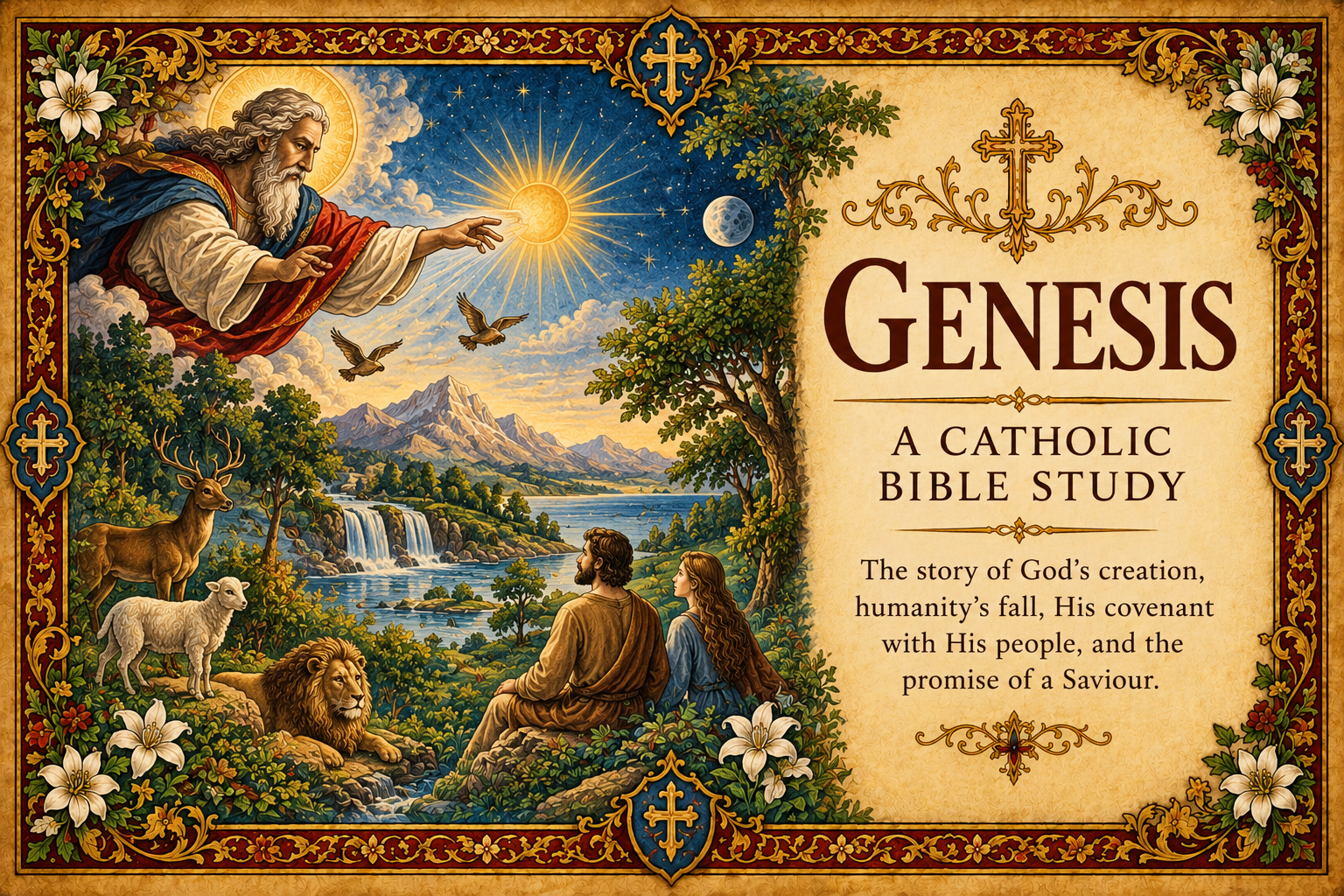
A Catholic Bible Study — Understanding God’s Judgement and Mercy, Noah’s Obedience, the Great Flood, Baptism and Salvation Through Jesus Christ
Introduction: The Flood Begins
In Genesis Chapter 1, we discovered that God created heaven and earth and that everything He made was good.
In Genesis Chapter 2, we saw how God created man and woman for friendship with Himself.
In Genesis Chapter 3, we learned how Adam and Eve disobeyed God and lost the original holiness in which they had been created.
In Genesis Chapter 4, we saw how sin spread through the human family when Cain murdered Abel.
In Genesis Chapter 5, we followed the generations from Adam to Noah, learning about the consequences of sin, the reality of death and God’s continuing faithfulness.
In Genesis Chapter 6, we discovered that human wickedness had become widespread.
The earth was filled with corruption and violence.
People had turned away from their Creator.
God therefore announced that He would send a great Flood upon the earth.
Yet in the middle of this wicked world, one man remained faithful.
His name was Noah.
Scripture tells us:
“But Noe found grace before the Lord.”
Genesis 6:8
God commanded Noah to build an ark.
Through this ark, Noah, his family and the living creatures entrusted to his care would be preserved.
Now, in Genesis Chapter 7, the time of preparation comes to an end.
Noah enters the ark.
The animals are gathered.
The door is closed.
The rain begins to fall.
The waters rise.
And the great Flood covers the earth.
This is one of the most solemn accounts in the Old Testament.
It reveals the seriousness of sin and the justice of God.
But it also reveals His mercy.
For while the Flood brings destruction upon a wicked world, God preserves Noah and his family.
This chapter helps us answer some important questions:
- Why did God command Noah to enter the ark?
- Why were seven of the clean animals taken?
- Why did God wait seven days before sending the Flood?
- What do the forty days and forty nights mean?
- Why does Scripture describe the waters covering the whole earth?
- What does the ark teach us about the Catholic Church?
- Why were eight people saved?
- How does the Flood point towards Baptism?
- What can we learn from Noah’s patience and obedience?
- How does the story lead us towards Jesus Christ?
These questions are not simply about events long ago.
The story of Noah teaches us how to live faithfully today.
We too live in a world where God’s commandments are often neglected.
We experience temptation, suffering and uncertainty.
We must learn to trust the Lord even when we cannot see what lies ahead.
And above all, we must remember that our salvation comes through Jesus Christ.
The great lesson of Genesis Chapter 7 is that God is just, God is merciful, and those who trust Him must respond with faith and obedience.
1. Entering the Ark — Faith Put into Action
“And the Lord said to him: Go in, thou and all thy house, into the ark: for thee I have seen just before me in this generation.”
Genesis 7:1
God now commands Noah to enter the ark.
The time of building has ended.
The time of preparation is complete.
The Flood is approaching.
Noah must now act upon everything God has told him.
Noah Trusts God’s Word
Think about Noah’s situation.
God has warned him that a great Flood is coming.
He has commanded him to build an enormous ark.
Noah has carried out those instructions.
But he has not yet seen the waters cover the earth.
He must trust God’s word before the judgement arrives.
This is what makes Noah’s faith so important.
He does not simply believe that God exists.
He believes what God has told him.
And because he believes, he obeys.
Faith Is More Than Believing Something Is True
Sometimes people think that faith means simply accepting certain religious ideas.
They may believe that God exists.
They may believe that Jesus Christ lived upon the earth.
They may even agree with much of the Church’s teaching.
But Christian faith requires more than intellectual agreement.
It calls us to trust God and respond to His will.
Noah shows us what this looks like.
He hears God’s command.
He accepts it.
And he acts.
Noah Brings His Family
God does not tell Noah to enter the ark alone.
He commands him to bring his household.
His wife, his three sons and their wives will be preserved with him.
This reminds us that our faith has responsibilities beyond ourselves.
We should care about the salvation of those entrusted to us.
Parents have a particular responsibility to teach their children the faith.
Grandparents can offer an important example of prayer and Christian living.
Godparents promise to help children grow in the Catholic faith.
And every Christian should desire that others come to know Jesus Christ.
Noah as a New Beginning
In Genesis Chapter 1, Adam was given responsibility for the creatures of the earth.
Now Noah is entrusted with preserving living creatures through the Flood.
The Church Fathers recognised a connection between Adam and Noah.
Noah becomes, in a certain sense, the father of a renewed human family.
Through him, God prepares a new beginning after the judgement.
What the Church Fathers Teach
Saint John Chrysostom praised Noah’s faith and obedience.
He emphasised that Noah trusted God rather than relying upon what he could see.
Saint Ambrose also recognised Noah as a figure of the renewed humanity that God would preserve through the Flood.
These reflections help us understand why the New Testament praises Noah as a man of faith.
What This Means for Us
There are times when we know what God wants but find obedience difficult.
We know that we should pray.
We know that we should attend Sunday Mass.
We know that we should forgive.
We know that we should avoid sin.
But sometimes we delay.
Noah reminds us that faith must become action.
Practical lesson: Think of one commandment or Christian duty you have been postponing. Ask God for the grace to obey Him without unnecessary delay.
2. The Clean and Unclean Animals — God’s Order and the Importance of Worship
“Of all clean beasts take seven and seven, the male and the female.”
Genesis 7:2
God now gives Noah further instructions concerning the animals.
He must take seven and seven of the clean beasts.
Of the unclean beasts, he must take two and two.
He is also instructed to preserve the birds of the air.
The purpose is to preserve living creatures through the Flood so that they may continue upon the earth afterwards.
What Are Clean and Unclean Animals?
Later in the Old Testament, particularly in the Law of Moses, we encounter distinctions between clean and unclean animals.
Some animals may be eaten or offered in sacrifice.
Others are forbidden for particular uses.
But here, long before Moses receives the Law at Mount Sinai, Scripture already speaks of this distinction.
Traditional Catholic commentators have recognised this as evidence that certain distinctions connected with worship and sacrifice were known before the written Law of Moses.
This should not surprise us.
Cain and Abel had already offered sacrifices to God.
The worship of the Creator existed long before Israel received the detailed ceremonial laws at Sinai.
Why Were More Clean Animals Taken?
The clean animals would have an important role after the Flood.
In Genesis Chapter 8, Noah builds an altar and offers sacrifice to God.
The additional clean animals therefore provide for the continuation of worship as well as the preservation of animal life.
God is preparing not simply for the survival of humanity, but for a renewed world in which He will again be worshipped.
What Is the Meaning of Seven?
The number seven appears frequently throughout Sacred Scripture.
God creates the world in six days and rests on the seventh.
The seventh day is blessed and made holy.
Throughout the Bible, seven often expresses completeness, holiness and the perfection of God’s work.
Christian tradition has therefore recognised a spiritual significance in the number of clean animals.
The ark is not simply a place of physical preservation.
It also prepares for the renewed worship of God.
What the Church Fathers Teach
Saint Ephrem the Syrian reflected upon the instructions given to Noah and the preservation of the animals.
The Fathers recognised that God’s plan was ordered and purposeful.
Even while judgement approached, the Lord was preparing the way for life and worship to continue.
The Importance of Offering God Our Best
The mention of sacrifice reminds us of Abel in Genesis Chapter 4.
Abel offered to God in faith.
His sacrifice was accepted.
Later, Noah will also offer sacrifice in thanksgiving.
The whole history of the Old Testament prepares us to understand the perfect sacrifice of Jesus Christ.
At Mass, Christ’s one sacrifice upon the Cross is made sacramentally present.
We are therefore called to worship God with reverence and gratitude.
What This Means for Us
We should not give God only whatever time or attention remains after everything else.
He deserves our worship.
He deserves our love.
He deserves the first place in our lives.
This does not mean neglecting family or ordinary responsibilities.
It means ordering our lives according to His will.
Practical lesson: Prepare properly for Sunday Mass. Arrive in good time, pray attentively and remember that you are coming to worship the living God.
3. The Seven Days of Waiting — God’s Patience Before Judgement
“For yet a while, and after seven days, I will rain upon the earth forty days and forty nights.”
Genesis 7:4
God tells Noah that the Flood will begin after seven days.
There will be a final period of waiting.
Why does God allow these seven days?
God’s Judgement Is Not Hasty
The Lord has already warned Noah about the coming Flood.
The ark has been prepared.
Noah has received his instructions.
Yet judgement does not begin immediately.
God allows another seven days.
Traditional Christian commentators have seen in this a sign of divine patience.
The Lord does not delight in the destruction of sinners.
He calls them to repentance.
His patience gives people opportunities to turn away from evil.
What Is Repentance?
Repentance means recognising our sins, being sorry for them and turning back towards God.
It is more than simply feeling guilty.
It involves a genuine change of heart.
The Church teaches that true repentance includes the intention to avoid sin and to make use of the forgiveness Christ offers.
For Catholics, the Sacrament of Confession is especially important.
Through this sacrament, sins committed after Baptism are forgiven by the power of Jesus Christ.
Why Do We Sometimes Delay Repentance?
We may know that something in our life is wrong.
Yet we tell ourselves that we will deal with it later.
We postpone Confession.
We delay making an apology.
We continue a sinful habit.
We imagine that there will always be another opportunity.
The seven days before the Flood remind us that God’s patience should never be taken for granted.
The Number Seven and God’s Rest
Seven also reminds us of the week of creation.
God’s work leads towards the rest of the seventh day.
The Flood will bring judgement upon a corrupted world, but it will also prepare for a renewed beginning.
Christian tradition has therefore recognised a connection between the seven days of waiting and the hope of a new creation.
What the Church Fathers Teach
Saint Augustine frequently reflected upon God’s patience towards sinners.
Divine patience is not weakness or uncertainty.
It reveals the mercy of the Lord, who gives opportunities for conversion.
Yet God’s patience must never become an excuse for remaining in sin.
What This Means for Us
God is patient with us.
He continues to call us even when we have repeatedly failed.
But we should respond to His mercy now.
We do not know how much time remains in our earthly lives.
The Christian should therefore seek to live in friendship with God each day.
Practical lesson: If there is a sin you need to confess or a relationship you need to repair, do not continue postponing it. Begin taking the necessary steps.
4. The Waters Begin — The Great Flood Comes Upon the Earth
“All the fountains of the great deep were broken up, and the flood gates of heaven were opened.”
Genesis 7:11
The seven days pass.
The Flood begins.
Scripture tells us that Noah is six hundred years old when the waters come upon the earth.
The account gives a particular year, month and day.
These details place the event within the sacred history being recorded.
The Fountains of the Deep
Genesis describes the fountains of the great deep being broken up.
Water comes forth from below.
At the same time, the floodgates of heaven are opened.
Rain pours down from above.
The waters rise.
The earth is overwhelmed.
The Connection with Creation
In Genesis Chapter 1, God brought order to creation.
He separated the waters.
He established the dry land.
He prepared the earth for living creatures.
Now, in Genesis Chapter 7, the waters cover the land again.
Christian commentators have recognised a striking connection between these two chapters.
The world that God created good has become deeply corrupted through human sin.
The Flood now brings judgement upon that corruption.
The rising waters recall the condition of the earth before the ordered creation described in Genesis.
Is the Flood Presented as a Real Event?
Yes. Genesis presents the Flood as an event within the history of the early human family.
The traditional Catholic understanding has treated Noah and the Flood as belonging to sacred history.
Our Lord Himself refers to the days of Noah when teaching about the coming judgement.
Saint Peter also refers to Noah and the Flood.
We should therefore approach the account as inspired Scripture, not dismiss it as a meaningless or imaginary story.
The Church has not defined every question concerning the physical extent and precise historical circumstances of the Flood.
But the traditional understanding of a great, comprehensive judgement upon the ancient world deserves respect.
The theological truths revealed by the passage are certain: human wickedness has consequences, God is just, and He preserves those whom He calls according to His saving plan.
What the Church Fathers Teach
Saint John Chrysostom and Saint Augustine treated the account of the Flood with great seriousness.
They recognised both the reality of God’s judgement and the deeper spiritual meanings that prepare us to understand Christ.
The Fathers did not imagine that recognising a spiritual meaning required denying the events described.
Rather, they saw the events as part of God’s providential preparation for the Gospel.
What This Means for Us
The world may appear stable and secure.
We make plans.
We build homes.
We pursue careers.
We arrange our futures.
Yet Genesis reminds us that earthly security is never absolute.
Everything depends upon God.
Our greatest security must therefore be our friendship with Him.
Practical lesson: Make sensible plans for your earthly responsibilities, but remember that your ultimate trust must be placed in God rather than possessions or worldly success.
5. Forty Days and Forty Nights — Judgement and Preparation
“And the rain fell upon the earth forty days and forty nights.”
Genesis 7:12
The rain continues for forty days and forty nights.
The waters rise steadily.
The Flood becomes increasingly overwhelming.
Why does Scripture draw attention to forty days?
The Meaning of Forty in Scripture
The number forty appears frequently throughout the Bible.
Moses spends forty days upon Mount Sinai.
The Israelites journey for forty years in the wilderness.
The prophet Elias travels for forty days towards Mount Horeb.
Jesus spends forty days fasting in the desert.
In many of these passages, forty is associated with testing, preparation, purification and a new beginning.
The forty days of the Flood belong to this wider biblical pattern.
The Flood and the Forty Days of Christ
Before beginning His public ministry, Jesus spends forty days in the wilderness.
There He is tempted by the devil.
But unlike Adam, He remains perfectly obedient to His Father.
The Flood reveals the consequences of humanity’s disobedience.
Christ’s forty days in the desert reveal His perfect faithfulness.
He comes to defeat the evil that entered human history through sin.
Water as a Sign of Life and Judgement
Water is normally associated with life.
Without water, plants cannot grow.
Animals cannot survive.
Human beings cannot live.
In Genesis Chapter 1, water belongs to God’s good creation.
Yet in Genesis Chapter 7, the same created element becomes the means through which judgement is carried out.
This reminds us that creation belongs to God.
He is its Lord.
The Flood and Baptism
The Church sees a deeper meaning in the waters of the Flood.
They prepare us to understand the Sacrament of Baptism.
Saint Peter teaches that the preservation of Noah and his family through the waters prefigures Baptism.
In Baptism, we are united to the death and Resurrection of Christ.
Original sin is removed.
We receive sanctifying grace.
We become children of God and members of His Church.
The Catechism teaches that the Flood prefigures Baptism because the waters mark an end to sin and the beginning of new life (CCC 1219).
What the Church Fathers Teach
Saint Ambrose explained the connection between the Flood and Baptism in his teaching on the sacraments.
The waters of the Flood brought judgement upon the wicked world.
The waters of Baptism communicate cleansing and new life through Jesus Christ.
This is one of the clearest examples of how the Old Testament prepares us for the New.
What This Means for Us
Baptism is not simply a welcoming ceremony or family celebration.
It is a sacrament instituted by Christ.
Through it, we receive new life in Him.
We should therefore value our Baptism and strive to live according to the grace we have received.
Practical lesson: Thank God for your Baptism. Ask Him to help you reject sin and live as His child.
6. The Ark Is Lifted Above the Waters — Safety Through God’s Providence
“And the waters increased, and lifted up the ark on high from the earth.”
Genesis 7:17
As the Flood becomes greater, something remarkable happens.
The ark rises.
The same waters that overwhelm the earth lift the ark above the ground.
Noah and his family remain within it.
They are preserved through the judgement.
God Preserves Noah
Noah cannot control the Flood.
He cannot command the rain to stop.
He cannot determine how high the waters will rise.
He must trust God.
The ark was built according to God’s instructions.
Now Noah must rely upon His promise.
This is an important lesson about faith.
We cannot control every circumstance in our lives.
But we can remain faithful to God.
The Ark and the Church
The Church Fathers recognised the ark as a figure of the Catholic Church.
The ark was surrounded by dangerous waters.
Yet those within it were preserved.
The Church also journeys through a world marked by sin, suffering and temptation.
She faces persecution, scandal, hardship and opposition.
Yet Christ remains her Lord.
He has promised to remain with His Church until the end of time.
Her ultimate security rests not in human strength but in the faithfulness of Jesus Christ.
The Wood of the Ark and the Cross
The ark was made of wood.
The Cross upon which Jesus died was also made of wood.
Christian tradition has recognised a connection between the two.
Through the ark, Noah’s family was preserved from the Flood.
Through the Cross, Christ has accomplished the redemption of humanity.
The ark is therefore a figure of something far greater.
What the Church Fathers Teach
Saint Augustine recognised rich symbolism in the ark, particularly its connection with Christ and His Church.
He understood the preservation of Noah through the waters as preparing us for the saving mystery of the Cross.
The ark points towards Christ, through whom salvation is given.
What This Means for Us
There will be times when life feels overwhelming.
We may face illness.
Family difficulties.
Financial worries.
Uncertainty about the future.
Or suffering within the Church.
The example of Noah reminds us that faith does not mean the absence of difficulties.
It means trusting God through them.
Practical lesson: When facing something beyond your control, pray for the grace to remain faithful rather than surrendering to fear or despair.
7. The Whole Earth Is Covered — The Seriousness of Divine Judgement
“And the waters prevailed beyond measure upon the earth: and all the high mountains under the whole heaven were covered.”
Genesis 7:19
The account now describes the extraordinary extent of the Flood.
The waters rise beyond measure.
The mountains are covered.
The living creatures outside the ark perish.
The judgement is terrible.
The Traditional Understanding of the Flood
The traditional reading of Genesis has generally understood the Flood as a universal judgement upon the wicked world.
Scripture uses sweeping language to describe the extent of the waters.
The Fathers received this account as a solemn revelation of God’s justice.
We should not diminish the seriousness of the event.
The Flood is not presented merely as an ordinary storm.
It is a judgement upon humanity’s widespread corruption.
At the same time, the Church has not defined every geographical or scientific detail of the Flood.
Catholics should therefore avoid making speculative claims about matters which Scripture does not explain.
What is clear is that Genesis presents the Flood as a great judgement upon the world of Noah’s generation.
Why Is the Judgement So Severe?
In Genesis Chapter 6, we learned that the earth had become filled with wickedness and violence.
Human beings had repeatedly rejected God’s goodness.
The Flood reveals that sin is not something insignificant.
God is the Creator.
He is perfectly just.
He has authority over life and creation.
His judgements are never arbitrary or unjust.
Does God Delight in Destruction?
No.
God is good and merciful.
He does not delight in evil.
Throughout Scripture, He calls sinners to repentance.
Yet His mercy does not mean that wickedness can remain without judgement.
Justice is itself part of God’s goodness.
A God who treated cruelty, murder and oppression as unimportant would not be perfectly good.
The Flood and the Last Judgement
Jesus refers to the days of Noah when teaching about the end of the world.
In Matthew Chapter 24, He explains that people continued their ordinary activities until the Flood came.
They were unprepared for judgement.
Christ uses the example to warn His followers to remain watchful.
One day He will return in glory.
The dead will rise.
Every person will be judged.
We must therefore live in friendship with God.
What the Church Fathers Teach
Saint John Chrysostom emphasised the seriousness of the Flood and the depth of human wickedness that preceded it.
Saint Augustine also understood the judgement as part of the sacred history through which God’s justice and mercy are revealed.
The Fathers teach us to read the account with reverence rather than curiosity alone.
What This Means for Us
We should not presume that our actions have no eternal consequences.
God is merciful.
But He is also just.
Our choices matter.
We should repent of sin, seek His forgiveness and live according to His commandments.
Practical lesson: Make a sincere examination of conscience. Ask whether you are living in a way that prepares you for the judgement of Christ.
8. The Eight People Saved — The Sign of the New Creation
“And Noe only remained, and they that were with him in the ark.”
Genesis 7:23
As the Flood covers the earth, eight people remain alive within the ark.
Noah.
His wife.
Their three sons.
And the wives of those sons.
Eight people are preserved through the waters.
This number has a special importance in Christian tradition.
Why Eight?
In Genesis Chapter 1, God creates the world in six days and rests on the seventh.
The seventh day completes the week.
But Jesus Christ rises from the dead on the first day of the week.
Christian writers have also called this the eighth day.
It is the beginning of the new creation.
The Eighth Day and the Resurrection
Jesus rose from the dead on Sunday.
His Resurrection marks the beginning of a new life for humanity.
Sin and death have been defeated.
The way to eternal life has been opened.
The Church Fathers therefore recognised the number eight as a sign of resurrection and new creation.
The eight people preserved in Noah’s ark prepare us to understand the greater salvation accomplished through Christ.
Baptism and the Eighth Day
In the early Church, baptismal buildings were sometimes constructed with eight sides.
This reflected the connection between Baptism and the new creation.
Through Baptism, we die to sin and receive new life in Christ.
We are no longer simply descendants of Adam according to our fallen human nature.
We become adopted children of God through Jesus Christ.
What Saint Peter Teaches
Saint Peter explicitly connects the eight people saved through the Flood with Baptism.
This is why the story of Noah has always held an important place in Christian teaching about Baptism.
It is not simply a connection invented by later commentators.
The New Testament itself makes the comparison.
What the Church Fathers Teach
Saint Augustine reflected upon the spiritual significance of the number eight and its relationship with the Resurrection.
The eighth day points towards the new life inaugurated by Christ.
The preservation of Noah’s family therefore prepares us for the new humanity gathered through the saving work of Jesus.
What This Means for Us
We should remember that Baptism gives us a new beginning.
It removes original sin.
It makes us children of God.
But we must continue living according to that grace.
We should not return willingly to the sins from which Christ has freed us.
Practical lesson: On Sunday, remember that you are celebrating the day of Christ’s Resurrection. Make the Lord’s Day a genuine celebration of your new life in Him.
9. The Waters Prevail for 150 Days — Learning to Wait upon God
“And the waters prevailed upon the earth a hundred and fifty days.”
Genesis 7:24
The chapter ends with the waters prevailing upon the earth for 150 days.
Noah and his family remain within the ark.
They have escaped the immediate destruction.
But their journey is not finished.
The waters have not yet disappeared.
They must continue waiting.
Faith Does Not Always Bring Immediate Relief
Noah has obeyed God.
He has entered the ark.
He has trusted the Lord’s promise.
Yet he must remain in the ark for a considerable time.
He cannot simply return to ordinary life.
He must wait for God to bring the Flood to its appointed end.
This is an important lesson.
Sometimes we obey God and still experience difficulties.
We pray, but our problems do not immediately disappear.
We make the right decision, but the consequences remain challenging.
We seek to live faithfully, yet we continue to suffer.
This does not mean that God has abandoned us.
What Is Perseverance?
Perseverance means remaining faithful even when circumstances are difficult.
It involves patience.
Trust.
Prayer.
And continued obedience.
The Christian life requires perseverance because we are journeying towards eternal life.
We cannot expect every difficulty to be removed immediately.
Noah’s Patience
Think about Noah’s situation.
He is surrounded by water.
He cannot see what the world will look like after the Flood.
He does not know through his own observation when it will be safe to leave the ark.
He must trust the Lord.
The same God who commanded him to enter will eventually bring him out.
What the Church Fathers Teach
Saint Ephrem reflected upon Noah’s faith and the preservation of those within the ark.
Christian tradition has long recognised Noah as an example of patient trust in God’s providence.
His obedience did not end when he entered the ark.
He had to persevere.
What This Means for Us
We may face periods when God seems silent.
Prayer may feel difficult.
Suffering may continue.
We may not understand why certain things are happening.
At such times, we must remember that God’s faithfulness does not depend upon our feelings.
He remains with those who trust Him.
Practical lesson: If you are experiencing a difficult period, ask God for perseverance. Continue praying, attending Mass and carrying out your responsibilities faithfully.
10. The Great Catholic Truths of Genesis Chapter 7
Having studied the chapter, we can now bring its teaching together.
God Is Perfectly Just
The Flood reveals the seriousness of human wickedness.
God does not treat sin as unimportant.
God Is Also Merciful
He provides the ark through which Noah and his family are preserved.
His justice and mercy belong together.
Faith Requires Obedience
Noah does not merely believe God’s warning.
He acts upon it.
True faith must influence the way we live.
God’s Patience Calls Us to Repentance
The seven days before the Flood remind us that opportunities for repentance should not be wasted.
God Is Lord of Creation
The waters of the Flood reveal that the created world remains subject to His power.
The Flood Was a Great Judgement
The traditional Catholic understanding takes seriously the biblical account of the destruction brought upon the wicked world.
The Number Forty Has Spiritual Significance
The forty days and nights belong to a wider biblical pattern of testing, preparation and purification.
The Ark Prefigures the Catholic Church
The Fathers recognised the ark as a figure of Christ’s Church, through which He gathers His people for salvation.
The Wood of the Ark Points Towards the Cross
The ark preserved Noah’s family through the Flood.
The Cross is the instrument through which Christ accomplished our redemption.
The Flood Prefigures Baptism
Saint Peter teaches that the preservation of Noah through the waters prepares us to understand Baptism.
The Eight People Point Towards the New Creation
The number eight recalls the Resurrection of Christ and the new life given through Him.
God Preserves His People
Noah and his family are preserved through the judgement according to God’s promise.
Faith Requires Perseverance
The 150 days remind us that God’s deliverance does not always come immediately.
We must remain faithful.
Jesus Christ Is the Fulfilment of the Story
The ark, the waters and the preservation of Noah prepare us to understand the salvation accomplished through Jesus Christ.
These teachings show us why Genesis Chapter 7 is so important.
It is not simply an account of destruction.
It is also a revelation of God’s mercy and a preparation for the Gospel.
11. The Ark of the Soul — Preparing Our Hearts for God
The Church Fathers did not read the account of Noah simply as something belonging to the distant past.
They recognised that it also teaches us about the spiritual life.
Just as Noah entered the ark for safety, Christians are called to seek refuge in God’s saving grace.
This has sometimes been described spiritually as building an ark within the soul.
What Does This Mean?
It does not mean that we can save ourselves by constructing some private spiritual refuge.
Only Jesus Christ can save us.
But we must cooperate with His grace.
Our hearts must become places where God is welcomed.
We must resist sin and cultivate virtue.
Faith Is the Foundation
Noah believed God.
We too must believe His Word.
The Catholic faith is not simply a collection of human opinions.
It is the truth revealed by God and entrusted to His Church.
We should therefore seek to know and understand what the Church teaches.
Hope Gives Us Strength
Noah trusted that God would preserve him.
Christian hope means trusting in God’s promises.
We hope for eternal life not because we possess the power to save ourselves, but because Jesus Christ has died and risen for us.
Hope keeps us from despair.
Charity Must Govern Our Lives
Love is the greatest of the theological virtues.
Without charity, our spiritual lives become empty.
We must love God above all things and our neighbours as ourselves.
Prayer, sacrifice and religious observance should lead us towards greater charity.
The Sacraments Strengthen Us
We cannot become holy merely through our own efforts.
We need grace.
Through Baptism, Christ gives us new life.
Through Confession, He forgives our sins.
Through the Eucharist, He nourishes us with His Body and Blood.
Through the other sacraments, He strengthens us according to our needs and vocations.
What the Church Fathers Teach
Christian preachers, including Saint Caesarius of Arles, frequently encouraged the faithful to examine their souls and cultivate virtue.
The image of the ark can help us remember the importance of living in grace, remaining faithful and trusting God through temptation.
What This Means for Us
We should ask whether our hearts are properly prepared for the Lord.
Do we pray?
Do we confess our sins?
Do we forgive others?
Do we seek to live according to God’s commandments?
Are we making use of the spiritual help Christ has given us?
Practical lesson: Choose one habit that will strengthen your spiritual life. It might be morning prayer, regular Confession, daily Scripture reading or a more careful examination of conscience.
12. Jesus Christ — The New and Greater Noah
The story of Noah becomes clearer when we read it in the light of Jesus Christ.
The Church Fathers recognised Noah as a figure of the Saviour.
But Jesus is infinitely greater than Noah.
Noah Was a Just Man
Scripture describes Noah as righteous.
He remained faithful in a wicked generation.
Jesus Christ is perfectly righteous.
He is without sin.
He is the eternal Son of God who became man for our salvation.
Noah Obeyed God
Noah obeyed the command to build the ark and enter it.
Jesus obeyed His heavenly Father perfectly.
He remained obedient even unto death upon the Cross.
Through His obedience, He accomplished our redemption.
Noah Preserved His Family
Through the ark, Noah and his household were preserved from the Flood.
Through Jesus Christ, salvation is offered to the whole world.
Christ came not merely to preserve earthly life, but to give eternal life.
Noah Built an Ark
Noah built the ark according to God’s instructions.
Christ established His Church.
He entrusted His teaching and sacraments to the Apostles.
He promised to remain with His Church until the end of time.
Noah’s Ark Was Made of Wood
The ark preserved life through the judgement.
Jesus accomplished our salvation upon the wood of the Cross.
This connection was recognised by the Fathers as part of the spiritual meaning of the account.
Noah Passed Through the Waters
Noah and his family were saved through the waters of the Flood.
Christ instituted Baptism, through which we are united to His death and Resurrection.
The saving power of Baptism comes not from water alone, but from Jesus Christ acting through the sacrament.
Noah Entered a Renewed World
After the Flood, Noah would emerge into a world given a new beginning.
Through Christ, we are called to a far greater new creation.
We are promised resurrection and eternal life.
The Church Is Christ’s Body
We should not separate the ark’s symbolism from the Church.
The Church is the Body of Christ.
She is the family of God.
She is the ordinary means through which the saving grace of Christ is communicated.
This is why the Church Fathers spoke of the ark as a figure of the Church.
The Catechism preserves this teaching in paragraph 845.
What This Means for Us
Our hope must be firmly placed in Jesus Christ.
Not in our own strength.
Not in worldly success.
Not merely in good intentions.
Salvation comes through Him.
He calls us to faith.
He gives us His grace.
He gathers us into His Church.
And He leads us towards eternal life.
Practical lesson: Renew your trust in Jesus Christ. Ask whether you are genuinely following Him or merely admiring His teaching from a distance.
13. Living Genesis Chapter 7 Every Day
Genesis Chapter 7 gives us important guidance for ordinary Catholic life.
It teaches us how to trust God, resist sin, persevere through difficulties and remain close to Christ.
Listen to God’s Word
Noah listened when God spoke.
We must also listen to the Lord.
Read Sacred Scripture.
Pay attention to the readings at Mass.
Learn the teaching of the Church.
Put Faith into Practice
Noah did not merely believe God’s command.
He obeyed it.
We too must put our faith into action through prayer, charity and obedience.
Do Not Delay Repentance
The seven days before the Flood remind us of God’s patience.
Do not postpone Confession or necessary changes in your life.
Take Sin Seriously
The destruction brought by the Flood reveals that sin has consequences.
We should examine our conscience and seek to remain in God’s grace.
Trust God’s Mercy
Although the Flood brought judgement, God preserved Noah.
We should never lose hope in His mercy.
Even after serious sin, the Lord calls us to repentance.
Value the Catholic Church
The ark reminds us that Christ has given us His Church.
Remain faithful to her teaching, worship and sacraments.
Remember Your Baptism
The waters of the Flood point towards Baptism.
Thank God for the grace of becoming His child.
Seek to live according to your baptismal promises.
Keep Sunday Holy
The eight people preserved through the Flood remind us of the new creation in Christ.
Sunday is the day of His Resurrection.
Make Mass the centre of the Lord’s Day.
Persevere Through Difficulties
Noah remained in the ark while the waters prevailed.
We must also remain faithful when life becomes difficult.
Do Not Rely Entirely upon Yourself
Noah could not control the Flood.
He depended upon God’s protection.
We too must recognise our need for grace.
Pray for Your Family
Noah entered the ark with his household.
Pray for those entrusted to your care.
Help them grow in faith through your example.
Prepare for Eternal Life
The Flood reminds us of the reality of divine judgement.
We do not know when our earthly lives will end.
We should therefore seek to live in friendship with God each day.
Remain Close to Jesus Christ
Noah’s ark points towards the greater salvation accomplished by Christ.
He alone is our Redeemer.
Through His Cross and Resurrection, He has opened the way to Heaven.
Practical lesson: Choose one area of your life in which you need greater trust, obedience or perseverance. Ask God for the grace to make a genuine change this week.
Questions for Reflection
Take some time to consider these questions prayerfully.
- Do I listen to God’s Word and seek to understand His will?
- Am I willing to obey God even when His commandments are difficult?
- Is there something in my life that I have been postponing because I am reluctant to change?
- Do I take the reality of sin and divine judgement seriously?
- Do I trust that God’s mercy is greater than my sins?
- What can I learn from Noah’s patience and obedience?
- Do I recognise the Catholic Church as a gift established by Jesus Christ for our salvation?
- Am I making proper use of the Sacrament of Confession?
- Do I understand the connection between the Flood and Baptism?
- Do I remember the importance of Sunday as the day of Christ’s Resurrection?
- How do I respond when God does not immediately remove a difficulty from my life?
- Am I helping my family and others grow in the Catholic faith?
- Do I place my greatest trust in Christ or in earthly security?
- Am I living in a way that prepares me for eternal life?
Choose one area in which you can make a genuine change.
Remember that God does not ask us merely to admire the faith of Noah.
He calls us to practise that same trust and obedience in our own lives.
A Simple Prayer with Genesis Chapter 7
Read Genesis 7:1 slowly:
“Go in, thou and all thy house, into the ark.”
Genesis 7:1
Pause for a moment.
Think about Noah hearing God’s command.
He has built the ark.
He has prepared everything according to God’s instructions.
Now he must enter and trust the Lord.
He does not know exactly what the coming days will be like.
But he knows that God is faithful.
Now consider your own life.
Are there things that frighten you?
Are you worried about the future?
Are you struggling with a particular temptation?
Have you been reluctant to obey something that God asks of you?
Remember that the Lord has not left you alone.
He has given you His Son.
He has given you His Church.
He has given you the sacraments.
And He calls you to trust Him.
Then pray:
Heavenly Father,
You are the Creator of heaven and earth, the Lord of justice and mercy.
You saw the wickedness of the world in the days of Noah, yet You preserved him and his family through the great Flood.
Teach me to trust You as Noah trusted You.
Give me the grace to listen to Your Word and obey Your commandments.
Forgive me for the times I have placed my own desires above Your will.
Help me to recognise temptation and resist sin.
When I fall, give me the humility to repent and seek Your forgiveness.
When difficulties surround me, strengthen my faith.
When the future seems uncertain, teach me to trust Your providence.
Through Your Son, Jesus Christ, You have given us the Church as the ordinary means of salvation.
Help me to remain faithful to her teaching and worship.
Renew within me the grace of Baptism.
Draw me towards Confession when I have sinned.
Nourish me through the Holy Eucharist.
Bless my family and those entrusted to my care.
Help me to guide others towards Christ through prayer, charity and faithful example.
And when the storms of this earthly life have passed, bring me safely into the eternal joy of Your heavenly Kingdom.
Through Christ our Lord.
Amen.
Conclusion: God Preserves Those Who Trust Him
Genesis Chapter 7 is one of the most solemn chapters in the early history of the Bible.
The world has become filled with wickedness.
Human beings have rejected the goodness of their Creator.
Violence and corruption have spread throughout the earth.
God now brings the judgement He had announced.
The fountains of the deep are broken open.
The floodgates of heaven are opened.
The rain falls for forty days and forty nights.
The waters rise.
The mountains are covered.
And the living creatures outside the ark perish.
The account reveals the seriousness of sin and the perfect justice of God.
But it also reveals His mercy.
For God does not abandon Noah.
He commands him to enter the ark.
He preserves his family.
He safeguards the living creatures entrusted to his care.
And through the ark, He prepares a new beginning for the world.
The chapter teaches us that faith requires obedience.
Noah does not save himself by his own power.
He trusts the Lord.
He follows His instructions.
He enters the ark.
And he remains there while the waters prevail.
This is an example for every Christian.
We too are called to listen to God’s Word.
To obey His commandments.
To resist sin.
To persevere through difficulties.
And to trust His saving mercy.
But the story of Noah points towards something greater.
The ark prepares us to understand the Catholic Church.
The wood of the ark points towards the Cross.
The waters of the Flood prefigure Baptism.
The eight people preserved through the waters remind us of the new creation inaugurated by the Resurrection.
And Noah’s obedience points towards the perfect obedience of Jesus Christ.
For Christ is greater than Noah.
Noah was a just man who trusted God.
Jesus Christ is the eternal Son of God, who became man for our salvation.
Noah entered the ark to preserve his family from the Flood.
Christ offered Himself upon the Cross to redeem humanity from sin and death.
Noah’s ark preserved earthly life.
Christ’s sacrifice opens the way to eternal life.
This is why the story of the Flood belongs to the great history of salvation.
It reminds us that sin is serious.
That God’s judgement is real.
That His mercy is great.
And that salvation comes through Jesus Christ.
As we finish Genesis Chapter 7, we leave Noah and his family within the ark.
The waters still cover the earth.
The Flood has not yet ended.
They must continue waiting.
But God has not forgotten them.
The next chapter will begin with the wonderful words:
“And God remembered Noe.”
Genesis 8:1
The same God who commanded Noah to enter the ark will bring him safely through the waters.
And the same Lord who calls us to follow Jesus Christ will give us the grace to persevere if we remain faithful to Him.
May we therefore learn from Noah’s example.
May we trust God when life is uncertain.
May we obey His commandments when doing so is difficult.
May we remain close to His Church and make faithful use of the sacraments.
And may we always remember that our true refuge is Jesus Christ, who through His Cross and Resurrection has conquered sin and death.
For the Lord who preserved Noah through the Flood is the same Lord who offers us eternal salvation through His Son.
Amen.

