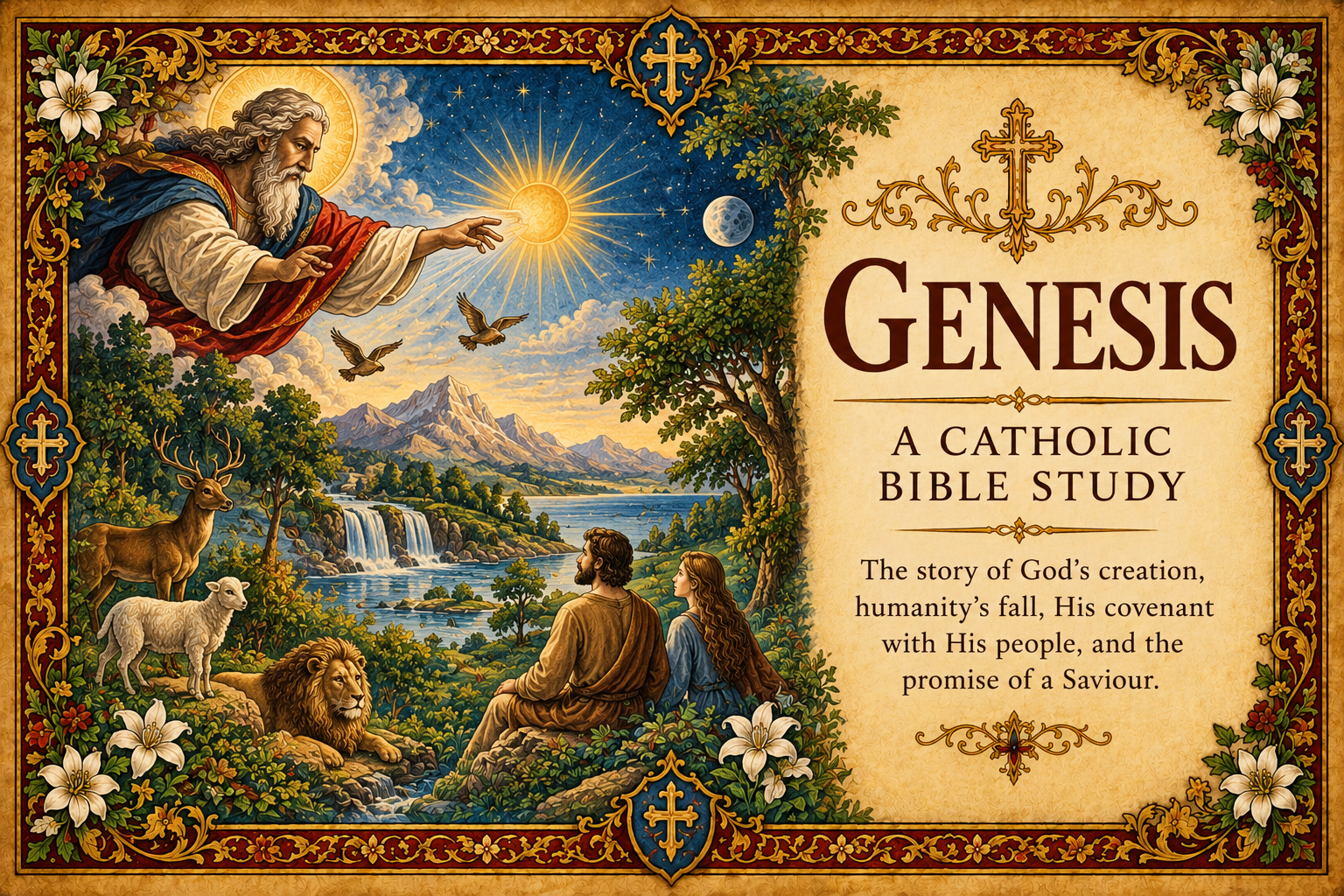
A Catholic Bible Study — Understanding God’s Covenant, the Sanctity of Human Life, the Rainbow, Noah’s Family and the Promise of Salvation Through Jesus Christ
Introduction: A New Beginning After the Flood
In Genesis Chapter 1, we discovered that God created heaven and earth and that everything He made was good.
In Genesis Chapter 2, we saw that God created man and woman for friendship with Himself.
In Genesis Chapter 3, we learned how Adam and Eve disobeyed God and lost their original holiness.
In Genesis Chapter 4, we saw how sin spread through the human family when Cain murdered Abel.
In Genesis Chapter 5, we followed the generations from Adam to Noah, learning about the reality of death and God’s continuing faithfulness.
In Genesis Chapter 6, we discovered that human wickedness had become widespread. The earth was filled with corruption and violence, and God announced that He would send a great Flood.
Yet Noah found grace before the Lord.
In Genesis Chapter 7, the Flood came.
The waters covered the earth, and the wicked world experienced God’s judgement.
But Noah and his family remained safe within the ark.
In Genesis Chapter 8, we saw that God remembered Noah.
The waters gradually disappeared.
The ark came to rest upon the mountains.
The dove returned with an olive branch.
And finally, Noah and his family emerged from the ark into a renewed world.
Noah’s first recorded act after leaving the ark was to build an altar and offer sacrifice to God.
He recognised that his preservation had come through the mercy of the Lord.
Now we come to Genesis Chapter 9.
God blesses Noah and his sons.
He renews the command to increase and multiply.
He gives further instructions concerning human life and the creatures of the earth.
And most importantly, He establishes His covenant with Noah and every living creature.
The visible sign of this covenant is the rainbow.
God declares:
“I will set my bow in the clouds, and it shall be the sign of a covenant between me, and between the earth.”
Genesis 9:13
This is one of the most beautiful promises in the Old Testament.
The world has passed through judgement.
Humanity has received a new beginning.
And God now gives a sign of His continuing mercy.
But Genesis Chapter 9 also reminds us that the Flood has not removed original sin.
Human beings remain weak.
Even within Noah’s family, we encounter wrongdoing, disrespect and the consequences of sin.
The chapter therefore contains both hope and warning.
God is faithful.
His covenant endures.
But humanity still needs redemption.
That redemption will come through Jesus Christ.
This chapter helps us answer some important questions:
- Why does God repeat the blessing originally given to Adam and Eve?
- What does it mean that human beings have dominion over animals?
- Why does God now permit the eating of animal flesh?
- Why is there a prohibition concerning blood?
- Why is every human life sacred?
- What exactly is God’s covenant with Noah?
- Why does God choose the rainbow as its sign?
- What does it mean when God says He will remember His covenant?
- Did Noah sin when he became drunk?
- What was wrong with the behaviour of Cham?
- Why does Noah pronounce a curse upon Chanaan?
- How do the blessings of Sem and Japheth prepare us for Christ?
- What does this chapter teach us about mercy, family life and Christian responsibility?
These questions concern our own lives.
We too are called to respect human life.
We must recognise God’s authority over creation.
We need to honour our parents and treat others with dignity.
We must learn to respond to the weaknesses of others with charity rather than ridicule.
And above all, we must trust the promises of God.
The great lesson of Genesis Chapter 9 is that God’s mercy remains faithful even when humanity is weak, and that His saving promises lead towards their fulfilment in Jesus Christ.
1. God Blesses Noah — The Renewal of Humanity
“And God blessed Noe and his sons. And he said to them: Increase, and multiply, and fill the earth.”
Genesis 9:1
Genesis Chapter 9 begins with a blessing.
After the terrible judgement of the Flood, God speaks to Noah and his sons.
He commands them to increase, multiply and fill the earth.
These words should sound familiar.
In Genesis Chapter 1, God gave a similar blessing to Adam and Eve.
He commanded them to be fruitful, multiply and fill the earth.
Now, after the Flood, the same blessing is renewed.
Why Does God Repeat This Command?
The Flood has brought judgement upon a wicked world.
But it has not destroyed God’s original plan for creation.
Human life remains good.
Marriage and family life remain part of His plan.
The world is still intended to be inhabited and cared for by humanity.
God therefore renews the blessing given at the beginning.
Noah and his family are to become the ancestors of the generations that follow.
Noah and Adam
There is an important connection between Adam and Noah.
Adam was placed in the world as the first man.
He was given responsibility for creation.
Noah emerges from the ark after the Flood.
He too receives a blessing and responsibility for the earth.
The Church Fathers recognised Noah as a figure of a new beginning for humanity.
In a certain sense, he stands at the beginning of the renewed human family.
Yet Noah is not another sinless Adam.
He remains a descendant of Adam and shares the wounded human condition brought about by the Fall.
The world has been renewed after the Flood, but original sin has not disappeared.
God’s Original Plan Remains Good
This is an important Catholic truth.
Sin has wounded creation, but it has not made God’s original work evil.
Marriage remains good.
Children remain blessings.
Family life remains part of God’s providence.
Work and responsibility remain important.
Human beings are still called to know, love and serve their Creator.
What the Church Fathers Teach
Saint Ambrose reflected upon the similarities between Adam and Noah.
The renewed blessing after the Flood reveals the continuing goodness of God’s purposes for humanity.
Saint Augustine likewise understood the generations following Noah as part of the continuing history of salvation.
God’s plan advances through the passing of human generations, despite the consequences of sin.
What This Means for Us
We should recognise the goodness of family life and the responsibility of passing on the faith.
Parents have the duty to care for their children and teach them about God.
Grandparents can offer wisdom, prayer and a faithful example.
Godparents have a special responsibility to help children grow in the Catholic faith.
And all Christians are called to value the dignity of marriage, family and human life.
Practical lesson: Thank God for the gift of family. Pray for parents and children, and consider how you can help the next generation grow in the Catholic faith.
2. Dominion Over Creation — Authority Must Be Used Responsibly
“And let the fear and dread of you be upon all the beasts of the earth.”
Genesis 9:2
God now speaks about the relationship between human beings and the animals.
He declares that the creatures of the earth are placed under humanity’s authority.
But something has changed since the original creation.
Dominion in Genesis Chapter 1
In Genesis Chapter 1, God gave humanity dominion over the creatures of the earth.
This authority was part of His good plan.
Human beings were created in God’s image.
They were entrusted with the responsibility of caring for creation.
In the original harmony of Eden, humanity lived according to God’s will.
The relationship between man and creation was ordered by divine wisdom.
Dominion After the Fall
Now, in Genesis Chapter 9, God speaks of fear and dread.
The harmony of the original creation has been disturbed.
Human beings still possess authority over the animals, but their relationship is no longer described in quite the same way.
The consequences of sin have affected the created order.
This reminds us that the Fall did not harm only our relationship with God.
It also disturbed the harmony that humanity was intended to enjoy with creation.
Does Dominion Mean We Can Do Whatever We Want?
No.
God has entrusted creation to humanity, but He remains its true Lord.
We are not absolute owners who may act without moral responsibility.
Our authority must be exercised according to His goodness and wisdom.
Animals are God’s creatures.
They have their proper place within creation.
We may use animals for legitimate human needs, including food and suitable work.
But we should not cause unnecessary suffering or act with cruelty.
The Catechism explains our duties towards animals and creation in paragraphs 2415–2418.
What the Church Fathers Teach
Saint John Chrysostom reflected upon the authority given to humanity over the animals.
He recognised that God’s providence continues to sustain human life after the Fall.
The Fathers also taught that created things are good because they come from God.
We must therefore receive them with gratitude and use them responsibly.
What This Means for Us
We should not take God’s creation for granted.
Food, water, animals, land and natural resources are gifts.
They are intended to sustain human life and serve good purposes.
We should avoid wastefulness and unnecessary cruelty.
We should also remember that authority always brings responsibility.
This applies not only to animals, but also to our relationships with other people.
Parents, teachers, employers and those in positions of leadership must exercise authority with justice and charity.
Practical lesson: Consider how you use the gifts and responsibilities God has entrusted to you. Seek to exercise authority with kindness, fairness and gratitude.
3. The Permission to Eat Meat — Receiving God’s Gifts with Gratitude
“And every thing that moveth, and liveth shall be meat for you: even as the green herbs have I delivered them all to you.”
Genesis 9:3
God now gives Noah and his descendants permission to eat animal flesh.
This is an important development in the biblical account.
What Had God Given Humanity Before?
In Genesis Chapter 1, God spoke of plants, herbs and fruits as food for humanity.
Now, after the Flood, He explicitly permits the eating of animals.
Traditional Catholic commentators have understood this as a further permission given to humanity in the renewed world.
The Lord provides for the needs of His creatures.
Is Eating Meat Wrong?
No.
Scripture expressly permits the eating of animal flesh.
The Catholic Church does not teach that eating meat is sinful in itself.
Our Lord Himself ate the Passover meal.
The risen Christ also ate in the presence of His disciples.
The Church therefore recognises that the lawful use of animals for food belongs within God’s providence.
At the same time, this permission must be exercised responsibly.
We should not treat animals cruelly.
Nor should we become wasteful or excessively attached to bodily pleasures.
Food Is a Gift from God
Everything we eat ultimately depends upon the goodness of the Creator.
The plants that grow.
The animals that provide food.
The work of farmers.
The labour of those who prepare our meals.
All these belong to the order of creation which God sustains.
Food should therefore lead us towards gratitude rather than selfishness.
Fasting and Abstinence
Although eating meat is lawful, the Church also teaches us the value of fasting and abstinence.
Catholics practise abstinence from meat on the days prescribed by the Church.
In England and Wales, this ordinarily includes Fridays throughout the year, unless a solemnity falls on the day.
Why do we abstain?
Not because meat is evil.
But because freely giving up something good can become an act of penance, self-discipline and love for God.
Fasting helps us remember that we are not created merely to satisfy bodily desires.
We are created for communion with God.
What the Church Fathers Teach
Saint Ambrose frequently taught the importance of temperance.
Created things are good, but they must be used in accordance with reason and virtue.
Saint John Chrysostom likewise encouraged gratitude and moderation in the use of food.
The Christian should receive God’s gifts without becoming enslaved by them.
What This Means for Us
We should learn to eat and drink with gratitude and moderation.
We should avoid greed and waste.
We should remember those who do not have enough food.
And we should practise the penitential discipline of the Church faithfully.
Saint Paul teaches:
“Whether you eat or drink, or whatsoever else you do, do all to the glory of God.”
1 Corinthians 10:31
Practical lesson: Say grace before meals, observe the Church’s days of penance, and remember those who struggle to obtain the necessities of life.
4. The Sacredness of Blood — Life Belongs to God
“Saving that flesh with blood you shall not eat.”
Genesis 9:4
After permitting the eating of animal flesh, God immediately gives a restriction.
Noah and his descendants must not eat flesh with its blood.
Why does God make this distinction?
Blood Is Associated with Life
Throughout the Old Testament, blood is closely associated with life.
When an animal loses its blood, it dies.
Blood therefore becomes a powerful biblical sign of life.
The prohibition teaches reverence for life and recognises God’s authority over living creatures.
Life is not something human beings have created for themselves.
It is a gift from God.
The Importance of Blood in the Old Testament
Later, under the Law of Moses, blood will have an important place in sacrificial worship.
The blood of sacrificial animals will be associated with atonement and the offering of life to God.
These practices prepare us to understand the saving sacrifice of Jesus Christ.
The sacrifices of the Old Testament are not the fulfilment of God’s plan.
They point towards the perfect sacrifice that Christ will offer upon the Cross.
Why Is Christ’s Blood So Important?
Jesus Christ gives His life for our salvation.
He sheds His Precious Blood upon the Cross.
His sacrifice reconciles us with the Father.
The Letter to the Hebrews explains that Christ enters the heavenly sanctuary through His own Blood, obtaining eternal redemption.
His Blood is infinitely more precious than the blood of animals because He is the eternal Son of God made man.
The Precious Blood and the Holy Eucharist
At the Last Supper, Jesus gives His disciples His Body and Blood.
He institutes the Holy Eucharist.
This is the fulfilment of the Old Testament preparation.
In the Eucharist, Christ gives us His true Body and Blood under the appearances of bread and wine.
This is not the ordinary consumption of animal blood forbidden in the ancient law.
It is the unique sacramental gift of the living and glorified Christ.
Under either Eucharistic species, the communicant receives the whole Christ: His Body, Blood, Soul and Divinity.
What About the Ancient Prohibition for Christians?
The early Church addressed questions concerning the consumption of blood in Acts Chapter 15.
The Apostles gave instructions intended to preserve fellowship between Christians from different backgrounds.
The Church subsequently distinguished the enduring moral teaching about reverence for life from the ritual and disciplinary requirements of the ancient law.
Catholics are therefore not bound to observe every Old Testament dietary restriction.
But the underlying truth remains.
Life belongs to God and must be treated with reverence.
What the Church Fathers Teach
Saint Irenaeus emphasised how the sacrifices and institutions of the Old Testament prepare us for the saving work of Christ.
Saint Augustine likewise understood the ancient sacrifices in the light of the one perfect sacrifice of Our Lord.
The blood of the Old Testament sacrifices points us towards the Precious Blood of Jesus.
What This Means for Us
We should recognise the sacredness of life and the greatness of Christ’s sacrifice.
When we attend Mass, we should remember that we are participating in the one sacrifice through which the world has been redeemed.
We should approach Holy Communion with faith, reverence and proper preparation.
Practical lesson: Before Mass, spend a few moments reflecting upon the sacrifice of Jesus Christ and thanking Him for the gift of His Precious Blood.
5. The Sanctity of Human Life — Every Person Bears God’s Image
“Whosoever shall shed man’s blood, his blood shall be shed: for man was made to the image of God.”
Genesis 9:6
This is one of the most important moral teachings in Genesis Chapter 9.
God declares that human life must be respected because man was created in His image.
The command comes after the Flood, but it takes us back to the beginning of creation.
Human Beings Are Made in God’s Image
In Genesis Chapter 1, God created man and woman in His own image and likeness.
This gives every human person a dignity greater than that of any other earthly creature.
We possess spiritual souls.
We are capable of knowing and loving God.
We are created for eternal life.
Sin has wounded human nature, but it has not destroyed the image of God within us.
Every human being therefore possesses an inherent dignity.
Why Is Murder So Serious?
Murder is not merely an offence against society.
It is a grave violation of the dignity God has given to the human person.
When Cain murdered Abel, he took the life of someone created in God’s image.
Now, after the Flood, God explicitly reaffirms the seriousness of shedding innocent human blood.
Human life must not be treated as though it belongs entirely to other human beings.
God is the Lord of life.
What Does the Command About Bloodshed Mean?
Genesis speaks of serious consequences for someone who deliberately sheds human blood.
The passage establishes the principle that murder requires justice and that society must protect innocent life.
In the ancient world, it also expressed the gravity of murder through the language of punishment.
But we must distinguish the permanent moral principle from the way civil punishments have been understood and applied in different circumstances.
The permanent principle is the sacredness of human life and the responsibility of legitimate authority to protect it.
The Church teaches that the death penalty is inadmissible today because it attacks the inviolability and dignity of the person, and she works for its abolition.
This is explained in the Catechism, paragraph 2267.
The lesson of Genesis remains clear: human life is sacred, and grave violence must never be treated lightly.
The Dignity of Life from Conception to Natural Death
Catholic teaching protects human life at every stage.
The child in the womb possesses dignity.
The newborn child possesses dignity.
The elderly person possesses dignity.
The sick and disabled possess dignity.
The dying person possesses dignity.
A person’s worth does not depend upon strength, intelligence, health, wealth or usefulness.
It comes from being created in God’s image.
What the Church Fathers Teach
Saint John Chrysostom emphasised the dignity of human beings as creatures made in God’s image.
The divine image is the foundation of our responsibility to respect others.
Saint Augustine also taught that human life must be governed by justice and charity rather than private revenge.
The Christian must recognise the dignity of others even when they have done wrong.
Jesus Deepens This Teaching
In the Sermon on the Mount, Jesus teaches us not only to avoid murder but also to resist anger, hatred and contempt.
He calls us to reconciliation.
He teaches us to love our enemies.
He commands us to forgive.
This does not mean that wrongdoing should be ignored.
It means that justice must be pursued without hatred.
What This Means for Us
Respect for life must shape our thoughts, words and actions.
We must reject deliberate violence against the innocent.
We must care for vulnerable people.
We should avoid hatred and cruelty.
And we must remember that every person we meet bears the image of God.
Practical lesson: Pray for the protection of human life at every stage, and consider how you can support someone who is vulnerable, lonely, sick or in need.
6. God’s Covenant with Noah — A Promise to All Creation
“Behold I will establish my covenant with you, and with your seed after you.”
Genesis 9:9
God now formally establishes His covenant with Noah.
We first encountered the promise of this covenant in Genesis Chapter 6.
Now, after the Flood, God explains its meaning.
What Is a Covenant?
A covenant is a solemn bond or relationship.
In Sacred Scripture, God establishes covenants through which He reveals His promises and calls humanity to respond to Him.
These covenants form part of the unfolding history of salvation.
God always takes the initiative.
He acts according to His goodness and mercy.
Who Is Included in the Covenant?
The covenant is not made with Noah alone.
It includes his sons.
Their descendants.
And the living creatures of the earth.
This is remarkable.
God’s promise extends to the whole created world.
The Lord who made creation good now promises to preserve it according to His providence.
What Does God Promise?
God promises that the world will not again be destroyed by a flood of the kind Noah has experienced.
The Flood has brought judgement upon the wickedness of humanity.
But God now establishes a lasting promise concerning the preservation of earthly life.
Does This Mean There Will Never Be Another Flood?
No.
The world may still experience floods, storms and other natural disasters.
The promise concerns the destruction of all flesh through another universal Flood.
God is not promising a world without suffering.
Nor is He promising that there will never be another judgement.
Sacred Scripture teaches that Christ will return in glory and that the present world will reach its final fulfilment according to God’s plan.
Why Is This Covenant Important?
The covenant shows that God has not abandoned His original creation.
Even after the wickedness that led to the Flood, He continues to sustain the world.
Human beings remain weak and sinful.
But God’s faithfulness continues.
What the Church Fathers Teach
Saint Irenaeus emphasised the unity of God’s plan throughout the covenants of Sacred Scripture.
The covenant with Noah belongs to the same divine plan that will later include Abraham, Moses, David and ultimately Jesus Christ.
The Catechism explains the importance of the covenant with Noah in paragraphs 56–58 and 71.
The Covenant and Salvation History
The covenant with Noah concerns the preservation of creation.
Later, God will call Abraham and promise that through his descendants all the nations of the earth will be blessed.
He will establish His covenant with Israel.
He will promise a kingdom through David.
And finally, Jesus Christ will establish the New and Eternal Covenant in His Precious Blood.
The covenants are not unrelated events.
They belong to the one saving plan of God.
What This Means for Us
God is faithful to His promises.
We may fail in our duties.
We may become distracted or discouraged.
But God remains perfectly faithful.
His promises do not depend upon changing human feelings.
We should therefore learn to trust Him.
Practical lesson: When you experience uncertainty, remember that God’s faithfulness is greater than human weakness. Pray for the grace to trust His promises.
7. The Rainbow — The Visible Sign of God’s Mercy
“I will set my bow in the clouds, and it shall be the sign of a covenant between me, and between the earth.”
Genesis 9:13
God now gives a visible sign of His covenant.
It is the rainbow.
After the darkness and destruction of the Flood, the rainbow becomes a sign of hope.
Why Does God Choose a Visible Sign?
Human beings learn through their senses.
We see.
We hear.
We touch.
We recognise signs that remind us of important realities.
God knows our nature.
Throughout the history of salvation, He makes use of visible signs to communicate His promises.
The rainbow becomes a sign of the covenant established with Noah and the living creatures.
Whenever it appears, it reminds humanity of God’s promise.
The Beauty of the Rainbow
A rainbow appears when light interacts with water droplets in the atmosphere.
It is part of the beauty and order of God’s creation.
But in Genesis Chapter 9, God appoints it as a sign of His covenant.
The natural beauty of the rainbow becomes a reminder of divine mercy.
After the storm, there is light.
After the judgement, there is a promise.
After the destruction, life continues.
The Bow and the Sign of Peace
The rainbow is described as God’s bow.
A bow was also a weapon used in warfare.
Traditional Christian commentators have sometimes reflected upon the image of the bow placed in the clouds as a sign that the great judgement of the Flood has ended.
This is a spiritual reflection upon the biblical image.
It directs our attention towards God’s promise of peace and preservation.
Does the Rainbow Remove the Reality of Judgement?
No.
The rainbow does not mean that sin has become unimportant.
God remains perfectly just.
Human beings remain accountable to Him.
The final judgement still lies ahead.
But the rainbow reveals that the Lord has established a particular promise of mercy towards His creation.
The Rainbow and the Cross
Christian tradition has recognised a spiritual connection between the rainbow and the Cross of Jesus Christ.
The rainbow is the sign of God’s covenant after the Flood.
The Cross is the instrument through which Christ establishes the New and Eternal Covenant.
The rainbow announces the preservation of earthly life.
The Cross opens the way to eternal life.
The comparison helps us recognise how God’s saving promises develop throughout Scripture.
What the Church Fathers Teach
Saint Ambrose and Saint Augustine reflected upon the spiritual significance of God’s covenant and the signs through which He revealed His mercy.
The Fathers understood that visible realities could direct the human mind towards divine truths.
We should not confuse the rainbow with one of the seven sacraments instituted by Christ.
It is a covenant sign, preparing us to appreciate how God communicates His promises through visible realities.
What This Means for Us
The rainbow should remind us of the faithfulness of God.
We may encounter storms in our own lives.
Periods of suffering.
Fear.
Disappointment.
Family difficulties.
But God’s mercy remains.
He calls us to trust Him through every circumstance.
Practical lesson: When you see a rainbow, remember God’s covenant with Noah and offer a simple prayer of thanksgiving for His faithfulness.
8. “I Will Remember My Covenant” — God’s Promise Endures
“And I will remember my covenant with you, and with every living soul that beareth flesh.”
Genesis 9:15
God now explains what will happen when the rainbow appears in the clouds.
He declares that He will remember His covenant.
This takes us back to Genesis Chapter 8.
There, Scripture told us:
“And God remembered Noe.”
Now God speaks again of remembrance.
Does God Need a Reminder?
No.
God never forgets.
His knowledge is perfect.
He does not need the rainbow to remind Him of something He might otherwise overlook.
When Scripture speaks of God remembering, it expresses His continuing faithfulness.
He remains true to His covenant.
He acts according to His promises.
A Covenant for Future Generations
The promise is not limited to Noah’s lifetime.
It extends to his descendants.
It concerns the generations that follow.
God’s covenant is therefore part of the continuing order of creation.
The Catechism explains that the covenant with Noah remains in force as long as the world lasts.
See paragraph 71.
God’s Faithfulness and Human Unfaithfulness
Human beings may break promises.
We may change our minds.
We may fail to carry out our responsibilities.
But God is not like us.
His faithfulness is perfect.
He does not become unreliable because humanity is weak.
This is one of the most comforting truths of Sacred Scripture.
Does This Mean Everyone Is Automatically Saved?
No.
The covenant with Noah concerns the preservation of the world.
It does not mean that repentance, faith and obedience are unnecessary.
Nor does it mean that everyone will automatically enter Heaven.
Salvation comes through Jesus Christ.
We must respond to His grace.
The covenant with Noah prepares the world for the unfolding history of redemption.
What the Church Fathers Teach
Saint John Chrysostom frequently emphasised the mercy and faithfulness of God.
He encouraged Christians to recognise that divine patience is intended to lead us towards repentance.
Saint Augustine also understood God’s covenants as belonging to His unchanging plan.
The Lord remains faithful because His goodness is perfect.
What This Means for Us
We should learn to distinguish God’s faithfulness from our changing feelings.
There may be days when prayer feels difficult.
There may be times when we struggle with doubt or discouragement.
But God’s truth does not change.
His promises remain.
We must continue trusting Him.
Practical lesson: When you feel spiritually discouraged, remember one of God’s promises in Scripture. Pray for the grace to remain faithful even when your feelings change.
9. Noah Plants a Vineyard — The Continuing Weakness of Humanity
“And Noe, a husbandman, began to till the ground, and planted a vineyard.”
Genesis 9:20
The chapter now moves to an event in Noah’s family life.
The Flood has ended.
God has established His covenant.
The rainbow has been given as its sign.
Noah begins cultivating the land.
He plants a vineyard.
This is part of humanity’s renewed responsibility for creation.
Work Continues After the Flood
God originally entrusted Adam with the care of the earth.
After the Flood, Noah also works the land.
He plants and cultivates.
This reminds us that human work remains part of God’s plan.
The world has received a new beginning, but ordinary responsibilities continue.
Noah Drinks Wine
Scripture then tells us:
“And drinking of the wine was made drunk, and was uncovered in his tent.”
Genesis 9:21
Noah becomes intoxicated and lies uncovered within his tent.
This is a difficult passage.
How should we understand it?
Did Noah Deliberately Sin?
We should be careful not to accuse Noah of a deliberate sin when Scripture does not establish that conclusion.
The traditional commentary accompanying the Douay-Rheims Bible explains that the Fathers judged Noah not guilty of sin in this incident because he did not know the strength of the wine.
In this understanding, his intoxication was not the result of a deliberate decision to become drunk.
He was overcome by wine without appreciating its effect.
This interpretation is worthy of respect.
Noah had been praised by God as a just man.
His faith and obedience had been extraordinary.
The passage does not require us to imagine that he had suddenly abandoned his righteousness.
Does This Mean Drunkenness Is Acceptable?
No.
The Church teaches that temperance is a virtue.
We should avoid excessive drinking and the deliberate loss of self-control.
The misuse of alcohol can cause serious harm.
But we should distinguish the moral wrong of deliberately abusing alcohol from Noah’s particular circumstances as understood by traditional commentators.
Noah’s Vulnerability
Whatever the precise circumstances of his intoxication, Noah becomes vulnerable.
He lies uncovered in his tent.
He needs others to treat him with dignity.
The next part of the story concerns the very different ways in which his sons respond.
This is the moral centre of the episode.
What the Church Fathers Teach
Saint Augustine understood the incident involving Noah, his vineyard and his sons as containing spiritual meanings that point towards Christ.
Other traditional commentators defended Noah against the assumption that he had deliberately sinned.
The episode reminds us that even a righteous person may find himself in a position of weakness and vulnerability.
What This Means for Us
We should be slow to condemn others.
Sometimes we see someone in an embarrassing or difficult situation without understanding what has happened.
We may be tempted to judge immediately.
But charity requires us to seek the truth and protect another person’s dignity.
Practical lesson: When someone is vulnerable or embarrassed, respond with compassion rather than ridicule. Do not assume you know all the circumstances of another person’s difficulty.
10. Cham, Sem and Japheth — Respect, Dishonour and the Future of Humanity
“Which when Cham the father of Chanaan had seen, to wit, that his father’s nakedness was uncovered, he told it to his two brethren without.”
Genesis 9:22
Cham discovers that Noah is lying uncovered in his tent.
Instead of protecting his father’s dignity, he tells his brothers.
The passage contrasts his behaviour with that of Sem and Japheth.
What Was Wrong with Cham’s Behaviour?
The traditional Catholic interpretation sees Cham’s conduct as an act of disrespect towards his father.
The problem is not simply that he accidentally saw Noah uncovered.
It is his response.
Rather than acting with reverence and discretion, he exposes his father’s shame to others.
Traditional commentators have understood this as involving mockery or contempt.
Cham fails to show the respect owed to his father.
What Do Sem and Japheth Do?
Sem and Japheth respond very differently.
They take a cloak.
They place it upon their shoulders.
They walk backwards towards Noah.
They cover him without looking upon his nakedness.
Their behaviour reveals modesty and reverence.
They do not join in their brother’s disrespect.
They protect their father’s dignity.
Honouring Father and Mother
Later, God will give Israel the Fourth Commandment:
“Honour thy father and thy mother.”
This commandment requires children to respect their parents.
As we grow older, the form of that responsibility changes.
Young children owe obedience to their parents in matters where obedience is rightly required.
Adult children are no longer subject to every parental decision, but they remain bound to show appropriate respect, gratitude and care.
This responsibility becomes especially important when parents grow elderly or infirm.
Does Respect Mean Ignoring Wrongdoing?
No.
Respect for parents and other authorities does not mean that we must conceal abuse, tolerate injustice or ignore serious wrongdoing.
There are circumstances in which protecting others, reporting harmful conduct or seeking proper help is necessary.
But such responsibilities should be carried out truthfully and without cruelty.
The lesson of Sem and Japheth is that we should not take pleasure in humiliating another person.
What the Church Fathers Teach
Saint Gregory the Great drew a spiritual lesson from the brothers covering Noah.
He applied the image to the way Christians should respond to the faults of others, particularly those entrusted with spiritual responsibilities.
We should not eagerly expose another person’s weaknesses or turn them into entertainment.
Saint Augustine also recognised deeper prophetic meanings in this event.
The differing responses of Noah’s sons point towards the spiritual divisions and blessings that will emerge in the generations that follow.
The Curse upon Chanaan
After Noah awakens, he learns what has happened.
He pronounces a curse upon Chanaan, the son of Cham.
This may initially surprise us.
Why is Chanaan named rather than Cham?
The traditional Douay-Rheims commentary explains that some ancient interpreters understood Chanaan as having participated in the disrespect shown towards Noah.
Another important aspect is the prophetic significance of the passage.
The curse concerns the future of Chanaan’s descendants and their relationship with other peoples.
Saint Augustine understood the words as prophetic rather than merely an expression of personal anger.
We must distinguish the biblical account from attempts to misuse it.
The passage does not teach that an entire race is naturally inferior.
It does not give anyone permission to enslave people because of their ancestry or colour.
Human dignity comes from being created in God’s image.
No person or people can lose that dignity through descent from a particular ancestor.
The Blessing of Sem
Noah then declares:
“Blessed be the Lord God of Sem.”
Genesis 9:26
Sem receives a special blessing.
His descendants will have an important place in salvation history.
Through the line of Sem, Scripture will eventually lead us towards Abraham.
Through Abraham, God will establish His promises concerning Israel.
And through the history of Israel, Jesus Christ will be born according to His human nature.
The Blessing of Japheth
Noah also speaks of Japheth being enlarged and dwelling in the tents of Sem.
The Church Fathers recognised a prophetic meaning in this blessing.
It points towards the inclusion of the Gentiles in the blessings that would come through Israel.
The Gospel is not intended for one nation alone.
Jesus Christ comes to save the world.
Through Him, Jews and Gentiles are called into one Church.
What the Church Fathers Teach
Saint Augustine explains the spiritual significance of these blessings in The City of God, Book XVI.
He sees in Sem a connection with the people through whom Christ would come.
In Japheth, he recognises the calling of the nations to share in God’s saving promises.
The episode therefore looks forward to the universal mission of the Catholic Church.
Noah’s Final Years
The chapter concludes by telling us that Noah lived another 350 years after the Flood.
His total lifespan was 950 years.
Then Scripture records his death.
This reminds us of the repeated words from Genesis Chapter 5:
“And he died.”
Even Noah, the righteous man preserved through the Flood, remains subject to death.
The renewal brought through the Flood is not yet the final victory over sin and death.
That victory belongs to Jesus Christ.
What This Means for Us
This part of Genesis teaches us to respect parents, protect the dignity of others and avoid taking pleasure in another person’s humiliation.
It also reminds us that God’s plan of salvation extends to all nations.
The Church is universal.
People from every nation and background are called to know and love Jesus Christ.
Practical lesson: Resist gossip and mockery. When you become aware of another person’s weakness, respond with discretion, truth and charity rather than unnecessary humiliation.
11. The Great Catholic Truths of Genesis Chapter 9
Having studied the chapter, we can now bring its teaching together.
God Renews His Blessing upon Humanity
The command to increase and multiply recalls the blessing originally given to Adam and Eve.
God’s plan for human life continues.
Creation Remains Good
The Flood has not destroyed the goodness of God’s original creation.
Human beings are still called to care for the earth.
Dominion Brings Responsibility
God entrusts the animals to humanity.
We must use creation according to His wisdom and avoid unnecessary cruelty.
Food Is a Gift from God
The permission to eat meat reminds us that God provides for our needs.
We should receive His gifts with gratitude and moderation.
Blood Is Associated with Life
The prohibition concerning blood teaches reverence for life.
It also prepares us to understand the importance of sacrifice in the Old Testament.
Christ’s Precious Blood Brings Redemption
The sacrifices of the Old Testament point towards the perfect sacrifice of Jesus Christ.
Through His Blood, we receive the gift of salvation.
Every Human Life Is Sacred
Human beings are made in God’s image.
This dignity belongs to every person, from conception until natural death.
God Establishes His Covenant with Noah
The covenant extends to Noah, his descendants and the living creatures of the earth.
It reveals God’s continuing faithfulness.
The Rainbow Is a Sign of Mercy
God gives the rainbow as the visible sign of His covenant.
It reminds humanity of His promise after the Flood.
God’s Promises Do Not Fail
When Scripture speaks of God remembering His covenant, it reveals His unchanging faithfulness.
Human Beings Remain Weak
The Flood has not removed original sin.
Humanity still needs the grace of redemption.
Noah’s Intoxication Must Be Understood Carefully
Traditional Catholic commentary does not necessarily regard Noah’s drunkenness as a deliberate sin.
We should avoid judging him beyond what Scripture teaches.
The Behaviour of Noah’s Sons Teaches Respect
Cham exposes his father’s shame.
Sem and Japheth protect his dignity.
We are called to act with charity and reverence.
The Blessings Point Towards Salvation History
Through Sem, the history of God’s promises will lead towards Abraham and Israel.
Through the blessing of Japheth, the Fathers recognised the future calling of the Gentiles.
Jesus Christ Is the Fulfilment of God’s Promises
The covenant with Noah prepares us for the greater covenant established through Christ’s Precious Blood.
These truths help us understand why Genesis Chapter 9 is so important.
It reveals the mercy of God, the dignity of humanity and the unfolding history of salvation.
12. Jesus Christ — The Fulfilment of God’s Covenant
The covenant with Noah is an important stage in the history of salvation.
But it is not the final fulfilment of God’s promises.
The whole of Sacred Scripture leads towards Jesus Christ.
The Covenant with Noah Preserves the World
God promises that the earth will not again be destroyed by a universal Flood.
This promise concerns the continuation of earthly life.
It provides the setting in which the history of salvation will continue.
God Calls Abraham
Later in Genesis, God will call Abraham.
He will promise him descendants and a land.
He will also promise that through him all the nations of the earth will be blessed.
The saving plan becomes more clearly revealed.
God Forms Israel
Through Moses, God will establish His covenant with Israel.
He will give His Law.
He will teach His people how to worship Him.
He will prepare them for the coming of the Messiah.
The Promise to David
God will promise David a lasting kingdom.
The prophets will announce the coming of a descendant of David who will reign in justice and peace.
These promises lead towards Jesus Christ.
Jesus Establishes the New Covenant
At the Last Supper, Jesus speaks of the New Covenant in His Blood.
Through His sacrifice upon the Cross, He reconciles humanity with the Father.
His death is not simply another event within human history.
It is the saving sacrifice of the eternal Son of God made man.
The covenant established through His Precious Blood is the New and Eternal Covenant.
The Rainbow and the Cross
The rainbow is the sign of God’s covenant with Noah.
The Cross is the instrument through which Christ establishes the New Covenant.
The rainbow speaks of the preservation of earthly life.
The Cross opens the way to eternal life.
The rainbow appears after the judgement of the Flood.
The Cross reveals the victory of divine mercy through Christ’s sacrifice.
Christian tradition has therefore recognised a beautiful spiritual connection between these signs.
The Blood of Christ
Genesis Chapter 9 teaches reverence for blood because it is associated with life.
The Old Testament sacrifices deepen this understanding.
But their fulfilment comes in Jesus Christ.
He gives His life upon the Cross.
He sheds His Precious Blood for our redemption.
Through Him, we receive forgiveness and the hope of eternal life.
The Holy Eucharist
At Mass, the Church celebrates the one sacrifice of Christ.
His sacrifice is made sacramentally present.
Under the appearances of bread and wine, we receive His true Body and Blood.
The Eucharist is therefore the centre of the life of the Church.
It is the sacrament of the New Covenant.
Sem, Japheth and the Universal Church
The blessings pronounced upon Noah’s sons also prepare us for the universal mission of Christ.
Through the descendants of Sem, the history of salvation leads towards Abraham and the people of Israel.
Jesus Christ is born within that history.
But His saving work is not limited to one nation.
He commands the Apostles to proclaim the Gospel to all peoples.
The Gentiles are called to share in the blessings of salvation.
The Church gathers people from every nation into one family of faith.
This is the deeper spiritual meaning recognised by Saint Augustine in the blessing of Japheth.
Christ Is Greater Than Noah
Noah was a just man preserved through the Flood.
Christ is the eternal Son of God who became man for our salvation.
Noah received God’s covenant.
Christ establishes the New and Eternal Covenant.
Noah’s family became the beginning of the renewed human family.
Through Christ, a new humanity is formed by grace.
Noah lived many centuries, but eventually died.
Christ died and rose again, conquering death forever.
What This Means for Us
We should read the Old Testament in the light of Jesus Christ.
The promises of God are not isolated events.
They belong to one saving plan.
The covenant with Noah reminds us of God’s faithfulness.
But the Cross reveals the fullness of His saving love.
Practical lesson: When you attend Mass, remember that you are participating in the New Covenant established through the Precious Blood of Jesus Christ.
13. Living Genesis Chapter 9 Every Day
Genesis Chapter 9 offers many lessons for daily Catholic life.
It teaches us how to respect human life, trust God’s promises, use creation responsibly and treat others with charity.
Thank God for the Gift of Life
The renewed blessing given to Noah reminds us that life comes from God.
We should receive it with gratitude.
Respect the Dignity of Every Person
Every human being is created in God’s image.
Treat others with dignity, especially those who are vulnerable.
Protect Human Life
The sacredness of life is a central teaching of this chapter.
We should oppose violence against the innocent and care for those in need.
Use God’s Creation Responsibly
The earth and its creatures are entrusted to our care.
Avoid unnecessary cruelty and waste.
Practise Temperance
Food and drink are gifts from God.
Use them with moderation.
Do not allow bodily desires to govern your life.
Observe the Church’s Penitential Discipline
Fasting and abstinence help us grow in self-control and offer sacrifices to God.
Practise them faithfully and with a sincere heart.
Remember the Precious Blood of Christ
Jesus shed His Blood for our salvation.
Approach the Holy Mass with reverence and gratitude.
Trust God’s Promises
The rainbow reminds us that God is faithful.
Do not allow difficulties to convince you that He has abandoned you.
Practise Gratitude
Remember the blessings God gives through creation, family, work and the sacraments.
Thank Him each day.
Respect Your Parents
Sem and Japheth protected their father’s dignity.
We should honour our parents and care for them, particularly when they become elderly or vulnerable.
Avoid Gossip
Do not take pleasure in another person’s embarrassment or weakness.
Speak truthfully and charitably.
Protect the Dignity of Others
Sometimes another person’s weakness should be treated with discretion.
Do not expose private difficulties unnecessarily.
Where serious wrongdoing requires appropriate action, seek justice without cruelty.
Do Not Judge Hastily
The traditional interpretation of Noah’s intoxication reminds us that we may not know all the circumstances of another person’s behaviour.
Seek the truth before making judgements.
Remember That the Church Is Universal
The blessing of Japheth points towards the calling of the nations.
The Catholic Church is for all peoples.
Treat others with charity and welcome those who seek Christ.
Live According to Your Baptism
Through Baptism, you have received new life in Jesus Christ.
Do not return willingly to the sins from which He has freed you.
Make Use of Confession
When you fall into sin, turn towards God’s mercy.
Seek forgiveness through the Sacrament of Penance.
Keep the Holy Eucharist at the Centre
At Mass, we participate in the saving sacrifice of Christ.
Do not allow Sunday worship to become unimportant in your life.
Prepare for Eternal Life
The covenant with Noah preserves earthly life.
But the New Covenant in Christ opens the way to eternal life.
Remember that Heaven is our true home.
Practical lesson: Choose one area in which you need greater charity, reverence or trust. Ask God for the grace to make a genuine change during the coming week.
Questions for Reflection
Take some time to consider these questions prayerfully.
- Do I recognise that my life is a gift from God?
- Am I grateful for the family and responsibilities He has entrusted to me?
- Do I use the created world with care and gratitude?
- Am I practising moderation in food, drink and other pleasures?
- Do I understand why every human life is sacred?
- Do I treat vulnerable people with dignity and compassion?
- What does the covenant with Noah teach me about God’s faithfulness?
- Do I remember God’s mercy when I see the beauty of creation?
- Am I trusting His promises during difficult periods?
- Do I recognise the importance of the Precious Blood of Jesus Christ?
- Am I approaching Holy Communion with proper reverence?
- Do I honour my parents and care for them according to their needs?
- Have I ever taken pleasure in another person’s embarrassment or failure?
- Do I sometimes participate in gossip or unnecessary criticism?
- Can I learn from Sem and Japheth to respond to weakness with discretion and charity?
- Do I understand how the blessings of Noah’s sons point towards the history of salvation?
- Am I grateful that the Gospel is offered to all nations?
- Do I recognise Jesus Christ as the fulfilment of God’s saving promises?
- Am I making proper use of the sacraments?
- What practical change could help me live more faithfully as a Catholic?
Choose one area in which you can make a genuine change.
Remember that holiness grows through our cooperation with God’s grace in the ordinary circumstances of daily life.
We are not called merely to admire the faith of Noah.
We are called to trust the same God and live according to His commandments.
A Simple Prayer with Genesis Chapter 9
Read Genesis 9:13 slowly:
“I will set my bow in the clouds, and it shall be the sign of a covenant between me, and between the earth.”
Pause for a moment.
Think about Noah and his family emerging from the ark.
They had passed through the terrible Flood.
They had witnessed the judgement of God.
Yet they had also experienced His mercy.
Now the Lord establishes His covenant.
He gives the rainbow as its visible sign.
It is a reminder that His promises endure.
Consider your own life.
Do you trust God’s faithfulness?
Do you remember His mercy?
Are you living with gratitude?
Are you respecting the dignity of others?
Are you responding to the weaknesses of those around you with charity?
Above all, are you remaining close to Jesus Christ, through whom God’s saving promises are fulfilled?
Then pray:
Heavenly Father,
You are the Creator of heaven and earth, the Lord of justice and mercy.
You preserved Noah and his family through the great Flood.
You blessed them and gave them a new beginning.
You established Your covenant with them and placed the rainbow in the clouds as a sign of Your faithfulness.
Teach me to trust Your promises.
When difficulties surround me, strengthen my hope.
When I become discouraged, remind me that Your mercy endures.
Help me to receive Your gifts with gratitude.
Teach me to use creation responsibly and to respect the life You have given to every person.
Forgive me for the times I have acted selfishly or failed to show charity towards others.
Give me a heart that honours the dignity of those around me.
Help me to respect my parents and care for those who are elderly, sick or vulnerable.
Keep me from gossip, ridicule and unnecessary judgement.
Teach me to respond to the weaknesses of others with truth, discretion and love.
Through Your Son, Jesus Christ, You have established the New and Eternal Covenant.
He shed His Precious Blood upon the Cross for our salvation.
May I never forget the greatness of His sacrifice.
Strengthen me through the grace of Baptism.
Restore me through Confession when I have sinned.
Nourish me through the Holy Eucharist.
Help me to live faithfully as a member of Your Church.
May my life become a witness to Your mercy and a sign of peace to those around me.
And when my earthly journey is complete, bring me safely into the eternal joy of Your heavenly Kingdom.
Through Christ our Lord.
Amen.
Conclusion: God’s Covenant Endures — And Christ Brings Eternal Salvation
Genesis Chapter 9 begins with a blessing.
After the terrible judgement of the Flood, God speaks to Noah and his sons.
He commands them to increase and multiply.
He renews humanity’s responsibility for creation.
He provides for their needs.
And He reminds them that human life is sacred because every person is created in His image.
Then God establishes His covenant.
He promises that the earth will not again be destroyed by a universal Flood.
And He gives the rainbow as the visible sign of His faithfulness.
This is a wonderful revelation of divine mercy.
The world has passed through judgement.
Humanity has received a new beginning.
And God’s saving plan continues.
But the chapter also reminds us that the Flood has not removed the wounded condition of humanity.
Sin remains a danger.
Human beings are still capable of disrespect, selfishness and wrongdoing.
Within Noah’s own family, we see the contrast between dishonour and reverence.
Cham exposes his father’s shame.
Sem and Japheth protect his dignity.
Their different responses remind us that our actions reveal the condition of our hearts.
We are called to charity.
To respect others.
To honour our parents.
To avoid gossip.
And to protect human dignity.
The blessings pronounced upon Sem and Japheth also prepare us for the history of salvation.
Through Sem, Scripture will lead us towards Abraham and the people of Israel.
Through the blessing of Japheth, the Church Fathers recognised the future calling of the Gentiles.
God’s saving plan is moving towards something greater than the covenant with Noah.
It is moving towards Jesus Christ.
For Christ is the fulfilment of the promises of God.
The rainbow is the sign of the covenant after the Flood.
The Cross is the instrument through which Christ establishes the New and Eternal Covenant.
The covenant with Noah promises the preservation of earthly life.
The sacrifice of Christ opens the way to eternal life.
The blood of animals was associated with life and sacrifice in the Old Testament.
But the Precious Blood of Jesus Christ brings redemption from sin.
And through His Church, the saving grace of Christ is offered to people of every nation.
This is why Genesis Chapter 9 is so important for Catholics.
It reminds us that God is faithful.
That His mercy endures.
That human life is sacred.
That His creation must be treated responsibly.
That our family relationships should be governed by charity.
And that all His promises find their fulfilment in Jesus Christ.
As we finish this chapter, we should remember that God’s covenant does not depend upon human beings becoming perfect.
God knows our weakness.
He knows that we need His grace.
And He has provided the Saviour.
Jesus Christ has died for us.
He has risen from the dead.
He has established His Church.
He has given us the sacraments.
And He calls us to eternal life.
May we therefore respond to His mercy with gratitude.
May we respect every person as one created in God’s image.
May we use His gifts responsibly.
May we treat the weaknesses of others with compassion rather than contempt.
May we remain faithful to His Church and make good use of the sacraments.
And may we always remember that the God who placed His bow in the clouds is the same God who sent His Son for our salvation.
“And the bow shall be in the clouds, and I shall see it, and shall remember the everlasting covenant.”
Genesis 9:16
May every reminder of God’s faithfulness lead us towards Jesus Christ, whose Precious Blood has established the New and Eternal Covenant and opened the way to everlasting life.
Amen.

