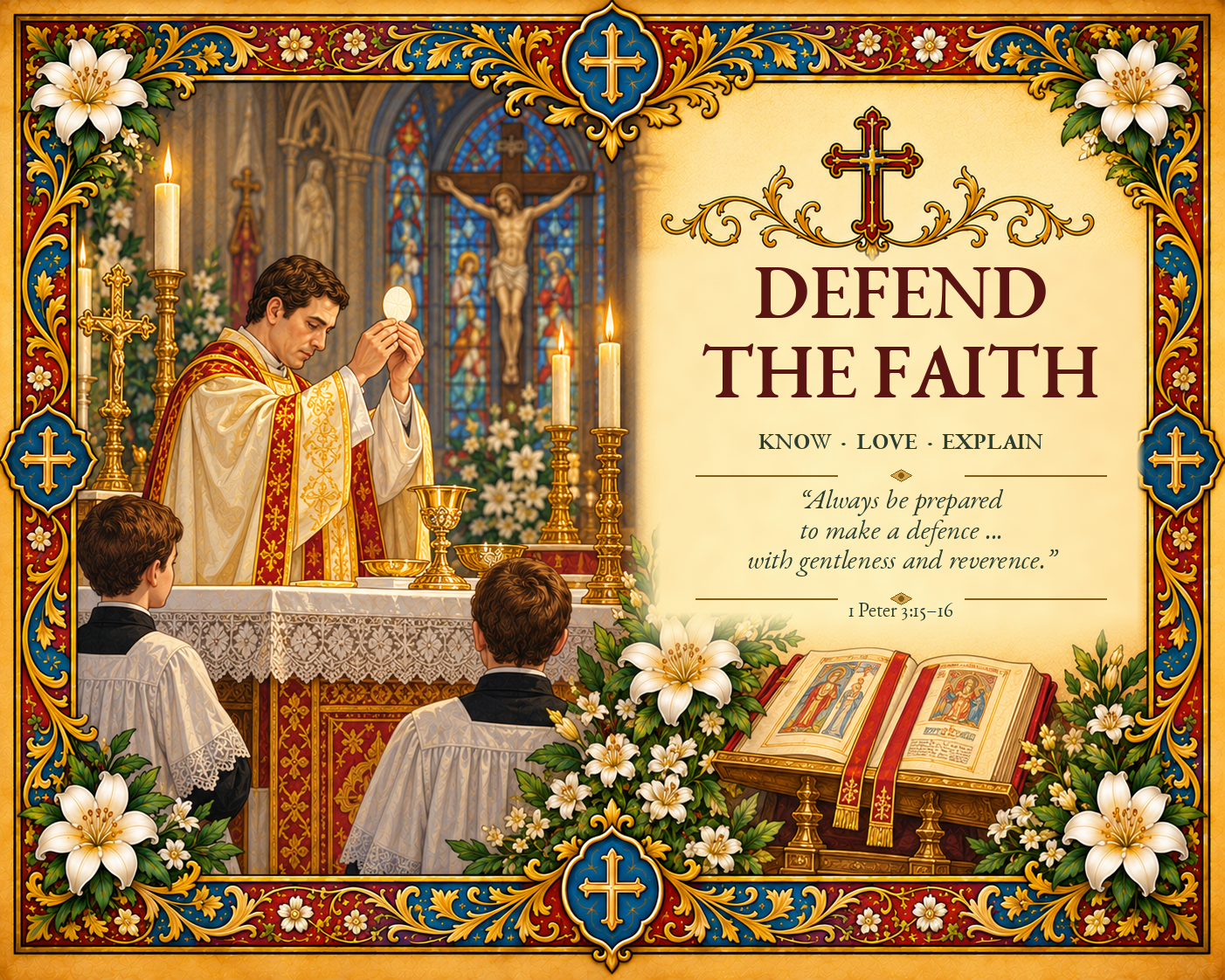
Defend the Faith — Session 22
Defending Catholic Truth, the Holy Sacrifice of the Mass and the Sacred Tradition of the Church
Opening Prayer
In the name of the Father, and of the Son, and of the Holy Spirit. Amen.
Lord Jesus Christ,
You are the Way, the Truth and the Life.
You founded Your Church to proclaim the truth, administer Your Sacraments and lead souls to eternal salvation.
Strengthen our faith in everything You have revealed.
Protect us from error, confusion and the temptation to change Your teaching to suit the passing opinions of the world.
Give us a deep love for the Holy Eucharist and a true understanding of the sacred mysteries celebrated at Mass.
Teach us to worship You with reverence, humility and love.
May we always defend the Catholic faith without pride, bitterness or contempt for others.
Through the intercession of the Blessed Virgin Mary, St Joseph and St Pius X, keep us faithful to Your truth and united in Your Church.
Amen.
Introduction: What Has Happened to the Sense of the Sacred?
Many Catholics have asked a troubling question.
What has happened to the sense of the sacred?
They remember a time when entering a Catholic church was immediately recognised as entering a holy place.
People genuflected before the Blessed Sacrament.
Silence was encouraged.
The priest approached the altar with visible reverence.
The language of the prayers, the sacred vestments, the music and the ceremonial reminded the faithful that something extraordinary was taking place.
The Holy Mass was understood as the sacrifice of Jesus Christ, offered sacramentally upon the altar.
Today, some Catholics feel that this sense of the sacred has been weakened.
They may have encountered liturgies in which the priest behaves more like an entertainer than a minister of the sacred mysteries.
They may have heard sermons which avoid speaking about sin, repentance, judgement or the necessity of conversion.
They may have encountered religious education which presents the Catholic faith as little more than an instruction to be kind to others.
They may have witnessed inappropriate innovations during Mass or seen photographs and videos of ceremonies involving costumes, theatrical performances or other behaviour which appears unworthy of divine worship.
The expression “clown Mass” has become a particularly notorious example.
Others are concerned about the weakening of Catholic moral teaching, the loss of devotional practices, confusion about the Real Presence, or the suggestion that traditional doctrines must be changed because modern society no longer accepts them.
These concerns deserve serious consideration.
It would be wrong simply to dismiss every Catholic who raises them as old-fashioned, rigid or unwilling to accept change.
The Church herself has repeatedly warned against doctrinal confusion, liturgical abuses and the loss of reverence.
But we must also distinguish genuine problems from exaggerated claims.
Not every change in the Church is a rejection of Tradition.
Not every modern method of teaching is modernism.
Not every Mass celebrated in English is irreverent.
Not every priest who is friendly or approachable is behaving improperly.
And not every unfamiliar liturgical practice is necessarily an abuse.
Our purpose is not to condemn everything associated with modern Catholic life.
It is to understand what the Church actually teaches, recognise the errors which genuinely threaten the faith, and recover the reverence and holiness which should characterise Catholic worship.
The central principle is simple:
The Catholic Church must proclaim the truth revealed by Jesus Christ and worship God according to the sacred mysteries He has entrusted to her. Neither doctrine nor divine worship may be reduced to whatever happens to please the modern world.
1. What Is Modernism?
The word modernism is often used rather loosely.
Some people use it to describe anything introduced during the last hundred years.
Others apply it to contemporary architecture, modern music, changes in church buildings or the use of modern technology.
But these things are not necessarily theological modernism.
In Catholic theology, Modernism has a more precise historical meaning.
It refers to a collection of philosophical and theological errors which were particularly influential during the late nineteenth and early twentieth centuries.
These errors were examined and condemned by Pope St Pius X.
In 1907, he issued the decree Lamentabili Sane Exitu through the Holy Office and the encyclical Pascendi Dominici Gregis.
The encyclical remains one of the most important Catholic documents for understanding the errors associated with Modernism.
Pope St Pius X described Modernism as the synthesis of all heresies.
Why did he use such strong language?
Because the system he was criticising threatened the very foundations of Christian Revelation.
The Central Error of Modernism
The central problem is the attempt to make religious truth depend ultimately upon human religious experience, changing historical circumstances or philosophical assumptions which exclude supernatural Revelation.
Instead of recognising that God has objectively revealed truths which mankind must receive, Modernism tends to explain religious doctrine as the expression of religious feelings or experiences.
Faith is thereby reduced to something originating principally within human consciousness.
Dogmas can then be treated as provisional expressions of religious experience rather than binding statements of truths revealed by God.
As society changes, these doctrines may be reinterpreted so radically that their original meaning disappears.
This undermines the very idea of unchanging revealed truth.
Let us consider an example.
The Catholic Church teaches that Jesus Christ is truly God and truly man.
This is not merely a poetic expression of the disciples’ admiration for Jesus.
It is a truth concerning who He actually is.
The eternal Son of God became man.
He possessed a true human nature while remaining the divine Person of the Word.
Modernist approaches of the kind condemned by St Pius X may attempt to explain such doctrines merely as the religious interpretations developed by the early Christian community.
The historical Jesus can then be separated from the Christ professed by the Church.
The Resurrection may be reduced to the disciples’ experience of renewed hope.
Miracles may be dismissed because they do not fit a naturalistic understanding of history.
And dogmas may be treated as symbols which can acquire meanings fundamentally different from those originally professed.
The Catholic Church cannot accept this approach.
Christianity is founded upon the real action of God in history.
Jesus Christ really became man.
He really performed miracles.
He really suffered and died.
He really rose bodily from the dead.
He really founded His Church.
And He really remains present in the Holy Eucharist.
These are not simply religious ideas which Christians happen to find meaningful.
They are truths which God has revealed and which the Church must faithfully proclaim.
Does This Mean That Catholics Must Reject Modern Learning?
Certainly not.
The Church is not opposed to genuine scientific discovery, historical research or careful biblical scholarship.
Reason is a gift from God.
The truth discovered through sound reasoning cannot ultimately contradict the truth revealed by God.
Catholic scholars may study ancient languages, archaeology, manuscripts and the historical circumstances of Sacred Scripture.
Pope Pius XII encouraged responsible biblical scholarship in Divino Afflante Spiritu.
The Second Vatican Council reaffirmed the historical character of the Gospels in Dei Verbum, paragraph 19.
The important distinction is between studying the faith more deeply and approaching it with assumptions which exclude divine Revelation before the investigation even begins.
Modern learning is not the enemy of Catholic faith. The problem arises when human theories are treated as possessing authority to overturn what God has revealed.
2. Can Catholic Doctrine Change?
This question lies at the heart of the dispute.
Catholic doctrine can develop in its expression and in the Church’s understanding of it.
But revealed truth cannot be changed into its opposite.
For example, the early Church believed that Jesus Christ was truly divine.
The Council of Nicaea in 325 defended this truth against Arianism.
Later councils explained the mystery of the Incarnation more precisely.
The Church did not invent a new Christ at each council.
She clarified the truth which had already been revealed.
This is authentic doctrinal development.
It makes the teaching clearer without destroying its meaning.
Modernism becomes dangerous when development is used to justify contradiction.
Consider the following claims:
The Church once taught that Christ rose bodily, but now we can understand the Resurrection merely as the survival of His influence.
The Church once taught that the Eucharist truly becomes the Body and Blood of Christ, but now we should understand it only as a symbol of community.
The Church once taught that certain actions are objectively sinful, but now they should be considered morally good because society has changed.
These are not simply improvements in theological language.
They would involve substantial alterations to the content of Catholic doctrine.
The Church does not possess authority to make such changes.
Jesus Christ entrusted the deposit of faith to the Apostles.
That Revelation was completed in the apostolic age.
The Church’s responsibility is to preserve, explain and transmit it faithfully.
The Catechism, in paragraphs 84–95, explains the relationship between the deposit of faith and the living Magisterium.
The Pope and bishops do not possess authority to invent new divine Revelation.
They are servants of the word of God.
The Catholic principle is therefore:
Doctrine may be explained more deeply, but the Church cannot contradict a truth which God has definitively revealed.
3. What Is Theological Liberalism?
The word liberalism also needs careful explanation.
In ordinary political discussion, it can refer to particular ideas about government, individual rights or economic policy.
These meanings are not identical with theological liberalism.
A Catholic may legitimately hold different political views on questions where the Church permits prudential disagreement.
The Church is not simply identified with a particular political party or economic programme.
The theological problem arises when religious truth is made subordinate to personal preference, cultural fashion or the demands of public opinion.
We might describe this as doctrinal liberalism or theological relativism.
It is the tendency to argue that Catholic teaching must be altered because people no longer find it acceptable.
For example, someone might say:
“We cannot keep preaching about sin because it makes people uncomfortable.”
Or:
“We should no longer speak about hell because modern people find it frightening.”
Or:
“The Church should change her moral teaching because society has moved on.”
Or:
“It does not really matter what religion someone believes, provided he is a decent person.”
These statements may sound compassionate or reasonable.
But they raise a fundamental question.
Who determines religious truth?
God, who reveals?
Or society, whose opinions continually change?
The Catholic answer is that truth comes from God.
Human beings are called to discover and embrace that truth.
We do not possess authority to change it simply because it is inconvenient.
Truth Is Not Decided by Popularity
At different periods of history, various Christian teachings have been unpopular.
The early Christians were persecuted because they refused to worship pagan gods.
The Church defended the divinity of Christ against powerful opposition.
Catholic moral teaching has frequently conflicted with prevailing cultural assumptions.
The fact that a doctrine is unpopular does not establish that it is false.
Indeed, Our Lord warned His disciples that they would encounter opposition.
He did not promise that the Gospel would always be welcomed.
The task of the Church is not to make every teaching acceptable to contemporary opinion.
It is to proclaim the truth with clarity and charity.
Does That Mean We Should Be Harsh?
No.
There is an enormous difference between preserving the truth and treating people harshly.
A priest should preach about sin without humiliating sinners.
He should defend Catholic marriage without disregarding the suffering of people whose marriages have broken down.
He should explain the Church’s moral teaching without treating those who struggle as enemies.
He should call people to repentance while making clear that Christ offers forgiveness and grace.
Catholic truth and Christian compassion are not opposites.
Indeed, genuine compassion requires truth.
If we love someone, we cannot knowingly mislead him concerning something which affects his eternal salvation.
The Church must therefore be both faithful and merciful.
She must never abandon the truth in the name of mercy, nor abandon mercy in the name of truth.
4. Is Conscience More Important Than Church Teaching?
One of the most common expressions of modern religious individualism is:
“I follow my conscience, so it does not matter what the Church teaches.”
But what does the Catholic Church actually teach about conscience?
Conscience is the judgement of reason by which a person recognises the moral character of a particular action.
It is extremely important.
We must not deliberately act against the certain judgement of conscience.
But conscience is not an independent power to create moral truth.
It must be properly formed.
The Catechism explains this in paragraphs 1776–1802.
For example, a person might sincerely believe that dishonesty is acceptable in certain circumstances.
But his sincere belief does not automatically make dishonesty morally good.
A person might convince himself that resentment, revenge or sexual immorality is justified.
But his conscience may be mistaken.
The solution is not simply to tell people to do whatever feels right.
It is to help them form their consciences according to truth.
Sacred Scripture, prayer, reason, the commandments, the teaching of the Church and the guidance of the Holy Spirit all have an important role.
Pope St John Paul II addressed these questions extensively in his encyclical Veritatis Splendor.
He insisted upon the essential relationship between freedom and truth.
Genuine freedom does not mean being able to declare anything good simply because we desire it.
It means being able to choose what is truly good.
The commandments are not arbitrary restrictions placed upon human happiness.
They guide us towards the life for which God created us.
And when we fail, Christ offers the grace of repentance and forgiveness.
A well-formed conscience therefore does not replace the teaching of the Church.
It helps us receive that teaching and apply it faithfully to our lives.
5. Has Modern Catholicism Forgotten About Sin?
One concern frequently raised by Catholics is that preaching about sin has become less prominent.
This cannot be measured simply from individual experiences or anecdotes.
Many priests continue to preach faithfully about conversion, Confession, judgement and the moral life.
Nevertheless, whenever these subjects are deliberately avoided or their seriousness is denied, Catholic teaching is weakened.
Why?
Because we cannot properly understand salvation without understanding what we need to be saved from.
Jesus Christ did not become man merely to encourage people to be pleasant to one another.
He came to save us from sin.
He died upon the Cross for our redemption.
He rose again to open the way to eternal life.
Our Lord’s public preaching included the command to repent and believe the Gospel.
He spoke about judgement.
He warned against sin.
He taught about heaven and hell.
He called His disciples to take up their crosses and follow Him.
These teachings are not optional additions to Christianity.
They belong to the Gospel.
Mortal Sin Is a Reality
The Catholic Church teaches that mortal sin destroys charity in the soul and deprives us of sanctifying grace.
For a sin to be mortal, three conditions are required: grave matter, full knowledge and deliberate consent.
This teaching is explained in Catechism paragraphs 1854–1864.
The distinction matters.
We must not treat every human weakness or mistake as mortal sin.
But neither should we pretend that grave sin does not exist.
God does not force anyone to remain in friendship with Him.
Human beings possess genuine freedom.
Through deliberate grave sin, a person can turn away from God.
This is why conversion matters.
This is why Confession matters.
And this is why the Church must continue to preach the whole Gospel.
What About Hell?
The Church teaches the reality of hell.
This does not mean that God takes pleasure in condemning people.
God desires the salvation of mankind.
He offers grace and calls sinners to repentance.
But His love does not abolish human freedom.
The possibility of definitively rejecting God is real.
We should never use this teaching to frighten people unnecessarily or claim to know the eternal destiny of particular individuals.
But we must not deny what Christ has revealed.
The Gospel contains both the promise of eternal life and serious warnings about the consequences of rejecting God.
A Christianity which removes judgement, sin, repentance and hell ceases to present the fullness of Christ’s teaching.
6. Has the Mass Become Too Human-Centred?
We now come to the question of divine worship.
The Holy Mass is the central act of Catholic worship.
But what exactly happens at Mass?
Many people understand that Mass involves listening to Scripture, praying together and receiving Holy Communion.
All these things are important.
But the Catholic understanding goes much further.
The Mass is the Holy Sacrifice of Jesus Christ, made sacramentally present upon the altar through the ministry of the priest.
Christ offered Himself once for all upon the Cross.
That sacrifice is not repeated as though Calvary were insufficient.
Rather, the one sacrifice of Christ is made sacramentally present in the Eucharistic celebration.
The faithful are invited to unite themselves with Christ’s offering to the Father.
The Mass is therefore first and foremost an act of divine worship.
It is directed towards God.
It is not simply a celebration of the community.
It is not primarily an opportunity for the priest to display his personality.
It is not a religious entertainment designed to keep people amused.
And it is not something which the congregation may redesign according to personal preferences.
This is why reverence matters.
At the altar, the priest acts in the person of Christ the Head.
The sacred words and actions do not belong to him personally.
They belong to the liturgy of the Church.
The priest is not the owner of the Mass.
He is its minister.
What Does It Mean for the Mass to Be Human-Centred?
There is nothing wrong with welcoming people warmly.
There is nothing wrong with involving the congregation in the prayers, responses and singing.
There is nothing wrong with a priest being friendly and approachable.
Indeed, good pastoral care requires warmth and charity.
The difficulty arises when the focus of the celebration shifts from the worship of God to the personality of the celebrant or the entertainment of the congregation.
When the priest continually draws attention to himself, the liturgy can become a performance.
When the sacred prayers are treated as material for improvisation, their theological meaning can be weakened.
When the Mass is organised primarily to provoke applause or amusement, its sacrificial character can become obscured.
The Church’s liturgy must be joyful.
But joy is not the same thing as entertainment.
The greatest joy of the Mass comes from encountering Jesus Christ and receiving the grace of His saving sacrifice.
7. What Are Clown Masses, and Why Are They Wrong?
The expression clown Mass refers to an unusual form of liturgical experimentation associated particularly with a small number of celebrations in the decades following the Second Vatican Council.
In some reported instances, clergy or other participants appeared in clown makeup or costumes, or introduced theatrical clowning into the Eucharistic celebration.
Such practices were never the normal liturgy of the Catholic Church.
They were not required by Vatican II.
They were not representative of the ordinary celebration of the reformed Roman Missal.
Nor should exaggerated internet accounts or isolated photographs be treated as evidence that all post-conciliar Catholic worship became irreverent.
But where these activities genuinely occurred within Mass, they raised serious problems.
Why Are They Inappropriate?
We must begin by understanding what Mass is.
The Holy Mass is the sacramental making-present of the sacrifice of Calvary.
It is the supreme act of the Church’s worship.
The priest approaches the altar to offer the Eucharistic sacrifice in the person of Christ.
He wears sacred vestments because he is acting in a sacred office.
He uses the prayers prescribed by the Church because he is serving the liturgy rather than inventing his own ceremony.
To replace sacred vestments with comic costumes, or to turn the sanctuary into a place of theatrical entertainment, contradicts the dignity and purpose of divine worship.
The problem is not that laughter is always sinful.
It is not that Christians must be gloomy.
It is not that humour has no place in parish life.
Humour can be a wonderful gift.
Parishes may enjoy social gatherings, performances, family celebrations and entertainment.
But the Holy Mass is not a parish social event.
It is the sacred worship of Almighty God.
What Does the Church Actually Say?
The Second Vatican Council’s Constitution on the Sacred Liturgy, Sacrosanctum Concilium, paragraph 22, teaches that the regulation of the liturgy belongs to the competent authority of the Church.
It expressly forbids individuals, including priests, from changing the liturgy on their own authority.
The instruction Redemptionis Sacramentum, published in 2004, reinforces this principle.
It condemns unauthorised changes to the liturgical texts and actions, requires proper sacred vestments, and warns against celebrations conducted merely for show or in the manner of secular ceremonies.
These principles provide a clear Catholic basis for rejecting clowning and similar theatrical experiments introduced into Mass.
A priest does not possess authority to transform the Eucharistic celebration into a personal performance.
He is obliged to celebrate according to the Church’s authorised rite.
Does This Mean Such a Mass Is Automatically Invalid?
Not necessarily.
The validity of the Eucharist depends upon the valid ordination of the priest, proper matter and form, the required intention, and the other essential sacramental conditions.
A serious liturgical abuse does not automatically make the Eucharist invalid.
But validity and lawful, reverent celebration are distinct questions.
A Mass can be valid while containing serious abuses.
That is no excuse for those abuses.
The faithful have a right to worship according to the liturgical books of the Church.
And they should be able to approach the Holy Eucharist without the sacred mysteries being obscured by inappropriate innovations.
The answer to clown Masses and similar abuses is not to reject the Catholic Church’s authorised liturgy. It is to celebrate that liturgy faithfully and reverently.
8. Did the Second Vatican Council Authorise Liturgical Irreverence?
No.
This is one of the most important corrections which must be made.
The Second Vatican Council called for a reform and renewal of the sacred liturgy.
But it did not command priests to abandon reverence.
It did not abolish the sacrificial nature of the Mass.
It did not deny the Real Presence.
It did not order the Church to discard Latin, Gregorian chant or sacred music.
And it did not permit every priest to invent his own liturgical ceremony.
In fact, Sacrosanctum Concilium contains several principles which are sometimes overlooked.
The Council Preserved the Sacred Character of Worship
The Council taught that Christ Himself acts in the liturgy.
It taught that the Eucharistic sacrifice makes present the saving work of Our Lord.
It emphasised that the faithful should participate consciously, devoutly and actively.
And it insisted that liturgical regulation belongs to the Church’s legitimate authority.
The Council Preserved Latin
Paragraph 36 states that the use of Latin is to be preserved in the Latin rites, while allowing approved use of the vernacular.
The Council did not declare Latin unsuitable for Catholic worship.
Nor did it require that every part of every Mass must be in the language ordinarily spoken by the congregation.
The Council Honoured Gregorian Chant
Paragraph 116 gave Gregorian chant pride of place in the Roman liturgy, while recognising other legitimate forms of sacred music.
This is particularly important when people assume that the Council intended sacred music to be replaced entirely by popular musical styles.
It did not.
The Council Encouraged Sacred Silence
Paragraph 30 explicitly recognised the importance of reverent silence.
Participation in the Mass therefore does not mean that everyone must be speaking, singing or moving continually.
Silence is itself a form of prayerful participation.
The Council’s teaching is not a mandate for noise or constant activity.
The Council Required Fidelity to Liturgical Law
Paragraph 22 is particularly clear.
The liturgy is regulated by the Church.
Individual priests have no general authority to add, remove or alter its prescribed elements.
The claim that inappropriate liturgical experimentation was authorised simply by the so-called spirit of Vatican II is therefore mistaken.
Pope Benedict XVI addressed this wider problem in his Christmas address to the Roman Curia in 2005.
He contrasted an interpretation of Vatican II which treated it as a rupture with the past against a proper understanding of reform within the Church’s continuing identity.
The Church did not become a different Church in the 1960s.
She remained the one Catholic Church founded by Jesus Christ.
Her authentic reform must therefore preserve the faith which she has always professed.
9. Is the Reformed Roman Mass Less Catholic Than the Traditional Latin Mass?
This question requires a clear answer.
The traditional Latin Mass is a venerable and beautiful part of the Roman liturgical inheritance.
Its prayers and ceremonial express profound truths concerning the Eucharistic sacrifice, the priesthood and divine worship.
Catholics may rightly cherish it.
But the reformed Roman Missal, promulgated by Pope St Paul VI and subsequently revised under Pope St John Paul II, is also a valid and legitimate form of Catholic worship.
The same Jesus Christ becomes present upon the altar.
The same Eucharistic sacrifice is offered sacramentally.
The priest acts in the person of Christ.
The faithful receive the Body and Blood of the Lord.
The Church cannot accept the assertion that her authorised reformed Mass is inherently an invalid or non-Catholic ceremony.
Can the Reformed Mass Be Celebrated Traditionally and Reverently?
Certainly.
It may be celebrated with solemnity, silence, beautiful music, incense, dignified vestments and careful observance of the rubrics.
It may include Latin and Gregorian chant where the approved liturgical norms permit them.
The altar can be treated with the greatest reverence.
The priest can celebrate without unnecessary commentary or personal improvisation.
The congregation can participate devoutly through prayer, responses, singing and silence.
A Mass does not become irreverent simply because it is celebrated in English.
Nor does a Mass become reverent automatically because it is celebrated in Latin.
Reverence requires both faithful observance of the liturgy and an interior disposition of worship.
A priest celebrating the reformed Roman Mass with care and humility is not doing something contrary to Catholic Tradition.
He is exercising the priestly ministry entrusted to him by the Church.
The task of Catholics is to celebrate the authorised liturgy faithfully, not to use legitimate liturgical differences as an excuse for division.
10. What About Bad Music at Mass?
Sacred music has an important role in Catholic worship.
Music is not merely a way of filling silences or making the congregation feel more cheerful.
It should serve the sacred action.
It should help the faithful pray.
It should express the truths of the faith.
And it should be appropriate to the dignity of the Eucharistic celebration.
The Church possesses an extraordinary musical inheritance.
Gregorian chant, sacred polyphony, traditional hymns and other forms of genuinely sacred music have nourished generations of Catholics.
These treasures should not be casually discarded.
But we should also avoid the opposite error of claiming that every newer composition is necessarily unworthy of worship.
The Church permits other forms of sacred music which are genuinely suited to the liturgy.
The question is whether the music serves the prayer of the Church.
What Makes Music Unsuitable?
Music may be unsuitable because its words are theologically misleading.
It may be excessively focused upon ourselves rather than upon God.
It may be chosen primarily for entertainment rather than prayer.
Or its style and presentation may be inappropriate to the sacred action.
Not every tune which people enjoy is therefore suitable for Mass.
A parish gathering or concert may provide an appropriate setting for music which would not belong within the liturgy.
Nor does the use of a particular instrument automatically determine whether a celebration is reverent.
The Church permits instruments appropriate to sacred worship, according to her liturgical norms.
The deeper question is whether the music truly supports the worship of God.
In August 2026, Pope Leo XIV addressed sacred music in a catechesis on Sacrosanctum Concilium.
He reaffirmed the importance of the Church’s musical heritage, the particular value of Gregorian chant, the suitability of liturgical texts, and the need for music to serve prayer rather than merely follow fashion.
These principles are not the property of one faction within the Church.
They belong to Catholic liturgical teaching.
Sacred music should lead us towards God, not make the congregation the centre of attention.
11. What About Applause, Jokes and Informal Behaviour During Mass?
Here we need good judgement.
There is nothing wrong with a priest being cheerful.
A suitable moment of gentle humour in a homily may sometimes help people understand a point.
The Church is not asking priests to behave as though they have no human personality.
But the Mass should not become a comedy performance.
The homily is part of the sacred liturgy.
Its principal purpose is to explain the word of God and lead the faithful towards deeper faith and conversion.
It should not be reduced to a succession of amusing stories.
Likewise, the congregation is not an audience attending a show.
Applause can sometimes arise spontaneously, particularly during exceptional celebrations.
But a culture in which applause becomes a regular measure of liturgical success risks turning attention towards human performance.
The important question is whether our behaviour leads us into worship or draws us away from it.
The priest should not need continual approval from the congregation.
His task is not to be admired.
His task is to lead the people in worship and proclaim the Gospel faithfully.
Does Reverence Mean Being Unfriendly?
Certainly not.
A reverent priest may also be a very warm and approachable priest.
A parish may welcome new people, encourage families, provide good catechesis and cultivate genuine friendship.
Indeed, a parish which is outwardly solemn but inwardly cold, unwelcoming or harsh would also be failing to reflect the love of Christ.
True Catholic worship should combine reverence towards God with charity towards our neighbour.
We must not confuse solemnity with unkindness.
Nor should we confuse friendliness with irreverence.
The two virtues can and should exist together.
12. Why Do Sacred Vestments and Ceremonies Matter?
Some people ask why priests must wear particular clothing at Mass.
Would it not be simpler for the priest to wear ordinary clothes?
Why have vestments, incense, processions, candles and sacred vessels?
Are these things really necessary?
Not every ceremonial detail belongs to the unchangeable substance of the Sacraments.
But the Church’s outward signs have important theological meanings.
The priest’s vestments remind us that he is acting in a sacred ministry.
The altar is treated with reverence because it is the place of the Eucharistic sacrifice.
Candles signify honour, solemnity and the light of Christ.
Incense expresses prayer, reverence and the worship offered to God.
Sacred vessels are reserved for the holy mysteries.
The tabernacle is a place of particular reverence because the Blessed Sacrament is reserved there.
These things are not merely decorations.
They help express the faith of the Church.
The Priest Must Not Make Himself the Centre
Sacred vestments also remind the priest of something important.
At Mass, he is not primarily appearing as a private individual.
He is acting through the ministerial priesthood of Jesus Christ.
His personality does not disappear.
But it must be subordinated to the sacred ministry he has received.
The vestments help express this truth.
This is why the Church requires the proper vestments for the celebration of Mass.
It is also why replacing them with theatrical costumes is fundamentally inappropriate.
External Reverence Must Express Interior Reverence
We must not forget, however, that outward ceremonies alone do not make someone holy.
It is possible to genuflect correctly while carrying resentment in one’s heart.
It is possible to wear beautiful vestments while lacking charity.
It is possible to celebrate a solemn liturgy and yet fail in humility.
Our Lord warned against merely external religion which does not lead to genuine conversion.
The answer is not to abandon outward reverence.
It is to unite outward reverence with inward devotion.
The Church calls us to worship God with our bodies, minds and hearts.
13. Why Does Silence Matter?
Modern life contains very little silence.
We are surrounded by conversation, entertainment, music, television, telephones and constant activity.
It is possible to go through an entire day without a few moments of genuine quiet.
Yet silence has an important place in the spiritual life.
It allows us to listen.
It helps us recognise the presence of God.
It gives us an opportunity to examine our consciences.
And it allows us to move beyond the constant distractions of everyday life.
In the liturgy, silence is not simply an absence of activity.
It can be a profound act of prayer.
The Church’s liturgical books provide for moments of silence, including opportunities for recollection, meditation upon the readings and thanksgiving after Holy Communion.
These moments should not be filled automatically with announcements, unnecessary music or casual conversation.
Silence Before the Blessed Sacrament
When we enter a Catholic church, our behaviour should recognise the presence of Our Lord in the tabernacle.
We should make the proper gesture of reverence according to the Church’s norms and our physical ability.
We should avoid unnecessary conversation which disturbs those praying.
We should teach children why the church is a sacred place.
This does not mean that young children must be perfectly silent at every moment.
Families with babies and small children should always be welcomed warmly.
The ordinary sounds of children are not equivalent to deliberate irreverence.
But parents can gradually help children understand that they are entering the house of God.
And adults must set the example.
It is difficult to teach a child reverence if adults treat the church as though it were merely another meeting place.
14. Has the Church Lost Belief in the Real Presence?
The Real Presence of Christ in the Eucharist is one of the central truths of Catholic faith.
The Church teaches that after the consecration, the whole Christ is truly, really and substantially present under the appearances of bread and wine.
The bread and wine are changed in their substance into His Body and Blood.
This change is called transubstantiation.
The outward appearances remain, but the reality present beneath them is changed.
Jesus Christ is not merely symbolically present.
The Eucharist truly is His Body and Blood.
This teaching was solemnly defended by the Council of Trent.
It was reaffirmed by Pope St Paul VI in Mysterium Fidei in 1965.
It is explained in the Catechism, particularly paragraphs 1373–1381.
Why Is This Relevant to Reverence?
Because if we truly believe that the consecrated Host is Jesus Christ, our behaviour must reflect that belief.
We should approach Holy Communion with faith and humility.
We should prepare ourselves properly.
We should observe the Eucharistic fast according to the Church’s law.
We should receive reverently.
We should make acts of thanksgiving after Communion.
And we should remember that serious sin requires repentance and sacramental reconciliation.
A person conscious of unconfessed mortal sin should not ordinarily receive Holy Communion before sacramental Confession.
This is not because the Church wishes to exclude sinners from the mercy of God.
It is because Holy Communion is a most sacred encounter with Christ, and the Church takes seriously the spiritual condition of those receiving Him.
St Paul warns about receiving the Body and Blood of the Lord unworthily in 1 Corinthians 11:27–29.
This teaching did not disappear after Vatican II.
Nor can it be dismissed as an outdated form of Catholic piety.
Is Communion in the Hand Automatically Irreverent?
No.
Where the Church permits reception of Holy Communion in the hand, Catholics may receive in that manner reverently.
Reception on the tongue is also a legitimate form according to the Church’s law.
The important point is that the faithful must recognise whom they are receiving and observe the Church’s requirements.
Reverence is not demonstrated simply by adopting one permitted outward practice while condemning everyone who adopts another.
The Church provides legitimate options, and they must be respected.
At the same time, every communicant must treat the consecrated Host with the greatest care.
The Eucharist is not ordinary food.
It is Our Lord Himself.
15. Is the Loss of Confession Connected with the Loss of Reverence?
There is a strong theological connection between our understanding of sin and our approach to the Eucharist.
If we cease to take sin seriously, we are less likely to recognise our need for Confession.
If we cease to understand Confession, we may lose sight of the importance of approaching Holy Communion in a state of grace.
And if we lose sight of the need for grace, the Eucharist can gradually be treated as a religious symbol rather than the greatest gift of Christ’s sacramental presence.
These errors reinforce one another.
The Church teaches that the Sacrament of Penance was instituted by Jesus Christ for the forgiveness of sins committed after Baptism.
Through the ministry of the priest, Christ Himself grants absolution to the repentant sinner.
Confession is therefore not an outdated custom.
It is one of the seven Sacraments.
It belongs permanently to the life of the Church.
Why Is Confession So Important?
Because we all need the mercy of God.
We all sin.
We all experience temptation.
We all need grace to grow in holiness.
The Church does not teach that Catholics should live in constant fear.
She teaches that Christ offers forgiveness and reconciliation.
Frequent Confession can help us recognise our faults, grow in virtue and resist temptation.
And when a Catholic has committed mortal sin, a good Confession restores the life of grace in the soul.
A parish which takes the Eucharist seriously should also take Confession seriously.
The two Sacraments belong together in the spiritual life.
16. Has Catholic Teaching Become Too Concerned with Being Nice?
Christian kindness is not something we should criticise.
Our Lord commanded us to love one another.
He taught us to forgive.
He showed compassion towards sinners.
He cared for the poor, the sick and the suffering.
A Catholic who lacks charity is not living the Gospel faithfully.
But Christianity cannot be reduced simply to being pleasant.
Our Lord did not say that all that matters is avoiding disagreement.
He commanded repentance.
He called people to conversion.
He instructed His disciples to take up their crosses.
He warned that the path to eternal life can be difficult.
And He taught that love for Him involves keeping His commandments.
The Difference Between Kindness and False Mercy
Suppose someone approaches a priest because he has fallen into serious sin.
A truly compassionate priest will listen carefully.
He will not humiliate the person.
He will explain the truth patiently.
He will encourage repentance.
And he will offer the mercy of Christ through the Sacrament of Confession.
What he must not do is pretend that sin no longer matters.
That would deprive the person of the very truth and grace which he needs.
The same principle applies to Catholic moral teaching generally.
We must not be cruel towards those who struggle with the commandments.
But neither should we tell people that the commandments can be ignored because obedience is difficult.
Christ came to forgive and transform sinners.
He did not come to declare that sin is no longer sin.
Authentic pastoral care therefore combines truth, patience, mercy and a genuine invitation to conversion.
17. Is Ecumenism the Same as Religious Indifferentism?
Some Catholics fear that modern ecumenism has weakened the Church’s conviction that Jesus Christ is the one Saviour and that the Catholic Church possesses the fullness of the means of salvation.
There have certainly been confused presentations of these matters.
But we must distinguish the authentic teaching of the Church from misleading interpretations.
The Second Vatican Council did not teach that every religion is equally true.
It did not deny the uniqueness of Jesus Christ.
It did not abolish the missionary responsibility of the Church.
The Catholic Church continues to teach that Jesus Christ is the one Redeemer of mankind.
In 2000, the Congregation for the Doctrine of the Faith published Dominus Iesus, approved by Pope St John Paul II.
The document reaffirmed the uniqueness and universal saving significance of Jesus Christ and His Church.
It expressly rejected the idea that other religions should be treated as equivalent paths of salvation alongside Christ.
At the same time, the Church recognises that truth and goodness may be found outside her visible boundaries and that God’s grace can work in ways known fully to Him.
These teachings are not contradictory.
Christ is the one Saviour.
His grace is the source of salvation.
And the Church He founded possesses the fullness of the means of salvation.
How Should Catholics Respond?
We should respect the dignity of people who belong to other religions.
We should avoid mockery and contempt.
We should recognise what is genuinely true and good.
But we should also profess the uniqueness of Jesus Christ without embarrassment.
Genuine dialogue does not require abandoning the Gospel.
True charity desires that all people come to know the fullness of God’s revealed truth.
18. Does the Church Have to Follow Modern Society?
The Church exists within human history.
She must speak to people living in the world as it actually is.
She cannot simply pretend that society, technology, culture and human circumstances never change.
But she must distinguish between using appropriate means of communicating the Gospel and changing the Gospel itself.
The Church may use modern technology.
She may develop new methods of catechesis.
She may engage with scientific discoveries.
She may consider new social problems and apply enduring moral principles to them.
But she must not alter revealed truth merely to accommodate fashionable opinions.
St Paul gives an important warning in Romans 12:2 against conforming ourselves to the pattern of this world.
The Catholic Church must remain faithful to Christ even when His teaching is unpopular.
This requires courage.
It is sometimes easier to avoid difficult subjects.
It may seem easier to tell people what they want to hear.
But a Church which ceases to proclaim the whole Gospel ceases to fulfil her mission faithfully.
The answer is not hostility towards the modern world.
It is evangelisation.
The Church must bring the light of Jesus Christ into the modern world.
She must not allow the darkness of error to extinguish that light.
19. What Does Genuine Catholic Renewal Look Like?
Having considered the problems, we should now ask a more constructive question.
What should a genuinely Catholic renewal look like?
The answer is not simply to complain about what has gone wrong.
Nor is it to imagine that every difficulty can be solved by returning automatically to the customs of a particular decade.
The renewal of the Church must begin with faithfulness to Jesus Christ.
It must involve sound doctrine.
It must involve reverent worship.
It must involve the Sacraments.
And it must involve genuine holiness.
Sound Catholic Teaching
Parishioners should be taught the faith clearly.
Children should know the basic truths of Christianity.
Adults should understand the Sacraments.
Catholics should be able to explain the Real Presence, Confession, the moral law, the role of the Blessed Virgin Mary and the authority of the Church.
The Catechism should not be treated as an embarrassment.
It is an essential guide to the faith.
Reverent Celebration of Mass
Priests should celebrate faithfully according to the approved liturgical books.
The sacred vessels should be treated with care.
The sanctuary should be dignified.
The prescribed prayers should be used.
The priest should avoid unnecessary improvisation.
Music should be suited to divine worship.
Sacred silence should be respected.
And the faithful should be helped to understand the mystery being celebrated.
Renewal of Confession
The Sacrament of Penance should be available and encouraged.
Catholics should be taught how to examine their consciences.
They should understand mortal and venial sin.
They should know how to make a sincere Confession.
And they should be encouraged to trust in God’s mercy.
Eucharistic Adoration
Adoration of the Blessed Sacrament is a powerful means of strengthening Eucharistic faith.
When we kneel or sit quietly before the Lord, we are reminded that He is truly present.
Adoration can deepen our understanding of Mass and our desire to receive Holy Communion worthily.
Traditional Devotions
The Rosary, Stations of the Cross, Benediction, processions, the Angelus, devotion to the Sacred Heart and honouring the saints all have an important place in Catholic life.
They are not outdated relics.
They are valuable spiritual practices which can help people grow in holiness.
Charity and Evangelisation
A genuinely renewed parish must also reach out to people.
It must care for the poor.
It must support families.
It must welcome those returning to the Church.
It must prepare people properly for the Sacraments.
And it must proclaim the Gospel to those who do not yet believe.
A parish can be very traditional in its outward worship and yet fail in charity.
It can also be very active in charitable work while neglecting sound doctrine and reverence.
Neither is sufficient.
The Church must be faithful in the fullness of her life.
20. What Should Catholics Do When They Encounter Liturgical Abuse?
Sometimes Catholics witness something at Mass which they believe is inappropriate.
Perhaps a priest changes the wording of the Eucharistic Prayer.
Perhaps the prescribed readings are replaced without authority.
Perhaps theatrical elements are introduced into the celebration.
Perhaps the priest omits required sacred vestments.
Or perhaps the congregation is encouraged to behave in ways which distract from the Eucharistic mystery.
How should Catholics respond?
First, they should distinguish between a genuine abuse and a practice which is merely unfamiliar.
Something is not automatically unlawful because we dislike it.
The Roman Missal contains legitimate options.
The Church permits different forms of music, certain variations in ceremonial and particular roles for lay people.
We should not condemn practices which the Church herself allows.
Secondly, if there appears to be a genuine problem, it is usually best to raise the matter respectfully and privately.
A calm conversation with the priest may resolve a misunderstanding.
It may reveal that a particular practice is authorised.
Or it may help correct a genuine mistake.
Thirdly, serious or persistent abuses may be brought to the attention of the diocesan bishop.
The Church’s instruction Redemptionis Sacramentum, particularly paragraphs 183–184, explains the rights of the faithful in this regard.
The appropriate response is not public humiliation.
It is not immediate hostility.
It is not recording isolated moments simply to provoke outrage on social media.
And it is not abandoning the Church.
Catholics should seek the correction of genuine abuses through the proper ecclesiastical channels.
We must remember that many priests serve their parishes with great generosity.
They carry heavy responsibilities.
They celebrate Mass, visit the sick, hear Confessions, prepare people for the Sacraments and care for souls.
A priest who makes an honest mistake is not necessarily guilty of deliberately attacking the faith.
Corrections should therefore be made with justice and charity.
But serious liturgical abuses should not be excused simply because confronting them may be uncomfortable.
The faithful have a right to the liturgy of the Church.
21. The Opposite Danger: When Concern for Reverence Becomes Pride
There is another danger which deserves attention.
A Catholic may rightly oppose modernism, irreverence and doctrinal confusion.
But he can gradually become so concerned about the faults of others that he neglects his own spiritual life.
He may spend hours criticising priests, bishops and liturgical practices.
He may become angry whenever he encounters a custom which differs from his own preference.
He may begin to regard himself as one of the few faithful Catholics remaining.
This attitude is spiritually dangerous.
Pride is not a virtue merely because it is expressed in defence of tradition.
Our Lord warned against the Pharisee who congratulated himself upon his religious observance while looking down upon the tax collector.
The problem was not that the Pharisee prayed or fasted.
Those were good practices.
The problem was that his religion had become a source of self-righteousness.
We must learn from this.
A Catholic who loves the traditional liturgy should not despise those who attend the ordinary parish Mass.
A Catholic who values Gregorian chant should not assume that everyone who enjoys another permitted form of sacred music lacks faith.
A Catholic who receives Communion on the tongue should not automatically condemn someone who reverently receives in the hand where the Church allows it.
And a Catholic who is committed to sound doctrine should not assume that everyone who asks difficult questions is a heretic.
The defence of the faith must never become an excuse for contempt.
The saints combined fidelity to doctrine with humility.
They loved the truth because they loved Jesus Christ.
They did not defend orthodoxy merely to prove themselves superior to others.
The correct response to irreverence is greater reverence. The correct response to error is truth. The correct response to hostility is charity.
22. How to Answer Common Questions
“What exactly is Modernism?”
In the theological sense condemned by Pope St Pius X, Modernism refers to errors which undermine the objective and supernatural character of divine Revelation, making religious doctrine dependent upon human experience, historical change or theories incompatible with the faith.
It is not simply the use of modern technology, scholarship or teaching methods.
“Can the Church change her doctrines?”
The Church can develop her understanding and explanation of revealed truth.
But she cannot contradict truths definitively revealed by God.
Authentic development preserves the apostolic faith.
It does not replace it with something fundamentally different.
“Is liberalism always contrary to Catholicism?”
The word has different political and theological meanings.
Catholics may legitimately differ on many political questions.
The error arises when religious truth and moral law are made subordinate to individual preference or changing social opinion.
Theological relativism is incompatible with Catholic faith.
“Should Catholics accept the Second Vatican Council?”
Yes.
It was a legitimate ecumenical council of the Catholic Church.
Its teaching must be received according to its proper authority and understood in continuity with the Church’s Tradition.
The Council did not authorise doctrinal modernism or arbitrary liturgical experimentation.
“Did Vatican II introduce clown Masses?”
No.
The Council did not require or authorise priests to dress as clowns or transform the Eucharist into theatrical entertainment.
Such activities were isolated liturgical experiments and must not be confused with the Church’s official liturgy.
“Are clown Masses sacrilegious?”
Deliberately treating the sacred mysteries with contempt is sacrilegious.
Introducing comic costumes or inappropriate theatrical entertainment into Mass is contrary to the dignity and norms of the sacred liturgy.
The precise gravity of an individual act and the personal culpability of those involved require consideration of the circumstances, knowledge and intention.
The Church’s judgement about the practice can be clear without claiming to know the state of every participant’s soul.
“Are Masses celebrated in English less sacred?”
No.
The Eucharistic sacrifice is the same.
The Church legitimately authorises the use of the vernacular.
A Mass celebrated in English can be solemn, beautiful and deeply reverent.
“Is the traditional Latin Mass better than the newer Mass?”
The traditional Roman liturgy is a precious part of the Church’s heritage.
Catholics may appreciate its particular spiritual and ceremonial qualities.
But the reformed Roman Mass is valid and legitimate.
The Church does not require Catholics to regard her authorised newer Missal as inferior in sacramental reality.
Both must be approached with reverence and celebrated according to the Church’s law.
“Can modern music be used at Mass?”
The Church permits forms of sacred music other than Gregorian chant, provided they are appropriate to divine worship and observe the liturgical norms.
The decisive question is whether the music serves prayer and expresses the faith.
Not every popular or enjoyable song is suitable for Mass.
“Are guitars automatically irreverent?”
No.
An instrument does not automatically determine whether the liturgy is reverent.
Its suitability depends upon the Church’s norms, the character of the music and the dignity of the celebration.
The Church nevertheless gives particular honour to Gregorian chant and the pipe organ within the Roman liturgical tradition.
“Should priests avoid humour completely?”
No.
A priest may speak warmly and appropriately use gentle humour.
But the homily should remain an explanation of the word of God, and the Mass should not become a comedy performance.
The priest is a minister of the sacred mysteries, not an entertainer.
“Is clapping always forbidden at Mass?”
The question requires attention to the circumstances and the Church’s liturgical norms.
But the Mass should not be treated as a performance which seeks audience approval.
Applause should never become the goal or organising principle of worship.
“Should churches always be completely silent?”
Sacred silence is important.
But churches are also places where families gather and the faithful participate in the liturgy.
The aim is reverence, not an unrealistic demand that every person, including small children, remain perfectly quiet.
Adults should set a prayerful example, and children should be gently taught the meaning of sacred space.
“Is Communion in the hand irreverent?”
Not when it is received properly and reverently in places where the Church permits it.
Reception on the tongue is also legitimate.
The important obligation is to receive the Body of Christ with faith, reverence and proper preparation.
“Does everyone have the right to receive Holy Communion?”
The Eucharist is not an ordinary expression of welcome.
It is the Body and Blood of Christ.
Those who receive must observe the Church’s sacramental discipline and be properly disposed.
A Catholic conscious of unconfessed mortal sin should ordinarily receive sacramental absolution before approaching Holy Communion.
“Is it wrong to preach about hell?”
No.
Jesus Christ Himself spoke about judgement and the possibility of eternal loss.
The Church must proclaim these truths faithfully.
But they should be taught within the fullness of the Gospel, which reveals the mercy of God and His desire for our salvation.
“Should priests avoid controversial moral questions?”
Priests should teach the whole Catholic faith with wisdom, sensitivity and courage.
They should not deliberately conceal revealed moral truths because they are unpopular.
But they must speak with charity towards those who struggle.
“Is being welcoming more important than teaching doctrine?”
The Church must do both.
Everyone should encounter kindness and respect.
But genuine pastoral welcome should lead people towards Christ, repentance, the Sacraments and the fullness of Catholic truth.
Welcome and conversion are not opposites.
“What should I do if I witness a serious liturgical abuse?”
First, establish whether the practice is genuinely contrary to the Church’s norms.
Where appropriate, raise the concern respectfully with the priest.
Serious or persistent matters can be referred to the diocesan bishop.
Avoid unnecessary public accusations and always act with charity.
“Are all modern priests and parishes irreverent?”
Certainly not.
Many priests celebrate Mass with great care and devotion.
Many parishes possess a profound Eucharistic faith.
It would be unjust to condemn an entire generation of Catholics because of particular abuses.
“What is the best way to restore reverence?”
Begin with genuine faith in the Real Presence, faithful celebration of the liturgy, regular Confession, prayer, Eucharistic Adoration, sound catechesis and a deep love for Jesus Christ.
Outward beauty and interior holiness must grow together.
23. What Does This Mean for Our Daily Catholic Lives?
It is easy to become concerned about problems within the Church.
It is easy to find examples of strange liturgies, confusing statements or irreverent behaviour.
But our first responsibility is to remain faithful ourselves.
We should ask some simple questions.
Do I really believe that Jesus Christ is present in the Holy Eucharist?
Do I prepare myself properly for Holy Communion?
Do I approach the Sacrament of Confession?
Do I spend time in prayer?
Do I teach my children the importance of reverence?
Do I listen carefully to the word of God?
Do I accept the moral teaching of the Church, even when it is difficult?
Do I treat others with charity?
And do I seek holiness in my ordinary life?
These questions matter more than our ability to identify the errors of other people.
We cannot directly control everything which happens within the wider Church.
But we can respond to the grace which God offers us.
We can take our own faith seriously.
We can help our families grow in holiness.
We can support faithful priests.
We can contribute to a reverent parish liturgy.
We can encourage good catechesis.
And we can pray for the renewal of the Church.
Authentic reform begins with conversion.
The saints changed the Church not simply by identifying problems, but by becoming holy.
That is the example which we should follow.
24. The Church Must Be Both Traditional and Missionary
Sometimes people speak as though Catholics must choose between preserving Tradition and reaching people in the modern world.
But these things are not opposed.
The Church must remain faithful to everything Christ revealed.
She must also proclaim that truth to every generation.
The Gospel must be preached to children, young people, families, those returning to the faith, and those who have never known Jesus Christ.
That requires patience, creativity, good teaching and appropriate pastoral methods.
But creativity in evangelisation is not the same as inventing new doctrine or redesigning the Holy Mass.
We can find new ways of explaining the Catechism.
We can use websites, videos, talks, discussion groups and personal instruction.
We can help people understand the meaning of the Church’s ceremonies.
We can encourage participation in prayer and parish life.
All of these things can be good.
But the content of the faith must remain the same.
A Catholic parish should therefore be both traditional and missionary.
Traditional in preserving the faith.
Missionary in proclaiming it.
Traditional in reverence towards the Holy Eucharist.
Missionary in inviting people to encounter Christ.
Traditional in moral teaching.
Missionary in accompanying people towards conversion.
Traditional in devotion and prayer.
Missionary in bringing the love of Christ to the world.
This is not a compromise between Catholicism and modernism.
It is the proper mission of the Catholic Church.
25. The True Meaning of Catholic Reverence
We should conclude by returning to the most important question.
Why does reverence matter?
It matters because God is holy.
It matters because Jesus Christ is truly present in the Eucharist.
It matters because the Mass is the supreme act of the Church’s worship.
And it matters because our outward actions help express what we believe.
But reverence is more than a particular style of ceremony.
It is an attitude of the whole person towards God.
The prophet Isaiah describes his vision of the heavenly court, where the seraphim proclaim the holiness of the Lord.
The Book of Revelation likewise presents the worship of heaven, filled with adoration before the throne of God.
When Catholics celebrate Mass, they are not merely gathering as a human community.
They are participating sacramentally in the worship of Christ and His Church.
The liturgy unites us with the praise of heaven.
This is why the Church’s worship must never be treated lightly.
But the same truth should also fill us with joy.
The God before whom the angels adore has chosen to come to us.
The eternal Son of God became man.
He died for our sins.
He rose again.
And He gives Himself to us in the Most Holy Eucharist.
What greater gift could we receive?
What greater reason could we have for love, gratitude and reverence?
The answer to irreverence is therefore not simply more rules.
The rules matter because they protect something sacred.
But the deepest answer is renewed faith in Jesus Christ.
When we truly understand the Eucharist, reverence follows naturally.
When we understand the sacrifice of Calvary, we recognise the holiness of the Mass.
When we understand the mercy of God, we appreciate Confession.
When we understand the truth of Revelation, we recognise why doctrine cannot be changed according to fashion.
And when we understand the Church as the Body of Christ, we seek to defend her truth while remaining faithful to her unity.
Conclusion: Neither Modernism Nor Harshness, but Catholic Truth and Holiness
The Catholic Church faces real dangers when revealed truth is treated as something which can be altered according to human preferences.
Modernism undermines the authority of divine Revelation.
Moral relativism weakens the distinction between good and evil.
Religious indifferentism obscures the uniqueness of Jesus Christ.
Liturgical irreverence can weaken the faithful’s understanding of the Eucharistic mystery.
And a refusal to preach about sin, conversion and judgement can leave people without a proper understanding of the salvation which Christ came to bring.
These are serious matters.
The Church must confront them faithfully.
But we must not make another mistake.
The solution is not to become angry, bitter or contemptuous.
It is not to condemn every recent development.
It is not to treat every priest who celebrates Mass in the reformed Roman rite as though he were compromising the faith.
And it is not to imagine that holiness consists primarily in criticising others.
The answer is genuine Catholic renewal.
A return to sound doctrine.
A return to reverent worship.
A return to Confession.
A return to prayer.
A return to Eucharistic devotion.
A return to the moral teaching of the Church.
And above all, a return to Jesus Christ.
For He is the same yesterday, today and for ever.
The truth which He revealed does not become false because the world changes.
The sacrifice which He offered upon Calvary does not lose its power because human beings grow careless.
The grace of His Sacraments does not cease to be available because Catholics sometimes fail to appreciate it.
And His Church does not cease to be His Church because her members require renewal.
We should therefore remain faithful.
Faithful to Sacred Scripture.
Faithful to Sacred Tradition.
Faithful to the Magisterium of the Church.
Faithful to the Sacraments.
Faithful to the teaching of the saints.
And faithful to the great commandment of charity.
The Catholic Church does not need to become less Catholic in order to reach the modern world. She needs to proclaim the Catholic faith more clearly, worship God more reverently, and live the Gospel more faithfully.
That is the true answer to modernism, irreverence and religious confusion.
Not anger.
Not despair.
Not nostalgia for its own sake.
But truth, grace, reverence, holiness and the love of Jesus Christ.
May we always remember that we do not defend Catholicism simply to preserve an institution or win an argument.
We defend the faith because it is the truth revealed by God.
We defend the Holy Mass because it is the sacrifice of Our Lord.
We defend reverence because God is worthy of our adoration.
And we defend the teaching of the Church because it leads souls towards eternal salvation.
May Our Lady, Mother of the Church, protect us from error and guide us always towards her divine Son.
May St Pius X, who courageously defended the faith against Modernism, pray for us.
And may we remain faithful to the truth, worship God with reverence, and live as disciples of Jesus Christ.
Amen.
Closing Prayer
In the name of the Father, and of the Son, and of the Holy Spirit. Amen.
Lord Jesus Christ,
You are the eternal Truth, the Light of the World and the Saviour of mankind.
You have entrusted Your Church with the fullness of Your teaching and the sacred mysteries of our salvation.
Protect us from error and confusion.
Help us never to place human opinions above Your revealed truth.
Give us a deep love for the Holy Eucharist and a renewed understanding of the sacrifice of the Mass.
Bless all priests who celebrate the sacred mysteries.
May they serve You with humility, fidelity and reverence.
Strengthen bishops, priests, catechists, parents and all who have responsibility for handing on the Catholic faith.
Help us to teach the truth without fear and to show mercy without compromising Your commandments.
Renew in us a love for Confession, Eucharistic Adoration, the Rosary and the spiritual traditions of the Church.
Keep us from pride, bitterness and harshness towards others.
Through the prayers of the Blessed Virgin Mary, St Joseph and St Pius X, preserve us in the true Catholic faith.
And may all that we believe, teach and celebrate lead us to greater holiness and, at last, to the eternal joy of heaven.
We ask this through Christ our Lord.
Amen.
Sacred Scripture References
Isaiah 6:1–8 — The holiness of God and the reverence of the heavenly court.
Malachi 1:11 — The prophecy of a pure offering among the nations.
Matthew 4:17 — Christ’s call to repentance.
Matthew 7:13–14 — The narrow way which leads to life.
Matthew 15:7–9 — The danger of merely external religion.
Matthew 16:18–19 — The authority entrusted to Peter.
Matthew 28:18–20 — The mission of the Church.
Mark 11:15–17 — Our Lord’s cleansing of the Temple.
John 2:13–17 — Christ’s zeal for the house of God.
John 6:51–58 — The Bread of Life and the Eucharist.
John 8:31–32 — The truth which sets us free.
John 14:6 — Christ as the Way, the Truth and the Life.
Romans 12:2 — The call not to be conformed to the world.
1 Corinthians 11:23–29 — The institution of the Eucharist and the warning against unworthy reception.
1 Corinthians 14:40 — The importance of order in Christian worship.
2 Thessalonians 2:15 — Fidelity to apostolic Tradition.
1 Timothy 3:15 — The Church as pillar and ground of truth.
2 Timothy 4:1–5 — The duty to preach the word faithfully.
Hebrews 12:28–29 — Worshipping God with reverence and awe.
Revelation 4:8–11 — The worship of heaven.
The Teaching of the Catholic Church
Catechism of the Catholic Church
Paragraphs 74–100 — Sacred Scripture, Sacred Tradition and the Magisterium.
Paragraphs 101–141 — The inspiration and truth of Sacred Scripture.
Paragraphs 811–870 — The marks of the Church.
Paragraphs 874–896 — The authority of the Pope and bishops.
Paragraphs 1066–1112 — The sacred liturgy.
Paragraphs 1322–1419 — The Most Holy Eucharist.
Paragraphs 1373–1381 — The Real Presence and transubstantiation.
Paragraphs 1384–1390 — Preparing for Holy Communion.
Paragraphs 1422–1498 — The Sacrament of Penance.
Paragraphs 1776–1802 — Conscience and moral judgement.
Paragraphs 1854–1864 — Mortal and venial sin.
Paragraphs 2083–2141 — Worship, adoration and the First Commandment.
Papal and Conciliar Documents
Pope St Pius X, Lamentabili Sane Exitu (1907) — Condemnation of Modernist propositions.
Pope St Pius X, Pascendi Dominici Gregis (1907) — The errors of theological Modernism.
Pope Pius XII, Divino Afflante Spiritu (1943) — Catholic biblical scholarship.
Pope Pius XII, Mediator Dei (1947) — The sacred liturgy, its authority and legitimate development.
Second Vatican Council, Sacrosanctum Concilium (1963) — Sacred worship, liturgical reform, reverence and participation.
Second Vatican Council, Dei Verbum (1965) — Divine Revelation, Scripture, Tradition and the Magisterium.
Pope St Paul VI, Mysterium Fidei (1965) — The Eucharistic mystery and the Real Presence.
Pope St John Paul II, Veritatis Splendor (1993) — Moral truth, conscience and the commandments.
Congregation for the Doctrine of the Faith, Dominus Iesus (2000) — The uniqueness of Jesus Christ and His Church.
Pope St John Paul II, Ecclesia de Eucharistia (2003) — The Eucharist in the life of the Church.
Congregation for Divine Worship and the Discipline of the Sacraments, Redemptionis Sacramentum (2004) — Liturgical abuses and the proper celebration of the Eucharist.
Pope Benedict XVI, Address to the Roman Curia (22 December 2005) — The interpretation of Vatican II as reform in continuity.
Pope Francis, Desiderio Desideravi (2022) — The meaning of the liturgy and the need for liturgical formation.
Pope Leo XIV, General Audience (19 August 2026) — Sacred music, the teaching of Vatican II and the dignity of divine worship.
Further Reading and Official Documents
Pope St Pius X — Pascendi Dominici Gregis
Second Vatican Council — Sacrosanctum Concilium
Second Vatican Council — Dei Verbum
Pope St Paul VI — Mysterium Fidei
Pope St John Paul II — Veritatis Splendor
Pope St John Paul II — Ecclesia de Eucharistia
Congregation for Divine Worship — Redemptionis Sacramentum
Pope Benedict XVI — Address on the Interpretation of Vatican II
Pope Francis — Desiderio Desideravi
Pope Leo XIV — The Importance of Sacred Music, 19 August 2026
Continue Exploring the Catholic Faith
This study forms part of the parish’s Defend the Faith series, explaining and defending Catholic teaching through Sacred Scripture, Sacred Tradition and the Magisterium of the Church.
Readers may also find the following sessions helpful:
Session 4 — Who Has Authority in the Church?
Session 5 — Why Do Catholics Go to Mass Every Sunday?
Session 6 — Is the Eucharist Really Jesus?
Session 10 — Why Does the Church Teach Difficult Moral Truths?
Session 21 — The Society of St Pius X: Tradition, Obedience and Unity in the Catholic Church


