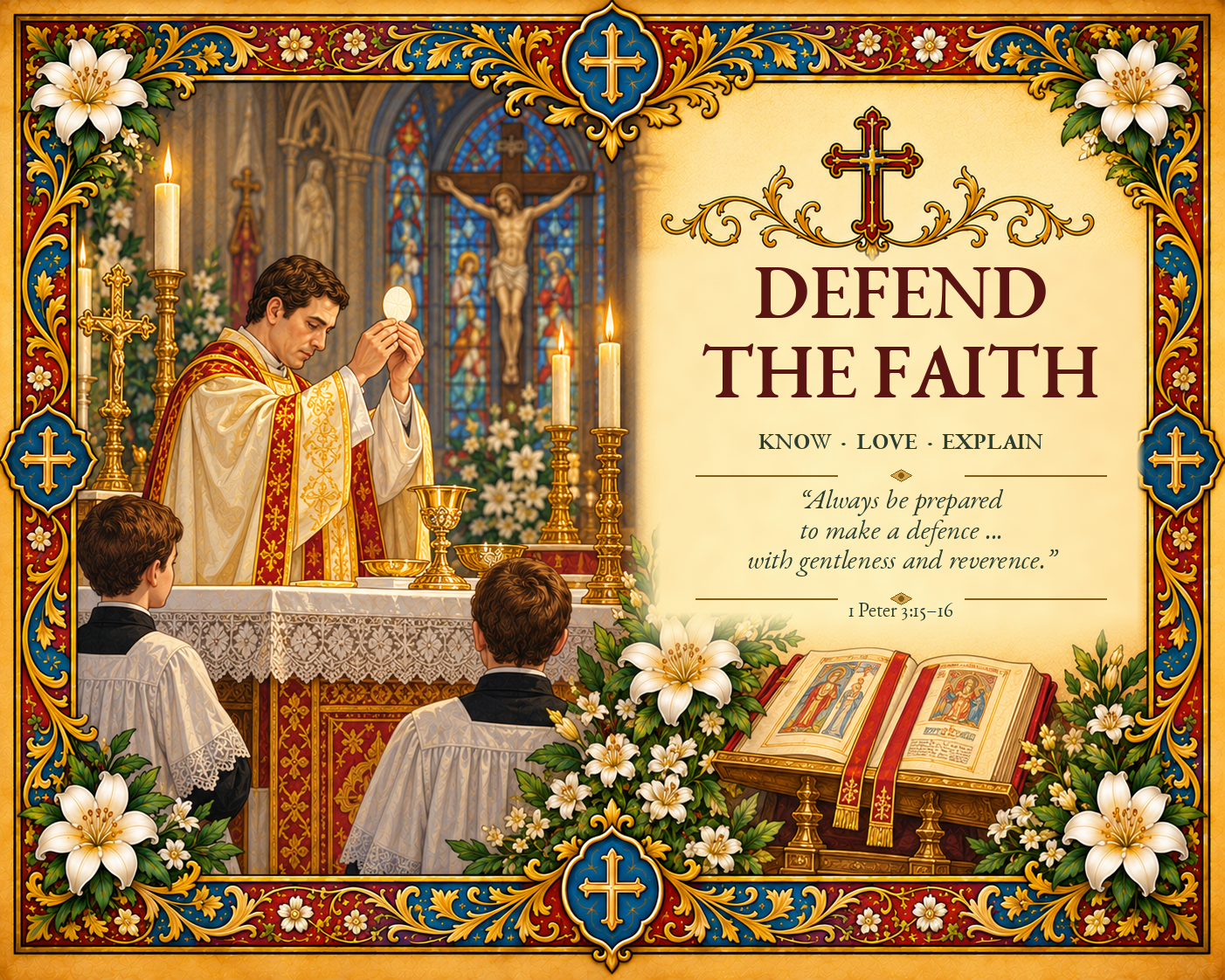
Knowing what we believe, why we believe it, and how to explain it with clarity and charity
Understanding and Explaining the Catholic Faith
Why be Catholic?
Did Jesus really found the Church?
Can we trust the Bible?
Why do Catholics confess their sins to a priest, honour Mary and the saints, and believe that the Eucharist is truly Jesus Christ?
Why does God allow suffering?
Are we saved by faith or by works?
These are important questions. Some come from sincere curiosity. Others arise from confusion, painful experiences, or objections people have heard about the Catholic Church.
Catholics themselves sometimes find it difficult to explain why the Church believes and teaches what she does.
Defending the Faith is a continuing series of Catholic teaching intended to help us understand our faith more deeply and explain it calmly, clearly, and faithfully.
Saint Peter encourages Christians to be ready to give a reason for the hope within them, but always with gentleness and reverence (1 Peter 3:15).
That is the spirit of this series.
We are not trying to win arguments, embarrass people, or speak harshly about those who believe differently.
We are seeking to understand the truth entrusted by Jesus Christ to His Church, to recognise its foundations in Sacred Scripture and Sacred Tradition, and to explain it with confidence and charity.
The Catholic faith is not simply a collection of rules, customs, and religious ceremonies.
It begins with a Person.
Jesus Christ, the Son of God, who became man, died for our sins, rose from the dead, and founded His Church to continue His saving work.
Everything in this series ultimately leads back to Him.
Who Is This Series For?
These teachings are intended for anyone who would like to understand the Catholic faith more deeply.
They may be especially helpful to practising Catholics who want to strengthen their knowledge, parents wishing to explain the faith to their children, young people encountering questions and objections, Catholics returning to the Church, and those who are exploring Christianity for the first time.
No previous theological knowledge is necessary.
Each session explains a particular question in accessible language while remaining faithful to the teaching of the Catholic Church.
The sessions draw upon Sacred Scripture, the Catechism of the Catholic Church, the Church’s Tradition, and the wisdom of Catholic theology.
They also offer practical ways of answering common questions and encourage personal reflection.
How to Use These Teachings
You are welcome to begin with the first session and follow the series in order. Each teaching builds upon the Catholic faith already introduced.
However, you can also choose a particular question which interests you or which you have found difficult to answer.
There is no timetable to complete and no expectation that you must read everything.
Take your time.
Read carefully.
Look up the Scripture passages.
Reflect upon what the Church teaches.
And, above all, allow what you learn to deepen your prayer, your participation in Sunday Mass, your reception of the sacraments, and your friendship with Jesus Christ.
The purpose of defending the faith is not simply to know more about Catholicism. It is to believe more deeply, live more faithfully, and help others encounter Christ.
Read the Sessions
Part One — Foundations of the Catholic Faith
Why belonging to the Catholic Church matters, why faith begins with Jesus Christ, and what the Church offers that private spirituality alone cannot provide.
2. Did Jesus Really Found the Church?
The Apostles, Saint Peter, the authority Christ gave His Church, and why the Church is not simply a later human invention.
Why Catholics believe in Sacred Scripture and Sacred Tradition, how the Bible was handed on, and why the Church has a responsibility to interpret it faithfully.
4. Who Has Authority in the Church?
Christ’s authority, the Apostles, the Pope, the bishops, the Magisterium, and why Catholic teaching authority exists to serve the truth.
Part Two — Catholic Worship, Sacraments and Moral Teaching
5. Why Do Catholics Go to Mass Every Sunday?
Why Sunday is the Lord’s Day, what happens at Mass, and why Catholic worship is more than personal prayer or a religious gathering.
6. Is the Eucharist Really Jesus?
The Real Presence of Christ, His teaching on the Bread of Life, transubstantiation, and why Catholics approach Holy Communion with reverence.
7. Why Confess Sins to a Priest?
Why Jesus gave His Church the authority to forgive sins, what happens in Confession, and why this sacrament is an encounter with Christ’s mercy.
Original sin, new life in Christ, the grace of Baptism, and why Catholic parents and godparents help children grow into the faith they receive.
9. Why Do Catholics Honour Mary and the Saints?
The difference between worship and honour, the communion of saints, Our Lady’s place in God’s plan, and why Catholics ask the saints to pray for them.
10. Why Does the Church Teach Difficult Moral Truths?
Why Catholic moral teaching is rooted in truth and love, the meaning of freedom and conscience, and why Christ calls us to conversion.
Part Three — Suffering, Death, Prayer and God’s Grace
11. Why Is There Suffering If God Is Good?
The problem of evil, human freedom, the Cross of Christ, and how Christian faith offers hope without pretending that suffering is easy.
The Catholic understanding of death, particular judgement, heaven, hell, purgatory, the resurrection of the body, and eternal life.
Why we pray when God already knows our needs, what prayer really is, and how we continue trusting Him when our prayers seem unanswered.
14. Does God Still Act in the World?
Divine providence, miracles, answered prayer, and the quiet ways in which God acts through creation, human freedom, and grace.
15. What Is Grace, and Why Do We Need It?
God’s free gift of supernatural life, sanctifying and actual grace, conversion, and why holiness is impossible without God’s help.
16. What Is a Sacrament, and Why Do We Need Sacraments?
The seven sacraments, visible signs of invisible grace, Christ acting through His Church, and why sacramental preparation and Christian living matter.
Part Four — Jesus Christ, the Resurrection and Salvation
The Incarnation, why Jesus is truly God and truly man, why He came to save humanity, and what His becoming man reveals about God’s love.
18. Did Jesus Really Rise from the Dead?
The empty tomb, the testimony of the Apostles, the historical evidence, common objections, and why the bodily Resurrection is essential to Christianity.
19. Are Catholics Saved by Faith or by Works?
Grace, faith, justification, Saint Paul and Saint James, the role of good works, and the Catholic teaching that living faith must bear fruit in charity.
More Questions Will Be Explored
The Catholic faith is rich, and the questions people ask about it are many.
Further sessions will continue to explore the person of Jesus Christ, the reliability of the Gospels, the Church’s history and authority, Christian divisions, Catholic worship and devotions, moral teachings, and objections frequently made against the Catholic Church.
Some questions will be straightforward.
Others will require careful explanation.
All deserve a faithful, thoughtful, and charitable response.
New teachings will be added to this page as the series develops.
Defending the Faith Begins with Living It
There is one final point which should never be forgotten.
The strongest defence of Catholicism is not cleverness.
It is holiness.
A person may know many arguments about God and yet fail to love Him.
Someone may be able to quote Scripture but struggle to forgive.
A Catholic may win a discussion while speaking without charity.
That is not the witness Christ asks of us.
We should know our faith.
We should understand the Church’s teaching.
We should be able to answer questions truthfully.
But our knowledge must lead us towards deeper conversion.
Sunday Mass.
Prayer.
Confession.
The Eucharist.
Charity towards the poor.
Patience with others.
Faithfulness in family life.
Courage in difficult circumstances.
And humble trust in Jesus Christ.
These are also ways of defending the faith.
We do not need to be professional theologians to speak about Catholicism.
We need to know what we believe, be willing to keep learning, and speak with gentleness and reverence.
We defend the faith best when the truth we profess can also be seen in the lives we lead.
A Prayer for Faith and Understanding
Lord Jesus Christ,
You are the Way, the Truth, and the Life.
Strengthen our faith in You.
Help us to love the Church You founded,
to understand the truth You have revealed,
and to receive Your teaching with humility.
Give us wisdom when we are questioned,
patience when we are misunderstood,
and courage when our faith is challenged.
Keep us from pride, anger, and harshness.
May our words be truthful,
our hearts charitable,
and our lives faithful to Your Gospel.
Help us not only to defend the Catholic faith,
but to live it with love.
Amen.

