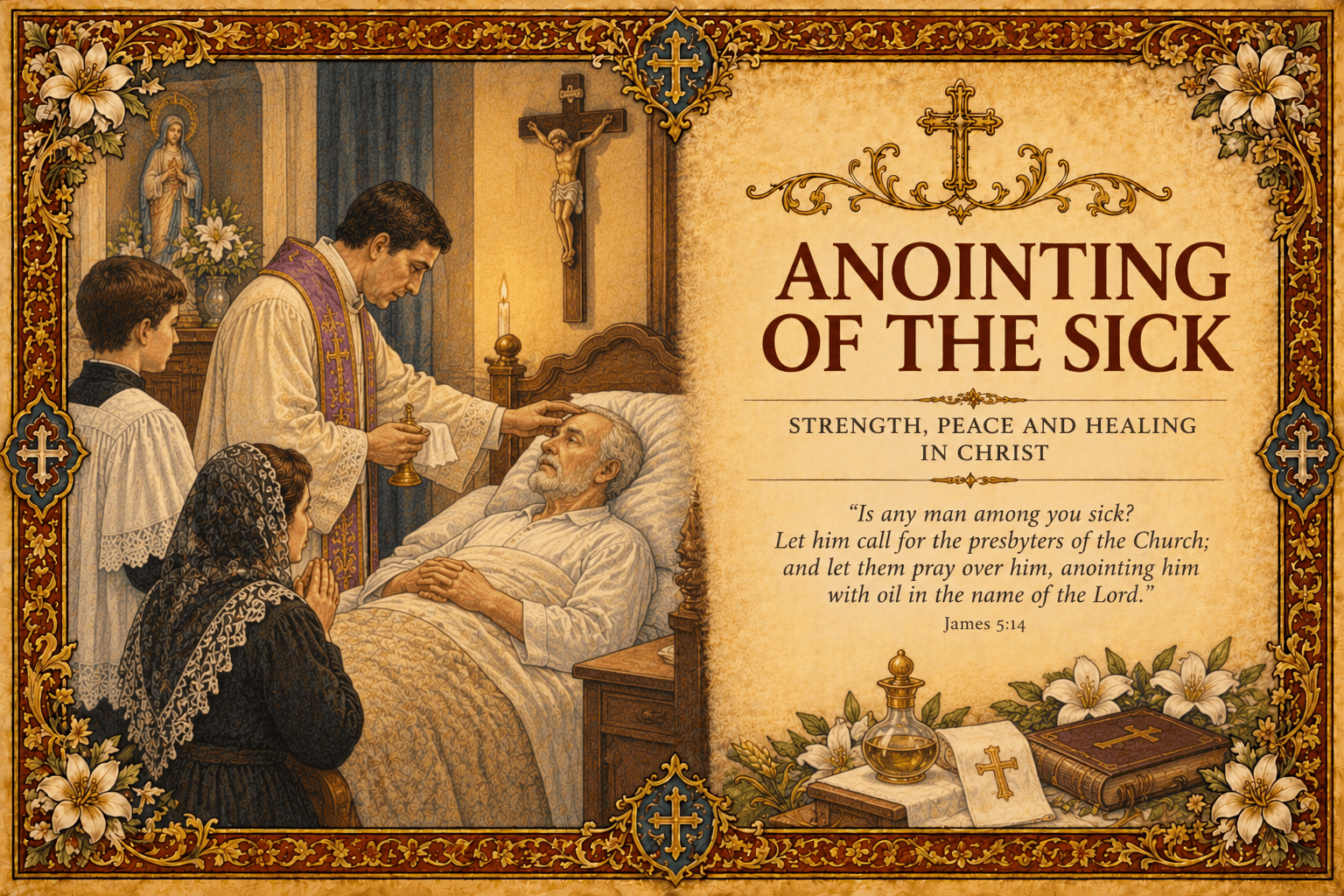
Christ’s strength, healing and peace in serious illness
The Anointing of the Sick is one of the seven sacraments of the Catholic Church.
Through the prayer and anointing of the priest, Jesus Christ comes close to those who are seriously ill, weakened by age or facing the danger associated with sickness.
The sacrament brings grace, strength, peace and courage. It unites the sick person more closely to Christ and entrusts them to the prayer and care of the whole Church.
“Is any man sick among you? Let him bring in the priests of the Church, and let them pray over him, anointing him with oil in the name of the Lord.”
James 5:14
If someone is seriously ill or near death
Please contact the parish as soon as possible.
Do not wait until the final moments. Early contact gives the person time to receive the sacraments peacefully and, where possible, while they are still able to participate.
For an urgent request, please telephone the Parish Office on 07354 832195.
If the person is in hospital, ask the ward staff to contact the Catholic chaplain immediately. Hospitals do not always inform the parish when a Catholic has been admitted.
The sacraments are given to the living. If someone has already died, the priest cannot administer Anointing, but he can pray for the person and support the family.
What are you asking for?
When a Catholic asks for the Anointing of the Sick, they are asking Christ to strengthen, heal and sustain them during serious illness or increasing frailty.
The sacrament can bring:
- strength, peace and courage;
- grace to endure the difficulties of illness;
- a deeper union with the Passion of Christ;
- forgiveness of sins when the person cannot make Confession and is properly disposed;
- spiritual healing and, if God wills, bodily healing;
- preparation for the final journey when death is approaching.
Anointing is not simply a general blessing or a prayer for recovery. It is a sacrament in which Christ acts through the ministry of his priest.
Who may receive the sacrament?
The Anointing of the Sick may be received by a baptised Catholic who:
- is seriously ill;
- has experienced a significant deterioration in health;
- is becoming seriously weakened by old age;
- is suffering from a serious physical or mental illness;
- or is preparing for surgery required because of a serious illness or medical condition.
Not every minor illness, injury, medical appointment or operation requires Anointing. If you are uncertain, please ask the priest. He will help determine whether the sacrament is appropriate.
A child who has reached the use of reason may receive Anointing when seriously ill.
If the sick person is unconscious or unable to communicate, please still contact the priest. The sacrament may be given when there is good reason to believe that the person would have asked for it.
If the person is not Catholic, or their situation is uncertain, please speak with the priest or hospital chaplain. They will explain what pastoral and sacramental care can be offered.
Not only for the final moments of life
The Anointing of the Sick is not reserved only for someone who is about to die.
It should be requested when serious illness or significant frailty begins, rather than being postponed until the person is unconscious or death is imminent.
The sacrament may be received again:
- if the illness becomes more serious;
- if the person recovers and later develops another serious illness;
- or if increasing age brings a further serious decline in health.
It is better to contact the priest early and ask than to leave the request too late.
What happens during Anointing?
The sacrament may be celebrated:
- at home;
- in hospital;
- in a care home;
- or, on suitable occasions, during a parish celebration.
The priest begins with prayer and, where appropriate, the Sacrament of Penance.
He lays his hands upon the sick person in silence, prays for them and anoints them with the Oil of the Sick.
The forehead and hands are ordinarily anointed while the priest says:
Through this holy anointing may the Lord in his love and mercy help you with the grace of the Holy Spirit.
May the Lord who frees you from sin save you and raise you up.”
The sacrament does not promise an automatic physical cure. It entrusts the sick person to Christ, who gives the healing, strength and grace they truly need.
Only a bishop or priest can administer the Anointing of the Sick.
Confession, Anointing and Holy Communion
Where possible, a seriously ill Catholic should be offered:
- the Sacrament of Penance and Reconciliation;
- the Anointing of the Sick;
- Holy Communion.
These sacraments bring forgiveness, strength and union with Christ.
When someone is approaching death, Holy Communion is received as Viaticum, which means food for the journey. Viaticum is the final Holy Communion of the Christian, strengthening the person as they prepare to pass from this life to the Father.
The priest may also give the Apostolic Pardon, which entrusts the dying person to God’s mercy and grants a plenary indulgence under the usual conditions.
Please ask early so that these sacraments can be celebrated calmly and reverently.
If you are going into hospital
When you are admitted to hospital, tell the ward staff or chaplaincy that you are Catholic.
You may ask for:
- the Catholic chaplain;
- Confession;
- the Anointing of the Sick;
- Holy Communion;
- or prayers before surgery.
Hospitals do not automatically tell the parish that someone has been admitted. A family member should also contact the parish if continuing prayer or pastoral support would be helpful.
Before surgery, Anointing is appropriate when the surgery is necessary because of a serious illness or medical condition.
Supporting someone who is ill
Family members and friends can help by:
- contacting the priest before the situation becomes critical;
- praying with the sick person;
- bringing a crucifix, Rosary or holy image if the person would find this helpful;
- helping them prepare for Confession if they wish;
- ensuring that hospital staff know they are Catholic;
- and remaining calmly present during the priest’s visit.
There is no need to prepare special words. The priest will guide everyone through the celebration.
Would you like to receive the Anointing of the Sick?
Please contact us if:
- you are seriously ill and would like to receive the sacrament;
- you are preparing for surgery because of a serious condition;
- your health or frailty has worsened;
- you are caring for someone who may need the sacrament;
- someone is approaching death;
- or you are uncertain whether Anointing is appropriate.
The sacrament is offered freely and pastorally.
Parish Priest: Fr John Owens
Telephone: 07354 832195
Email: john.owens@dioceseofnottingham.uk
READ THE CATECHISM ON THE ANOINTING OF THE SICK
In asking for Anointing, we ask Jesus Christ to strengthen, heal and sustain the sick person, and to keep them close to him in suffering, weakness and hope.

