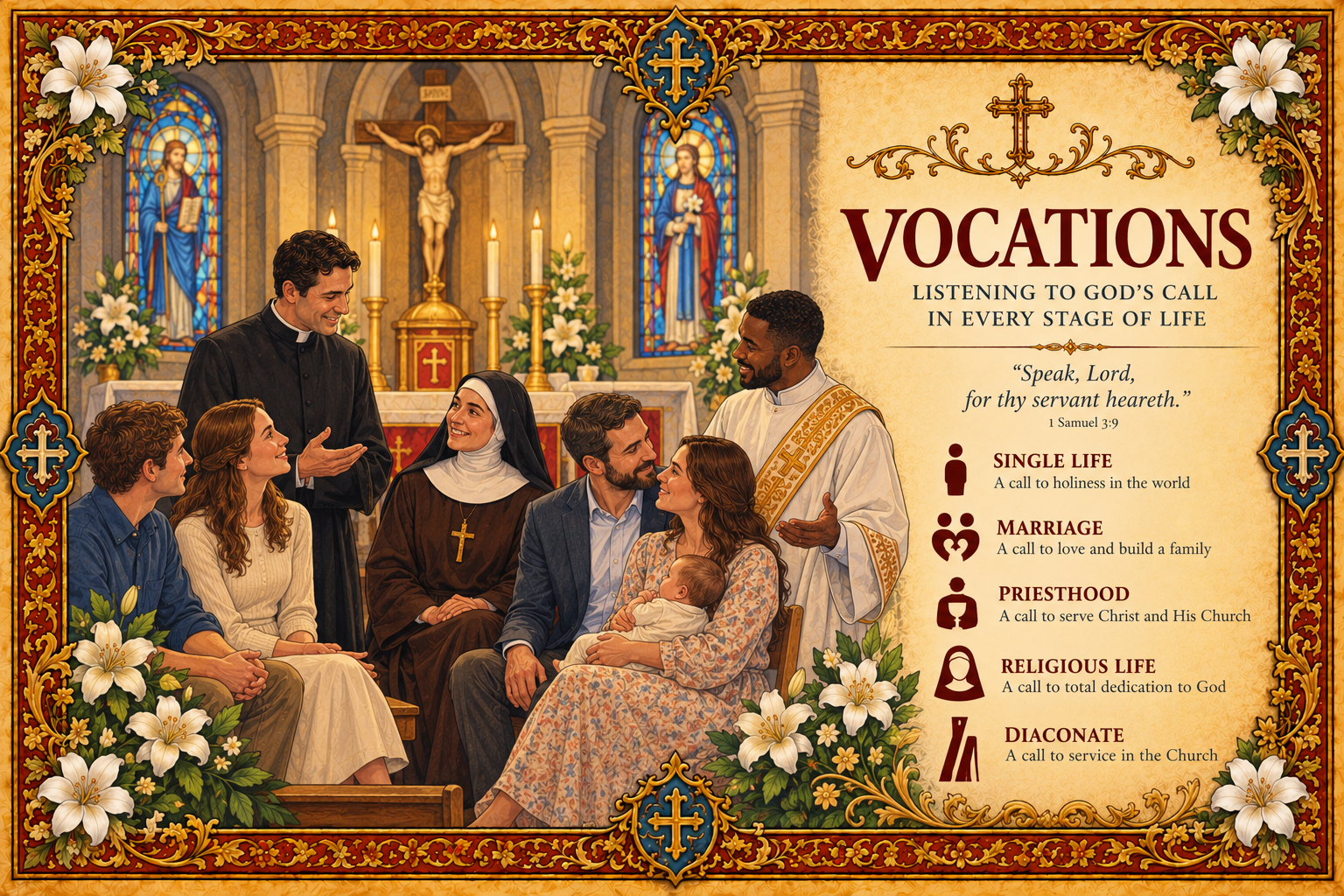
Called by God to Holiness and Service
Every Christian has a vocation.
Our first and universal calling is to know, love and serve God, to become holy and to help others reach heaven. Within that shared calling, God gives each person a particular path through which to love and serve him.
This may be:
- Marriage and family life
- Priesthood
- The permanent diaconate
- Religious or consecrated life
- A faithful single life offered in service to God and others
A vocation is not merely a career or personal project. It is a call from God, discovered through prayer, freedom, faithful Catholic life and discernment within the Church.
“Speak, Lord, for thy servant heareth.”
1 Samuel 3:10
Discerning God’s Call
God’s call does not always arrive as a sudden certainty.
It may begin with:
- A growing love for Christ and his Church
- A desire to serve
- A love for the Mass and the sacraments
- A question which repeatedly returns
- An attraction towards a particular form of life
- Other faithful Catholics recognising gifts in us
- A sense that God may be asking for something more
Uncertainty is normal. Certainty usually grows through discernment, not before it.
Asking about a vocation does not commit someone to seminary, religious life, ordination or any other final decision. It simply means being willing to ask honestly:
“Lord, what are you calling me to do with the life you have given me?”
The Priesthood
The ministerial priesthood is essential to the sacramental life of the Church.
Through the Sacrament of Holy Orders, a priest is configured to Christ in a particular way. He acts in the person of Christ the Head when he:
- Offers the Holy Sacrifice of the Mass
- Consecrates the Eucharist
- Forgives sins in Confession
- Anoints the sick
- Preaches the Gospel
- Shepherds God’s people
- Celebrates the other sacraments entrusted to him
The priesthood exists for the worship of God, the proclamation of the Gospel and the salvation of souls.
A man does not decide by himself that he should become a priest. He asks the Church to discern with him whether Jesus Christ is calling him to ordained ministry.
Formation includes prayer, study, human and spiritual formation, pastoral experience and careful discernment over several years.
Possible signs of a priestly vocation may include:
- A deep love for Jesus Christ
- Faithful participation in Mass and Confession
- A desire to bring people to God
- Love for Scripture and Catholic teaching
- A willingness to serve without seeking status
- A question about priesthood which does not disappear
No one should be pressured into priesthood, and no one should dismiss the possibility merely through fear or a sense of unworthiness.
The first step does not require certainty. It requires openness, prayer and an honest conversation.
LEARN ABOUT PRIESTHOOD IN THE DIOCESE OF NOTTINGHAM
The Permanent Diaconate
Deacons receive the Sacrament of Holy Orders and are ordained for a ministry of service, the Word and the liturgy.
A deacon may:
- Proclaim and preach the Gospel
- Assist the priest at Mass
- Baptise
- Witness marriages
- Preside at funerals and certain other services
- Serve the poor, sick and vulnerable
- Assist with catechesis and pastoral care
A deacon cannot consecrate the Eucharist, hear Confessions or celebrate the Anointing of the Sick.
There are two forms of the diaconate:
- A transitional deacon is preparing for priesthood.
- A permanent deacon remains a deacon throughout his ministry.
A married man may be considered for the permanent diaconate. His wife’s consent and the wellbeing of his family form an essential part of the Church’s discernment.
Men considering the permanent diaconate are normally mature in faith, active in parish life and drawn towards a stable life of service.
LEARN ABOUT THE PERMANENT DIACONATE
Religious and Consecrated Life
In religious life, a man or woman gives himself or herself to God through the vows of:
- Poverty
- Chastity
- Obedience
Religious sisters, brothers and priests usually live in a community and follow the rule and charism of a particular religious family.
Some communities are devoted especially to prayer and contemplation. Others serve through teaching, healthcare, missionary work, care for the poor, preaching or other apostolates.
Not every religious man is a priest, and not every priest belongs to a religious community. Many priests serve a diocese rather than a religious order.
Possible signs of a vocation to religious life may include:
- A desire for deeper prayer
- Attraction to community life
- A desire to belong entirely to God
- Interest in a particular religious community
- A longing to serve Christ through a particular charism
Discernment normally begins with prayer and conversation. A person may then visit or contact a religious community without making any immediate commitment.
Marriage
Christian marriage is also a vocation.
In the Sacrament of Matrimony, a baptised man and woman enter a lifelong covenant of faithful and exclusive love. They are called to help one another become holy and to welcome and educate the children God may entrust to them.
Discernment of marriage should therefore ask more than whether two people are attracted to one another. It should consider whether they can freely promise lifelong fidelity, sacrifice, openness to family life and a shared commitment to Christ.
LEARN ABOUT MARRIAGE AND PREPARATION
Faithful Single Life
Some Catholics serve God faithfully while remaining unmarried.
For some, this may be a lasting and deliberately discerned way of life. For others, it may be their present state while God’s future call remains unclear.
An unmarried person is not without a vocation or outside the life of the Church. Every baptised person is called to prayer, holiness, charity, service and mission.
The important question is not simply, “What title or role do I have?” It is:
“How is God asking me to love and serve him faithfully now?”
How to Begin Discernment
If you believe God may be calling you to priesthood, the diaconate or religious life, begin simply.
Pray Daily
Ask God honestly what he desires for your life. Spend time before the Blessed Sacrament and read the Gospels.
Attend Mass Faithfully
A vocation grows within the ordinary life of the Church. Sunday Mass, regular Confession and personal prayer provide the necessary foundation.
Serve
Take a real part in parish life. Service helps reveal gifts, weaknesses, motives and areas of growth.
Seek Guidance
Speak to a priest or another suitable and faithful guide. Discernment should not be carried out entirely alone.
Be Patient
Do not demand an immediate answer. God ordinarily guides us through prayer, circumstances, the judgement of the Church and growing freedom over time.
If You Would Like to Talk
If you are quietly wondering whether God may be calling you, you are very welcome to speak with Fr John.
The conversation is confidential and carries no pressure, expectation or commitment.
Fr John Owens
Email: john.owens@dioceseofnottingham.uk
You may also speak to Fr John before or after Mass at St Mary’s, St John Bosco or St Edward’s.
For diocesan information and guidance:
DIOCESE OF NOTTINGHAM VOCATIONS
Diocesan Vocations Office:
vocations@dioceseofnottingham.uk
Prayer for Vocations
Lord Jesus Christ,
you call each of us by name
and invite us to follow you.
Give us generous hearts,
freedom from fear
and the courage to answer your call.
Raise up holy priests, deacons,
religious sisters and brothers,
faithful married couples
and generous Christian witnesses.
Help each of us to discover
and live the vocation you have given us.
Our Lady, Mother of the Church, pray for us.
Amen.

