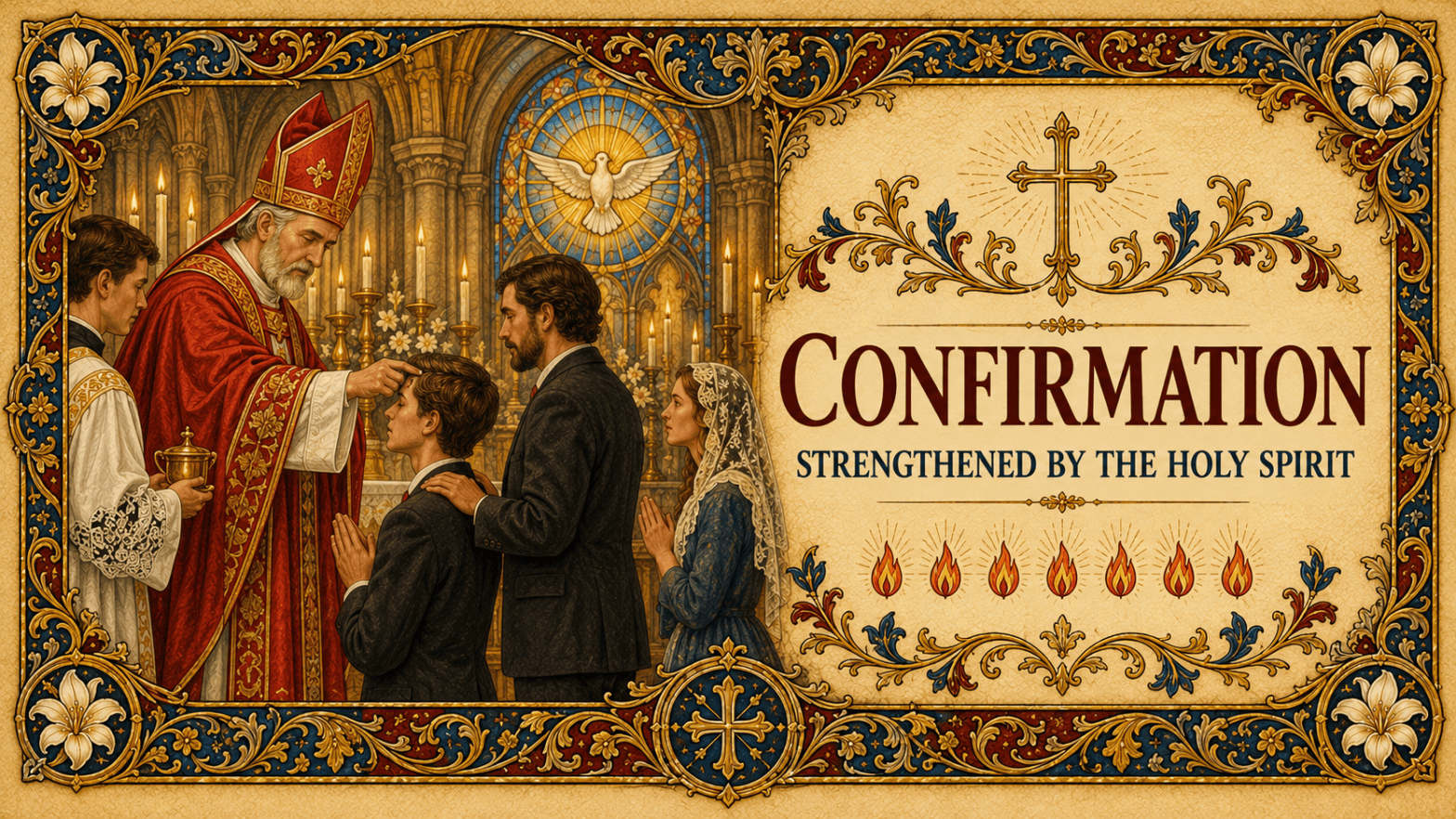
Strengthened by the Holy Spirit
Confirmation is one of the seven sacraments of the Catholic Church and one of the three Sacraments of Christian Initiation, together with Baptism and the Holy Eucharist.
In Confirmation, the grace first received in Baptism is completed and strengthened through a special outpouring of the Holy Spirit.
The confirmed person is united more firmly to Jesus Christ and his Church, strengthened to live the Catholic faith and sent to bear witness to Christ in the world.
The first step is Sunday Mass, prayer and a conversation with the parish.
Which pathway should I follow?
Our parish provides separate pathways for young people and adults.
Confirmation for young people
This pathway is for baptised Catholic young people who have not yet received Confirmation.
Preparation is personal, catechism-led and supported by parents and, where helpful, a parish mentor.
Adult Confirmation
This pathway is for an adult who was baptised Catholic, has received First Holy Communion, but has never been confirmed.
If you are not yet Catholic
If you have never been baptised, your proper pathway is Christian initiation through the catechumenate.
If you were baptised in another Christian Church or community and now wish to become Catholic, please follow the pathway for reception into full communion.
If you were baptised or chrismated in an Orthodox or other Eastern Christian Church, please speak with the parish priest before beginning any preparation. A different canonical and sacramental route may apply.
If you are uncertain which pathway is right for you, please contact the parish. You do not need to work it out alone.
What is Confirmation?
Confirmation is not simply a public statement that someone has chosen to remain Catholic.
It is a sacrament in which God acts.
Through Confirmation, Christ gives a new sacramental strengthening of the Holy Spirit and marks the person with a permanent spiritual seal.
Confirmation:
- increases and deepens baptismal grace;
- roots us more deeply as children of God;
- unites us more firmly to Jesus Christ;
- increases the gifts of the Holy Spirit within us;
- makes our bond with the Church more perfect;
- gives special strength to spread and defend the faith by word and action;
- and imprints an indelible spiritual character upon the soul.
Because Confirmation gives a permanent spiritual seal, it can be received only once.
What Confirmation is not
Confirmation is sometimes misunderstood.
It is not:
- becoming an “adult Catholic”;
- graduating from the Church;
- choosing whether Baptism should count;
- receiving the Holy Spirit for the first time;
- a reward for completing a course;
- or simply a family celebration.
The Holy Spirit already comes to dwell within us through Baptism.
Confirmation gives a further sacramental outpouring of the Holy Spirit, strengthening baptismal grace and equipping the Christian for witness, mission and a more mature life of faith.
Confirmation does not mark the end of formation. It strengthens us for the Catholic life that follows.
What are you asking for?
When someone asks for Confirmation, they are asking for more than a ceremony.
They are asking:
- to receive the strengthening grace of the Holy Spirit;
- to be united more firmly to Christ and his Church;
- to renew their baptismal promises sincerely;
- to receive the permanent seal of Confirmation;
- to be strengthened for Christian witness and mission;
- and to continue living faithfully as a Catholic.
A candidate does not need perfect knowledge or perfect faith before beginning.
However, Confirmation should be desired freely and received with genuine understanding, proper preparation and the intention to continue living the Catholic faith.
In asking for Confirmation, we ask the Holy Spirit to strengthen this person to live as a disciple and witness of Jesus Christ within his Church.
Who may receive Confirmation?
A person may receive Confirmation if they:
- have been validly baptised;
- have not already been confirmed;
- are properly instructed according to their age and ability;
- understand the sacrament sufficiently;
- desire to receive it freely;
- are properly disposed;
- and are prepared to renew their baptismal promises.
A candidate should receive Confirmation in a state of grace.
They should normally receive the Sacrament of Penance and Reconciliation before Confirmation.
If someone is seriously ill or in danger of death and has not been confirmed, please contact the priest immediately. Special provision can be made without waiting for the ordinary preparation process.
Preparation is personal
Our parish uses personal and flexible preparation rather than a single annual course.
Preparation begins with a conversation.
We listen to the candidate, establish their sacramental record and discuss:
- their Baptism and previous formation;
- their present participation in Sunday Mass;
- their life of prayer;
- what they understand about Confirmation;
- any questions or difficulties;
- any learning, language or additional needs;
- and the most suitable way to prepare.
Young people prepare with the continuing involvement of their parents. A parent may lead the preparation using the parish catechism, or a parish mentor may accompany the young person and family.
Adults may prepare individually, with a sponsor, parish mentor or priest.
The parish preparation books contain the Catholic teaching. Optional web apps provide additional help with reading, learning and revision.
The apps do not replace Sunday Mass, prayer, Confession, personal accompaniment or parish life.
Preparation proceeds at a suitable pace. Lessons may be repeated, divided or explored more deeply.
Readiness matters more than speed.
Sunday Mass comes first
Confirmation belongs within the worshipping life of the Church.
The Eucharist is the source and summit of Catholic life. Someone cannot meaningfully prepare to be strengthened for Catholic discipleship while remaining completely detached from Sunday Mass and the sacramental life of the Church.
Candidates are therefore encouraged to:
- participate faithfully in Sunday Mass;
- develop a regular life of prayer;
- read Sacred Scripture;
- receive the Sacrament of Penance;
- grow in charity and service;
- learn the Catholic faith;
- and become more fully part of parish life.
If you are not currently attending Mass regularly, do not wait until everything feels perfect.
Simply begin.
Come to Mass, become familiar with the parish and allow your life of faith to grow from there.
Confession before Confirmation
Confirmation should be received in the state of grace.
Candidates should therefore normally receive the Sacrament of Penance and Reconciliation before the celebration.
Confession is not a punishment or an examination. It is the sacrament in which Jesus Christ forgives our sins, restores us to grace and prepares our hearts to receive the Holy Spirit more fruitfully.
LEARN ABOUT PENANCE, CONFESSION AND RECONCILIATION
The seven gifts of the Holy Spirit
The traditional seven gifts of the Holy Spirit are:
Wisdom · Understanding · Counsel · Fortitude · Knowledge · Piety · Fear of the Lord
These gifts help us become more ready to recognise and follow the promptings of the Holy Spirit.
They are not magical powers or rewards for learning their names.
They strengthen us to:
- know and love God more deeply;
- judge things in the light of faith;
- choose what is good;
- persevere when faith is difficult;
- resist sin;
- pray with trust and reverence;
- and live faithfully as children of God.
Fear of the Lord does not mean being terrified of God. It means reverent awe, loving God above everything and not wanting to turn away from him.
Choosing a sponsor
Each candidate should, as far as possible, have a suitable Confirmation sponsor.
A sponsor is not merely someone who stands beside the candidate during the ceremony.
The sponsor should be a practising Catholic who:
- has received Baptism, Confirmation and the Holy Eucharist;
- is mature enough to fulfil the responsibility;
- lives in a way consistent with the Catholic faith;
- is willing to pray for and encourage the candidate;
- and meets the requirements of the Church.
The candidate’s father or mother cannot act as sponsor.
Where possible, choosing one of the candidate’s baptismal godparents is especially appropriate because it expresses the close relationship between Baptism and Confirmation.
The parish will help if the candidate does not know someone suitable.
Choosing a saint’s name
Candidates are often invited to choose the name of a saint or blessed as part of their preparation.
This is a good Catholic custom, but it is not essential to the validity of the sacrament.
The chosen saint should be someone whose faith, courage, charity or vocation can inspire the candidate.
Keeping one’s baptismal name is also a good and meaningful choice. It emphasises that Confirmation strengthens the grace and Christian identity already received in Baptism.
What happens during Confirmation?
The ordinary minister of Confirmation is the bishop, although a priest may sometimes receive the faculty to confirm.
During the celebration:
- the candidates renew their baptismal promises;
- the bishop or priest prays for the outpouring of the Holy Spirit;
- the candidates approach with their sponsors;
- each candidate is anointed on the forehead with sacred chrism;
- and the sacramental words are spoken.
The minister says:
“N., be sealed with the Gift of the Holy Spirit.”
The candidate answers:
“Amen.”
The minister then says:
“Peace be with you.”
The candidate answers:
“And with your spirit.”
Through this anointing, the candidate receives the permanent spiritual seal of Confirmation and is strengthened by the Holy Spirit for Christian life and mission.
How is readiness discerned?
Readiness is not decided simply by age, school year, attendance at a certain number of lessons or the ability to pass an examination.
At a level appropriate to their age and ability, a candidate should:
- know who the Holy Spirit is;
- understand what Confirmation is;
- desire to receive the sacrament freely;
- understand that Confirmation strengthens baptismal grace;
- be willing to renew the baptismal promises sincerely;
- participate faithfully in Sunday Mass;
- have begun a genuine life of prayer;
- be prepared to receive Confession;
- understand the principal parts of the rite;
- and show a willingness to continue living as a Catholic.
Parents, sponsors and parish mentors help the candidate prepare.
The parish priest has responsibility for the final discernment of readiness and the arrangements for the celebration.
The purpose is not to catch anyone out. It is to ensure that the candidate knows what they are asking for and is properly prepared to receive the sacrament.
After Confirmation
Confirmation is not the end.
There is no graduation from being Catholic.
The grace of Confirmation is given so that the confirmed person can continue to grow through:
Sunday Mass · Holy Communion · regular Confession · daily prayer · Sacred Scripture · charity · service · parish life · Christian witness
The confirmed person is called to ask:
- Where is God asking me to serve?
- How can I use the gifts he has given me?
- How can I bear witness to Christ at home, at school, at work and among friends?
- What vocation may God be asking me to consider?
- How can I take a more responsible place within the life and mission of the Church?
The Holy Spirit is given not only for the day of Confirmation, but for a lifetime.
Ready to begin?
Choose the pathway that applies to you:
If you are uncertain, simply contact the parish.
The first step is a conversation, followed by Sunday Mass, prayer and preparation at a suitable pace.
Parish Priest: Fr John Owens
Telephone: 07354 832195
Email: john.owens@dioceseofnottingham.uk
READ THE CATECHISM ON CONFIRMATION
“Be sealed with the Gift of the Holy Spirit.”
Confirmation strengthens the grace of Baptism so that we may live as faithful disciples and witnesses of Jesus Christ.

