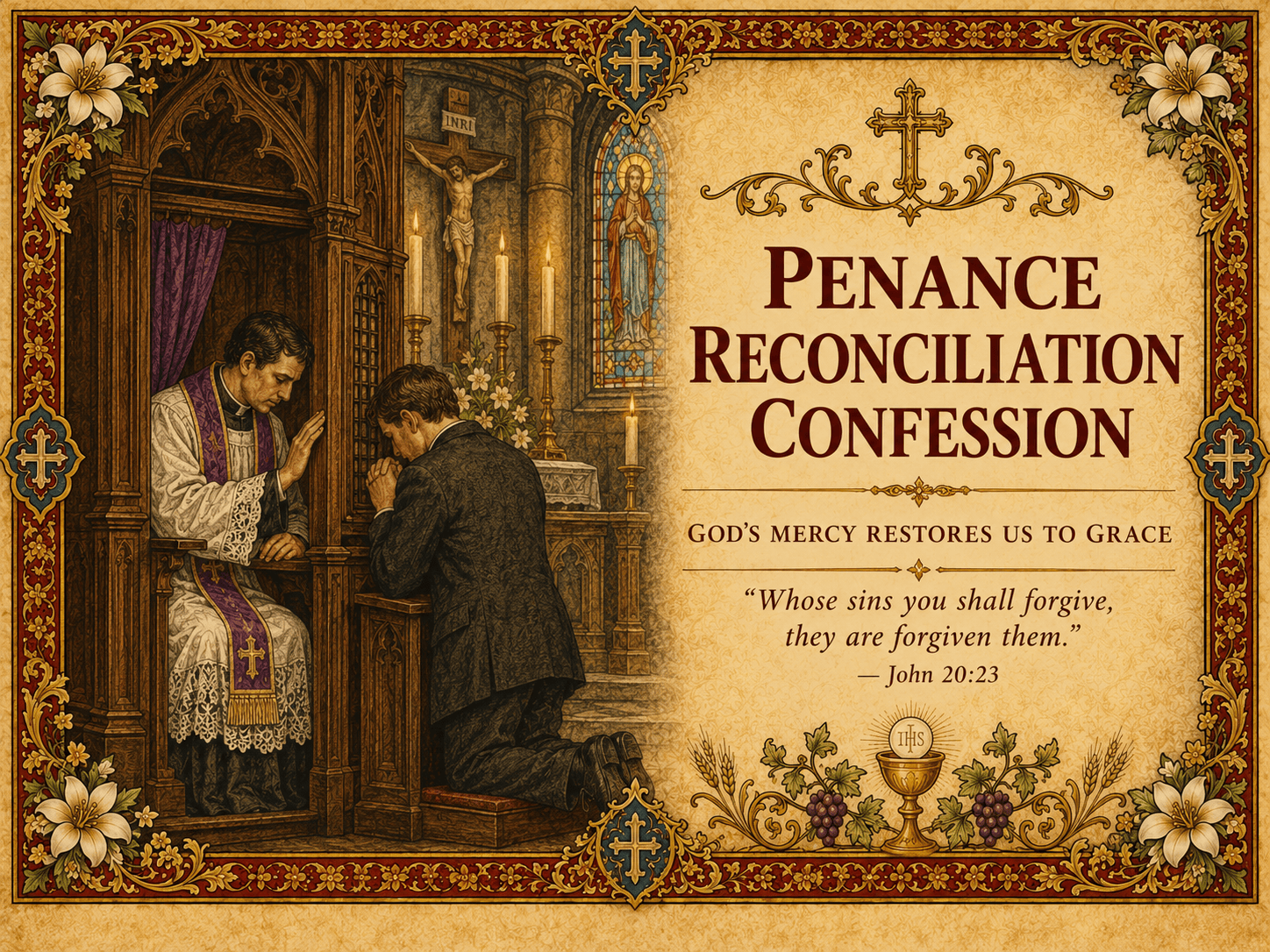
Meet Christ in his mercy
The Sacrament of Penance is one of the greatest gifts Jesus Christ has given to his Church.
In Confession, we do not meet condemnation. We meet the merciful Christ, who forgives our sins, restores his grace and gives us strength to begin again.
Jesus entrusted this ministry to his Apostles when he said:
“Receive ye the Holy Ghost. Whose sins you shall forgive, they are forgiven them.”
John 20:22–23
If you have been away from Confession for many years, have forgotten what to do or feel nervous about returning, please do not be afraid.
You are welcome. The priest will help you.
Confession times
Confession is ordinarily available:
- Saturday, 5.30 to 5.50 pm, St John Bosco
- Sunday, 5.30 to 5.50 pm, St Mary’s, before the 6.00 pm Mass
- half an hour before an evening Mass or devotion
- after a morning Mass, by request
- by appointment at another suitable time
View Mass and Confession Times
If you would prefer to arrange a private appointment, please contact the parish.
What is the Sacrament of Penance?
Sin wounds our friendship with God, harms us and damages our communion with the Church.
In the Sacrament of Penance, a baptised person:
- examines their conscience;
- is sorry for their sins;
- confesses those sins honestly to a priest;
- sincerely intends to turn away from sin;
- accepts a suitable penance;
- and receives sacramental absolution.
Through the ministry of the priest, Christ forgives sins committed after Baptism and reconciles the penitent with God and the Church.
The priest does not merely tell us that God may have forgiven us. Through the words of absolution, Christ sacramentally grants forgiveness.
Why does the sacrament have different names?
The same sacrament is commonly called:
Confession
We confess our sins honestly and profess our faith in God’s mercy.
Penance
We turn away from sin, return to God and accept a penance as a sign of conversion and reparation.
Reconciliation
Christ restores our friendship with God and reconciles us with his Church.
Each name helps us understand part of the same sacrament.
Why confess sins to a priest?
Only God can forgive sins. Jesus, who is God the Son, gave his Apostles authority to forgive sins in his name.
That ministry continues in the Church through bishops and priests.
When a priest hears a sacramental Confession, he acts as a minister of Christ and the Church. The penitent speaks to the priest, but it is Christ who forgives through the priest’s absolution.
Confession also protects us from deceiving ourselves. Speaking our sins honestly helps us take responsibility, receive clear forgiveness and begin again with the grace of God.
Mortal and venial sin
Not every sin has the same seriousness.
Mortal sin
Mortal sin destroys charity in the soul and causes the loss of sanctifying grace.
For a sin to be mortal, three conditions must all be present:
- The matter is grave.
- The person knows that it is gravely wrong.
- The person freely and deliberately chooses it.
Mortal sin cannot be committed accidentally. Fear, pressure, lack of understanding, habit or reduced freedom may affect a person’s responsibility.
Anyone conscious of mortal sin should receive sacramental absolution before receiving Holy Communion.
Venial sin
Venial sin does not destroy our friendship with God, but it wounds that friendship, weakens charity and makes it more difficult to resist temptation.
Venial sins may be forgiven through prayer, charity, sincere repentance and participation in Mass. Nevertheless, confessing them regularly is a valuable and strongly encouraged Catholic practice.
Frequent Confession helps us form our conscience, resist temptation and grow in holiness.
When should I go to Confession?
You should go to Confession:
- when you are conscious of having committed a mortal sin;
- when you are returning to the practice of the Catholic faith;
- when you have been away from the sacrament for a long time;
- when preparing for Confirmation, Marriage or another important stage of Christian life;
- and regularly as part of an ordinary Catholic life.
Catholics who have reached the use of reason are obliged to confess serious sins at least once a year.
There is no need to wait until you have committed a mortal sin. Many Catholics find monthly Confession, or Confession every few weeks, a helpful spiritual practice.
What if I have been away for many years?
Simply tell the priest:
“Father, it has been many years since my last Confession, and I am not sure what to do.”
The priest will guide you through the sacrament.
You do not need to remember every prayer or explain your whole life story. Prepare as honestly as you can, confess the serious sins you remember and allow the priest to help you.
If you cannot remember how many times something happened, give an honest indication. God does not ask the impossible.
If you honestly forget a mortal sin, it is forgiven with the other sins. If you remember it later, mention it at your next Confession.
Do not deliberately conceal a mortal sin. Confession depends upon honesty, sorrow and a sincere intention to change.
If you are returning to the practice of the Catholic faith, our Returning to the Faith pathway may also help you.
Returning to the Catholic Faith
How to prepare
1. Ask the Holy Spirit for light
Begin with a short prayer:
Holy Spirit, help me to see my sins honestly, to trust in the mercy of Jesus and to make a good Confession.
2. Examine your conscience
Think prayerfully about your life since your last good Confession.
Consider:
- your relationship with God;
- Sunday Mass and prayer;
- your responsibilities towards your family;
- your treatment of other people;
- honesty, justice and charity;
- purity in thought and action;
- forgiveness;
- the proper use of money, possessions, work and time;
- and the good you should have done but deliberately neglected.
The purpose is honesty, not anxiety. You are not trying to remember every imperfection or produce the longest possible list.
3. Be sorry for your sins
Contrition means genuine sorrow for sin and rejection of what is wrong.
Perfect contrition arises from love of God. Imperfect contrition may begin from recognising the ugliness of sin or fearing its consequences. Both can lead a person to the sacrament.
4. Make a sincere purpose of amendment
You should sincerely intend to turn away from sin and avoid what leads you into it.
This is not a promise that you will never struggle or fall again. It is an honest decision, made with God’s grace, not to choose the sin again.
How to go to Confession
If you are uncertain at any point, tell the priest. He will guide you.
1. Begin
Make the Sign of the Cross and say:
“Bless me, Father, for I have sinned. It has been _____ since my last Confession.”
If this is your first Confession, or your first for many years, say so.
2. Confess your sins
Confess your sins simply and honestly.
All mortal sins that you remember must be confessed. Say what the sin was and, as honestly as possible, how many times it happened.
Venial sins may also be confessed.
There is no need for unnecessary detail. Do not tell long stories to excuse or justify what happened.
When you have finished, you may say:
“For these and all the sins I cannot now remember, I am truly sorry.”
3. Listen to the priest
The priest may ask a question, offer brief guidance and give you a penance.
If something is unclear, you may ask him to explain.
4. Accept your penance
A penance may be a prayer, an act of charity or another suitable action. It does not purchase forgiveness. Christ has already paid the price of our redemption.
Penance expresses our willingness to repair the harm caused by sin and to begin living differently.
5. Make an Act of Contrition
You may use this form:
O my God,
I am very sorry that I have sinned against you,
and by the help of your grace
I will not sin again. Amen.
If you forget the words, tell the priest. He will help you, or you may express your sorrow sincerely in your own words.
6. Receive absolution
The priest extends his hand and says the prayer of absolution.
Listen prayerfully. When he makes the Sign of the Cross, make the Sign of the Cross yourself and answer:
“Amen.”
Through this absolution, Christ forgives the sins you have confessed with the proper disposition.
7. Give thanks and complete your penance
After leaving the confessional, thank God for his mercy and complete your penance as soon as reasonably possible.
What does Confession give us?
The Sacrament of Penance brings:
- reconciliation with God;
- forgiveness of sins;
- restoration of sanctifying grace when it has been lost;
- reconciliation with the Church;
- peace and serenity of conscience;
- spiritual consolation;
- strength to resist temptation;
- and grace for the continuing Christian life.
Confession does not merely remove a record of the past. It heals, strengthens and restores us to friendship with God.
Is Confession private?
Yes. The sacramental seal is absolute.
A priest may never reveal anything learnt through sacramental Confession. He may not repeat it directly, hint at it indirectly or use it against the penitent.
The seal applies even after the penitent has died.
This complete confidentiality allows every person to approach Christ’s mercy honestly and without fear.
What if I feel anxious?
Nervousness is very common, especially when someone has been away for a long time.
You may:
- tell the priest at the beginning that you are nervous;
- bring a short written list to help you remember;
- ask the priest to guide you;
- request an appointment if you need more time;
- and use our practical guide before coming.
The priest has heard many Confessions. You will not shock him, and you do not need to find perfect words.
Read What to Expect at Confession
First Confession for children
Children preparing to receive the Sacrament of Penance for the first time follow our personal First Confession pathway.
Preparation uses My First Confession Catechism, together with its Activity and Conversation Companion. A parent may lead the preparation, or the parish can provide a mentor to accompany the family.
Parents and mentors help the child understand the sacrament, but they must never ask the child to reveal real personal sins. Practice examples should always be invented.
First Confession is normally received before First Holy Communion.
First Confession Preparation for Children
A regular part of Catholic life
Confession is not a punishment and should not be reserved only for emergencies.
It is an ordinary part of Catholic life.
Through regular Confession we learn to:
- examine our lives honestly;
- take responsibility for our choices;
- trust the mercy of God;
- repair harm where possible;
- resist repeated temptation;
- and begin again after falling.
We do not come because we are already holy. We come because Jesus Christ is merciful and wants to make us holy.
Need to talk?
If you would like to arrange Confession, ask a question or speak to the priest outside the confessional, please contact:
Fr John Owens
john.owens@dioceseofnottingham.uk
View Mass and Confession Times
Church teaching
Catechism of the Catholic Church, The Sacrament of Penance and Reconciliation
Code of Canon Law, The Sacrament of Penance
However far you have wandered, the mercy of Christ is greater.
Come honestly, receive forgiveness and begin again.

