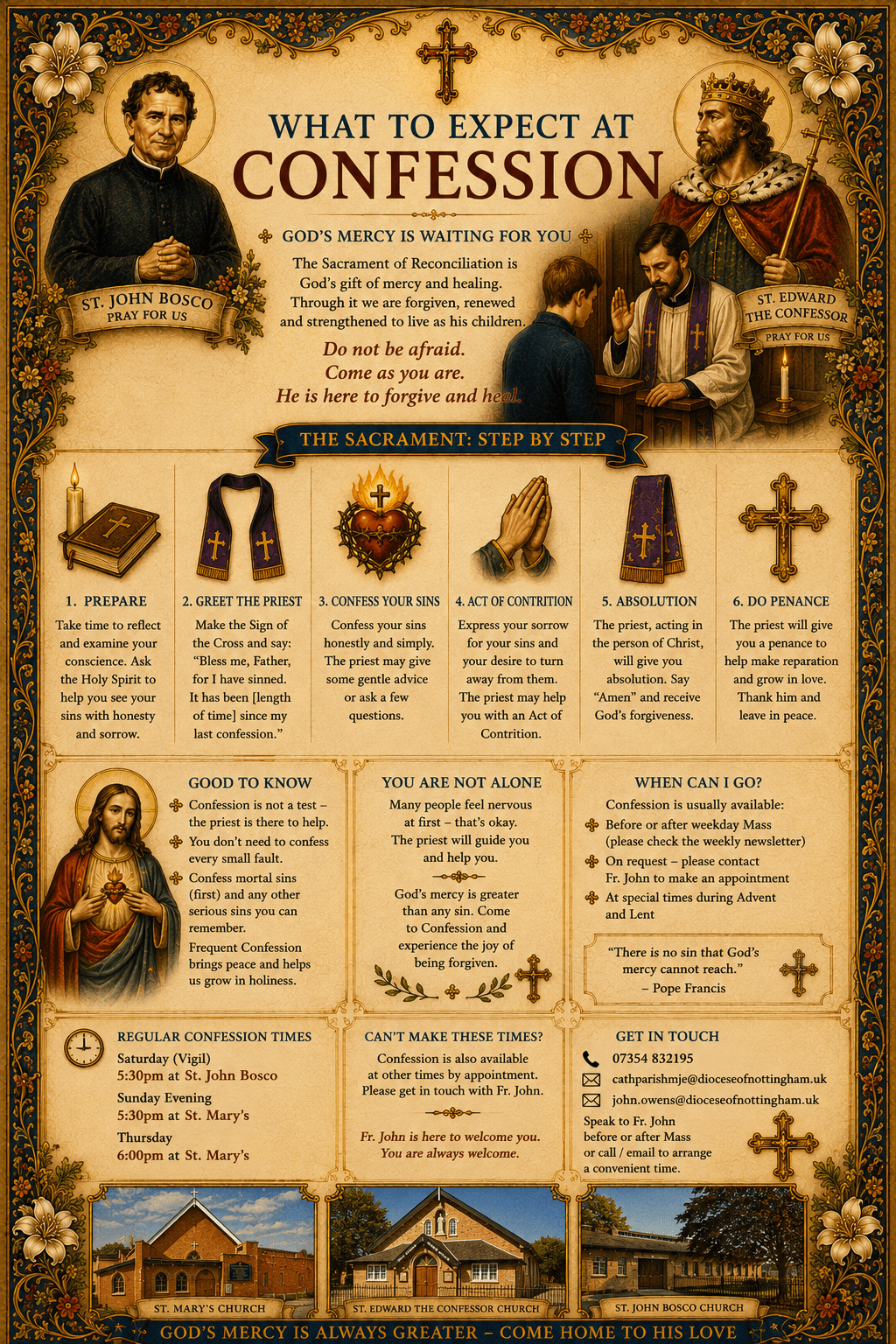
If you have not been to Confession for a long time, or have never been before, it is completely normal to feel nervous.
Please be reassured:
The Sacrament of Reconciliation exists to bring you Christ’s mercy, not embarrassment.
You do not need to remember every prayer perfectly. Tell the priest that you are unsure or that it has been a long time, and he will guide you.
What Is Confession?
In the Sacrament of Penance and Reconciliation, we confess our sins to a priest and receive forgiveness from Jesus Christ through the words of absolution.
After his Resurrection, Jesus said to the Apostles:
“Receive ye the Holy Spirit. Whose sins you shall forgive, they are forgiven them; and whose sins you shall retain, they are retained.”
John 20:22–23
The priest does not forgive sins by his own power. He acts in the person of Christ and exercises the ministry which Christ entrusted to his Church.
Through Confession, God gives us:
- Forgiveness of sins
- Reconciliation with himself and the Church
- Healing and peace
- Grace to resist future sin
- A fresh beginning
LEARN MORE ABOUT PENANCE, CONFESSION AND RECONCILIATION
Who Can Go to Confession?
The Sacrament of Confession is for baptised Catholics who have reached the age at which they can understand personal sin.
If you are not Catholic, are preparing to become Catholic, or are unsure whether you can receive the sacrament, you are very welcome to speak to the priest. He will explain the appropriate next step.
Preparing for Confession
Before Confession, spend a little time in prayer.
Ask the Holy Spirit to help you recognise your sins honestly and trust in God’s mercy.
You may then make an examination of conscience by considering:
- My relationship with God
- Sunday Mass and prayer
- My use of God’s name
- My treatment of family and other people
- Anger, hatred and refusal to forgive
- Dishonesty, stealing or damage to another person’s reputation
- Purity and respect for the dignity of others
- Envy, greed and selfishness
- Duties which I have deliberately neglected
The purpose is not to make yourself anxious or to remember every minor imperfection. It is to recognise where you have freely chosen what is wrong and to bring it honestly to Christ.
Mortal and Venial Sin
Mortal sin destroys sanctifying grace in the soul and breaks our friendship with God.
For a sin to be mortal, all three conditions must be present:
- The matter is seriously wrong.
- The person knows that it is seriously wrong.
- The person freely and deliberately chooses it.
Venial sin wounds our relationship with God but does not destroy sanctifying grace.
We must confess all mortal sins committed since our last good Confession, giving their kind and approximate number as honestly as we can. It is also very good to confess venial sins.
If you are unsure whether something was mortal, simply explain the matter briefly to the priest.
When You Enter
Confession may take place behind a screen or face to face, according to the arrangement available.
The priest may welcome you and make the Sign of the Cross.
You may begin:
“Bless me, Father, for I have sinned. It has been [say how long] since my last Confession.”
If it has been many years, you can simply say:
“Bless me, Father, for I have sinned. It has been a long time since my last Confession, and I may need some help.”
That is enough to begin.
Confessing Your Sins
Tell the priest your sins simply and honestly.
You do not need to:
- Tell a long story
- Justify yourself
- Give the names of other people
- Describe unnecessary details
- Use special religious language
For example:
“I missed Sunday Mass without a serious reason on two occasions. I have neglected prayer. I spoke cruelly about someone, lost my temper and refused to apologise. I have been dishonest at work.”
When you have finished, you may say:
“For these and all the sins of my past life, I am truly sorry.”
The priest may ask a simple question or offer a few words of advice. Confession is not an interrogation.
If You Forget a Sin
Do not panic if you accidentally forget something.
Sins which are honestly forgotten are forgiven in absolution. If you later remember a mortal sin which you genuinely forgot, mention it at your next Confession.
Deliberately hiding a mortal sin is different. We must not knowingly conceal a grave sin through embarrassment or fear. If this has happened in the past, explain it honestly to the priest, who will help you put matters right.
Your Penance
The priest will give you a penance. This is usually a prayer or another simple action.
The penance does not purchase God’s forgiveness. Christ has already won forgiveness for us through his Cross.
It helps us respond to God’s mercy, begin repairing the harm caused by sin and strengthen our desire to change.
If you do not understand the penance, or know that you cannot complete it, tell the priest before absolution.
The Act of Contrition
The priest will invite you to express sorrow for your sins.
You may use this Act of Contrition:
O my God, because you are so good,
I am very sorry that I have sinned against you,
and by the help of your grace
I will not sin again. Amen.
You may use another approved form, or express your sorrow in your own words if the priest invites you to do so.
True contrition includes sorrow for sin and a sincere intention to avoid sin in the future. It does not require certainty that you will never fall again. It requires an honest decision to turn back to God and resist the sin.
Absolution
The priest extends his hand and speaks the words of absolution.
Listen carefully and make the Sign of the Cross as he says:
“And I absolve you from your sins, in the name of the Father, and of the Son, and of the Holy Spirit.”
You answer:
“Amen.”
At that moment, your sins are forgiven.
The priest may then say:
“Go in peace.”
You can answer:
“Thanks be to God.”
After Confession
Complete your penance as soon as reasonably possible.
Take a moment to thank God for his mercy. You do not need to continue worrying about sins which have been honestly confessed and absolved.
If your sin harmed another person, you should also do what you reasonably can to repair the harm. This might include returning something, correcting a lie, apologising or fulfilling a neglected duty.
Confession gives grace for a new beginning. It should lead us towards prayer, Sunday Mass, charity and a more faithful Christian life.
The Seal of Confession
Everything confessed in the sacrament is protected by the seal of Confession.
The priest is absolutely forbidden to reveal what he has heard in Confession for any reason. He may not repeat it afterwards or use it against the penitent.
This complete confidentiality allows the penitent to confess honestly and receive Christ’s mercy without fear.
Receiving Holy Communion
A Catholic who is conscious of mortal sin should receive sacramental absolution before receiving Holy Communion.
If you are unsure about your situation, speak privately to the priest. He will help without placing you under unnecessary pressure.
Confession Times
Confession is normally available:
| Day | Time | Church |
|---|---|---|
| Saturday | 5.30pm to 5.50pm | St John Bosco |
| Sunday | 5.30pm to 5.50pm | St Mary’s |
Confession is also available:
- For half an hour before an evening Mass or devotion
- After a morning Mass, when requested
- By appointment at another suitable time
If you think your Confession may take longer, especially after many years away, arranging an appointment may allow you more time and privacy.
To arrange a suitable time, contact the Parish Office:
Telephone: 07354 832195
Email: cathparishmje@dioceseofnottingham.uk
A Final Reassurance
You do not need to wait until you feel worthy.
You do not need to remember every formula.
You do not need to explain yourself perfectly.
Come honestly, acknowledge your sins and trust the mercy of Jesus Christ.
If it has been many years, simply tell the priest. He will help you through every step.

