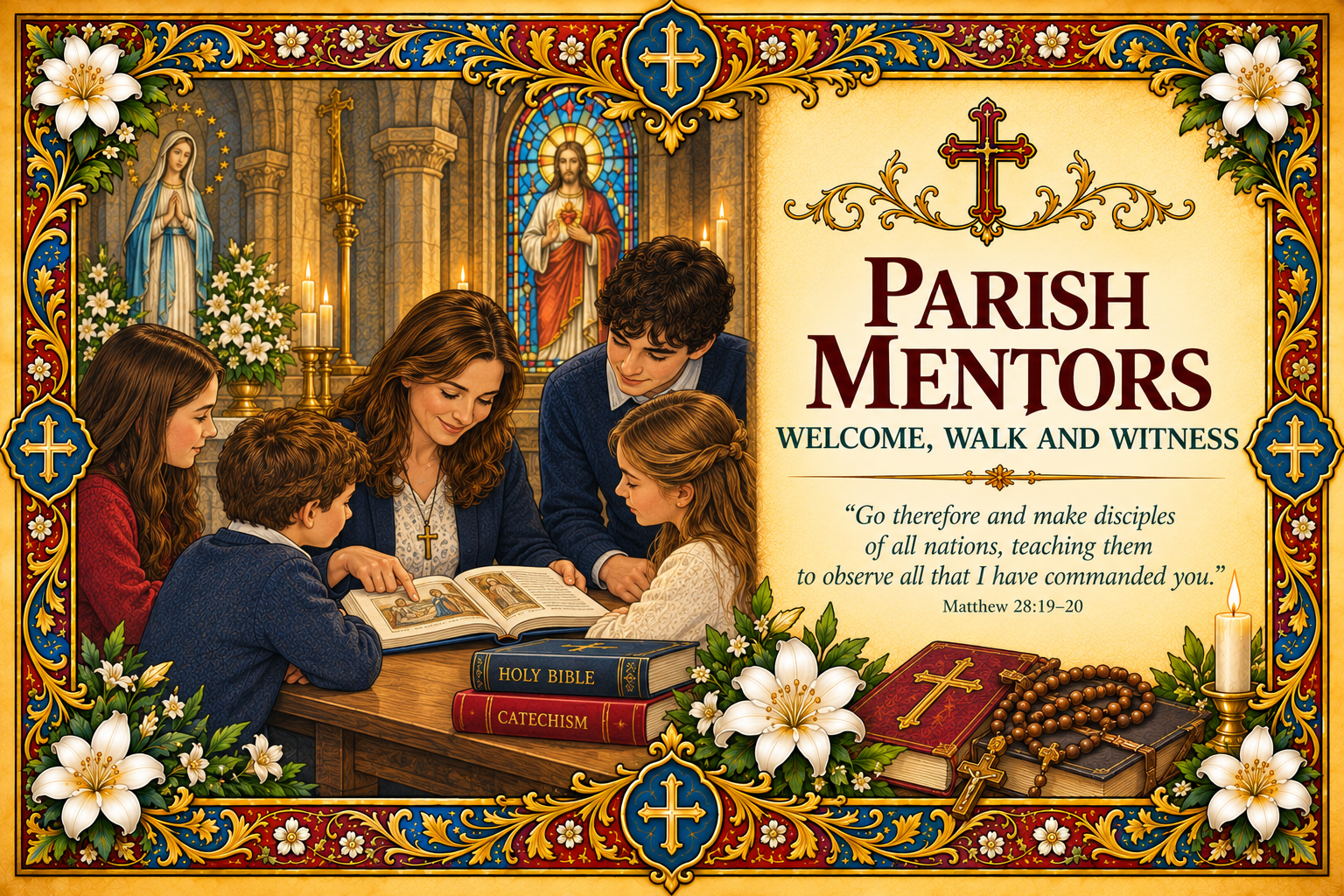
Accompanying one person or family at a time
Parish mentors help children, young people, adults and families as they prepare for the sacraments or take another step in Catholic life.
The role is simple:
Welcome people into the life of the Church. Walk alongside them as they learn and grow. Witness to the Catholic faith through ordinary Christian life.
Mentors do not have to invent lessons, prepare talks or know the answer to every question.
The parish provides the teaching and the practical resources.
The mentor’s task is to listen, use the assigned material faithfully, help the person understand what the Church teaches, pray with them and encourage one realistic next step.
Welcome, Walk and Witness
Welcome
Learn people’s names.
Greet them at Mass.
Help them know where to go and whom to ask.
Make room for honest questions without embarrassment.
People come to the Church from many different circumstances. A mentor helps them feel that they have a place in the parish while remaining faithful to what the Church teaches.
Walk
Take one manageable conversation at a time.
Use the preparation book and matching activity guide.
Read together, explain unfamiliar words and give people time to think and answer.
A conversation may be repeated, divided or adapted when necessary.
There is no need to rush simply to complete a programme.
Witness
Let ordinary Catholic life support what you teach.
Sunday Mass, prayer, Confession, charity, family life and faithful Christian duties are not additions to sacramental preparation. They are part of learning to live as a Catholic.
A mentor does not have to be impressive.
A quiet, faithful Catholic who listens well, speaks truthfully and knows when to ask for help can be an excellent mentor.
How one conversation works
Each pathway has a preparation book and a matching activity or conversation guide.
The preparation book gives the Catholic teaching.
The activity guide helps mentor and candidate explore that teaching through a question, activity, conversation, prayer and practical action.
The ordinary pattern is:
1. Welcome and listen
Ask how things have been.
Return briefly to anything discussed previously.
Allow the person to speak before beginning to explain.
2. Try the activity
Use the simple activity provided in the guide.
It may involve an ordinary object, a short scenario, a few handwritten cards, pointing, drawing or conversation.
No elaborate resources are required.
3. Open the preparation book
Read the Scripture and teaching indicated in the guide.
Explain an unfamiliar word where necessary and help the person understand why the teaching matters.
4. Talk and check understanding
Use the questions provided.
Let the person answer in their own words before looking at the short Catholic answer.
This is a conversation, not an examination.
5. Pray together
Use the supplied prayer.
Give the person time to participate, listen or add a simple intention.
6. Choose one practical step
Agree something realistic before the next conversation.
It might be Sunday Mass, a short prayer, an act of charity, speaking to Fr John or something else already suggested in the guide.
Then agree the next meeting or contact.
The preparation has already been done
Mentors are not expected to write lessons.
There is normally no need for additional worksheets, internet research, craft projects or prepared talks.
Open the assigned preparation book and matching activity guide and use them together.
If a conversation is going well, you do not have to use every possible question or activity.
If someone needs longer, slow down.
If a question comes up that you cannot answer, simply say:
“I do not know. Let us ask Father.”
That is a perfectly good answer.
Parents, mentors and the priest
Each has a different role.
Parents
Parents remain the first educators of their children in the faith.
A parent and child may use the parish books together at home without a mentor being present for every conversation.
Where a mentor is helping a child or family, the parent remains present and involved.
Mentors
Mentors support the person or family.
They use the parish materials, listen, explain, encourage prayer and help people remain connected with the life of the parish.
Mentors do not decide sacramental dates or determine whether somebody is ready to receive a sacrament.
The priest
The priest establishes the appropriate sacramental pathway, deals with sacramental and canonical questions and discerns readiness.
Questions about previous Baptism, marriage circumstances, missing sacraments, reception into the Church or anything outside the mentor’s role should be brought to Fr John.
Our sacramental pathways
Always use the pathway assigned by the parish.
A person’s age or school year alone does not determine which preparation they require.
The following parish pages contain the relevant teaching and preparation resources:
Children and families
Baptism for Babies and Young Children
For parents preparing for the Baptism of a baby or young child.
Baptism for Children Aged Seven and Over
For an unbaptised child old enough to understand and respond personally to the faith.
Baptised Child Coming into the Catholic Church
For a validly baptised non-Catholic child preparing to be received into full communion with the Catholic Church.
For baptised Catholic children preparing for the Sacrament of Penance and Reconciliation.
For baptised Catholic children preparing to receive our Lord in Holy Communion for the first time.
For baptised Catholic young people preparing for Confirmation.
Adults
For an unbaptised adult beginning the catechumenate.
For a validly baptised Christian preparing to be received into the Catholic Church.
For an already-baptised Catholic adult who has not received Confirmation.
For Catholics returning to Mass and the sacramental life of the Church after time away.
For couples preparing for Christian marriage.
Sunday Mass remains central
Sacramental preparation is not simply learning information.
It belongs within the worshipping life of the Church.
Mentors should encourage candidates and families to participate in Sunday Mass and gradually become at home in the life of the parish.
When helpful, a conversation after Mass can connect the lesson with something the person has just heard, seen or celebrated.
If somebody is struggling to attend because of work, health, transport, caring responsibilities or another difficulty, listen first and bring persistent difficulties to Fr John.
Readiness is not a test
Mentors help people grow.
They do not conduct pass-or-fail examinations.
Readiness is discerned with the priest according to the particular sacrament and the person’s age, capacity, circumstances and pathway.
Mentors may notice:
- growing understanding of the central truths of the faith;
- a sincere and free desire for the sacrament or step being sought;
- prayer and participation in Sunday worship;
- willingness to live the Catholic faith;
- understanding of the sacrament and its celebration;
- questions or difficulties which need further help.
People do not have to use perfect theological language.
A child, young person or adult should be allowed to explain what they understand in ordinary words.
Keep the role clear
A parish mentor is a practising Catholic appointed by the parish to welcome, guide and encourage.
Mentoring is not private counselling or spiritual direction.
A mentor does not:
- ask somebody to reveal personal sins;
- ask what somebody has confessed;
- determine sacramental readiness;
- promise sacramental dates;
- investigate safeguarding concerns;
- privately message children or young people;
- arrange secret or hidden meetings;
- act beyond the role agreed with the parish.
When teaching or practising Confession, always use invented examples.
If an adult or child begins disclosing actual sins, stop the exercise kindly and help them speak with the priest where appropriate.
Safeguarding
Safeguarding arrangements apply to all parish mentoring.
Parents remain with their children during family mentoring meetings.
Meetings use the arrangements approved by the parish, and communication takes place through parents or approved parish channels.
If somebody discloses abuse or harm:
- remain calm and listen;
- do not investigate;
- do not ask leading questions;
- do not promise secrecy;
- do not confront the person accused;
- make the required factual record;
- follow the diocesan safeguarding procedure immediately.
If somebody is in immediate danger, call 999.
VIEW PARISH SAFEGUARDING INFORMATION
Safeguarding concerns are not recorded in ordinary mentor progress notes.
Before a mentor begins
Being willing to help is the beginning, but mentors do not simply download the resources and begin working independently.
Before serving, the parish confirms:
- appointment to the role;
- safer recruitment arrangements;
- any required DBS check;
- diocesan safeguarding training;
- appropriate meeting places;
- communication arrangements;
- the pathway being assigned;
- and where the mentor can obtain continuing support.
Every mentor also completes the parish Welcome, Walk and Witness Mentor Induction.
The induction includes an opportunity to practise a real conversation using the parish method before beginning.
Mentor resources
Parish Mentor Induction
The full induction explains:
- Welcome, Walk and Witness;
- how to use the two books;
- family and adult pathways;
- how to lead one conversation;
- practice examples;
- boundaries;
- safeguarding;
- adapting conversations;
- readiness;
- records and support;
- and the mentor commitment.
DOWNLOAD THE PARISH MENTOR INDUCTION
This booklet is used as part of parish mentor induction. Downloading it does not by itself appoint or authorise somebody to act as a parish mentor.
Parish Mentor Quick Guide
The four-page Quick Guide is designed to stay beside the preparation books during mentoring.
It gives the six-step conversation method, essential boundaries, help for difficult situations and parish safeguarding contacts.
DOWNLOAD THE PARISH MENTOR QUICK GUIDE
Universal Conversation Check-In
For ordinary check-ins, mentors do not need to repeat an entire lesson. This two-page card gives a simple pattern for listening, checking one central truth, connecting it with Catholic life, praying together and agreeing the next step.
It can be used with any of the parish sacramental or faith pathways.
DOWNLOAD THE UNIVERSAL CONVERSATION CHECK-IN
Keep this beside the assigned preparation book. Use the fuller Activity & Conversation Guide whenever more structure, explanation or practical activity would be helpful.
Pathway Master Sheet
Appointed mentors may also be given the current Pathway Master Sheet to help identify and use the correct materials.
DOWNLOAD THE PATHWAY MASTER SHEET
Simple records and continuing support
Mentors keep only the brief information required for continuity under parish arrangements.
A simple note may record:
- meeting date;
- book and conversation used;
- one agreed practical step;
- whether Fr John needs to follow something up;
- and the next meeting.
Actual sins, detailed personal circumstances and safeguarding disclosures do not belong in ordinary mentor notes.
Do not carry difficulties alone.
Bring unclear teaching, repeated obstacles, sacramental questions or concerns beyond your role to Fr John.
After the sacrament
Accompaniment should not automatically end on the day of the sacrament.
Where appropriate, agree a further conversation afterwards.
Ask simply:
- What grace are you grateful for?
- Is there anything you are still wondering about?
- What would help you continue living the faith?
Encourage a realistic pattern of Sunday Mass, prayer, Confession, learning, charity and participation in parish life.
The aim is not merely to prepare someone for a celebration.
It is to help them continue walking with Christ in his Church.
Interested in becoming a parish mentor?
You do not need to be a professional teacher or have all the answers.
You do need to be a practising Catholic willing to hand on the faith faithfully, listen patiently, follow the parish safeguarding arrangements and ask for help when necessary.
If you think you might be able to accompany a person or family, please speak to Fr John.
You are welcome to ask about the role before making any commitment.
Welcome people into the life of the Church.
Walk with them one faithful step at a time.
Witness to the faith you have received.“

