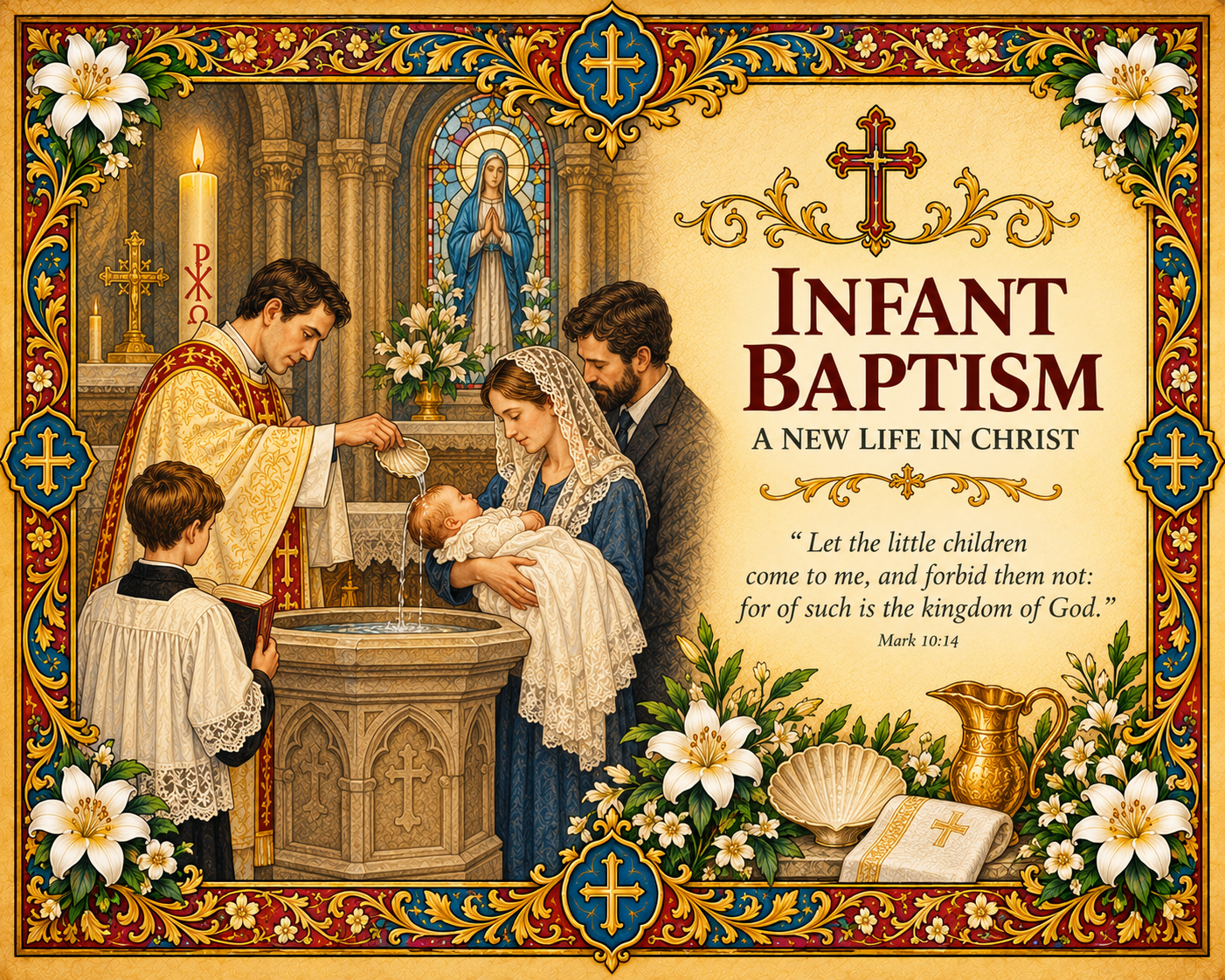
Baptism is the joyful beginning of new life in Christ.
Through Baptism, a child is freed from original sin, born again by water and the Holy Spirit, united with Jesus Christ, made an adopted child of God and welcomed into his Church.
Baptism is not simply a naming ceremony, a family tradition or a beautiful occasion. It is a sacrament in which God truly acts.
In asking for Baptism, you are asking the Church to help your child begin a life with Christ.
What Baptism gives
At the heart of Baptism, water is poured over the child in the name of the Father, and of the Son, and of the Holy Spirit.
Through this sacrament, the child receives:
- freedom from original sin;
- sanctifying grace;
- the indwelling of the Holy Spirit;
- new life in Christ;
- adoption as a child of God;
- membership of the Catholic Church;
- and a permanent spiritual mark of belonging to Christ.
Because Baptism marks a person permanently, it can never be repeated.
Why does the Church baptise babies?
A baby has committed no personal sin. Original sin means that every human being is born into a fallen human condition and needs the salvation and supernatural life which Christ gives.
The Church baptises babies because grace is a gift.
A child receives life, love, care and a family before being able to choose them. In the same way, parents ask the Church to give their child the gift of new life in Christ. Parents, godparents and the parish then undertake to help that life of faith grow.
If a child is in danger of death, contact a priest or hospital chaplain immediately. If no priest or deacon is available, anyone may baptise, provided that they intend to do what the Church does. Pour water over the child’s head while saying: “N., I baptise you in the name of the Father, and of the Son, and of the Holy Spirit.” Contact the parish afterwards so that the Baptism can be recorded and the remaining rites supplied.
What are parents asking for?
When parents ask for Baptism, they are asking that their child be baptised into Jesus Christ and his Church.
They are also accepting the responsibility of helping their child grow in the Catholic faith. This includes:
- bringing their child to Sunday Mass;
- teaching their child to pray;
- helping them come to know and love Jesus Christ;
- giving them a good Christian example;
- preparing them for Confession, Holy Communion and Confirmation;
- and raising them within the life of the Catholic Church.
You do not need to be a perfect Catholic family before asking for Baptism. What matters is a sincere desire for the sacrament and a genuine intention to allow the faith given in Baptism to grow.
If prayer or Sunday Mass has not been a regular part of family life, preparation for Baptism can be an opportunity to begin again honestly. The parish will help you take a real and manageable next step.
How preparation works
Preparation is personal and flexible. It begins with a conversation rather than an application deadline or fixed annual course.
1. Begin with a conversation
The first step is to speak with the parish priest.
We will talk about your child, your family, your connection with the parish and what you are asking for in Baptism. You can also raise any questions about godparents, family circumstances or the celebration itself.
2. Work through the preparation
Parents receive our parish preparation book, My Child’s Baptism.
It contains three short conversations:
- Baptism: New Life in Christ
What Baptism is, what grace it gives and why the Church baptises babies. - The Rite: Water, Faith and the Signs
What happens during the celebration and what the baptismal promises mean. - Living Baptism: Raising a Child in Faith
How parents, godparents and the parish help the life of grace grow afterwards.
Parents should complete all three conversations. Godparents should join them where possible. If a godparent lives elsewhere, they can be sent the preparation book and work through the same material themselves.
A family may use the resources at home. Where helpful, a parish mentor can also accompany the parents and godparents.
There are no lessons to prepare and no examination to pass. Read the short teaching, talk honestly, learn the essentials, pray together and take one practical step.
Understanding and sincerity matter more than speed.
3. Take part in the life of the parish
Baptism brings a child into the Church. Preparation therefore belongs within the ordinary life of the Catholic community.
Parents are encouraged to attend Sunday Mass, begin or strengthen prayer at home and become familiar with the parish in which their child will be baptised.
4. Have a final parish conversation
Before the Baptism, there will normally be a final conversation to:
- answer any remaining questions;
- check the practical arrangements;
- make sure the godparent requirements are understood;
- review the baptismal promises;
- and help everyone approach the celebration with confidence.
This is not a test. Its purpose is to make sure that the sacrament is being requested sincerely and that the parents and godparents understand the promises they will make.
5. Celebrate the Baptism
The priest or deacon will guide the family through the celebration.
The rite includes:
- the welcoming of the child;
- the Sign of the Cross;
- the proclamation of Sacred Scripture;
- prayer for the child and family;
- the renunciation of sin and profession of faith;
- Baptism with water;
- anointing with sacred chrism;
- the white garment;
- the baptismal candle;
- and the final blessing.
Parents and godparents answer “I do” when they renounce sin and profess the Catholic faith. These are real promises, not simply ceremonial responses.
Preparation resources
My Child’s Baptism
This is the principal preparation book for parents and godparents. It contains the Catholic teaching, the three conversations, an explanation of the rite, guidance about godparents, a readiness review and practical help for the day.
DOWNLOAD THE PARENT AND GODPARENT PREPARATION BOOK
Baptism Preparation App
The app provides the same teaching in a simple digital format, with questions to help parents and godparents remember what they have learnt.
It is an additional help and does not replace personal conversation, prayer or participation in parish life.
OPEN THE BAPTISM PREPARATION APP
Baptism Activity and Conversation Companion
This practical companion is for parents, godparents, mentors and priests.
It is used alongside My Child’s Baptism and brings the teaching to life through simple objects, activities, discussion and prayer. It also includes a practical rehearsal of the rite, a godparent conversation and help with forming a simple Catholic rule of life at home.
No lesson planning or specialist equipment is needed.
DOWNLOAD THE BAPTISM ACTIVITY AND CONVERSATION COMPANION
Short Parish Pathway Guide
This short leaflet gives families a simple overview of the whole parish Baptism pathway.
DOWNLOAD THE INFANT BAPTISM PARISH PATHWAY GUIDE
Choosing godparents
A godparent is not simply an honorary guest. A godparent helps the parents and the baptised child to live faithfully according to the grace and responsibilities of Baptism.
A Catholic godparent should normally:
- be chosen because they genuinely intend to fulfil the role;
- be a Catholic who has received Confirmation and the Holy Eucharist;
- practise the Catholic faith;
- normally be at least sixteen years old;
- not be the father or mother of the child;
- and not be prevented from fulfilling the role by Church law.
One Catholic godparent is sufficient.
If two Catholic godparents are chosen, one is male and one is female. A baptised non-Catholic Christian may take part as a Christian witness alongside a Catholic godparent.
If you are unsure whether someone may act as a godparent, please ask before making firm arrangements.
Choose a godparent for the Christian life you hope your child will see.
After the Baptism
Baptism is a beginning, not an end.
For a child, the home is normally the first school of faith. The life given in Baptism is helped to grow through:
- Sunday Mass;
- family prayer;
- the Holy Eucharist;
- Confession and conversion;
- learning the Catholic faith;
- forgiveness and charity;
- Christian example;
- and belonging to the parish.
Parents might begin with simple habits such as blessing their child, making the Sign of the Cross together, saying grace before meals, telling Gospel stories and attending Sunday Mass as a family.
Godparents should continue to pray for the child, encourage the family and remain visibly involved in the child’s Christian life.
When things become difficult, begin again. The parish remains here to help.
Baptism of children aged seven and over
Children who are old enough to understand and respond personally require preparation suited to their age and circumstances.
This is a different pathway from the Baptism of a baby or young child.
BAPTISM FOR CHILDREN AGED SEVEN AND OVER
Baptism of adults
An adult who has never been baptised normally prepares through the RCIA, also called the Catechumenate.
When ready, an unbaptised adult ordinarily receives Baptism, Confirmation and the Holy Eucharist together.
BECOMING A CATHOLIC, RCIA AND THE CATECHUMENATE
Someone who has already received a valid Christian Baptism is not baptised again. Please see our pathway for Reception into Full Communion.
RECEPTION INTO FULL COMMUNION FOR ADULTS
Would you like to ask for Baptism?
You do not need to have everything arranged before contacting us. The first step is simply a conversation.
If you have been away from Mass, are unsure about godparents, have a complicated family situation or have another concern, please mention it. We would much rather speak openly and help you find a genuine way forward.
Baptisms may be celebrated at St Mary’s, St John Bosco or St Edward’s.
Contact: Fr John Owens
Email: john.owens@dioceseofnottingham.uk
You are God’s beloved child.
You belong to Christ.
You are part of his Body.
That is what Baptism proclaims.

