The Heart of Catholic Life
The Holy Mass is at the centre of the life of our parish communities, St Mary’s, St John Bosco and St Edward’s.
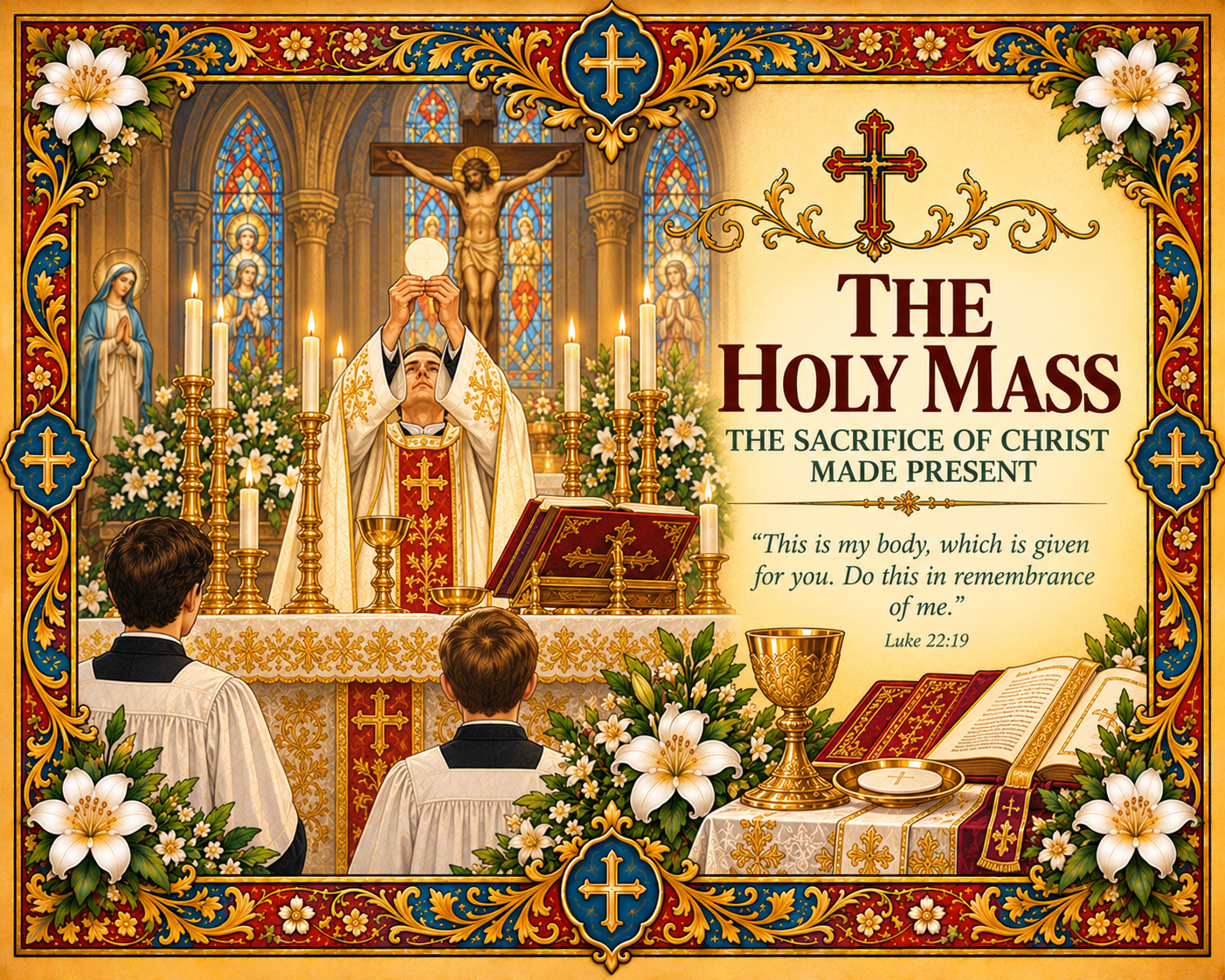
At Mass, Jesus Christ gathers his Church, speaks to us through Sacred Scripture and makes his one Sacrifice upon the Cross present sacramentally. The Church is united with Christ as he offers perfect worship to the Father.
The Mass is therefore much more than a meeting, a service or a time of private prayer. It is the action of Christ and his Church.
At its heart is the Holy Eucharist. Under the appearances of bread and wine, Jesus Christ is truly, really and substantially present, Body, Blood, Soul and Divinity.
For this reason, the Eucharist is the source and summit of the Christian life.
VIEW MASS AND CONFESSION TIMES
You Are Welcome
Whether you come to Mass every week, are visiting for the first time, or are returning after many years, you are very welcome.
You do not need to understand everything before coming. If you are unfamiliar with the prayers or do not know when to stand, sit or kneel, you may simply listen, pray and follow those around you.
No one is expected to know everything immediately. Familiarity grows through coming, listening and praying with the Church.
Our introductory guide explains what happens at Mass, what you may see and what to do if you are not receiving Holy Communion.
You can also use the complete text of the prayers and responses:
Sunday Mass
From the earliest days of the Church, Christians have gathered on Sunday, the Day of the Lord, to celebrate the Resurrection of Jesus Christ.
Sunday Mass is not simply one devotion among many. It is the ordinary centre of Catholic life. We gather to hear the Word of God, join ourselves to Christ’s Sacrifice and be nourished by him in the Holy Eucharist.
Catholics are obliged to participate in Mass on Sundays and Holy Days of Obligation unless prevented by illness, caring responsibilities or another serious reason.
This obligation is not merely a rule. We come because Christ calls his Church together and gives himself to us.
SEE OUR SUNDAY AND WEEKDAY MASS TIMES
The Liturgy of the Word
During the first principal part of the Mass, God speaks to his people through Sacred Scripture.
On Sundays we normally hear:
- A reading from the Old Testament
- A psalm
- A reading from the New Testament
- The Gospel
The priest or deacon then gives the homily, helping us understand the readings and live the Catholic faith.
We respond by professing the Creed and offering the Prayer of the Faithful for the Church and the needs of the world.
PRAYERS OF THE FAITHFUL AND INTERCESSIONS
The Liturgy of the Eucharist
Bread and wine are brought to the altar. The priest, acting in the person of Christ, offers the Church’s prayer of thanksgiving and consecration.
By the power of the Holy Spirit, the bread and wine become the Body and Blood of Jesus Christ.
Christ does not die again at every Mass. His Sacrifice upon Calvary was offered once for all. In the Mass, that one saving Sacrifice is made sacramentally present, and we are invited to unite our lives, prayers, work and suffering with his perfect offering to the Father.
Holy Communion is therefore not merely a symbol or a sign of friendship. It is the reception of Christ himself.
Because receiving Holy Communion also expresses full communion with the Catholic Church, it is ordinarily received by Catholics who are properly prepared and in a state of grace. Anyone who is not receiving Communion is very welcome to remain prayerfully in their place.
A CLEAR GUIDE TO HOLY COMMUNION
Taking Part in the Mass
Taking part in Mass means more than having a visible role. Our most important participation is interior. We listen with faith, answer the prayers, join in the singing and offer ourselves with Christ.
The Church uses words, silence, music, posture, vestments, candles and incense to serve the worship of God. These are not decorations added to a meeting. They help express the sacred action in which we are participating.
The following guides explain the Mass in greater depth:
- A Complete Guide to the Holy Mass
- A Guide for Parishioners at Mass
- Singing the Mass, How the Church Prays
Serving at Mass
Some parishioners are called to assist with particular ministries. These roles should always be carried out faithfully, prayerfully and according to the Church’s instructions.
- Guide for Altar Servers
- Guide for Readers at Mass
- Guide for Extraordinary Ministers of Holy Communion
Anyone interested in serving should speak to the parish priest.
Mass Intentions
The Holy Mass may be offered for someone who has died, for someone who is living, in thanksgiving or for another suitable intention.
A Mass offering is not a payment for the Mass. It is a voluntary contribution connected with the ancient practice of supporting the Church and her priests.
No one should feel unable to request a Mass because they cannot make an offering.
LEARN ABOUT OR REQUEST A MASS INTENTION
Prayer Before and After Mass
It is good to arrive a little early, enter the church quietly and prepare for Mass in prayer.
After Mass, especially after receiving Holy Communion, it is fitting to remain for a short time in thanksgiving. Christ has given himself to us. These are precious moments in which to thank him and pray for our families, the Church and the world.
The Eucharistic presence of Christ continues after Mass. Catholics therefore pray before the Blessed Sacrament outside Mass as well as during the liturgy.
ADORATION OF THE BLESSED SACRAMENT
Understanding the Signs and Traditions of the Mass
The Church’s worship contains many signs and traditions which have developed over centuries. These are secondary to the Mass itself, but understanding them can help us appreciate the reverence, history and continuity of Catholic worship.
For example, the biretta is a traditional clerical hat which may be worn on certain occasions. It is not essential to the celebration of Mass and has no sacramental power, but it belongs to the wider history of Catholic clerical dress.
THE BIRETTA, ITS HISTORY AND USE
Sent into the World
The Mass does not end our Christian duty. It prepares us to live it.
Having heard the Word of God and encountered Christ in the Eucharist, we are sent to carry his grace into our homes, work, schools and communities.
The Mass should gradually shape:
- Our daily prayer
- Our family life
- Our treatment of other people
- Our willingness to forgive
- Our care for the poor and vulnerable
- Our courage in witnessing to Christ
- Our desire to live in holiness
We come to Christ at the altar so that we may carry Christ into the world.

