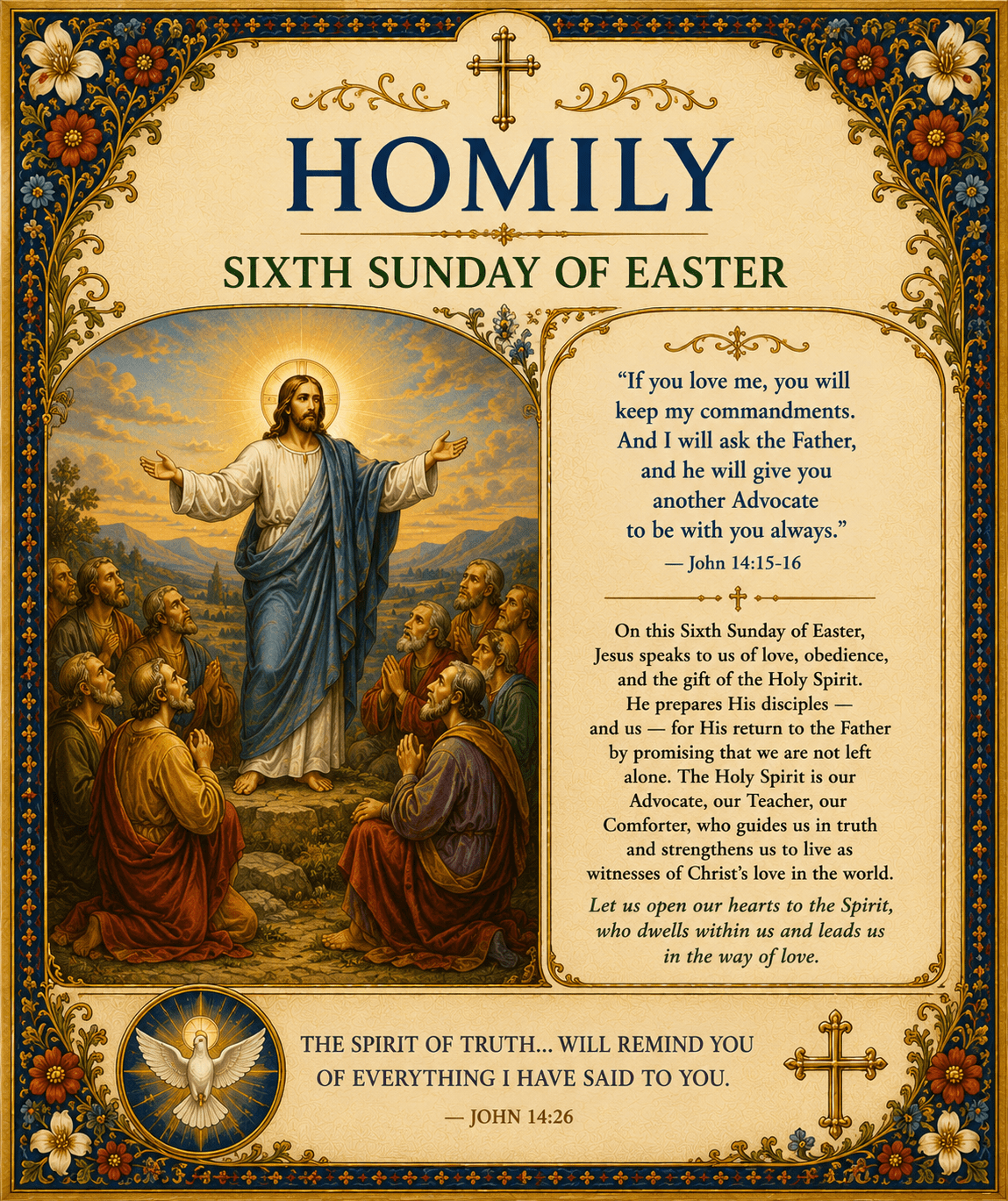
We are coming close now to the end of the Easter season.
The Church is standing in a moment of transition.
Christ is preparing to ascend into heaven.
Pentecost is drawing near.
The apostles are beginning to understand that everything is about to change.
And in the Gospel today, we hear part of Christ’s farewell at the Last Supper.
It is tender.
But it is also full of tremendous depth. “I will not leave you orphans.”
That is one of the great promises of the Gospel.
Because the deepest fear of the human heart is abandonment.
To be left alone.
To be left without guidance.
Without protection.
Without hope.
And Christ says:
You will not be abandoned.
But immediately a question rises.
How?
Because we do not see Him walking visibly among us now.
The apostles touched Him.
Heard His voice.
Sat beside Him.
We do not.
So how is Christ still with His Church?
And the answer is profoundly Catholic.
Christ remains with us sacramentally.
The sacraments are not religious symbols invented by the Church.
They are the living actions of Christ in His Church.
The risen Christ still touches souls.
Still heals.
Still strengthens.
Still forgives.
Still feeds His people.
And suddenly the whole of life becomes illuminated.
Because Christ has not abandoned any stage of human life.
At every major moment of existence—He is there.
At birth, there is Baptism.
A child can do nothing.
Cannot speak.
Cannot reason.
Cannot earn grace.
And that is precisely the point.
Baptism is pure gift.
A helpless child is carried to the font and reborn by water and the Holy Spirit.
Original sin is washed away.
A soul dead to grace becomes alive in Christ.
That child is no longer merely a creature of earth—
but a son or daughter of God.
That is not poetry.
That is reality.
Then comes growth.
A child begins to learn the Faith.
To understand prayer.
Truth.
Sacrifice.
And then comes Confirmation.
And today’s first reading opens that mystery before us.
Philip has already baptised the people of Samaria.
But something remains unfinished.
Peter and John must come.
Why?
Because the fullness of the apostolic laying on of hands belongs to the apostles.
The Holy Spirit descends in a deeper outpouring.
And this continues in the Church now.
The bishop lays hands upon the confirmed—
because Confirmation is Pentecost entering personally into a soul.
The Holy Spirit strengthens Christians not merely to believe privately—
but to witness publicly.
To defend the Faith.
To live courageously in a hostile world.
And we desperately need that strength now.
Because the modern world is confused about nearly everything.
Truth is blurred.
Human dignity is attacked.
Life is cheapened.
Pleasure is treated as ultimate.
And weak Catholics cannot withstand a collapsing culture.
The sacrament of Confirmation forms soldiers for Christ.
Not violent soldiers.
Saints.
Witnesses.
Men and women who are not ashamed of the Gospel.
Then Christ remains with us throughout daily life in the Eucharist.
Because souls cannot survive without nourishment.
The Eucharist is not merely a reminder of Christ.
It is Christ.
Body. Blood. Soul. Divinity.
The same Lord who said: “I will not leave you orphans”
places Himself into our mouths.
Feeds His people with divine life.
And this is why the Mass is the centre of Catholic life.
Without the Eucharist, the soul slowly starves.
And because we are weak, Christ gives another sacrament: Confession.
Divine medicine.
Because even after Baptism, we sin.
We fall.
We become wounded.
We wander.
And Christ does not abandon sinners either.
In Confession, He raises the fallen soul again.
Not symbolically.
Really.
The chains of sin are broken.
Grace is restored.
Then there is marriage.
Not merely romance.
A vocation ordered toward holiness.
A man and woman united not simply to live together—
but to help one another reach heaven.
To form a domestic church.
To raise children in the Faith.
To reveal something of Christ’s love for His Church.
And alongside marriage stands Holy Orders.
Because Christ continues shepherding His people through priests.
The priest stands at the altar not in his own name—but in the person of Christ.
Through him Christ baptises.
Christ absolves.
Christ offers sacrifice.
Without priests there are no sacraments.
Without sacraments the Church starves.
And finally, at the edge of death, Christ is still there.
Anointing of the Sick.
Because even suffering has now been entered by Christ.
The dying Christian is not abandoned in darkness.
Christ comes one final time strengthening the soul for the final journey.
And so from birth to death—Christ remains.
That is the meaning of today’s Gospel.
“I will not leave you orphans.”
The sacraments are Christ continuing His saving work in time.
And this means the sacramental life is not one part of Catholic life.
It is Catholic life.
Because grace is not an idea.
Grace is given.
Through water.
Oil.
Words.
Touch.
Bread and wine.
God reaches souls through visible signs because we are not angels.
We are body and soul.
And now, as Pentecost approaches, the Church asks us something very direct:
Are we living sacramentally—or merely culturally Catholic lives?
Because a soul cannot survive long cut off from grace.
The saints understood this. That is why they clung to the sacraments.
Because they knew:
Christ has ascended into heaven—but He has not abandoned His Church.
He remains.
And where the sacraments are lived faithfully—
Christ is still healing the sick, forgiving sinners, feeding souls, strengthening the weak, and preparing His people for eternal life.
That is the glory of the Catholic Faith. Not that we remember Christ only.
But that Christ remains truly present among His people still.

 St. Mary's, St. John Bosco and St. Edward's