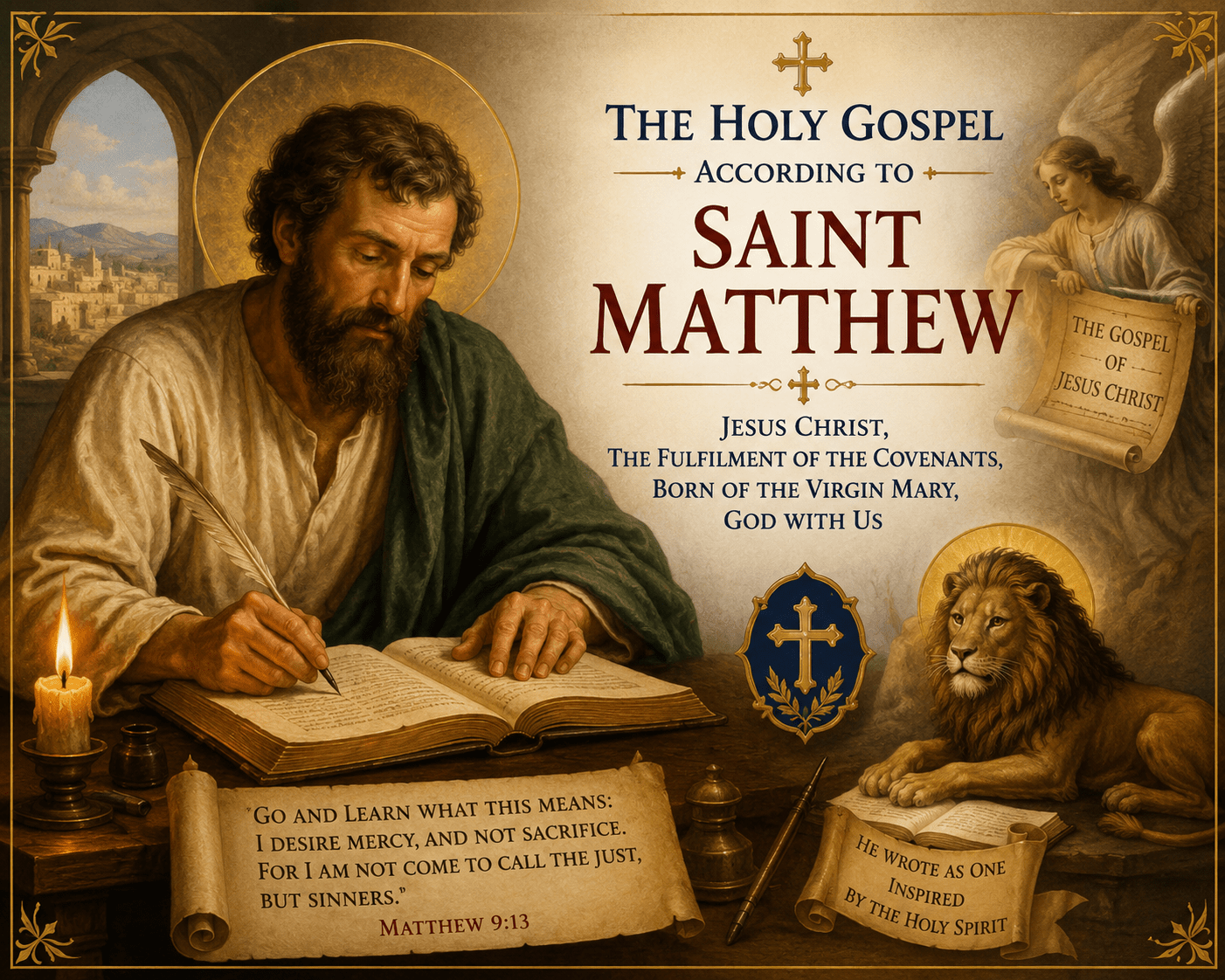
How the Opening of Saint Matthew Already Reveals the Catholic Church
Many Christians read Matthew 1 only as:
• a genealogy
• a birth narrative
• an introduction to Jesus’ earthly life
But Catholics read Scripture more deeply and sacramentally.
The Church Fathers constantly taught that the Gospel reveals not only Christ Himself, but also:
• His Church
• the sacraments
• liturgical worship
• covenant fulfilment
• the new people of God
Matthew Chapter 1 already contains the seeds of Catholic Christianity.
Nothing in Catholicism appears suddenly later.
The Church, sacramental life, liturgical fulfilment, and covenant worship are already being prepared here from the very beginning.
1. The Church Is Rooted in Salvation History
Matthew begins with a genealogy because Christianity is not disconnected from Israel.
The Catholic Church is not a new religion invented centuries later.
She is the fulfilment of God’s covenant plan unfolding throughout history.
Abraham and the Church
Matthew calls Jesus:
“the son of Abraham.”
Why?
Because God promised Abraham:
“In thy seed shall all nations be blessed.”
The Church is the fulfilment of this promise.
The Catholic Church gathers:
• every nation
• every language
• every people
into one covenant family through Christ.
This is why the Church is called:
Catholic
meaning:
universal.
The Church as the New Covenant People
Israel was:
• covenant people
• worshipping assembly
• sacrificial community
The Church becomes:
• the new covenant people
• the Body of Christ
• the sacramental assembly gathered around Christ.
Matthew Chapter 1 already prepares for this universal covenant reality.
2. Davidic Kingship and the Kingdom of the Church
Matthew emphasises repeatedly:
“son of David.”
This is not accidental.
The Messiah was expected to establish the Kingdom of God.
But Christ’s kingdom is not merely political.
It becomes:
• spiritual
• sacramental
• universal
• eternal
The Church as the Kingdom of Christ
The Catholic Church teaches that Christ’s kingdom is already present visibly in history through His Church.
The Church is:
• not merely an invisible idea
• not merely private spirituality
• but a visible kingdom under Christ the King.
This is why Matthew’s Gospel constantly emphasises:
“the kingdom of heaven.”
Peter and the Kingdom
Later in Matthew, Christ gives Peter:
• the keys of the kingdom
• authority to bind and loose
This kingdom structure is already being prepared from Chapter 1 onward through the emphasis on Davidic kingship.
The Catholic Church therefore sees herself not merely as organisation, but as:
the visible kingdom of Christ in history.
3. The Genealogy and Apostolic Continuity
The genealogy teaches something profoundly Catholic:
continuity matters.
Matthew carefully traces succession through generations.
This prepares us to understand why the Church values:
• apostolic succession
• continuity of authority
• historical transmission of faith.
Modern Christianity often treats history as unimportant.
But Matthew does not.
The Gospel itself begins with continuity.
Apostolic Succession
Just as the covenant promises passed faithfully through generations, Christ later entrusts authority to:
• apostles
• bishops
• the Church.
Catholicism preserves this continuity visibly.
The faith is not reinvented by every generation.
It is handed on.
4. The Liturgy Hidden in Matthew 1
Modern readers often think liturgy appears later in Christianity.
But Matthew 1 already moves liturgically.
The Genealogy as Sacred Proclamation
In ancient Judaism, genealogies were proclaimed publicly because covenant identity mattered.
Matthew’s genealogy functions almost liturgically:
• proclaiming salvation history
• recounting covenant memory
• declaring God’s faithfulness.
Catholic liturgy does the same.
At Mass, the Church continually proclaims:
• salvation history
• covenant fulfilment
• God’s promises fulfilled in Christ.
Catholic Worship Is Historical
Catholic worship is not merely emotional expression.
It remembers and makes present God’s saving acts in history.
This pattern already appears in Matthew 1.
5. Fulfilment and the Structure of Catholic Worship
Matthew repeatedly says:
“that it might be fulfilled.”
This language is profoundly liturgical.
Why?
Because liturgy is the place where fulfilment is celebrated sacramentally.
Old Covenant Worship Fulfilled
The Old Testament contained:
• sacrifices
• priesthood
• temple worship
• sacred feasts
• covenant rituals.
Christ fulfils them all.
The Catholic liturgy participates in this fulfilment.
The Mass as Fulfilment
The Mass is not disconnected from Scripture.
It is the fulfilment of:
• Passover
• temple sacrifice
• covenant worship
• priestly mediation.
Matthew Chapter 1 already establishes the entire Gospel as fulfilment.
6. The Virgin Birth and Sacramental Theology
One of the deepest Catholic themes hidden in Matthew 1 is sacramentality.
God Uses Matter
Christ enters the world:
• through a real human body
• through Mary
• through history
• through physical reality.
This matters enormously.
Catholicism is sacramental because Christianity is incarnational.
The Incarnation Is the Foundation of the Sacraments
The sacraments communicate grace through matter:
• water
• bread
• wine
• oil
• touch.
Why?
Because God Himself entered matter in the Incarnation.
Matthew 1 already establishes this principle.
Anti-Sacramental Christianity Contradicts the Incarnation
Many modern Christians reduce Christianity to:
• ideas
• feelings
• symbolism only.
But Matthew Chapter 1 reveals:
God enters creation physically.
Therefore matter can truly become instrument of grace.
7. Mary and the Church
Mary is not merely private individual in Matthew 1.
She already prefigures the Church.
Mary as Model of the Church
Mary:
• receives the Word of God
• believes in faith
• brings Christ into the world
• remains faithful in obedience.
The Church does the same.
The Church:
• receives divine revelation
• proclaims Christ
• bears Christ sacramentally to the world.
Marian and Ecclesial Connection
The Fathers constantly linked Mary and the Church.
What is true of Mary personally becomes true of the Church corporately.
| Mary | Church |
| Virgin | spiritually pure |
| receives Christ | bears Christ sacramentally |
| mother of Christ | mother of believers |
| obedient | faithful |
8. Joseph and the Guardianship of the Church
Joseph protects:
• Mary
• Christ
• the mystery entrusted to him.
This foreshadows pastoral guardianship in the Church.
The Church also guards:
• doctrine
• sacraments
• divine revelation
• the mystery of Christ.
Bishops as Guardians
Catholic bishops continue this protective role:
• preserving apostolic teaching
• defending truth
• guarding sacramental life.
Matthew already introduces this principle through Joseph’s faithful guardianship.
9. Emmanuel and the Eucharist
Matthew declares:
“Emmanuel… God with us.”
This theme governs the whole Gospel.
Christ Remains With His Church
The Gospel begins:
“God with us.”
It ends:
“I am with you always.”
How does Christ remain with His Church?
Most profoundly through:
• Eucharist
• sacramental presence
• liturgical worship.
Eucharistic Presence
Catholicism insists:
Christ is not absent from His Church.
He remains truly present sacramentally.
Matthew’s opening and closing already prepare this reality.
10. Matthew 1 and the Catholic Vision of Worship
Matthew 1 already reveals the foundations of Catholic worship:
| Theme in Matthew 1 | Catholic Fulfilment |
| covenant history | liturgical proclamation |
| fulfilment | sacramental worship |
| Davidic kingdom | Church |
| Emmanuel | Eucharistic presence |
| divine action in matter | sacramental theology |
| genealogy and continuity | apostolic succession |
| obedience of Joseph | ecclesial guardianship |
| Mary bearing Christ | Church bearing Christ |
11. Why This Matters Today
Modern Christianity often becomes:
• individualistic
• non-sacramental
• historically disconnected
• anti-liturgical
• emotionally driven.
Matthew Chapter 1 points in the opposite direction.
The Gospel begins with:
• covenant continuity
• visible history
• fulfilment
• divine authority
• sacramental reality
• ecclesial identity.
Catholicism preserves these realities fully.
Final Reflection
Matthew 1 is not merely introduction to Jesus’ earthly birth.
It already reveals:
• the Church
• covenant fulfilment
• sacramental theology
• liturgical worship
• apostolic continuity
• Eucharistic presence
• the kingdom of Christ.
The Catholic Church therefore does not add herself onto Scripture later.
She emerges organically from the very structure of the Gospel itself.
Final Exhortation
The opening of Matthew teaches us that Christianity is not:
• isolated spirituality
• private interpretation
• symbolic religion only.
It is:
• covenant fulfilment
• incarnational reality
• sacramental worship
• visible communion
• divine presence in history.
And all of this reaches fulfilment in Christ and His Church.
Closing Prayer
Lord Jesus Christ,
Emmanuel, God with us,
grant that Thy Church may always remain faithful
to the Gospel entrusted to her.
Deepen our love for Thy sacraments,
our reverence for Thy liturgy,
and our obedience to Thy truth.
May we always recognise Thy presence
in Thy Church and Eucharist,
until we worship Thee perfectly
in the heavenly kingdom.
Who livest and reignest for ever and ever.
Amen.

 St. Mary's, St. John Bosco and St. Edward's