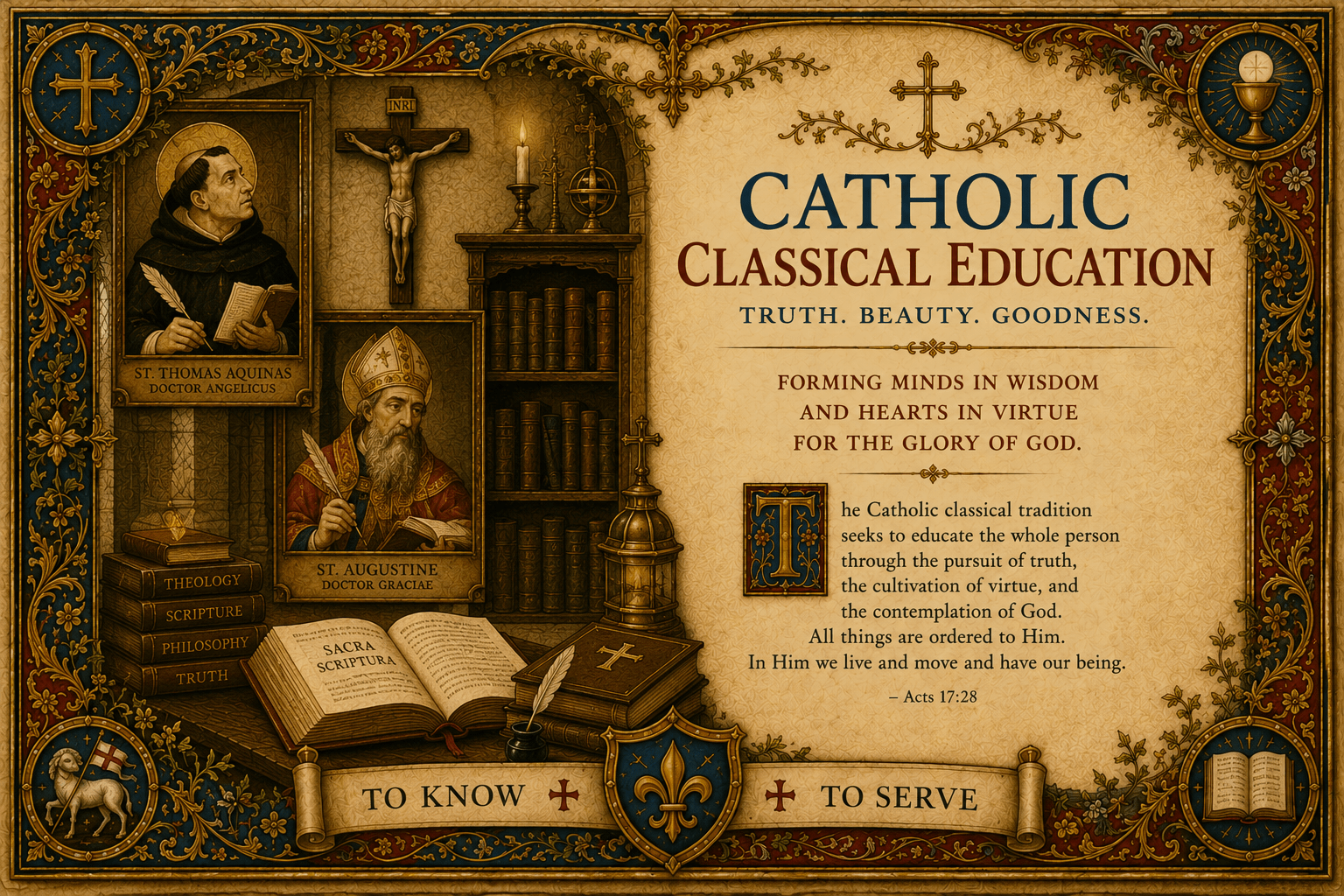
St Augustine knew both the attraction and the danger of education.
As a young man, he received an excellent training in grammar and rhetoric. He learned how to analyse texts, construct arguments and move an audience with words. These gifts eventually made him a successful teacher of rhetoric.
Yet education did not immediately make him wise or good. His learning became entangled with ambition, pride and error. He could speak beautifully while living badly. He could recognise faults in another person’s grammar while remaining blind to the disorder within his own soul.
After years of intellectual and moral wandering, Augustine was converted to the Catholic faith. The abilities he had once used in the pursuit of worldly success were placed at the service of Christ and his Church.
As a bishop, Augustine became one of the greatest teachers in Christian history. In his work De Doctrina Christiana, usually translated as On Christian Doctrine or On Christian Teaching, he explains how Christians should understand and communicate Sacred Scripture.
The work also presents a vision of education. Learning is good, but it must have a proper purpose. Knowledge must serve truth, truth must lead to charity, and charity must bring us to God.
What Should We Enjoy?
Augustine begins by making a distinction between things to be enjoyed and things to be used.
In ordinary English, “use” can sound selfish, especially when applied to people. Augustine is employing the words in a more careful philosophical sense.
To enjoy something means to rest in it as our final happiness. To use something means to receive it and direct it towards the proper end for which it has been given.
Only God can be enjoyed as our final end. Father, Son and Holy Spirit are the infinite Good for whom the human heart was created. Every created good is limited. If we try to make wealth, pleasure, reputation, knowledge or even another person bear the weight of our final happiness, we will eventually be disappointed.
Created things are good, but they are not God.
This does not mean that we should treat creation coldly or regard other people merely as instruments. We must love our neighbours truly, seeking their good and helping them towards God. We love them in God and for God, recognising that they share the same eternal calling.
Our Lord gives us the proper order of love:
“Thou shalt love the Lord thy God with thy whole heart, and with thy whole soul, and with thy whole mind. This is the greatest and the first commandment. And the second is like to this: Thou shalt love thy neighbour as thyself.”
— Matthew 22:37–39
Education must therefore teach us not only what things are, but how they should be loved.
Sin disorders love. We give first place to lesser things and neglect the highest good. We love possessions more than people, approval more than truth, comfort more than duty, and our own opinions more than God’s revelation.
Christian education seeks to restore the proper order. It teaches us to receive created goods gratefully without mistaking them for our final end.
Things and Signs
Augustine next distinguishes between things and signs.
A thing is a reality that exists. A sign is something that directs our mind towards another reality.
Smoke is a natural sign of fire. A spoken or written word is a conventional sign because it directs the hearer or reader towards the thing it signifies. The word “tree” is not itself a tree, but it allows the mind to consider one.
This distinction is important because God has chosen to speak to us through signs. The words of Holy Scripture signify realities. The events of salvation history may also signify and prepare for later realities. The Passover lamb points towards Christ. The crossing of the Red Sea prepares us to understand Baptism. The manna in the wilderness points towards the Eucharist.
Christian learning therefore requires us to attend both to words and to the realities signified by them.
Careless reading confuses signs, overlooks context and imposes meanings that the author did not intend. Faithful reading asks what the words mean, what reality they signify and how the passage belongs within the whole of God’s revelation.
This is one reason grammar matters. If we misunderstand the words, we may misunderstand the teaching. Definitions, sentence structure, translation and context are not dry technical matters when the text before us is Sacred Scripture.
Charity Is the Rule of Interpretation
For Augustine, the whole of Scripture leads towards the love of God and the love of our neighbour.
If an interpretation encourages pride, hatred, dishonesty or disobedience to God, something has gone wrong. We may have understood individual words while missing the purpose of the passage.
Augustine teaches that anyone who thinks they understand Scripture but does not build up this twofold love of God and neighbour has not yet understood Scripture as they should.
This does not mean that charity allows us to replace the actual meaning of Scripture with a pleasant message of our own invention. Love rejoices in truth. Genuine charity cannot contradict sound doctrine or excuse sin.
Nor does it mean that every passage will make us feel comfortable. Scripture corrects, reproves and warns. Sometimes love requires a difficult truth to be spoken. A doctor does not love a patient by concealing a dangerous illness.
The commandments, warnings and judgements of Scripture serve charity because they turn us away from what destroys communion with God. Divine love does not merely affirm us as we are. It purifies and transforms us.
The rule of charity therefore protects us from two errors. It prevents harsh interpretations detached from love, and it prevents sentimental interpretations detached from truth.
Truth and charity belong together because both come from God.
The Difficulties of Scripture
Augustine recognises that parts of Scripture are difficult. He does not tell Christians to pretend that every verse is immediately obvious.
Some difficulties arise because a word is unknown. Others arise because a familiar word can have more than one meaning. There may also be differences of language, history, geography, customs or figurative expression.
A serious student must therefore be patient.
Augustine recommends knowledge of the biblical languages, comparison of translations, attention to context and familiarity with the natural world and human customs mentioned in Scripture. Numbers, music, history, geography, animals, plants, stones and methods of work may all assist understanding.
This teaches an important lesson: piety is not an excuse for intellectual laziness.
Prayer is essential, but prayer does not remove the responsibility to read carefully. The Holy Spirit inspired particular words through particular human authors. Reverence for inspiration should make us more attentive to those words, not less.
At the same time, technical knowledge alone is insufficient. A person may know Hebrew and Greek, understand ancient history and analyse every grammatical construction while lacking faith, humility and charity.
The Christian reader needs both disciplined study and spiritual conversion.
Taking What Is True and Useful
Augustine considers what Christians should do with knowledge inherited from non-Christian cultures.
He uses the biblical image of the Israelites taking gold and silver from Egypt. These treasures had been misused within a pagan society, but they could be removed from that false worship and employed for a better purpose.
In the same way, non-Christian writers may possess genuine knowledge of language, logic, mathematics, nature or human affairs. Truth does not become false simply because it is spoken by someone outside the Church. Whatever is genuinely true belongs ultimately to God.
Christians may therefore take what is true and useful and place it at the service of divine revelation.
But this image must be understood carefully.
Israel did not remain in Egypt in order to admire its religion. The people departed from Egypt to worship the true God. The gold was not taken so that Israel might continue Egyptian paganism under another name. It was removed from false worship and placed at the service of God.
Augustine therefore does not tell Christians to make pagan culture the master of Christian education. He condemns superstition, idolatry, falsehood and morally corrupt teaching. What is received must be tested, purified and subordinated to Christian truth.
Scripture remains central. The rule of faith remains governing. Christ remains the Teacher.
The Christian does not approach non-Christian learning as an empty vessel waiting to be filled. We approach it as members of Christ’s Church, already possessing the light by which its claims can be judged.
This is a disciplined appropriation, not an uncritical surrender.
The Ascent towards Wisdom
Augustine describes learning as a spiritual ascent.
It begins with the fear of God: reverence, humility and the recognition that we must submit to divine judgement. From holy fear comes piety, by which we receive Scripture rather than resist it.
Knowledge then helps us recognise both what God commands and how far our lives have fallen short. This knowledge produces not self-satisfaction but repentance.
The learner must then possess fortitude, persevering through difficulty and resisting the attachments that draw the heart away from God. Mercy purifies our relationship with our neighbour. Purity of heart frees us from disordered desires. Finally, the learner advances towards wisdom, delighting in God as the highest good.
For Augustine, education is therefore not merely an accumulation of facts. It is a moral and spiritual journey.
The order of learning matters because the condition of the learner matters. Pride darkens understanding. Disordered desire makes us unwilling to accept truths that challenge us. A pure heart sees more clearly because it is less determined to bend reality around selfish wants.
Our Lord says:
“Blessed are the clean of heart: for they shall see God.”
— Matthew 5:8
Wisdom is not given simply to the person with the quickest mind. It is received by the person whose mind and heart are being brought into right order beneath God.
Teaching the Truth Well
The final part of Augustine’s work concerns the Christian teacher.
It is not enough to discover the meaning of Scripture. The truth must also be communicated.
Augustine recognises the value of rhetoric: the art of speaking well. Falsehood is often presented attractively and persuasively. Christians should not imagine that truth must be communicated carelessly or obscurely.
The teacher should speak in order to teach, to delight and to move.
First, listeners must understand what is being said. Clarity is more important than displaying cleverness. Language should serve the truth rather than drawing attention to the speaker.
Second, the truth may be presented in a way that delights the listener. Beauty of expression can awaken attention and help the truth remain in the memory.
Third, the hearer must be moved towards action. Christian teaching is not complete when someone merely understands an idea. Truth makes a claim upon life.
St James warns:
“But be ye doers of the word, and not hearers only, deceiving your own selves.”
— James 1:22
The Christian teacher must also strive to live according to what is taught. An eloquent defence of virtue loses force when the teacher’s life openly contradicts it.
Wisdom is more important than eloquence. The best Christian teacher possesses both, but if a choice must be made, truthful and holy speech is better than impressive language without wisdom.
The teacher should study diligently, prepare carefully and pray earnestly. Human skill has a real place, but only God can move the heart inwardly and give the increase.
Knowledge Must Become Wisdom
St Augustine gives Christian education a clear order.
We learn words in order to understand realities. We study the arts in order to serve truth. We interpret Scripture in order to grow in charity. We teach in order that others may know and live the truth. We pursue wisdom so that our souls may rest in God.
Knowledge becomes dangerous when separated from this order.
St Paul writes:
“Knowledge puffeth up; but charity edifieth.”
— 1 Corinthians 8:1
Paul does not condemn knowledge. He condemns knowledge swollen by pride and separated from love.
The true Christian scholar should become increasingly humble. Each new truth reveals more of the wisdom of God and more of the limits of the human mind. Learning should produce wonder, gratitude and reverence.
Augustine’s own life demonstrates this transformation. The young rhetorician sought success through words. The converted bishop placed words at the service of the Word. His learning became fruitful when it was ordered towards Christ and the care of souls.
That remains the pattern for Christian education today.
We should study carefully, reason honestly and communicate clearly. We may receive whatever is genuinely true and useful. But all learning must be judged by divine revelation, governed by charity and directed towards God.
The purpose is not simply to understand books. It is to become wise.
Questions for Reflection
- Is my learning directed towards God, or has knowledge itself become a source of pride?
- When I read Scripture, do I attend carefully to its actual words and context?
- Does my interpretation of the faith lead towards both truth and genuine charity?
- Are there ideas or cultural influences that I have accepted without testing them against Christian revelation?
A Practical Exercise
Choose a short passage from the Sunday Gospel.
Read it once and identify the important words and actions. Read it a second time and ask what those words and actions signify. Read it a third time and consider how the passage builds up love of God and love of your neighbour.
Then write one sentence answering each of these questions:
- What does the passage teach?
- What error does it correct?
- What virtue does it encourage?
- What action does it require from me?
Finish by asking the Holy Spirit for the grace not only to understand the Word of God, but to live it.

 St. Mary's, St. John Bosco and St. Edward's