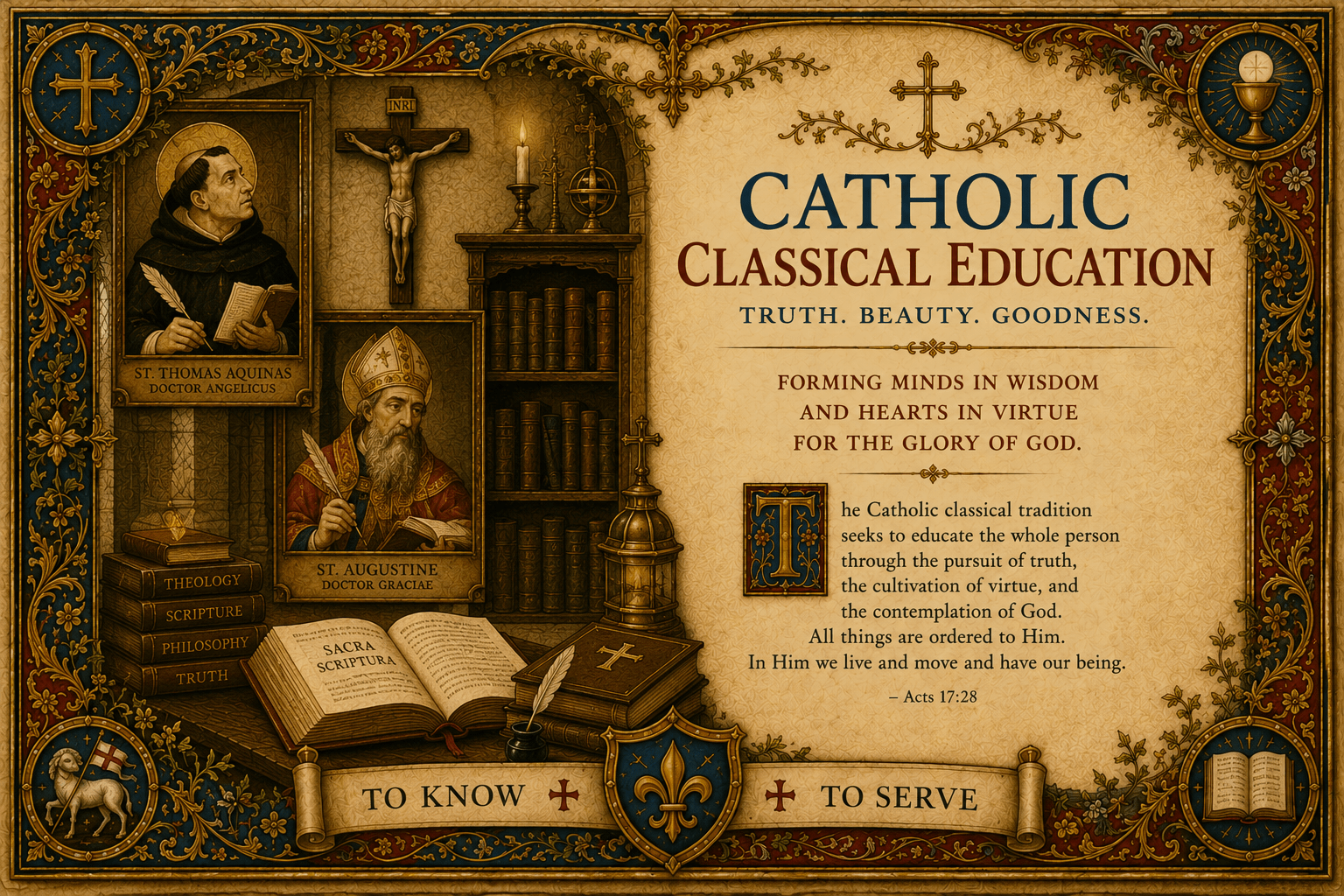
The first three liberal arts—grammar, dialectic and rhetoric—train us to understand words, reason correctly and communicate truth. Together they form the trivium.
The remaining four arts—arithmetic, geometry, music and astronomy—form the quadrivium. They direct our attention towards number, proportion, harmony, space, movement and time.
In a common summary:
- Arithmetic considers number in itself.
- Geometry considers number and proportion in space.
- Music considers number and proportion in sound.
- Astronomy considers number, space and movement in the heavens.
This does not mean that medieval students reduced creation to mathematical formulas. The quadrivium trained the mind to recognise that creation is not chaotic. Things possess measure, relationships, patterns and order.
Holy Scripture says of God:
“But thou hast ordered all things in measure, and number, and weight.”
— Wisdom 11:21
Number is not God, and creation did not come into existence through mathematical necessity. God freely created all things from nothing. Yet because creation comes from divine wisdom, it possesses an order that the human mind can discover.
The quadrivium teaches us to attend to that order.
Creation Is Intelligible
When we count objects, measure distance, recognise a musical interval or calculate the movement of a heavenly body, we discover relationships that we did not invent.
Two and two make four regardless of our preferences. A badly measured wall will not stand because the builder sincerely wished it to do so. A musical note has a definite relationship to another note. The movements of the earth, moon and sun establish real patterns by which days and seasons can be measured.
The mind can understand these patterns because both the world and the human intellect come from God.
St Paul writes:
“For the invisible things of him, from the creation of the world, are clearly seen, being understood by the things that are made.”
— Romans 1:20
Created order does not reveal everything about God. We need divine revelation to know the mysteries of the Holy Trinity, the Incarnation and our supernatural destiny. Nevertheless, creation bears the marks of its Creator’s wisdom, goodness and power.
The quadrivium cultivates wonder before this intelligibility. It teaches us not merely to use the world but to contemplate it.
Arithmetic: The Meaning of Number
Arithmetic begins with number.
We use numbers continually: to count money, measure time, plan journeys and organise work. Yet arithmetic as a liberal art considers number not only for its immediate usefulness but as an intelligible reality.
The mind recognises unity and multiplicity. One object can belong to a group. A whole can possess parts. Equal quantities remain equal even when the objects counted are different.
Three stones and three candles are not the same things, but the number three can be recognised in both. The mind moves beyond the material objects and understands the numerical relationship.
Number allows us to perceive order. Without it we could not distinguish regularity from confusion, proportion from disproportion or rhythm from random sound.
Holy Scripture frequently uses numbers. There are seven days of creation, twelve tribes of Israel, forty years in the wilderness, twelve Apostles and three days between the death and Resurrection of Christ.
Some biblical numbers possess symbolic importance. Seven may signify completion, twelve the people of God, and forty a period of testing or preparation. But this symbolism must be received from Scripture and the Church’s tradition rather than invented according to private imagination.
Christian arithmetic must not become numerology.
Numerology treats numbers as possessing hidden powers or uses them to predict events and discover secret messages that God has not revealed. This is superstition, not Christian wisdom.
Numbers may serve the understanding of revelation, but they do not provide an alternative revelation.
Arithmetic teaches us to recognise real patterns while resisting the temptation to find mysterious significance wherever we please.
Geometry: Measure, Form and Proportion
Geometry considers extension, shape, position and proportion.
A line, circle, triangle or square can be understood according to definite relationships. Geometry enables builders to create stable structures, surveyors to measure land and artists to arrange images proportionately.
But geometry also trains the imagination to perceive order in space.
A well-proportioned building does more than remain standing. Its parts belong to a whole. Walls, windows, pillars and arches are related according to scale, balance and purpose.
Sacred architecture uses material space to serve worship. The arrangement of a church directs attention towards the altar. Height can draw the eyes upwards. Light can distinguish particular spaces. The relationship between the nave, sanctuary, font and tabernacle expresses something about the Church’s sacramental life.
A church is not made sacred merely by possessing attractive proportions. It is set apart for divine worship through the Church’s rites. Yet proportion and beauty can assist the building’s sacred purpose.
Geometry reminds us that human beings do not occupy an abstract world. We live, worship and act within material places. The arrangement of a place can encourage attention or distraction, reverence or carelessness, community or isolation.
Measure also teaches humility.
A builder must submit to the nature of the materials. A structure cannot be made sound by enthusiasm alone. Reality places demands upon us. Good intentions do not remove the need for accuracy.
Geometry forms the mind by teaching it to respect order outside itself.
Music: Hearing Proportion
Within the quadrivium, music was not understood principally as performance or entertainment. It concerned the numerical relationships that make harmony and rhythm possible.
When two notes sound together, their relationship may produce harmony or discord. Rhythm depends upon measured patterns in time. Melody requires both movement and order.
Music allows proportion to be heard.
Boethius and other Christian teachers recognised several dimensions of musical order. There is the audible music made by voices and instruments. There is also a harmony within human life when body, reason and desire are rightly ordered. Beyond this lies the wider order of creation beneath divine providence.
These comparisons should not be treated as though the universe produces a tune that could be heard with the ears. They express the conviction that multiplicity can possess unity and that different parts may be ordered within a greater whole.
This has an important moral meaning.
Virtue produces harmony within the person because the passions are brought beneath reason and reason beneath God. Sin produces disorder because a lesser good is given a place it should not possess.
A person dominated by appetite is like a song in which one part overwhelms everything else. Christian freedom is not the absence of order but the right ordering of the whole person.
Music also occupies an important place in the Church’s worship. The Psalms are songs. The sacred liturgy is naturally sung because music gives solemn and communal expression to prayer.
Sacred music should serve the words and action of the liturgy. It should not become a performance that turns attention away from God and towards the musicians. Its beauty is ministerial: it serves worship.
Silence also belongs to musical order. Without silence, sounds cannot be properly distinguished. In the liturgy, silence is not an empty interruption. It allows the Word to be received, prayer to deepen and sacred action to be contemplated.
Music teaches us that order does not destroy beauty. It makes beauty possible.
Astronomy: The Heavens and the Ordering of Time
Astronomy considers the movements and relationships of heavenly bodies.
Ancient peoples often worshipped the sun, moon, planets and stars as gods or believed that heavenly movements controlled human destiny.
Sacred Scripture rejects this idolatry. The heavenly bodies are not divine. They are creatures made by God and placed within his ordered creation.
Genesis says:
“Let there be lights made in the firmament of heaven, to divide the day and the night, and let them be for signs, and for seasons, and for days and years.”
— Genesis 1:14
The sun and moon help measure days, months and seasons. The study of their movements enabled people to construct calendars, organise agriculture, navigate and determine the times of religious observance.
Astronomical calculation became particularly important within Christian life because the Church needed to determine the date of Easter and order the liturgical year.
Time itself was brought within worship. Days were marked by prayer. The week moved towards Sunday. The year unfolded through Advent, Christmas, Lent, Easter and the seasons of the Church.
Astronomy therefore served more than practical calculation. It helped Christian society inhabit time as a gift from God.
This must be clearly distinguished from astrology.
Astronomy studies heavenly bodies and their movements. Astrology claims that the stars and planets determine human character or foretell personal events.
Christian faith rejects such determinism and superstition. The stars are creatures, not masters of human freedom. Our lives rest beneath divine providence, not an impersonal arrangement of planets.
The Psalmist writes of God:
“Who telleth the number of the stars: and calleth them all by their names.”
— Psalm 146:4
The heavens do not rule God. God rules the heavens.
The Quadrivium and Christian Worship
Arithmetic, geometry, music and astronomy come together particularly clearly within the sacred liturgy.
Arithmetic assists the calculation of dates, the arrangement of the calendar and the measured repetition found within prayer.
Geometry serves the shape and proportion of sacred buildings, the arrangement of liturgical space and the work of sacred art.
Music orders voices and sounds in the praise of God.
Astronomy helps establish the natural cycles of days and seasons within which the liturgical year unfolds.
These arts do not create the sacred liturgy. The liturgy is given to the Church by Christ and celebrated through the authority of the Church. But the arts can serve it.
This reveals their proper relationship.
The arts are neither rejected nor worshipped. They become servants of divine worship.
The Church does not preserve music merely because music is culturally valuable. She sings because God is worthy of praise. She does not build beautiful churches merely to demonstrate architectural skill. She builds places set apart for the Holy Sacrifice and the presence of Christ in the Blessed Sacrament.
Number, shape, sound and time are gathered and offered back to their Creator.
The Dangers of Mathematical Pride
The success of mathematical reasoning can tempt us to imagine that everything real can be reduced to what can be counted or measured.
But many of the most important realities cannot be adequately expressed as quantities.
We may count the number of people attending a funeral, but not the depth of their grief. We may measure the length of a marriage, but not its faithfulness. We may record the amount donated to a charitable cause, but not the charity with which it was given.
Grace, virtue, love, justice and holiness are real, although they cannot be placed upon a set of scales.
The measurable is real, but reality is greater than the measurable.
The quadrivium should therefore produce humility rather than mathematical pride. The discovery of order should awaken wonder at the wisdom of God, not encourage the belief that human formulas can contain every mystery.
A scientist may explain many aspects of how a human body functions. This knowledge is valuable. But the person cannot be reduced to biological processes. Each human being possesses a spiritual soul, moral responsibility and an eternal destiny.
Quantity serves wisdom when it remains within its proper limits.
Recovering the Contemplative Vision
Modern education often values mathematics and science principally because they produce technology, economic growth or practical control.
The quadrivium reminds us that knowledge has a contemplative purpose.
We should sometimes study creation not because we intend to manufacture something, earn something or solve an immediate problem, but because truth is worth knowing.
A night sky should not be reduced to a collection of useful astronomical data. A piece of sacred music should not be reduced to vibrations. A church should not be reduced to measurements and building materials.
Each possesses a real material structure, but the human mind can also recognise meaning, beauty and order.
The Christian receives creation as a gift. We investigate it carefully because it is real, intelligible and good. We also recognise that it points beyond itself.
The Psalmist says:
“The heavens shew forth the glory of God, and the firmament declareth the work of his hands.”
— Psalm 18:2
The heavens do not speak with human words. Their existence, order and beauty bear witness to their Creator.
The quadrivium teaches the mind to notice that witness.
Measure, Number, Weight—and Wisdom
Arithmetic, geometry, music and astronomy form different habits, but they share one purpose: to awaken the mind to order.
Arithmetic reveals number. Geometry reveals proportion in space. Music reveals harmony in sound and time. Astronomy reveals movement and order in the heavens.
Together they remind us that creation is not meaningless.
Yet the final purpose of Christian education is not found in number, shape, music or the stars. It is found in God.
The arts prepare the mind for wisdom, but they cannot give the grace of salvation. They may help us recognise order, but Christ restores order within the soul. They may reveal beauty, but God is the source of all beauty. They may measure time, but Christ leads us towards eternity.
The proper response to creation is therefore not mastery alone, but praise.
“But let all things be done decently, and according to order.”
— 1 Corinthians 14:40
The Christian learner seeks order in thought, worship and life because God himself is not the author of confusion. To recognise his order is to receive creation more gratefully and offer it back to him more worthily.
Questions for Reflection
- Do I regard the created world principally as something to use, or also as something to contemplate?
- How do number, proportion, rhythm and order appear within my ordinary life?
- Do I confuse what can be measured with everything that is real?
- Does beauty lead me towards gratitude and worship, or stop at created things?
- Are there any superstitious ideas about numbers, stars or hidden patterns that I need to reject?
A Practical Exercise
Spend a few quiet minutes inside a church.
Look for the four arts of the quadrivium:
- Arithmetic: Notice repetition, grouping and number.
- Geometry: Notice lines, shapes, proportions and the direction of the building.
- Music: Notice sound, rhythm and silence.
- Astronomy: Notice natural light, the time of day and the place of the celebration within the liturgical year.
Then turn your attention towards the altar, tabernacle and crucifix.
Ask how these created forms are being placed at the service of something higher: the worship of God and the salvation of souls.
Finish with the words:
“Thou hast ordered all things in measure, and number, and weight.”
Give thanks to God for the order of creation and ask him to bring your own life into its proper order beneath his wisdom.

 St. Mary's, St. John Bosco and St. Edward's