Someone may know how to pass examinations, use complicated technology, earn a good salary and speak confidently on many subjects. Yet that same person may not know what life is for, how to distinguish good from evil, why suffering must sometimes be endured, or how to prepare for death.
Is that person truly educated?
Modern education often concentrates upon what will be useful: useful for employment, useful for economic growth or useful for solving an immediate problem. These things have their proper place. People need knowledge and practical skills. Christians have never despised careful study, honest work or the cultivation of the mind.
But usefulness cannot be the highest purpose of education. Before asking how something can be used, we must ask whether it is true, whether it is good and whether it will lead us towards our proper end.
Christian education is therefore concerned with three great things: truth, virtue and God.
Education Is for Truth
The human mind was made to know truth. We naturally want to understand what things are, why they exist and how they belong together. A young child repeatedly asks, “Why?” because the desire to know is already awakening.
Truth is not something we invent. It is something we receive and discover. Two contradictory statements cannot both be true in the same sense. Reality does not change merely because we dislike it or find it inconvenient.
This is why genuine education requires humility. We must allow reality to correct us. We must learn to listen, examine, distinguish and judge. Education should free us from ignorance, confusion, prejudice and manipulation.
Our Lord says:
“You shall know the truth, and the truth shall make you free.”
— John 8:32
For the Christian, truth is not merely a collection of correct statements. All truth finds its unity in Christ, the eternal Word of God. He does not simply teach truths; he says:
“I am the way, and the truth, and the life.”
— John 14:6
To seek truth honestly is therefore already to move towards the One through whom all things were made. Grammar, history, music, mathematics and the study of nature concern different aspects of reality, but reality has one Creator. No genuine truth can finally contradict another genuine truth because God is the author of all truth.
Christian education does not fear reason. It teaches reason to work carefully and recognises its proper limits. Reason can discover many truths, but humanity also needs divine revelation. We could not discover by our own powers the inner life of the Holy Trinity, the Incarnation of the Son of God or the supernatural destiny to which grace raises us. God must reveal these mysteries, and we receive them through faith.
Faith does not destroy reason. It heals, elevates and perfects it.
Education Is for Virtue
Knowing what is right does not automatically make us good.
A person may understand justice while behaving unjustly. Someone may speak eloquently about courage while running away from every sacrifice. Intelligence can be used to defend falsehood, excuse selfishness or manipulate other people.
Christian education must therefore form not only the mind but also the will. It should help us love what is good and practise it consistently.
A virtue is a stable disposition towards what is good. We acquire the moral virtues through repeated good actions, assisted and perfected by God’s grace. We become just by doing what is just, courageous by facing difficulties for the sake of the good, and temperate by learning not to be ruled by every appetite.
This requires discipline. A mind that is constantly distracted will struggle to contemplate truth. A person who never learns self-denial will find it difficult to pursue a demanding good. Someone governed by pride will resist correction even when correction is deserved.
Traditional Christian education therefore valued habits such as attention, memory, silence, perseverance, courtesy and obedience to rightful authority. These were not arbitrary restrictions. They prepared a person to become free in the fullest sense: free to recognise and choose what is truly good.
Freedom is not the ability to obey every passing desire. It is the ability to act according to truth and attain the good for which we were created.
Yet education alone cannot overcome sin. We need redemption. We need the grace won for us by Jesus Christ and communicated through his Church, especially in the Sacraments. Christian education may teach us about virtue, but Christ must heal and strengthen us so that we can live virtuously.
The educated Christian should therefore become not merely clever, but humble; not merely articulate, but truthful; not merely successful, but holy.
Education Is for God
The final purpose of human life is not found within this passing world.
We were created by God and for God. No amount of knowledge, wealth, pleasure, recognition or worldly achievement can completely satisfy the human heart. Each created good is limited. Our deepest desire reaches beyond them towards the unlimited Good.
St Augustine expressed this at the beginning of his Confessions: God has made us for himself, and our hearts are restless until they rest in him.
Holy Scripture teaches:
“The fear of the Lord is the beginning of wisdom.”
— Psalm 110:10
This does not mean a servile terror of God. It means reverence before his holiness, recognition of his authority and the humble acceptance that we are creatures rather than the Creator. Wisdom begins when God occupies his proper place in our lives.
The highest knowledge is therefore the knowledge of God—not merely knowing facts about him, but knowing him through faith and charity. Our Lord prayed to the Father:
“Now this is eternal life: That they may know thee, the only true God, and Jesus Christ, whom thou hast sent.”
— John 17:3
All other learning must be ordered beneath this final purpose. Literature can teach us to recognise the movements of the human heart. History can show the consequences of virtue and vice. Logic can help us distinguish sound reasoning from error. Music can train us to perceive harmony and order. The study of nature can awaken wonder at the wisdom of the Creator.
But none of these should become an idol. Learning is good, but it is not God. It fulfils its proper purpose when it helps us receive truth gratefully, live well and praise the One from whom every good thing comes.
Forming the Whole Person
Christian education concerns the whole person: body and soul, intellect and will, memory and imagination. It takes place not only through books and lessons but through worship, family life, friendship, work, discipline and good example.
The first teachers of a child are ordinarily the parents. The Christian household teaches through its prayers, customs, conversations and priorities. The Church teaches through Scripture, doctrine, the lives of the saints and the sacred liturgy. Good teachers assist this work by handing on truth faithfully and living in accordance with what they teach.
Christ himself provides the perfect pattern of human formation:
“And Jesus advanced in wisdom, and age, and grace with God and men.”
— Luke 2:52
The purpose is not to produce people who can merely repeat information. It is to form people capable of sound judgement, faithful action, reverent worship and generous service.
The Beginning of Our Journey
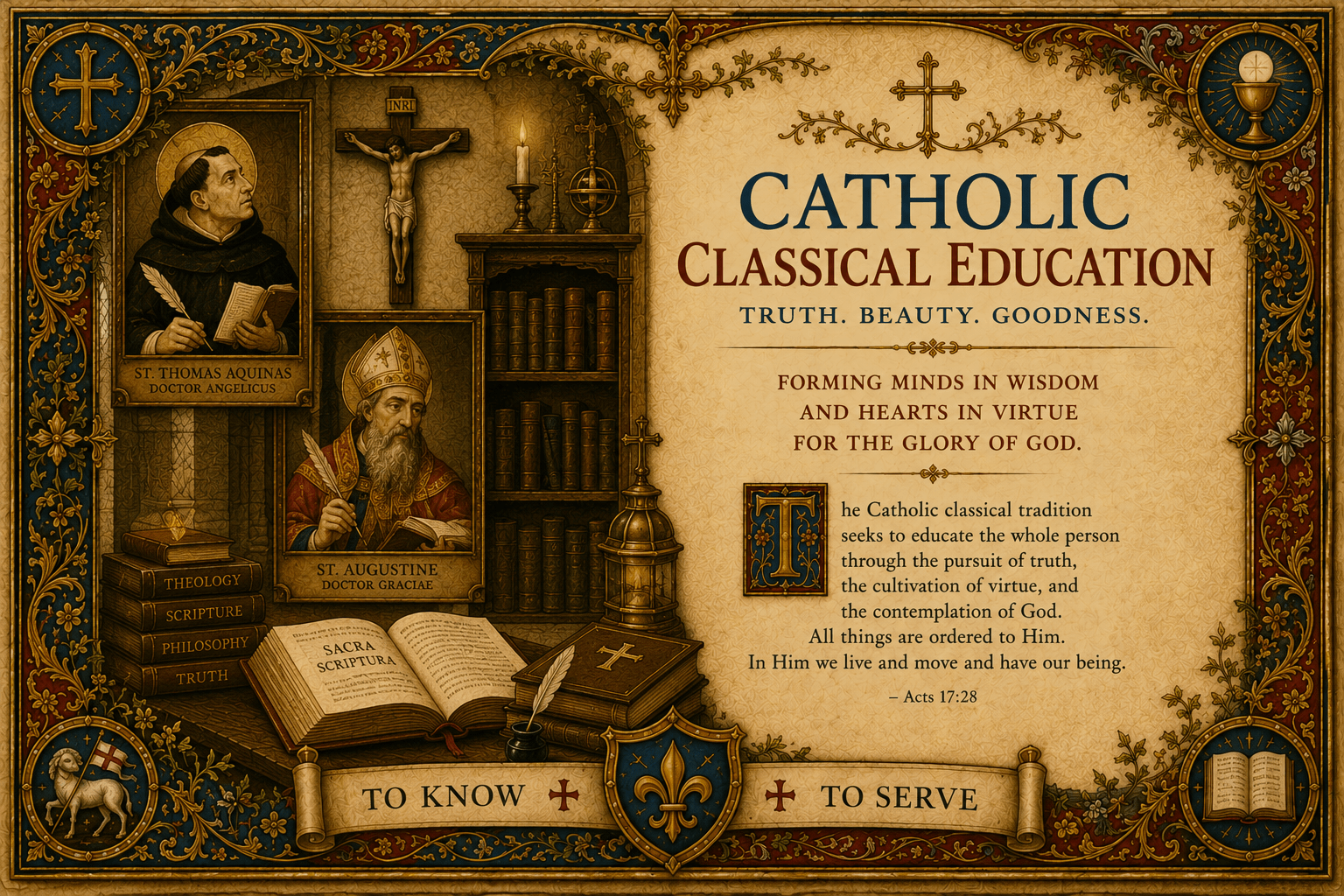
This series will explore the Christian tradition of education through some of its greatest teachers: St Augustine, Cassiodorus, Boethius, St Isidore, St Bede, Alcuin, Hugh of St Victor and St Thomas Aquinas.
We shall consider how Christians read, reasoned, remembered and taught. We shall examine the liberal arts, the relationship between faith and reason, and the importance of virtue, beauty, silence and contemplation.
But we begin with the end in view.
Christian education exists to help us know truth, practise virtue and journey towards God. It should teach us not only how to make a living, but how to live; not only how to understand the world, but how to see it as God’s creation; not only how to speak, but how to speak truthfully; and not only how to prepare for the future, but how to prepare for eternity.
Questions for Reflection
- What is the difference between possessing information and possessing wisdom?
- Are there areas of my life in which I know what is right but struggle to practise it?
- Does the way I learn lead me towards greater humility, truthfulness and love of God?
A Practical Exercise
Choose a short passage from one of the Gospels. Read it slowly three times. On the first reading, notice what the passage says. On the second, consider what it teaches about Christ. On the third, ask what change it calls for in your life.
Do not hurry. Christian learning begins with attention.

 St. Mary's, St. John Bosco and St. Edward's