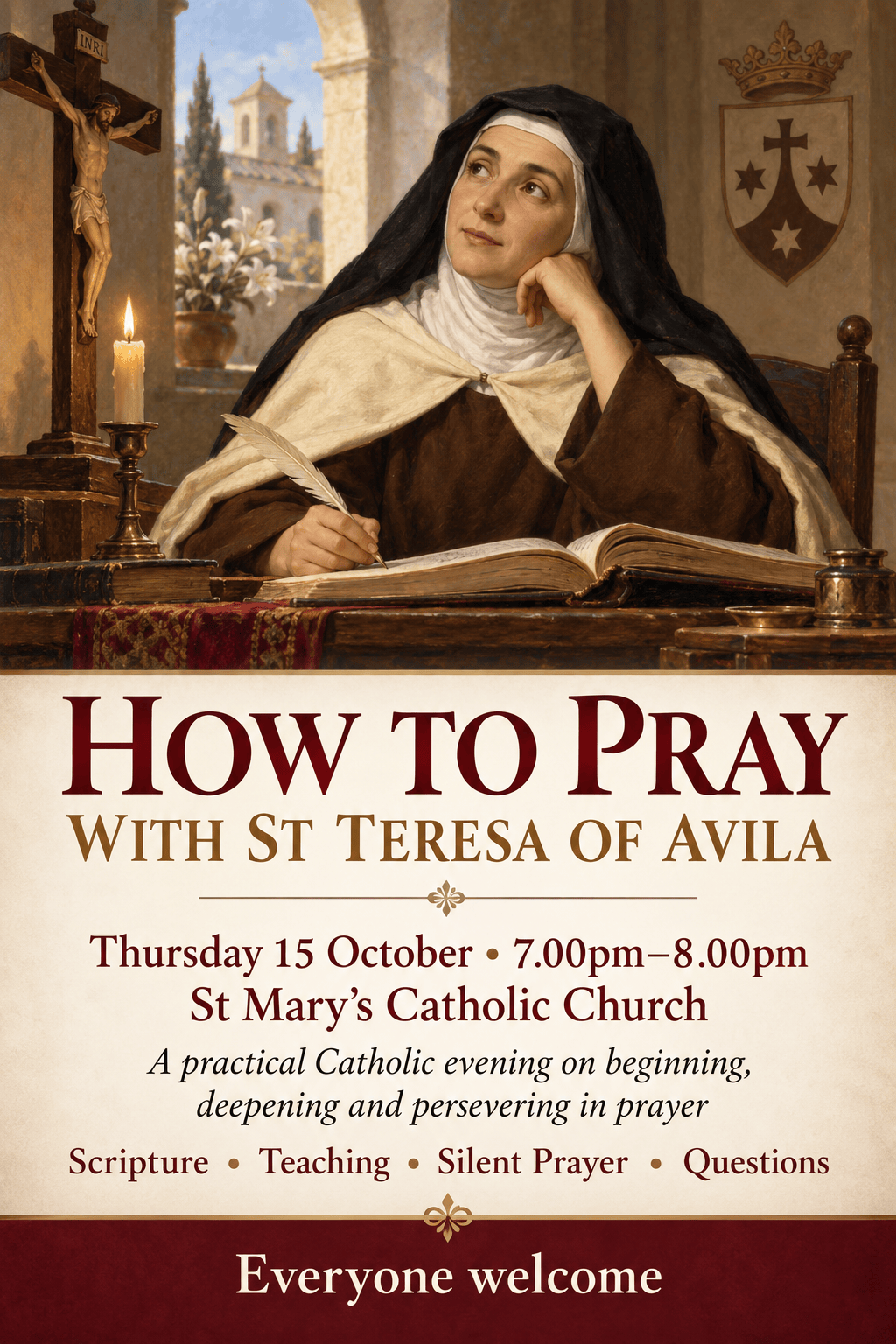
A Simple Method of Mental Prayer
Prayer is God’s invitation to every Christian. It is not reserved for priests, religious or experts. It is the living relationship of God’s children with their heavenly Father, through Jesus Christ, in the Holy Spirit.
St Teresa of Avila is one of the Church’s greatest teachers of prayer. Her teaching is practical, honest and particularly helpful when prayer feels difficult.
This page offers a simple pattern for daily mental prayer. You can use it alone, with your family or as part of a parish group.
This method can be used with any passage of Sacred Scripture. John 15:1–11 is provided below as one example. When beginning, you may find it easiest to choose a short passage from one of the Gospels.
Who Was St Teresa of Avila?
Teresa was born in Ávila in Spain in 1515. She became a Carmelite nun, a reformer of religious life, a writer and a teacher of prayer.
The Church later declared her a Doctor of the Church because her teaching helps the whole Church understand the life of faith.
Teresa was intelligent, practical, warm and sometimes very funny. She knew illness, opposition, distraction and misunderstanding. Her authority as a teacher of prayer did not come from having an easy life. It came from allowing Christ to lead her through difficulty into deeper trust.
She described mental prayer as:
“An intimate sharing between friends; it means taking time frequently to be alone with him who we know loves us.”
This gives us the foundation of Christian prayer.
Prayer is not a technique for controlling our feelings. It is not an attempt to empty the mind into nothingness. It is a real relationship with the living God, who has first sought us, spoken to us and loved us.
What Is Mental Prayer?
Mental prayer is personal, attentive prayer in which the mind and heart turn towards God.
It often begins with:
- A passage of Sacred Scripture
- An event in the life of Jesus
- A truth of the Catholic faith
- A crucifix or sacred image
- A mystery of the Rosary
- Something which has happened in our own life
Mental prayer includes reflection, honest conversation with God, silence and a practical response.
The word “mental” distinguishes it from prayers which are recited aloud or read from a book. It does not mean merely thinking about religious ideas.
In mental prayer, we place ourselves before God, listen to his word, speak to him and allow him to change us.
God Begins
We may imagine that prayer begins when we decide to look for God. In fact, God always acts first.
He created us, calls us, gives us grace and draws us towards himself. Even the desire to pray is already a sign of his grace at work.
Prayer is our response.
God speaks through Sacred Scripture, through the teaching and worship of the Church, through the sacraments and through the quiet promptings of grace.
We answer with:
- Faith
- Repentance
- Adoration
- Thanksgiving
- Petition
- Intercession
- Praise
- Love
Prayer Is Centred on Jesus Christ
Catholic prayer is never merely a private spiritual experience.
Through Baptism we belong to Christ and to his Body, the Church. We pray to the Father, through the Son, in the Holy Spirit. Even when we pray alone, we remain members of the Church.
St Teresa encourages us to remain close to the humanity of Jesus.
We look towards Christ in the Gospels:
- Teaching
- Healing
- Forgiving
- Welcoming
- Suffering
- Dying
- Risen from the dead
We speak to him honestly and allow his words and actions to shape our lives.
A Five-Part Method of Daily Prayer
This is not the only Catholic method of prayer, but it is reliable, simple and suitable for everyday use.
1. Choose a Time and Place
Choose a definite time which you can ordinarily keep.
This might be:
- On waking
- After returning home
- Before the rest of the household wakes
- During a quiet part of the day
- Before going to bed
Do not wait until you feel especially prayerful.
Sit or kneel somewhere reasonably quiet. You may place a crucifix, Bible or sacred image before you.
Five or ten faithful minutes each day are better than attempting a long period once and then giving up.
2. Place Yourself in God’s Presence
Make the Sign of the Cross slowly:
In the name of the Father, and of the Son, and of the Holy Spirit. Amen.
Remember that God is present. You do not have to create his presence or manufacture a special feeling.
Ask the Holy Spirit for help:
Come, Holy Spirit. Open my mind to the truth, quieten what is restless within me and teach me to pray. Help me to know Jesus Christ, listen to his word and remain faithfully in his presence. Amen.
3. Read Sacred Scripture
Choose a short passage of Scripture.
Read it slowly. Read it a second time if this is helpful.
Do not try to cover a whole chapter or understand every detail. Notice one word, action or sentence which draws your attention.
Ask:
- What does this passage show me about God?
- What is Jesus saying or doing?
- Is there a promise, command or warning?
- What response is Christ asking from me?
You may use any passage of Sacred Scripture with this method. A Gospel passage is often easiest when beginning because it helps us remain close to the words and actions of Jesus.
John 15:1–11 is used below as a guided example, but you are not limited to this passage.
4. Speak Honestly and Listen
Speak to Christ about what is truly in your heart.
This may include:
- Gratitude
- Sorrow
- Fear
- Confusion
- Temptation
- Hope
- A person who needs prayer
- A sin for which you need mercy
- A decision for which you need guidance
You do not need to make a speech or use impressive words.
After speaking, remain quietly with Christ. Silence is not an empty gap. It is attentive presence before someone whom we love.
5. Make a Resolution and Finish with Prayer
Ask what response Christ is inviting you to make.
Choose one simple and concrete action, such as:
- Apologising to someone
- Resisting gossip
- Forgiving an offence
- Making time for someone who is lonely
- Returning to Confession
- Completing a neglected duty
- Keeping tomorrow’s prayer time
Finish with the Our Father, the Glory Be or another familiar prayer.
A Guided Example Using John 15
The following passage comes from Our Lord’s teaching at the Last Supper.
Read it slowly. Then read it again, listening for one word or sentence which seems particularly important.
I am the true vine, and my Father is the husbandman. Every branch in me that beareth not fruit, he will take away: and every one that beareth fruit, he will purge it, that it may bring forth more fruit.
Now you are clean, by reason of the word which I have spoken to you.
Abide in me, and I in you. As the branch cannot bear fruit of itself, unless it abide in the vine, so neither can you, unless you abide in me.
I am the vine: you the branches. He that abideth in me, and I in him, the same beareth much fruit: for without me you can do nothing.
If any one abide not in me, he shall be cast forth as a branch and shall wither: and they shall gather him up and cast him into the fire: and he burneth.
If you abide in me and my words abide in you, you shall ask whatever you will: and it shall be done unto you.
In this is my Father glorified: that you bring forth very much fruit and become my disciples.
As the Father hath loved me, I also have loved you. Abide in my love.
If you keep my commandments, you shall abide in my love: as I also have kept my Father’s commandments and do abide in his love.
These things I have spoken to you, that my joy may be in you, and your joy may be filled.
John 15:1–11
Pause quietly.
Become aware that you are in the presence of God. You do not have to create his presence. He is already with you.
Recall the words of Jesus:
“Abide in me, and I in you.”
Speak to him silently. You might simply say:
Lord Jesus, help me to remain in you.
Remain in silence.
Bring before Christ whatever is occupying your heart. Do not disguise it.
If it is a person, place that person in his care.
If it is a sin, ask for mercy and the courage to repent.
If it is gratitude, give thanks.
Remain in silence again.
Ask:
Lord, what are you asking of me?
Do not strain for an extraordinary answer. Attend quietly to his word and to any simple duty, change or act of charity which comes clearly to mind.
Finally, set aside even your own words. Remain quietly with Christ.
When distractions come, return gently to his name:
Jesus.
Finish by praying:
Lord Jesus Christ,
without you we can do nothing.
Keep us close to you.
Purify our desires,
strengthen what is weak
and teach us to love.
Amen.
Make the Sign of the Cross.
Other Scripture Passages You Could Use
The same method can be used with any passage of Scripture. These passages may be especially helpful when beginning:
- Matthew 6:25–34, trusting our heavenly Father
- Matthew 11:28–30, coming to Jesus for rest
- Mark 10:46–52, the healing of Bartimaeus
- Luke 10:38–42, Martha and Mary
- Luke 15:11–32, the loving father and his two sons
- Luke 24:13–35, the road to Emmaus
- John 4:5–26, Jesus and the woman at the well
- John 10:1–18, Jesus the Good Shepherd
- John 20:19–29, the risen Lord and St Thomas
- Psalm 22, the Lord is my shepherd
- Psalm 50, a prayer of repentance
- Psalm 138, God knows and loves us
You may also use:
- The Gospel from the previous Sunday
- The Gospel for the following Sunday
- A reading from the Mass of the day
- A passage suggested by a priest or spiritual guide
- A passage which speaks to a present need or difficulty
The purpose is not to collect large amounts of information. It is to listen to God’s word and respond faithfully.
What About Distractions?
Nearly everyone becomes distracted in prayer.
A thought about tomorrow, an old conversation or an unfinished task suddenly enters the mind. This does not mean that prayer has failed.
Once you notice the distraction, return gently to Christ. You may have to do this many times. Each return is itself an act of love.
Do not become angry with yourself. Do not deliberately follow every thought which appears.
Notice the distraction, entrust it to God if necessary and return to:
- The Scripture passage
- The crucifix
- The name of Jesus
- A short phrase from the reading
What About Dryness?
Sometimes prayer brings peace or consolation. At other times it feels dry, empty or difficult.
Feelings are real, but they are not the measure of faith.
A person may feel nothing and still make a profound act of love by remaining faithfully with God.
Dryness may have ordinary causes, including:
- Tiredness
- Anxiety
- Illness
- Stress
- Distraction
- Unrealistic expectations
Sometimes it may reveal that we have become too dependent upon pleasant feelings. It may also be a trial through which God purifies our love.
Do not make dramatic judgements. Continue simply, receive the sacraments and seek wise help if the difficulty is persistent or serious.
Perseverance
St Teresa repeatedly teaches the importance of determined perseverance.
Prayer needs a real place in our day. We should choose a reasonable time and protect it.
Five faithful minutes every day are better than an ambitious hour attempted once and then abandoned.
Prayer and moral life also belong together. We cannot sincerely seek friendship with Christ while deliberately refusing his commandments.
When we sin, we should not hide from God. We repent, make use of Confession when needed and begin again.
Does God Always Answer Prayer?
God always hears prayer, but he answers according to his wisdom and our true good.
His answer may be:
- The grace to endure something difficult
- A call to change
- Help given through another person
- A door which opens
- A door which remains closed
- Something we understand only later
Prayer is not a way of controlling God or forcing a particular result. It teaches us to seek, trust and obey his will.
Prayer is not a replacement for medical care, professional support or practical action when these are needed.
A Practice for the Coming Week
Choose one passage of Scripture.
Set aside five to ten minutes each day and use the five-part method:
- Choose a time and place.
- Place yourself in God’s presence.
- Read the passage slowly.
- Speak honestly and listen.
- Make one resolution and finish with prayer.
You may remain with the same passage throughout the week or choose another passage when appropriate.
The aim is fidelity, not a particular feeling.
Questions for Reflection
- What most commonly makes prayer difficult for me?
- Which part of the five-part method will help me most?
- What time can I realistically give to prayer each day?
- Do I speak honestly to Christ?
- Am I willing to listen as well as speak?
- Is my prayer producing greater obedience, charity and forgiveness?
- What simple resolution is Christ asking me to make?
Closing Prayer
Let nothing disturb thee;
Let nothing dismay thee;
All things pass;
God never changes.
Patience attains all that it strives for.
He who has God finds he lacks nothing.
God alone suffices.St Teresa of Jesus, pray for us.
Our Lady of Mount Carmel, pray for us.In the name of the Father,
and of the Son,
and of the Holy Spirit. Amen.


