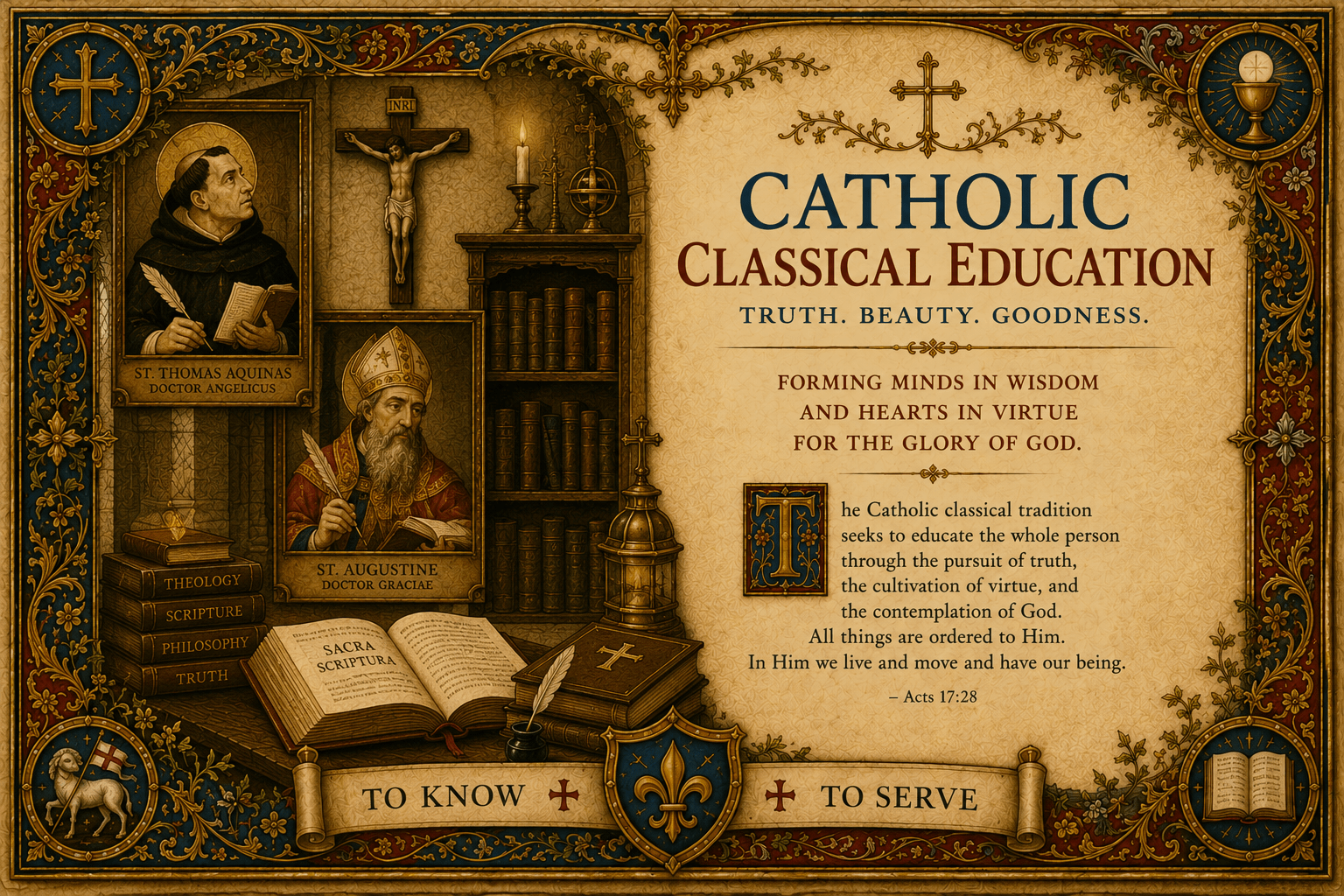
The Christian classical tradition may appear distant from modern life.
We do not live in monasteries or medieval cathedral schools. Most people cannot devote several hours each day to Latin, theology or the liberal arts. Work, family responsibilities, illness and ordinary duties place real limits upon our time.
Yet Christian education is not reserved for professional scholars.
Its essential habits can be recovered by anyone willing to read carefully, think honestly, pray faithfully and order learning towards God.
You do not need an expensive course, an enormous library or specialist qualifications. You do not need to master everything at once.
You need a Catholic Bible, the Catechism, one worthwhile book, a notebook and a modest rule of life.
The purpose is not to recreate the Middle Ages. It is to recover a Christian way of learning: Scripture at the centre, the Church as guide, reason in the service of truth, memory strengthened through practice, virtue formed through action and everything directed towards worship.
Begin with the Right End
Before choosing books or arranging a programme, remember what Christian education is for.
We study so that we may recognise truth, love what is good, live virtuously and know God more deeply.
Learning should make us more humble, prayerful and faithful. If it merely gives us more subjects about which to argue, something has gone wrong.
This protects us from turning Christian education into a hobby for collecting old books or displaying unusual knowledge. It also prevents study from competing with our actual duties.
A parent should not neglect a child in order to read about virtue. A priest should not neglect his parish in order to study pastoral theology. A person should not abandon prayer in order to read books about prayer.
The duties of our state of life come from God. Study must assist us in fulfilling them more faithfully.
Our Lord says:
“But one thing is necessary. Mary hath chosen the best part, which shall not be taken away from her.”
— Luke 10:42
The final purpose is union with God. Every lesser study must remain ordered towards that end.
Worship Comes First
A Christian education begins within the worshipping Church.
Sunday Mass is not one element within the programme. It is the governing centre. The Eucharist is the source and summit of Christian life, and every authentic Catholic education should lead towards more faithful participation in the sacred liturgy.
Regular Confession is also essential. Study can expose errors in our thinking, but only Christ can forgive sin and restore sanctifying grace through the Sacrament of Penance.
We should also learn to inhabit the liturgical year. Advent, Christmas, Lent, Easter, Sundays and the feasts of the saints provide a Christian ordering of time.
This protects education from becoming purely intellectual.
We learn within the life of grace: worshipping, repenting, receiving the Sacraments and living as members of Christ’s Church.
If study makes us less attentive at Mass, less willing to confess our sins or more contemptuous of ordinary Catholics, it is not producing Christian wisdom.
Give Scripture the First Place
Begin with Sacred Scripture.
Do not attempt to read the entire Bible quickly merely to say that it has been completed. Start with a Gospel, the Psalms or the readings for Sunday Mass.
Read a short passage slowly. Notice repeated words. Ask what the sacred author is affirming. Read within the faith of the Church rather than according to private interpretation.
St Paul advises St Timothy:
“Till I come, attend unto reading, to exhortation, and to doctrine.”
— 1 Timothy 4:13
Fifteen attentive minutes are more valuable than an hour of distracted reading.
A simple daily practice might be:
- Read a short passage twice.
- Identify one central truth.
- Copy one sentence.
- Consider what it reveals about Christ.
- Respond to God in prayer.
- Carry one phrase into the day.
Reading the coming Sunday’s Gospel is especially useful. It prepares us to hear the passage proclaimed within the Church and connects private study with the sacred liturgy.
Scripture should become familiar enough that its words, images and patterns gradually furnish the mind.
Read One Good Book at a Time
The availability of books can create a new difficulty: we begin many and finish none.
Choose one worthwhile Christian book and remain with it.
Read ten pages carefully rather than fifty hurriedly. If the work is difficult, read only a few paragraphs. Look up unfamiliar words and write a short summary.
The purpose is not speed. It is understanding.
A beginner’s path might include:
- One of the Gospels and the Psalms
- Selected sections of the Catechism of the Catholic Church
- St Augustine’s Confessions
- The Rule of St Benedict
- St Augustine’s On Christian Doctrine
- Boethius’s Consolation of Philosophy
- Hugh of St Victor’s Didascalicon
- Selected questions from St Thomas Aquinas
These need not be read consecutively without any other material. Nor must every work be read in full. A reliable introduction or selected passages may be more suitable at first.
The list is a path, not a test.
If a book consistently proves too difficult, place it aside and return later. Humility includes recognising when we need a simpler preparation.
Keep a Commonplace Book
Use one notebook to preserve what you learn.
When you encounter an important passage, copy it by hand and record its source. Add a brief explanation in your own words. You may also note a related Scripture passage, a question or a practical application.
The notebook might contain sections for:
- Sacred Scripture
- Catholic doctrine
- Prayer and the spiritual life
- Virtue and moral teaching
- History
- Language and reasoning
- Sacred music, art and creation
Do not attempt to record everything. Choose what deserves to remain within the memory.
Copying by hand slows the mind and requires attention. Summarising tests whether we have understood. Returning to previous notes strengthens memory.
A commonplace book should not become another collection that is never used. Read through older entries regularly. Learn some of them by heart. Use them in prayer and conversation.
The aim is to carry a small treasury of truth within you.
Practise the Trivium
Grammar, dialectic and rhetoric do not require a medieval classroom. They can be practised through ordinary reading, writing and conversation.
Grammar: Receive the Words
Choose a sentence from Scripture or another serious text.
Identify the important words. Look up their meaning. Notice who is acting, what is being affirmed and how the sentence belongs within the surrounding passage.
Then rewrite the sentence in your own words without changing its meaning.
This teaches the first discipline of learning: receive before judging.
Dialectic: Examine the Argument
When you encounter a claim, ask:
- What exactly is being asserted?
- Which words require definition?
- What reasons are offered?
- Are the premises true?
- Does the conclusion follow?
- What is the strongest reasonable objection?
Do not limit this practice to religious writing. Apply it to news reports, advertisements, online discussions and your own opinions.
St Paul tells us:
“But prove all things; hold fast that which is good.”
— 1 Thessalonians 5:21
The purpose is not continual suspicion. It is freedom from manipulation and greater obedience to truth.
Rhetoric: Explain the Truth
Choose one truth you have learned and explain it in a short paragraph.
Write for a real person rather than an imaginary academic audience. Avoid unnecessary terminology. Use one fitting example. End by stating why the truth matters.
You might explain:
- Why Catholics attend Mass every Sunday
- What grace is
- Why Confession is necessary
- What Christians mean by virtue
- How faith and reason belong together
Then read what you have written aloud. Remove anything unclear, exaggerated or needlessly complicated.
If we cannot explain a truth simply, we may not yet understand it properly.
Recover Memory
Choose a small amount of material worthy of being memorised.
Begin with:
- The Our Father
- The Apostles’ Creed
- The Ten Commandments
- The Beatitudes
- A short Psalm
- The Act of Contrition
- A sentence from the Sunday Gospel
- A traditional Catholic prayer
Recite what you are learning each day. Add nothing new until the present passage is secure.
Memory should not replace understanding, but understanding should enter the memory.
A truth remembered can return during temptation, suffering or prayer. A forgotten truth cannot easily guide us when a decision must be made.
St Paul writes:
“Let the word of Christ dwell in you abundantly, in all wisdom.”
— Colossians 3:16
To dwell suggests more than a brief visit. The Word should find a lasting home within us.
Encounter Number, Harmony and Creation
The quadrivium can also be recovered without attempting to reproduce a medieval mathematical syllabus.
Study arithmetic and geometry carefully enough to appreciate their order rather than treating them merely as unpleasant school subjects. Notice proportion in buildings, patterns within nature and the relationship between parts and wholes.
Learn something about the Church’s music. Listen attentively to Gregorian chant and good sacred polyphony. Follow the words and notice how the music serves them. Learn to sing one simple chant or hymn well.
Look at the night sky. Learn the basic movements that establish days, months and seasons. Notice how natural time and the liturgical year belong together.
Attend closely to a church building. Observe its shape, direction, light, images and arrangement around the altar.
The point is not to discover secret messages hidden in numbers or stars. Christians reject numerology and astrology. The purpose is to recover wonder before a creation ordered in measure, number and weight.
Allow knowledge to become praise.
Learn Christian Latin Gradually
Latin is not required before someone can begin a Christian education. Yet some knowledge of it can open the language of the Roman Church, her liturgy, theology and centuries of Christian writing.
Begin modestly.
Learn the Sign of the Cross, the Our Father, the Hail Mary and the Glory Be in Latin. Become familiar with common words found in the liturgy and theology.
Notice the roots Latin has given to English words such as grace, virtue, justice, sacrament, incarnation and redemption.
Do not allow language study to become a cause of discouragement or pride. Someone who knows no Latin may possess profound faith and holiness. Someone with excellent Latin may remain spiritually immature.
Latin is a servant of sacred truth, not a measure of personal worth.
Find Teachers and Companions
Self-education should not become intellectual isolation.
Christian learning belongs within the Church. Speak to a priest, catechist or trustworthy Catholic teacher when a difficulty arises. Use editions and explanations faithful to the Magisterium.
Discussing a book with another person can reveal misunderstandings and sharpen memory. A small reading group may be helpful if it remains prayerful, disciplined and focused.
We should also allow the saints and Doctors of the Church to become our teachers. Reading an old book is a form of entering a conversation that began before us.
Yet no private writer, however learned, replaces the teaching authority of the Church.
The internet can provide useful texts, lectures and reference material. Digital tools may help locate information, compare explanations and organise notes. They should not replace reading the original text, exercising personal judgement or seeking trustworthy human guidance.
A summary may tell us about a book. It cannot do all the work of reading the book.
Join Learning to Virtue
Christian education must change how we live.
After each period of study, ask:
- What truth have I learned?
- Which error has been corrected?
- Which virtue does this require?
- What action should follow?
- What should become part of my prayer?
Reading about temperance should lead to some act of self-restraint. Reading about justice should make us more honest. Reading about prayer should make us pray. Reading about the Eucharist should deepen our reverence at Mass.
St James warns:
“But be ye doers of the word, and not hearers only, deceiving your own selves.”
— James 1:22
One practical act is better than several resolutions that remain vague.
Choose something small and definite: apologise, keep a promise, resist gossip, fast from an unnecessary pleasure, visit someone who is lonely or attend Confession.
The test of Christian learning is not how much we can discuss, but whether truth is becoming visible in our lives.
A Simple Rule of Christian Learning
A sustainable rule should be modest enough to continue.
Each Day
- Pray at a regular time.
- Read Scripture for approximately fifteen minutes.
- Copy or memorise one important sentence.
- Perform the duties of your state of life faithfully.
Each Week
- Participate in Sunday Mass.
- Spend two short periods reading a Christian classic.
- Write one paragraph summarising what you have learned.
- Consider one argument carefully.
- Practise one deliberate act of virtue.
- Make time for silence and attention to creation or sacred beauty.
Each Month
- Receive sacramental Confession regularly.
- Review your commonplace book.
- Learn one passage, prayer or hymn by heart.
- Discuss one question with a trustworthy Catholic.
- Perform a deliberate work of mercy.
- Decide whether your rule remains realistic.
This pattern should be adapted according to vocation, health and responsibilities. Someone caring for children or an ill relative may have very little uninterrupted time. Five faithful minutes may be more pleasing to God than an ambitious plan repeatedly abandoned.
Consistency matters more than quantity.
Avoiding Common Mistakes
Several dangers can undermine the work.
Attempting Too Much
Enthusiasm may produce an elaborate programme that lasts two weeks. Begin with less than you think you can manage and allow the habit to grow.
Reading without Prayer
Study about God cannot replace speaking to God. Begin and end with prayer.
Collecting without Understanding
Buying books, saving articles and compiling lists can create the appearance of study without its substance. Finish something small.
Pride in Unusual Knowledge
Christian learning should not produce contempt for those with less education. Intellectual gifts create a duty of service.
Neglecting the Church
Private reading must not become private religion. Remain guided by Scripture, Tradition and the Magisterium.
Endless Argument
Apologetics has a proper place, but Christianity is more than answering objections. Do not allow controversy to crowd out prayer, worship and charity.
Confusing Difficulty with Depth
A text is not necessarily profound because it is obscure. Seek clarity.
Forcing Spiritual Experiences
Prayerful reading may sometimes feel dry. Remain faithful without inventing meanings or emotions.
The cure for each danger is humility and a return to the proper end.
Families and Children
A Christian household can adopt these practices without attempting to become a formal school.
Read a short passage of Scripture together. Learn one prayer. Keep Sunday Mass central. Tell the lives of the saints. Sing a hymn. Look carefully at a church or work of sacred art. Ask children what a word means and help them explain a truth in their own language.
Let children see adults reading, praying and admitting when they do not know something.
The example of a parent who seeks truth humbly may teach more than an elaborate lesson.
Do not burden family life with continual academic pressure. Wonder, conversation, prayer and good example provide fertile ground for later study.
The aim is not to produce impressive children. It is to form disciples of Christ.
Begin Small and Persevere
The Christian classical tradition was built through centuries of faithful labour. We should not expect to possess it within a few weeks.
Begin with one Gospel, one notebook and one good book.
Read slowly. Ask precise questions. Memorise something true. Explain it clearly. Practise one virtue. Attend Mass faithfully.
When you fail, begin again.
Education is not completed when a course ends. It continues throughout life because truth is inexhaustible and our conversion remains unfinished.
The goal is not to know everything. No created mind can do so. The goal is to know what is worth knowing, love what is worth loving and order everything towards God.
Christian learning begins in attention, grows through discipline, bears fruit in virtue and returns in gratitude to worship.
Questions for Reflection
- What realistic amount of time can I give to Christian learning?
- Which book should I read slowly rather than beginning several?
- Which passage of Scripture should I commit to memory?
- Is my learning strengthening prayer and virtue?
- What unnecessary activity could be reduced to make room for something better?
A Practical Exercise
Create a personal rule for the next four weeks.
Write down:
- A regular time for daily prayer
- A short book of Scripture to read
- One Christian book
- One passage to memorise
- One virtue to practise
- A date for Confession
- The Sunday Mass you ordinarily attend
Keep the rule simple. Place it somewhere visible.
After four weeks, review it honestly. Retain what was fruitful, reduce what was unrealistic and continue without discouragement.
Do not wait until you can design a perfect education.
Begin with the truth already before you.

 St. Mary's, St. John Bosco and St. Edward's