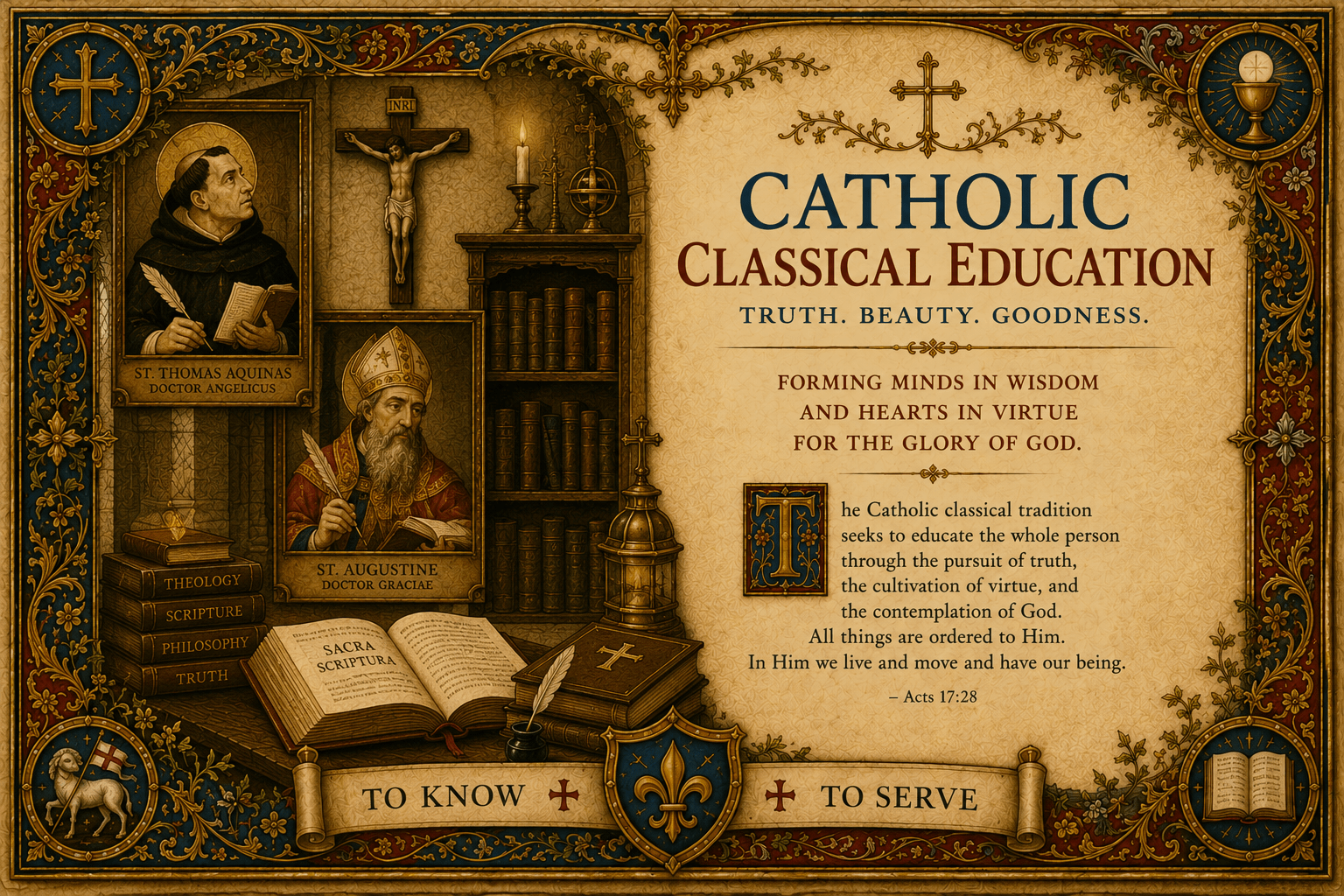
The Christian intellectual tradition finds its completion not in the library, classroom or lecture hall, but in the worship of God.
Grammar teaches us to receive words faithfully. Dialectic teaches us to distinguish truth from error. Rhetoric teaches us to communicate truth well. The quadrivium trains us to recognise number, proportion, harmony and order. Scripture, the Fathers and theology form the mind according to divine revelation.
In the sacred liturgy, all these things are gathered and directed towards their highest purpose.
Words become prayer. Reason assents to the Creed. Music becomes praise. Time is sanctified. Material things become sacramental signs. The human body kneels, stands, listens and receives. Scripture is proclaimed, Christ’s Sacrifice is made present and the faithful are drawn into the worship of heaven.
We may therefore call the liturgy the highest school of Christian culture—but only if we remember that it is infinitely more than a school.
The liturgy does not merely teach us about God. It is the public worship of the Church and the saving action of Christ. In the Sacraments, Christ does not simply explain grace; he gives it.
Worship before Instruction
The first purpose of the liturgy is the worship of God and the sanctification of his people.
It should never be reduced to an educational technique, a community gathering, a musical performance or a means of displaying cultural heritage.
The liturgy certainly teaches. Its prayers, readings, signs and ceremonies form the faithful. But they do so because the Church is first worshipping the divine Majesty.
God is worthy of worship because he is God. We do not come to Mass principally to obtain an interesting thought, enjoy music, meet friends or experience a particular emotion. We come to adore the Father, through the Son, in the Holy Spirit.
At the centre stands the Sacrifice of Christ.
At the Last Supper, Our Lord took bread and wine, gave thanks, and said:
“This is my body, which is given for you. Do this for a commemoration of me.”
— Luke 22:19
The Mass is not a new sacrifice added to Calvary. It is the one Sacrifice of Christ made sacramentally present. The same Christ who offered himself once upon the Cross offers himself through the ministry of the priest.
The Church joins herself to his perfect offering.
The liturgy forms us because it draws us into something objectively greater than ourselves.
The Action of Christ and His Church
The liturgy is not principally something that we manufacture for God. It is Christ acting in and through his Church.
Christ is present in the person of the ordained minister. He is present in his Word when the Scriptures are proclaimed. He is present when the Church prays and sings. Above all, he is present substantially under the Eucharistic species.
The whole Christ—Head and members—offers worship to the Father.
This means that the liturgy is never a private possession.
It does not belong to the personal creativity of the priest, the preferences of a planning group or the tastes of a congregation. The sacred rites belong to the Church. They are received and celebrated according to her authority.
This protects the faithful.
A Catholic should be able to enter a church and encounter the worship of the Church rather than the personality of the celebrant. The priest serves the rite; he does not own it. The congregation participates in the action of Christ; it does not assemble to create a religious experience.
Liturgical laws and rubrics are therefore not mere fussiness. At their best, they protect the integrity of the rite and free worship from individual invention.
Legitimate authority may regulate and develop the liturgy. No individual—including a priest—may add, remove or change elements on personal authority.
Obedience allows the liturgy to remain the prayer of the whole Church.
Source and Summit
The Church teaches that the sacred liturgy is the summit towards which her activity is directed and the source from which her power flows.
Evangelisation leads towards worship. People are called to faith and Baptism so that they may become members of Christ, join the Church’s offering and share in the Lord’s Supper.
The liturgy then sends the faithful back into the world strengthened by grace.
This pattern can be seen at the end of Mass. We are dismissed not because worship has been unimportant, but because what we have received must now shape our lives.
The Eucharist is the source and summit of Christian life because it contains Christ himself.
Every work of catechesis, charity, mission and parish life must remain connected to this centre. A parish may provide excellent activities, attractive resources and generous service. But if these things do not lead towards faithful worship and deeper union with Christ, their Christian purpose has become uncertain.
Likewise, attendance at Mass should lead to conversion and charity. We cannot receive the Sacrament of unity while deliberately nurturing division, injustice or contempt.
The movement flows in both directions: Christian life leads towards the altar, and grace flows from the altar into Christian life.
The Liturgy Teaches Scripture
The sacred liturgy is filled with the language of the Bible.
Scripture is proclaimed in the readings. Psalms are sung. The prayers of the Mass echo biblical words and images. Liturgical gestures and material signs draw their meaning from the history of salvation.
The Lamb of God recalls the Passover, the sacrifice of the Temple and St John the Baptist’s testimony to Christ. The chalice recalls covenant, sacrifice and the Blood poured out for the forgiveness of sins. Water, oil, fire, white garments and the laying on of hands carry meanings formed throughout Scripture.
A person who attends the liturgy faithfully is gradually immersed in a scriptural world.
The Bible is not presented as a disconnected collection of private devotional sayings. The Church places passages together according to the liturgical season and the mystery being celebrated.
Advent teaches us to wait for the coming of Christ. Christmas proclaims the Incarnation. Lent calls us to penance and Baptismal renewal. Easter celebrates the victory of the Crucified and Risen Lord. Ordinary Time leads us through his teaching and public ministry.
The liturgical year becomes a school of salvation history.
It does not simply remind us of past events. The mysteries of Christ are sacramentally celebrated and their grace is communicated to the Church.
The Body Learns to Worship
Christianity does not treat the body as an obstacle to spiritual life.
The Son of God assumed a true human body. He redeemed us through his bodily Passion and rose bodily from the dead. The Sacraments use material signs because human beings are a unity of body and soul.
In the liturgy, the body is educated for worship.
We stand in reverence and readiness. We sit to listen. We kneel in adoration. We make the Sign of the Cross. We strike the breast in repentance. We bow, process, sing and keep silence.
These actions should express and assist the interior disposition of the soul.
Kneeling does not automatically produce humility, but it gives humility bodily expression and can help form it. Saying “Amen” does not guarantee faith, but the word gives public voice to our assent. Extending a hand in peace should correspond to a genuine willingness to live in charity.
External participation without interior attention becomes empty. Interior devotion that refuses every fitting external expression misunderstands our bodily nature.
The liturgy forms the whole person.
Learning through Sacred Signs
A Sacrament is an efficacious sign of grace instituted by Christ and entrusted to the Church.
The sign does not merely provide an illustration. Through the sacramental action, Christ truly gives the grace signified.
Water in Baptism signifies washing, death and new life. Through Baptism, sin is truly forgiven and the person is reborn in Christ.
Oil signifies strengthening and consecration. In Confirmation, the Holy Spirit strengthens the baptised Christian and marks them more perfectly with the gift of the Spirit.
Bread and wine signify nourishment, sacrifice and communion. At Mass, they become the Body and Blood of Christ.
The sacramental signs educate us by joining visible realities to invisible grace. They teach us to see creation as capable of serving God’s saving purpose.
This is not magic. The Sacraments act through the power and promise of Christ. They require faithful celebration and call for proper reception.
The Christian learns to approach them neither as empty symbols nor as automatic rituals detached from conversion.
The signs communicate what Christ has promised, and we are called to receive their grace fruitfully.
Time Made Holy
The liturgy does not only order sacred space. It orders time.
The day can be sanctified through the Divine Office. The week moves towards Sunday, the Day of the Lord and the day of the Resurrection. The year unfolds through the mysteries of Christ and the feasts of Our Lady and the saints.
This rescues time from becoming an endless succession of work, consumption and entertainment.
Sunday is not simply spare time at the end of the week. It is the Lord’s Day. Catholics gather for Mass because Christ is risen, the Church is his Body and the Eucharist is the heart of Christian life.
The Sunday obligation protects this sacred order. It reminds us that worship is not fitted around everything else as an optional extra. Our lives must be fitted around God.
The seasons of fasting and feasting also educate desire.
Lent teaches that we do not live by pleasure alone. Easter teaches that Christian life is ordered towards resurrection and joy. Feast days keep alive the memory of God’s works and the witness of the saints.
The liturgical calendar forms a Christian memory.
Without it, public life will be ordered by commercial seasons, sporting events, holidays and political anniversaries. These may have a legitimate place, but they cannot give time its final meaning.
The Church’s year teaches us to live within the time of Christ.
Sacred Music and Silence
Music gives solemn and communal expression to prayer.
The Church does not sing merely to make worship more entertaining. She sings because the human voice can unite words, breath, melody and bodily effort in praise of God.
Sacred music must therefore serve the liturgical action.
The words should be faithful to Catholic doctrine. The musical form should be suited to prayer. The place of the choir or musician is ministerial rather than performative.
The Church gives Gregorian chant a privileged place within the Roman liturgy. Other forms of sacred music may also be suitable when they accord with the holiness and true spirit of the rite.
The question is not simply whether people enjoy a piece of music. We must ask whether it serves the sacred text, supports the liturgical action and directs attention towards God.
Silence is equally important.
Reverent silence is not a failure to participate. It allows the Word to descend into the heart, gives space for personal prayer and acknowledges mysteries that words cannot exhaust.
A liturgy filled with constant explanation, music or speech may leave little room for contemplation.
Sound and silence must both be ordered towards worship.
Beauty in the Service of Holiness
Church architecture, vestments, vessels, images, music and ceremonial actions should possess a fitting beauty.
Beauty is not an unnecessary luxury added after practical needs have been met. It can express reverence, manifest the importance of divine worship and lift the mind towards God.
But sacred beauty is not mere decoration.
An expensive object may be ostentatious rather than beautiful. A striking design may draw attention towards the artist rather than the mystery. Sentimentality may produce immediate emotion without genuine reverence.
Sacred art serves when it directs attention beyond itself.
A crucifix should reveal the saving Passion of Christ. An image of a saint should awaken a desire for holiness and communion with heaven. The altar should appear as the centre of the Eucharistic action. The tabernacle should be treated with unmistakable reverence.
Noble simplicity and sacred splendour are not necessarily opposed. Both reject carelessness, clutter and self-display.
The church building teaches before anyone speaks. Its arrangement reveals what the community considers central.
Active Participation
The Church calls all the baptised to full, conscious and active participation in the liturgy.
This does not mean that everyone must perform a visible ministry or remain continually occupied with external activity.
Participation begins inwardly: understanding what is being celebrated, uniting ourselves to the prayers, listening to the Word, offering ourselves with Christ and receiving grace with faith.
It is then expressed outwardly through responses, singing, gestures, posture, reverent silence and the particular ministries assigned by the Church.
At Mass, the faithful do not offer the Eucharistic Sacrifice in the same manner as the ordained priest, who acts sacramentally in the person of Christ the Head. Yet by virtue of Baptism, they unite their prayers, works, sufferings and lives to Christ’s offering.
This is active participation at its deepest:
“I beseech you therefore, brethren, by the mercy of God, that you present your bodies a living sacrifice, holy, pleasing unto God, your reasonable service.”
— Romans 12:1
We come to Mass not as spectators but as members of Christ’s Body. We bring our whole lives to the altar so that they may be united to his perfect Sacrifice.
The Liturgy Forms Virtue
The liturgy repeatedly places us within the proper order of reality.
God is adored. Sin is confessed. Mercy is requested. Scripture is heard. The needs of others are remembered. Gifts are offered. Christ’s Sacrifice is made present. The faithful receive divine life and are sent to serve.
This pattern forms virtue.
Prudence is formed as the Word of God teaches us to judge life rightly. Justice is formed as we give worship to God and pray for our neighbour. Fortitude is strengthened by Christ’s Sacrifice and the witness of the saints. Temperance is formed through fasting, discipline and reverence.
Faith professes the Creed and recognises Christ in the Sacrament. Hope looks towards his return and the resurrection of the dead. Charity is nourished by the Eucharist, the Sacrament of love and unity.
This formation is not automatic.
The Church warns that we must come with proper dispositions, unite our minds to our voices and cooperate with grace. A person may attend Mass while remaining deliberately inattentive or refusing conversion.
If we are conscious of mortal sin, we should still attend Mass but must not receive Holy Communion until we have received sacramental absolution in Confession.
The liturgy calls for faith, repentance and fruitful participation.
From Worship Comes Christian Culture
A Christian culture is not created first by producing Christian entertainment, schools, books or political programmes.
It grows from a people who worship God.
The liturgy forms language through its prayers and Scriptures. It forms music through chant and hymnody. It forms architecture through churches and shrines. It forms time through Sundays and feast days. It forms community through Baptism, marriage, funerals and the Eucharistic assembly.
It teaches a people how to welcome birth, face suffering, bury the dead, practise penance, celebrate joy and hope for eternal life.
When worship weakens, the surrounding Christian culture gradually becomes detached from its source. Sacred art becomes a museum piece. Feast days become commercial holidays. Christian words remain while their meaning is forgotten.
Culture detached from worship becomes a memory of Christianity rather than a living Christian life.
The renewal of Catholic culture must therefore begin at the altar.
The Completion of Christian Learning
The whole of this series leads towards the sacred liturgy.
Grammar teaches us to hear the words of Scripture and prayer accurately.
Dialectic enables us to profess the Creed without confusion and recognise the harmony of Catholic doctrine.
Rhetoric enables the Word to be proclaimed clearly and the faith communicated faithfully.
The quadrivium reveals number, proportion, music and the ordering of time, all placed at the service of worship.
Prayerful reading prepares us to hear Christ speaking in the Scriptures.
The scholastic method helps us understand the doctrines proclaimed and answer objections to the faith.
St Thomas teaches us that faith and reason, nature and grace, study and prayer belong within one divine order.
Virtue prepares the whole person to worship faithfully and carry the fruits of worship into daily life.
But the liturgy exceeds every human art. It is not our ascent to God by intellectual achievement. It is Christ drawing his Church into his own perfect worship of the Father.
Here Christian learning becomes praise.
Come to the Sacred Mysteries
The best way to understand the Mass is not merely to read about it. We must come, listen, pray and allow the Church to form us.
Come each Sunday.
Come even when you feel distracted. Come when the week has been difficult. Come when you do not feel spiritually successful. Come to hear the Word of God, offer your life with Christ and receive him worthily in Holy Communion.
If sin has separated you from sacramental Communion, come to Mass and return to Confession.
The liturgy is not reserved for people who have completed their education or achieved holiness. It is where Christ gathers sinners, teaches his disciples, offers his Sacrifice and feeds his people.
The Christian tradition of learning reaches its summit here: not in possessing many ideas about God, but in joining the worship of the Church and receiving the life of Christ.
“And they were persevering in the doctrine of the apostles, and in the communication of the breaking of bread, and in prayers.”
— Acts 2:42
This is where Christian culture begins.
This is where wisdom learns to kneel.
Questions for Reflection
- Do I approach Mass principally as something to receive, something to perform or the worship Christ offers through his Church?
- Are my outward actions at Mass united to interior faith and attention?
- How has the liturgical year shaped my understanding of time?
- Does receiving the Eucharist produce greater charity and conversion within my life?
- Is Sunday Mass genuinely the organising centre of my week?
A Practical Exercise
Prepare deliberately for the next Sunday Mass.
Before Mass
- Read the Sunday Gospel in advance.
- Examine your conscience.
- If conscious of mortal sin, arrange to receive Confession and do not receive Holy Communion before absolution.
- Arrive early enough to become quiet and recollected.
During Mass
- Listen for words and images from Scripture.
- Join the responses and singing attentively.
- Notice when you stand, sit and kneel, and allow the bodily action to express the prayer of your heart.
- At the Offertory, place your work, joys, sufferings and intentions spiritually upon the altar.
- At the Consecration, adore Christ truly present.
- Receive Holy Communion with faith and reverence if properly disposed.
After Mass
- Spend a few moments in thanksgiving.
- Remember one sentence from the readings or prayers.
- Choose one act of charity through which the grace received may bear fruit.
Christian learning begins in attention, grows through truth and reaches its summit in worship.

 St. Mary's, St. John Bosco and St. Edward's