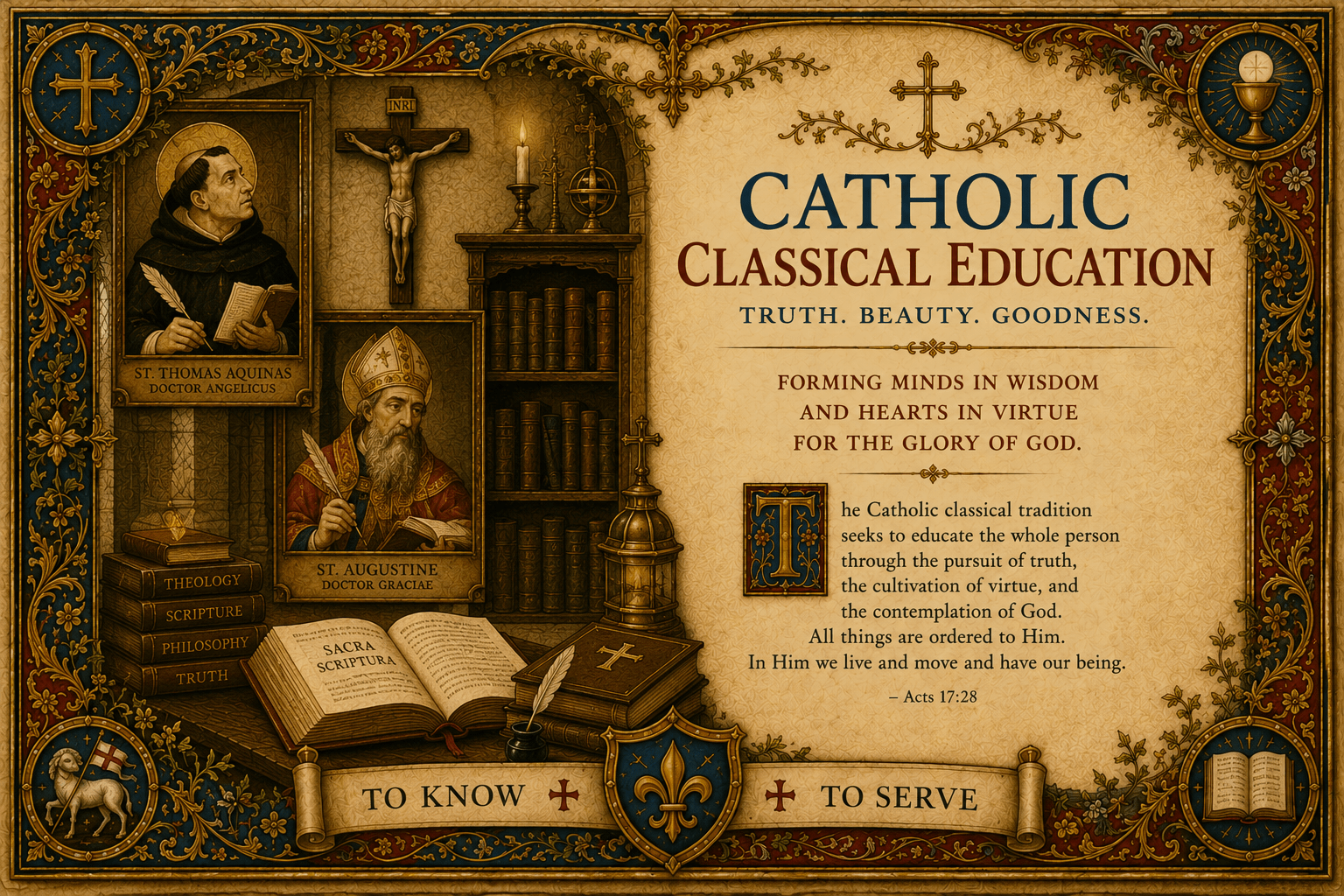
St Thomas Aquinas is sometimes imagined as a cold and complicated thinker who attempted to reduce the mysteries of God to a system.
This seriously misunderstands him.
Thomas was a Dominican friar, priest, biblical commentator, teacher and man of prayer. His intellectual work was not an attempt to place human reason above divine revelation. It was an act of service to the truth revealed by God and entrusted to the Church.
He believed that faith and reason cannot ultimately contradict one another because both come from the same divine source.
Reason receives the created order and discovers truths within it. Faith receives what God has freely revealed. The two forms of knowledge are distinct, but they are not enemies.
Faith elevates reason. Reason helps us understand, explain and defend the faith.
This harmony stands at the centre of the Christian intellectual tradition.
A Christian Teacher
Thomas was born in Italy in the thirteenth century and entered the Order of Preachers founded by St Dominic.
His family had expected a different path for him and strongly opposed his vocation. Thomas nevertheless persevered. He was eventually sent to study under St Albert the Great and later taught in Paris and Italy.
Thomas wrote biblical commentaries, theological works, philosophical treatises and explanations of disputed questions. His best-known work is the Summa Theologiae, intended to provide an ordered account of sacred doctrine.
The Summa begins with God and the truths he has revealed. It considers creation, the angels and the human person. It then examines humanity’s return towards God through our actions, virtues, law and grace. Finally, it turns to Jesus Christ, the Sacraments and the means by which God brings us to salvation.
This order reflects Thomas’s fundamental vision: all things come from God and are called to return to him.
Theology is therefore not a collection of unrelated religious facts. It is wisdom because it considers every reality in relation to the highest cause and final end.
One Source of Truth
Thomas possessed a great confidence in truth.
He did not believe that Christians needed to fear anything genuinely demonstrated by reason. If something is true, it cannot contradict the God who is Truth.
An apparent conflict between faith and reason must arise from some error. Perhaps the reasoning is faulty. Perhaps the evidence is incomplete. Perhaps the doctrine of the Church has been misunderstood. Perhaps Scripture has been interpreted carelessly.
The solution is not to abandon faith or reason, but to examine the difficulty more carefully.
Thomas received useful philosophical ideas from non-Christian writers, particularly Aristotle. But he did not place those writers above Scripture or the faith of the Church.
Where a philosophical argument was true, it could be received. Where it was incomplete, it could be corrected. Where it contradicted revelation, it had to be rejected.
Human philosophy did not determine the content of Christianity. It provided words, distinctions and arguments that could be placed at the service of revealed truth.
Thomas therefore avoided two opposite errors.
The first rejects reason as dangerous to faith. The second makes human reason the supreme judge of revelation.
Christian wisdom accepts neither. Reason is a genuine gift from God, but it remains created, limited and wounded by sin. Revelation comes from God, who can neither deceive nor be deceived.
Reason serves faith without ceasing to be reason. Faith elevates reason without destroying it.
What Reason Can Know
Thomas teaches that human reason can discover real truths about God from creation.
We see things that change, things that are caused, things that begin and cease to exist, and different degrees of goodness and perfection. We also perceive order within nature.
These realities do not provide their own final explanation. Reason can move from the effects we observe towards a first cause, a necessary being and an intelligent source of created order.
St Paul writes:
“For the invisible things of him, from the creation of the world, are clearly seen, being understood by the things that are made.”
— Romans 1:20
Thomas’s arguments for God’s existence do not place God within the universe as one cause alongside others. God is not simply the first event in a very long sequence. He is the sustaining cause upon whom every created being depends here and now for its existence.
Creatures possess existence, but God does not receive existence from another. He is not one being among many. He is the uncreated source of all that exists.
Reason can therefore know that God exists and can recognise something of his unity, goodness, wisdom and power.
But this knowledge has limits.
Reason alone cannot discover that God is Father, Son and Holy Spirit. It cannot discover that the eternal Son would become man, die upon the Cross and rise again. It cannot know that we are called to share supernaturally in the divine life.
These truths must be revealed.
Why Revelation Is Necessary
Even truths about God that reason can discover are not known easily by everyone.
Thomas observes that only a few people would reach them, after a long period of study and with the danger of many errors. Yet knowledge of God concerns the purpose and salvation of every human being, not merely those with unusual intellectual ability and leisure.
God therefore reveals both truths beyond reason and truths that reason could in principle discover.
Revelation does not humiliate reason. It shows God’s mercy.
A child can know with certainty that God created the world without first mastering metaphysics. An ordinary Catholic can profess the Holy Trinity without constructing a philosophical demonstration. The dying person can place hope in Christ without completing a lifetime of academic study.
Faith rests upon the authority of God who reveals.
This does not mean believing without reason. There are reasons for recognising that revelation is credible: the person of Christ, his miracles, his Resurrection, the fulfilment of prophecy, the witness and endurance of the Church and the holiness produced by grace.
Yet faith itself assents because God has spoken.
Faith is not a guess where knowledge fails. It is a supernatural act by which the intellect, moved by grace, assents to divine truth.
Sacred Doctrine as Knowledge
Thomas calls sacred doctrine a “science.” He does not mean experimental science in the modern sense.
He uses the word for an ordered body of knowledge proceeding from recognised principles.
Arithmetic begins from principles concerning number. Geometry begins from principles concerning quantity and shape. Sacred doctrine begins from truths known perfectly by God and communicated to us through revelation.
The theologian does not invent these principles. They are received through faith.
Sacred doctrine then considers God and every other reality in relation to God. It asks what has been revealed, how revealed truths belong together and what conclusions follow from them.
Scripture provides its fundamental authority. The Church’s Tradition and Magisterium faithfully preserve and interpret the deposit of faith. Human reasoning assists by clarifying terms, drawing conclusions and answering objections.
Theology is therefore both receptive and active. It receives its principles from God and applies the mind diligently to understanding them.
This is why humility is essential. The theologian is not the master of revelation.
Mystery Is Not Contradiction
A mystery is a truth that exceeds the complete comprehension of the human mind.
This does not mean that a mystery is meaningless or contradictory.
The Holy Trinity does not mean that God is one Person and three Persons. God is one divine nature in three distinct Persons.
The Incarnation does not mean that Christ is one person and two persons. The one divine Person of the Son possesses two natures, divine and human.
A contradiction would affirm and deny the same thing in the same respect. Catholic doctrine does not do this.
Reason cannot fully comprehend how God is three Persons in one nature. But it can show that the doctrine, correctly stated, does not violate the principle of non-contradiction.
This is one of reason’s important services to faith. It cannot prove every mystery from natural principles, but it can expose false representations and show that objections do not necessarily follow.
Faith does not ask us to believe nonsense. It asks us to receive truths greater than our minds because they have been revealed by God.
Grace Perfects Nature
One of Thomas’s most important principles is that grace does not destroy nature but perfects it.
God created human nature good. We possess a body and spiritual soul, intellect and will. Sin has wounded our nature, darkened the intellect, weakened the will and disordered the passions.
But sin has not made human nature entirely evil or destroyed our ability to recognise every natural truth.
Grace does not replace humanity with something unrelated. It heals and elevates the person God created.
This protects us from two errors.
One error imagines that we can save ourselves through natural effort. If we become disciplined, educated or virtuous enough, we supposedly no longer need grace.
This is false. No natural achievement can forgive sin, give sanctifying grace or raise us to the vision of God. Salvation is God’s gift through Jesus Christ.
The opposite error treats nature as worthless. Human reason, moral effort, education and natural virtue are then dismissed as though grace made them unnecessary.
This is also false. Grace heals the intellect and will so that we can act more perfectly. It does not excuse laziness, ignorance or vice.
The Christian must pray and study, trust God and cooperate, receive grace and practise virtue.
Everything good begins from God’s grace, is sustained by grace and reaches fulfilment through grace. Yet grace enables rather than abolishes our real human response.
Virtue and the Moral Life
For Thomas, morality is not principally a collection of arbitrary rules.
Every action is directed towards some perceived good. The question is whether the good is genuine, whether it is chosen in the right way and whether it is ordered towards our final end.
Virtues are stable dispositions that enable us to act well.
The cardinal virtues—prudence, justice, fortitude and temperance—bring order to human action and desire. The theological virtues—faith, hope and charity—are infused by God and direct us towards him as our supernatural end.
Grace therefore forms the whole person.
Faith perfects the intellect by enabling us to assent to God’s revelation. Hope directs us confidently towards eternal life with God’s assistance. Charity unites us to God and enables us to love our neighbour for his sake.
Charity is the highest of the virtues because it unites us directly to God.
A person may possess considerable knowledge without charity. Such learning does not yet constitute Christian wisdom. The mind may be well trained while the will remains turned towards pride.
True theology should lead towards holiness.
Human Happiness
Thomas asks what can finally make the human person happy.
Wealth cannot provide perfect happiness because it is a means rather than our final end. Honour depends upon the judgement of others. Fame is unstable. Power cannot remove suffering or sin. Bodily pleasure satisfies only part of the person. No created good can fully satisfy the human desire for truth and goodness.
Our final happiness consists in God.
In this life, we can know and love God truly but imperfectly. In eternal life, the blessed are given the direct vision of the divine essence: the Beatific Vision.
Our Lord says:
“Now this is eternal life: That they may know thee, the only true God, and Jesus Christ, whom thou hast sent.”
— John 17:3
This final end gives order to everything else.
Education, work, friendship, family life, human culture and the created world possess genuine goodness. But none is the final purpose of the human person. Each must be received and loved within our journey towards God.
Christian education therefore cannot be satisfied with producing successful people. It seeks to form people capable of truth and virtue, receptive to grace and directed towards eternal beatitude.
Theology on Its Knees
Thomas’s intellectual work was inseparable from prayer.
He did not consider sacred doctrine merely as material for academic discussion. Theology concerns the living God and the salvation of souls.
This is particularly clear in his teaching about the Holy Eucharist.
Human senses perceive the appearances of bread and wine. Through the words of consecration, however, the substance of bread and wine is changed into the Body and Blood of Christ. The appearances remain while the underlying substance is changed.
The distinction between substance and appearances helps state the mystery accurately. But the Real Presence is not established by philosophical reasoning alone. We believe because Christ has spoken and the Church has faithfully handed on his teaching.
Reason serves the mystery by clarifying what the Church means. Faith kneels before Christ who is truly present.
At Mass, theology reaches worship. What has been studied becomes adoration. What has been defined is received sacramentally.
This is the proper end of Christian learning.
Reading Thomas within the Church
St Thomas possesses a unique place within Catholic intellectual life. The Church has repeatedly recommended his thought, particularly his harmony of faith and reason, his theological method and his understanding of nature and grace.
Nevertheless, Thomas is not the Magisterium.
Not every opinion found in his writings has been defined as Catholic doctrine. His work should be read within the faith of the Church, alongside Sacred Scripture, the Fathers, councils and subsequent magisterial teaching.
To follow Thomas faithfully is not merely to repeat his conclusions. It is to share his reverence for truth, careful use of reason, submission to revelation and desire to understand the whole in relation to God.
Thomas helps us avoid fragmented thinking.
Reason and faith, nature and grace, body and soul, doctrine and morality, study and prayer are distinct but not meant to be divided.
Each possesses its proper place within the one order established by God.
Wisdom, Not Cleverness
St Thomas teaches us confidence without pride.
We may trust reason because God created it. We may trust revelation because God has spoken. We may receive natural goods because creation is good. We must depend upon grace because our nature is wounded and our destiny is supernatural.
The wise person does not confuse these levels. Nor does the wise person tear them apart.
Faith without the proper use of reason may become confused or vulnerable to superstition. Reason closed against faith becomes narrow and unable to receive the highest truths. Nature without grace cannot attain humanity’s supernatural end. Grace falsely separated from nature becomes detached from the person God actually created.
Christian wisdom holds them together in the proper order.
The final purpose is not to become clever enough to master God. It is to know him truly, love him above all things and one day see him face to face.
Thomas’s greatness lies not simply in the number of questions he answered. It lies in the direction he gave to learning.
All truth comes from God. All created goods depend upon God. All grace comes through Christ. And all Christian wisdom should return in worship to the One from whom it came.
Questions for Reflection
- Do I treat faith and reason as enemies or as gifts from the same God?
- Do I expect reason to answer questions that can be known only through revelation?
- Do I rely upon natural effort without grace, or use grace as an excuse to neglect effort?
- Is my learning producing humility, virtue and prayer?
- Do I recognise the vision of God as the final purpose of human life?
A Practical Exercise
Draw two headings:
- Truths accessible to natural reason
- Truths known through divine revelation
Under the first heading, place truths such as the existence of God, the reality of objective moral law and the spiritual nature of the human soul.
Under the second, place the Holy Trinity, the Incarnation, Christ’s saving death and Resurrection, sanctifying grace and the Real Presence in the Eucharist.
Then consider how reason serves the revealed truths without pretending to discover them by its own power.
At the next Mass, listen carefully to the Creed. Notice how many of its truths could never have been discovered by unaided reason.
When Christ is elevated in the Sacred Host, make the act of faith of St Thomas the Apostle:
“My Lord, and my God.”
— John 20:28
Ask for a mind that seeks truth, a faith that receives revelation and a heart that brings both into worship.

 St. Mary's, St. John Bosco and St. Edward's