Christian faith does not forbid difficult questions.
God has revealed truths that exceed the full comprehension of the human mind, but he has also given us reason. We are called to receive revelation with faith, seek a deeper understanding of what we believe and answer objections as clearly as we can.
St Peter tells Christians to be:
“Ready always to satisfy every one that asketh you a reason of that hope which is in you.”
— 1 Peter 3:15
During the Middle Ages, Christian teachers developed a disciplined method of asking and answering questions. This became known as the scholastic method.
Scholasticism was not simply one set of opinions. It was a way of teaching and reasoning, particularly associated with the medieval schools and universities. It sought to bring authorities, arguments and objections into an ordered discussion beneath the light of Christian faith.
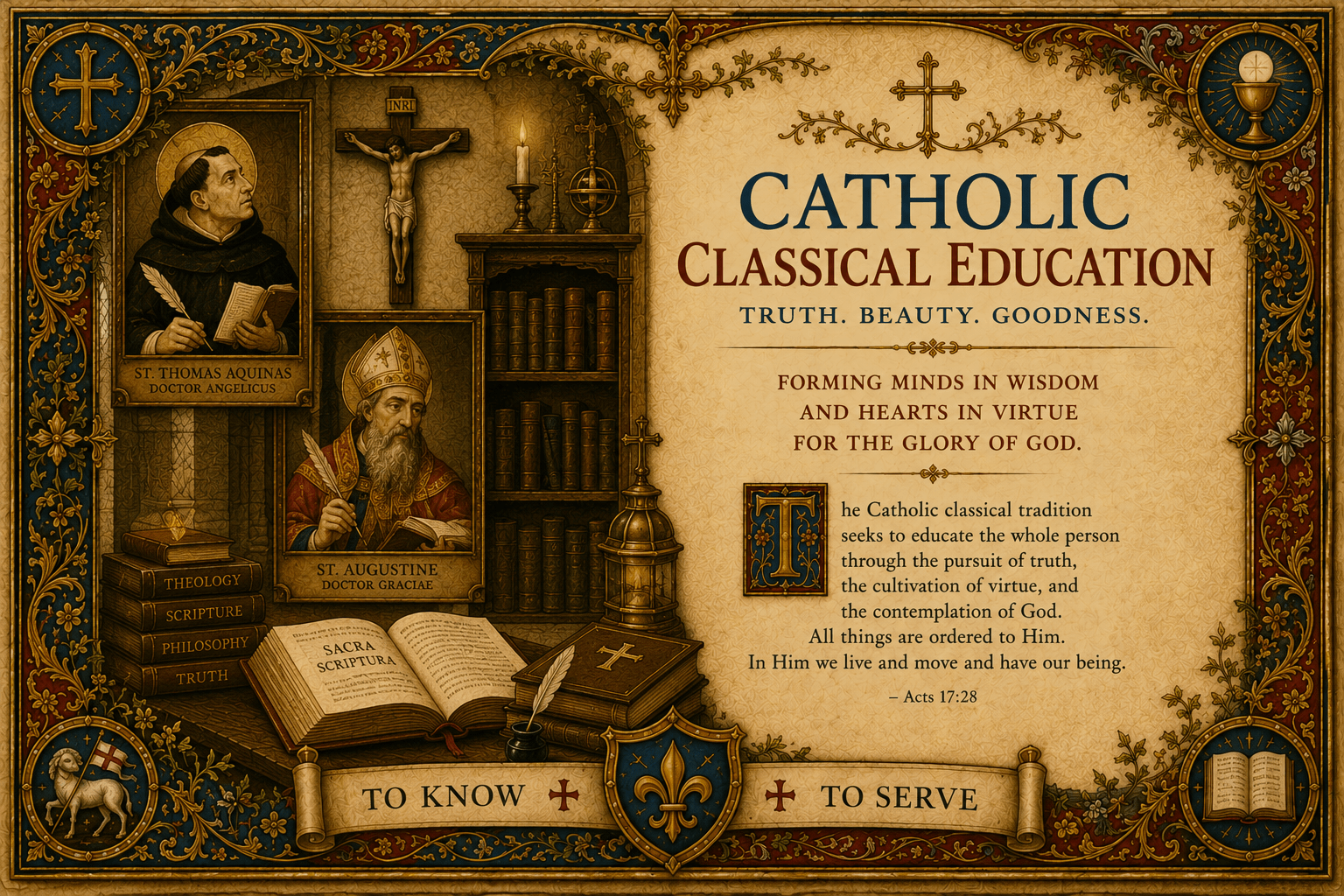
Its most familiar form can be seen in the works of St Thomas Aquinas.
A question is stated precisely. Serious objections are presented. An argument pointing in the opposite direction is introduced. The teacher gives a considered answer, usually making important distinctions. Finally, each objection is answered individually.
This method teaches us something urgently needed today: a difficult objection should be heard, understood and answered—not ignored, mocked or replaced by a weaker argument.
From Reading to Questioning
The scholastic method grew from a culture of careful reading.
A teacher would read an authoritative text and explain its words, structure and meaning. This might be a passage of Sacred Scripture, a work of a Father of the Church, a theological text or a recognised work of philosophy.
Careful reading naturally produced questions.
Two passages might appear to conflict. A term might be ambiguous. A conclusion might seem to follow from the text, while another authority appeared to teach something different. A student might raise a serious objection.
The question did not necessarily arise from disbelief. It arose from the desire to understand.
St Anselm described theology as faith seeking understanding. Faith comes first because God has revealed himself. Understanding then seeks to penetrate more deeply into the truth received.
This order matters.
The Christian theologian does not stand above divine revelation as a judge who will believe only what can be fully comprehended. Nor does the theologian abandon reason and refuse to consider difficulties.
Revelation is received with faith, and reason is placed at its service.
Formulating the Question
A good answer begins with a good question.
Scholastic questions were often stated in the form, “Whether…”:
- Whether God exists
- Whether the human soul is immortal
- Whether grace is necessary for salvation
- Whether faith can exist without charity
- Whether every lie is sinful
This form requires precision. It identifies the point that must be affirmed or denied.
Many modern disagreements remain confused because several questions are mixed together.
For example, “Is the Church right about marriage?” may contain numerous distinct questions:
- What is marriage?
- Is marriage established by God or created by society?
- Why is marriage naturally ordered towards the union of man and woman?
- What makes a marriage sacramental?
- Can a valid sacramental marriage be dissolved?
- How should the Church care for people in irregular situations?
Unless these questions are distinguished, one answer may be expected to resolve several different difficulties at once.
Scholastic method teaches us to narrow the discussion until we know exactly what is being asked.
A precise question is not a restriction upon thought. It makes genuine thought possible.
Presenting the Objections
Once the question has been stated, the scholastic article begins with objections to the answer that will eventually be defended.
This can surprise a modern reader. Why begin by presenting arguments against the truth?
Because an objection that has not been understood cannot be answered adequately.
A weak teacher may hide difficult arguments, ridicule the person asking them or answer a simplified version. A confident Christian thinker should be willing to state the real difficulty in its strongest reasonable form.
When St Thomas asks whether God exists, he does not begin by declaring the question foolish. He considers serious objections, including the existence of evil and the claim that natural causes can explain the world without reference to God.
These are not trivial difficulties. Their presence does not mean that Aquinas doubts the faith. It means that he respects the question enough to answer it honestly.
Presenting an objection fairly is an act of intellectual justice.
Holy Scripture warns:
“He that answereth before he heareth, sheweth himself to be a fool, and worthy of confusion.”
— Proverbs 18:13
Before answering, we must listen.
This does not mean that every objection is equally strong or that every opinion deserves equal acceptance. Some arguments are based upon false premises, misunderstood terms or simple contradictions.
But we should show why they fail rather than dismiss them merely because we dislike their conclusion.
“On the Contrary”
After the objections, a scholastic article often introduces a consideration beginning, “On the contrary.”
This may be a passage from Scripture, a statement from an authoritative Christian teacher or a concise argument pointing towards the answer that will be defended.
Its place in the structure shows that the first set of arguments has not settled the question. There is another side that must be heard.
In theology, not every authority possesses the same weight.
Sacred Scripture is inspired by God. Sacred Tradition and the Church’s Magisterium faithfully communicate and guard the deposit of faith. The Fathers and Doctors provide authoritative guidance, although individual opinions among them do not all possess the same force.
Philosophers and other human writers may offer genuine insight, but their conclusions must be judged according to truth and cannot overrule divine revelation.
The scholastic method gathers authorities, but it does not treat them as an undifferentiated collection of quotations. Their proper relationship must be understood.
An apparent conflict may disappear when we examine context, definitions and the precise question each author was addressing.
“I Answer That”
The heart of the scholastic article begins with the words, “I answer that.”
Here the teacher offers a reasoned solution.
The answer does not simply repeat an authority or count how many writers appear on each side. It seeks to explain why the conclusion is true and how the difficulty should be understood.
Very often the solution depends upon a distinction.
We distinguish between nature and grace, substance and accidents, person and nature, mortal and venial sin, the act itself and the intention of the person acting, or what belongs to something essentially and what belongs to it only accidentally.
Consider the claim: “Christians should not judge.”
A distinction is necessary.
Christians must not judge another person’s soul rashly, pretend to know hidden motives or condemn someone as though we possessed God’s authority. Yet we must make moral judgements about actions. Without such judgement, we could not distinguish justice from injustice or virtue from sin.
Our Lord’s warning against wrongful judgement does not abolish moral reasoning. It condemns hypocrisy, rashness and usurping the judgement that belongs to God.
The distinction allows us to preserve both truths.
A good distinction does not divide reality artificially. It recognises a difference already present within the thing being considered.
Much theological confusion results from failing to distinguish.
God is one in nature and three in Persons. Christ is one Person with two natures. In the Eucharist, the substance of bread and wine is changed while the appearances remain. Grace perfects nature rather than destroying it.
Precise distinctions protect the faith from both contradiction and oversimplification.
Answering Each Objection
After giving the central answer, the scholastic teacher returns to the original objections one by one.
This is essential.
A general explanation may establish the truth without resolving the particular difficulty that troubled the questioner. Each objection may depend upon a different misunderstanding and therefore require a different reply.
One objection may use an ambiguous word. Another may begin from a false premise. A third may notice something true but draw a conclusion that goes too far.
Returning to each objection demonstrates that it has not been forgotten.
This practice also tests the strength of the main answer. If the answer cannot meet the objections, further clarification may be required.
Christian teaching should not be satisfied with announcing the correct conclusion. It should help people see why the conclusion is true and why the alternatives fail.
Questions That Are Open and Truths That Are Settled
The scholastic method does not mean that every doctrine remains permanently open to debate.
Some truths have been revealed by God and definitively taught by the Church. The divinity of Christ, the Holy Trinity, the Real Presence of Christ in the Eucharist and the bodily Resurrection are not provisional theories awaiting a future vote.
Reason receives these truths through faith and seeks to understand them more deeply. It may answer objections, clarify terms and draw further conclusions. It may not reverse what God has revealed.
Other questions permit legitimate differences of theological opinion. Faithful Catholic thinkers may disagree about how best to explain a mystery, the interpretation of a particular passage or the prudential application of moral principles.
The first task is therefore to know what kind of question we are asking.
Is this a defined doctrine, a theological conclusion, a matter of discipline, a historical claim or a prudential judgement?
Confusion among these levels produces unnecessary conflict. Someone may treat a changeable discipline as though it were divine law, or treat revealed doctrine as though it were merely a current policy.
Scholastic precision helps us assign each claim its proper weight.
Faith Is Not Produced by Argument
A sound argument can remove confusion, expose contradiction and demonstrate that an objection fails. It cannot by itself produce supernatural faith.
Faith is a gift of God. The Holy Spirit moves the heart to assent to God who reveals.
A person may lose an argument and remain unconvinced. Pride, fear, previous wounds or attachment to sin may prevent a person from embracing what the mind has begun to recognise.
The Christian should therefore combine reasoning with prayer, patience and good example.
We must not imagine that conversion will occur if only we find an irresistible phrase. God uses human words, but grace acts within the soul.
This should make the Christian apologist humble. We explain and defend the faith, but we do not control another person’s response.
The goal is not to defeat someone. It is to serve the truth and remove whatever obstacles we can.
The Dangers of Scholasticism
A good method can be misused.
Questions may become needlessly obscure. Distinctions may multiply without serving understanding. Debate may become an intellectual sport disconnected from prayer, virtue and the salvation of souls.
A person may learn how to answer every objection while remaining proud, impatient and uncharitable.
This is not the fulfilment of scholasticism but its corruption.
The greatest scholastic teachers were not meant to be manufacturers of verbal puzzles. St Thomas Aquinas was a theologian, priest and man of prayer. His study was ordered towards sacred truth and the contemplation of God.
The purpose of a distinction is to reveal reality more clearly. The purpose of an argument is to reach truth. The purpose of theology is to know God through what he has revealed and to direct human life towards him.
When the method forgets this end, it becomes sterile.
Scholastic Habits for Modern Christians
The scholastic method offers several useful habits for contemporary discussion.
First, state the question precisely. Do not attempt to resolve several issues under one vague heading.
Second, present the strongest reasonable objection. Do not replace another person’s position with a weak imitation.
Third, make the necessary distinctions. Ask whether the same word or claim is being used in more than one sense.
Fourth, give a positive answer. Do not merely criticise the alternative; explain what is true.
Fifth, return to every objection. Show precisely where each one succeeds or fails.
Sixth, remain humble. The purpose is truth, not victory.
These habits would greatly improve public debate, online discussion, catechesis and ordinary parish conversations.
They also form the learner morally. Listening to an objection requires patience. Presenting it fairly requires justice. Admitting that it has exposed a weakness requires humility. Following the truth despite personal cost requires courage.
The scholastic method is not merely a structure for writing. It is a school of intellectual virtue.
Asking Questions within Faith
The Catholic faith does not need protection from honest questions.
Christ is the Truth. Whatever is genuinely true cannot overthrow him.
Some questions arise from curiosity, some from suffering and some from a sincere desire to believe. They should be received patiently.
Other questions may be used to avoid obedience or prolong an argument indefinitely. Even then, the Christian should respond without contempt, while recognising when further debate is no longer fruitful.
The pattern remains valuable:
- What exactly is the question?
- What is the strongest objection?
- What has God revealed?
- What distinctions are necessary?
- What is the positive answer?
- How should each difficulty be resolved?
This method does not replace prayer, Scripture or the teaching authority of the Church. It helps us receive and explain the faith with greater clarity.
Christian confidence does not consist in never hearing an objection. It consists in trusting that truth possesses an order and that difficulties can be examined beneath the light of Christ.
Questions for Reflection
- Do I listen to an objection fully before answering?
- Can I state the opposing position in words its defender would recognise?
- Do I distinguish between doctrine, discipline and personal opinion?
- Am I willing to admit when an objection reveals weakness in my reasoning?
- Is my desire to answer motivated by love of truth and the good of the other person?
A Practical Exercise
Consider the question:
Is Sunday Mass really necessary?
Begin with three objections:
- God is everywhere, so I do not need to attend a particular church.
- Worship should come freely from the heart, not from an obligation.
- A good person who helps others may seem better than someone who attends Mass but lives badly.
Now make the necessary distinctions.
God is everywhere, but Christ established a visible Church and gives himself sacramentally in the Eucharist. Obligation does not destroy love; important relationships create real duties. Hypocrisy is sinful, but one person’s hypocrisy does not make worship unnecessary.
Give the positive answer:
Sunday Mass is necessary because God is owed worship, Sunday commemorates the Resurrection, Christians belong to the visible Body of Christ, and the Eucharist is the Sacrifice and food Christ gives to his Church. For this reason, the Church obliges Catholics to participate on Sundays and holy days unless a serious reason excuses them.
Then return to each objection individually.
Do not merely announce that the objections are wrong. Identify the truth contained within each one, make the necessary distinction and show why its conclusion does not follow.
Finish with prayer. Ask God to make your reasoning clear, your faith firm and your speech charitable.

 St. Mary's, St. John Bosco and St. Edward's